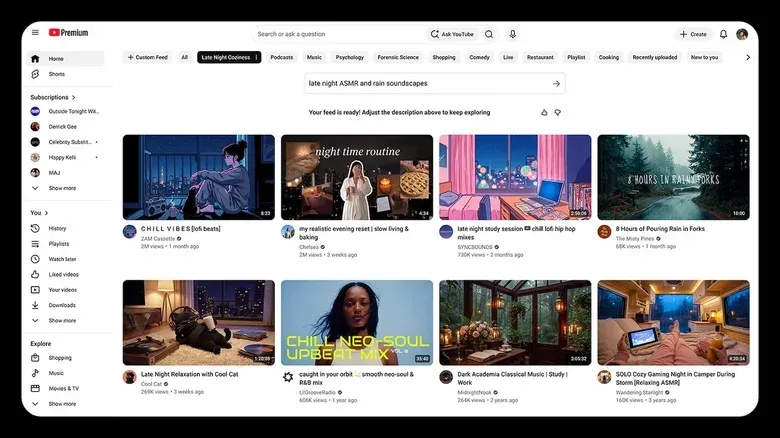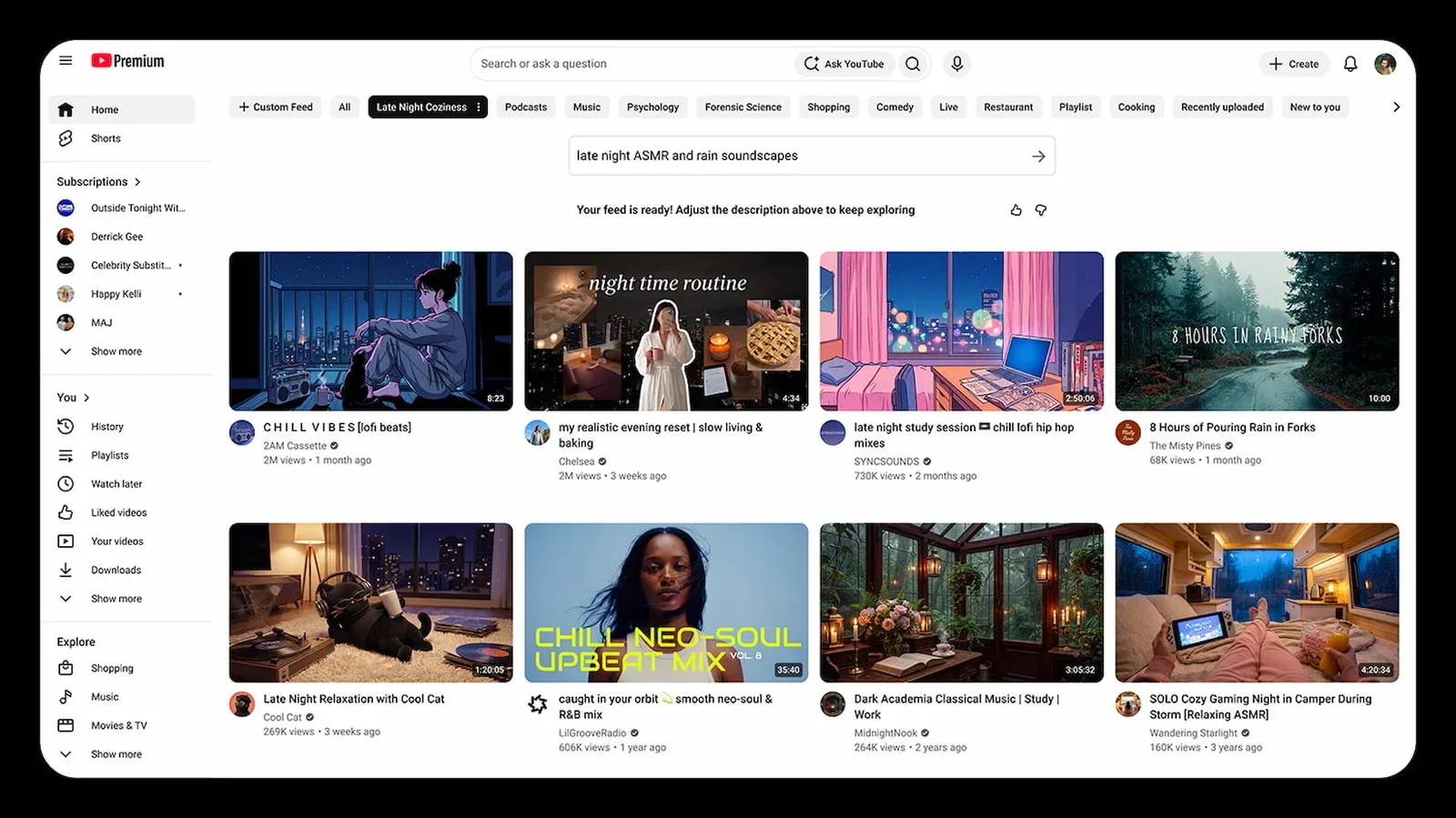
YouTube is preparing a set of viewing, commenting and discovery changes that could matter a great deal to people whose game coverage arrives through a sprawling mix of guides, long-form video essays, speedruns, patch explainers, livestream clips and Shorts. The most immediately interesting addition is a forthcoming option to make custom feeds from the platform homepage: user-defined streams of recommendations shaped through conversational AI prompts.
The feature is expected to reach US users on the web, mobile devices and TVs soon. Elsewhere in the update slate, YouTube is adding searchable GIF replies to mobile comments globally this fall, allowing creators to organize Shorts as sequential episodes with custom thumbnails, and expanding AI-driven product and music discovery tools. A live auto-dubbing pilot for English and Spanish is also planned for early 2027.
Not every item is specifically about games. But YouTube remains a major place for game audiences to find information and personalities, and these changes are aimed at a familiar problem: the standard recommendation feed can be useful, yet it is rarely built around the precise mode of watching someone has in mind at a particular moment.
Custom feeds could separate game research from game comfort viewing
A custom feed is, in simple terms, a user-created recommendation destination rather than a single general-purpose homepage stream. YouTube says viewers will be able to make feeds around moods or interests by using conversational prompts. Its examples include a workout-focused feed, one for long documentaries and another meant to surface newer creators in a given niche.
For gaming viewers, the practical appeal is easy to see. One feed might be framed around long RPG analysis and retrospectives; another could focus on competitive match breakdowns; a third could seek out new creators covering a specific genre, platform or community. The point is not merely filing subscriptions into folders. It is asking the system for a particular kind of recommendation context, then using that context as a separate place to browse.
That distinction matters because game-viewing habits can be unusually purpose-specific. Someone looking for a spoiler-conscious discussion of a new release is not necessarily looking for the same thing as someone who wants background video from a familiar creator, or a deep technical explanation of a game’s systems. A general feed frequently has to juggle all of those intentions at once.
Conversational AI refers to a system that accepts natural-language requests rather than requiring users to select from a rigid set of menus or filters. In this case, the relevant promise is that a viewer can describe the kind of feed they want. The eventual quality of the results will depend on how well YouTube interprets those requests and how effectively its recommendations reflect them. The announced feature does not mean a feed will be perfectly comprehensive, neutral or free of unwanted recommendations.
It also should not be confused with a guarantee that every relevant channel or video will appear. A recommendation feed is still a selection mechanism. For viewers, the useful approach will likely be to treat a custom feed as a discovery and browsing tool, while continuing to use direct subscriptions, saved playlists and search when they need a specific creator or video.
A potentially clearer route to smaller channels
YouTube’s own example of finding newer creators in a niche is potentially significant for viewers who feel that ordinary recommendations overemphasize channels they already know. Gaming has broad, overlapping niches—from hardware repair and modding to lore discussion, fighting-game analysis, cozy games, challenge runs and preservation-minded retrospectives. A feed asked to explore one of those areas could offer a more deliberate alternative to endlessly refreshing the same default selection.
That does not establish how discoverable any channel will become or how creators will be ranked. It does, however, put a useful degree of control on the viewer’s side: people can define a viewing lane instead of waiting for a universal homepage to infer one.
Sequential Shorts could make short-form series less chaotic
YouTube has also expanded its Shows feature to Shorts, letting creators arrange short videos as episodic material with custom thumbnails and sequential playback. The immediate use case highlighted is microdrama, a format built around brief serialized episodes. Yet the format has an obvious relevance to gaming content as well.
Sequential playback means episodes can be watched in order rather than treated purely as isolated clips. That is a small structural change with potentially useful consequences for creators publishing multi-part tips, build breakdowns, challenge updates, lore explainers or concise news recaps. A viewer encountering part three first is a common short-form-video frustration; an explicit episode order offers a way to reduce it.
Custom thumbnails add another practical layer. Thumbnails can help distinguish parts in an ongoing sequence, especially where titles are similar or the topics build on each other. For viewers, that may make a Shorts series easier to scan. For creators, it offers a clearer presentation for projects that are meant to be followed rather than simply discovered at random.
There is an important limit: episodic organization cannot replace the detail and context sometimes required by a full guide, a careful review or a lengthy technical demonstration. But it can make short-form material more legible. A series of thirty-to-sixty-second clips is more useful when audiences can tell what it is, where it begins and what comes next.
For gaming channels, that could be particularly helpful when Shorts are used as companions to longer work. A creator might use a sequence to outline separate ideas while directing interested viewers toward deeper videos. The newly announced tools describe the structure available to creators; they do not dictate a particular editorial strategy.
GIFs are coming to YouTube comments on mobile
YouTube comments are also becoming more visual. The platform plans to let people post GIFs beneath videos through a searchable library. The feature is due to arrive globally in the YouTube mobile app sometime this fall.
A GIF is a short, looping animated image. In online conversation, GIFs often work as quick reactions: excitement, disbelief, recognition or a joke that would take longer to explain in text. For the huge communities that gather under trailers, tournament clips, game announcements and creator uploads, the change could make comment sections feel more immediate and expressive.
It could also make them noisier. Reaction media is fast and accessible, but it can crowd out written exchanges when deployed heavily. Whether GIF comments improve a given discussion will depend more on the community and moderation around a channel than on the format itself. The announced change establishes a new reply option, not a quality-control mechanism.
On TV, YouTube now supports posting comments by voice through a text-to-speech tool, provided the television supports the capability. This is another attempt to make participation less dependent on typing with a remote. It may be convenient for brief reactions, though voice input brings its own obvious need to check what has been transcribed before posting.
Ask YouTube moves closer to product research
The platform is broadening the shopping-related capabilities of Ask YouTube, its chatbot-style tool. When users ask for reviews of a product, it will be able to provide video recommendations and a comparison table. It will also support questions about products visible in a video even when the creator does not mention them, such as an item of clothing.
A comparison table is a structured display that places product information side by side, making it easier to assess differences at a glance. For gamers, that may sound useful in principle when researching visible microphones, controllers, cameras, displays or other equipment in videos. But the key word is “may.” A convenient summary is not the same as a complete purchasing assessment, and a product being visible on screen does not by itself explain its condition, settings, compatibility or suitability for a particular setup.
The safest use of this kind of tool is as a starting point for finding relevant videos and identifying products worth investigating further. Viewers should still pay attention to what a creator actually demonstrates, whether the content addresses their own needs and what information is absent from a brief AI-produced comparison.
Ask YouTube will also allow conversations to continue when a user moves from the search screen to a video player. In practical terms, that could reduce the friction of going back and forth between looking for a subject and watching material about it. The feature reinforces a wider direction in the announcement: YouTube wants more parts of the viewing experience to be navigated through questions rather than only keywords, menus and clicks.
Music, podcasts and language tools round out the update
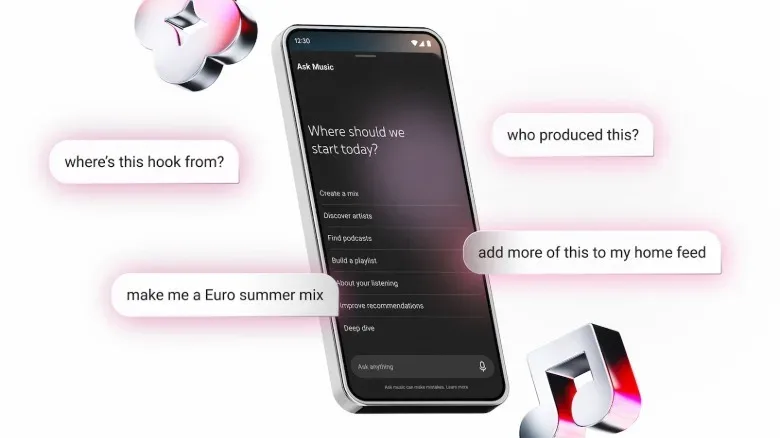
YouTube Music is receiving related AI-focused additions. Ask Music will allow listeners to learn more about an artist and change their song queue. The service is also preparing Podcast Lineup, a generative-AI feature intended to help people discover shows. It will provide a short weekly preview of suggested podcasts and explain why they may be appealing before taking listeners to episodes. YouTube describes the feature as hands-free.
Both the Ask Music additions and Podcast Lineup are planned for YouTube Music and Premium subscribers worldwide. These tools may be relevant to gaming audiences who use podcasts for industry discussion, game criticism or creator interviews, although the announcement does not identify game-specific programming or recommendation criteria.
Looking further ahead, YouTube plans to begin piloting Live auto-dubbing in early 2027, initially for English and Spanish. Auto-dubbing is the automated creation of spoken audio in another language. In this proposed live context, the goal is real-time translation of what a creator says into a viewer’s preferred language. If it functions well, the feature could lower the language barrier around live streams and international creator communities. Because this is described as a pilot, its scope and real-world performance should remain an open question until it is actually tested.
YouTube has additionally extended its exclusive rights to stream Coachella through 2030. That agreement is separate from the gaming-oriented implications of the platform changes, but it fits the same broad picture: YouTube is combining event programming, creator tools, AI-assisted discovery and more ways to interact across its apps and screens.
For gaming viewers, the most tangible changes are likely to be the custom feeds and the improved organization of Shorts. One promises a more intentional way to browse; the other gives serialized short-form videos a clearer shape. The rest of the package points to an increasingly conversational YouTube, where asking a question, reacting with a GIF or following a short series in order becomes part of the normal path from discovery to viewing. For more on the wider platform and hardware landscape around game video, see this look at Yoniq’s planned Duo and Portal handheld campaign.