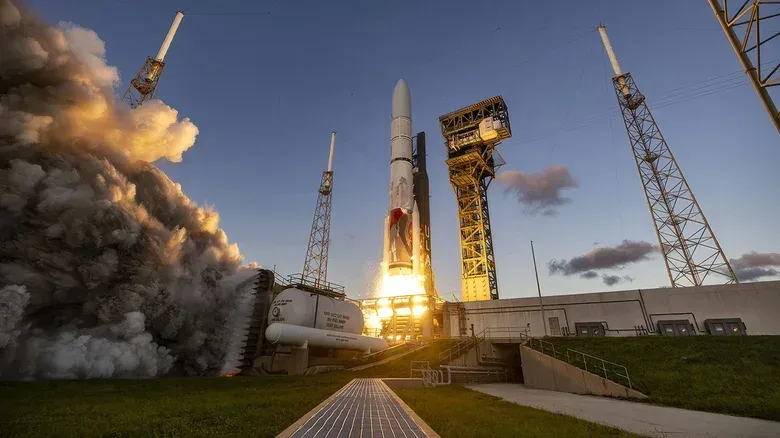
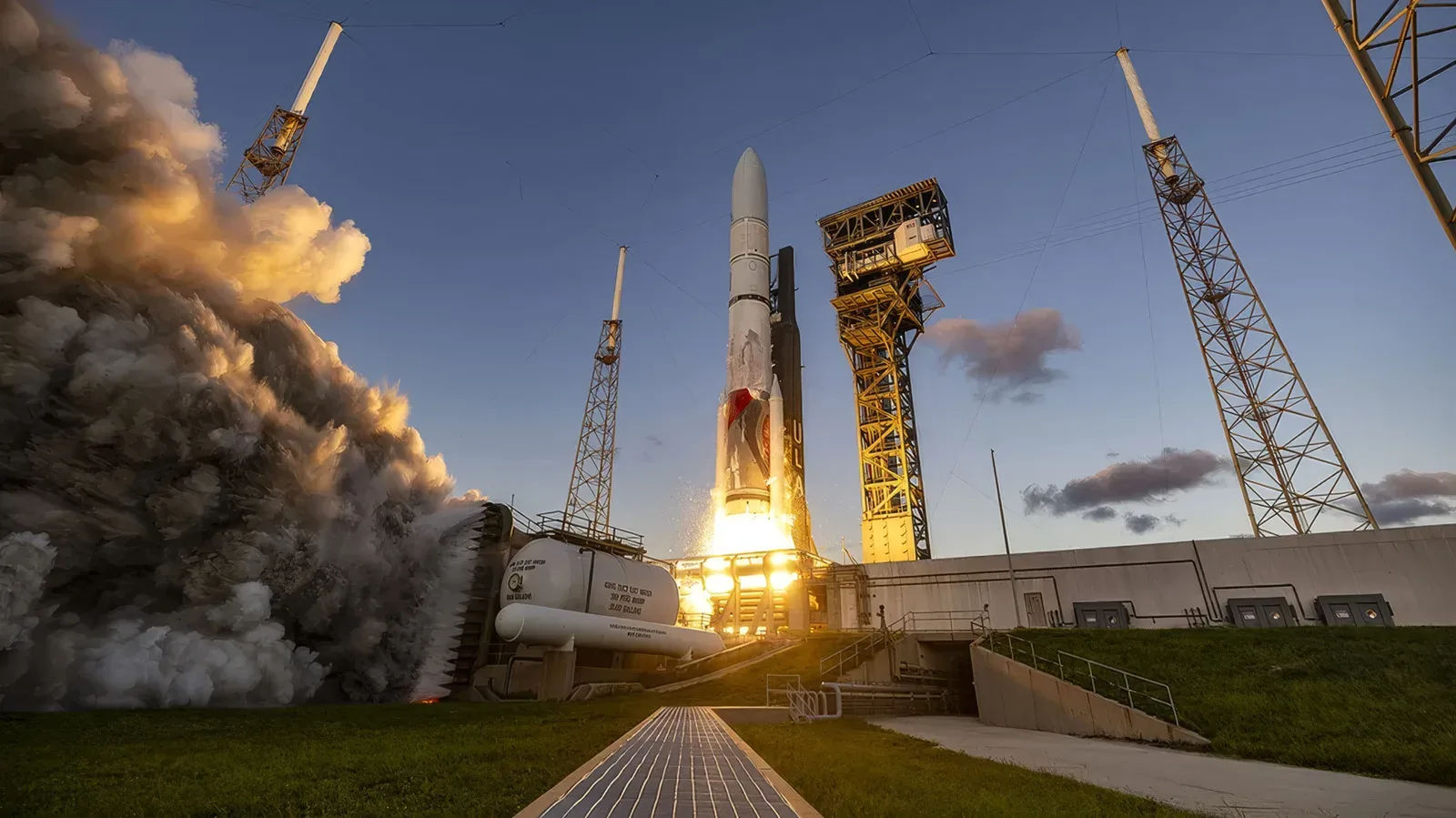
United Launch Alliance’s Vulcan rocket has failed during an Amazon Leo mission, destroying all 40 internet satellites aboard and denying the constellation another badly needed addition to orbit. The company confirmed that the vehicle encountered an anomaly roughly 10 minutes after lifting off from Space Launch Complex 41 and did not deliver the payload as planned.
The failure is consequential on two fronts. It is the first launch failure for United Launch Alliance since the Boeing and Lockheed Martin partnership was formed in 2006, ending a long streak associated particularly with its Atlas V rocket. For Amazon Leo, it removes another batch of satellites from a deployment schedule that was already under intense pressure from launch-provider setbacks and regulatory milestones.
ULA says it will investigate the event with its customer and relevant organizations, identify the cause, apply corrective action, and return Vulcan to flight as quickly as possible. At this early stage, the company has not identified a specific technical cause. That distinction matters: observations from the launch can suggest where investigators will look, but they are not a confirmed explanation for the failure.
A launch day with several warning signs, but no established cause
The mission’s path to liftoff was not entirely smooth. A refuelling issue scrubbed a planned Friday attempt. The flight was then rescheduled for Sunday, November 15, with liftoff initially expected around noon Eastern time. Controllers also stopped the countdown at T-minus 20 seconds over an unidentified technical issue. The issue was resolved within the launch window, and Vulcan ultimately left the pad at 12:40 p.m. ET.
That sequence provides important context, but it should not be treated as proof that the pre-launch issues caused the loss. Launch investigations work by examining recorded vehicle data, ground-system information, procedures, and hardware evidence where available. A scrub, a countdown hold, and a later in-flight anomaly may turn out to be connected, or may be separate events entirely.
The rocket’s solid boosters, which had presented issues on two prior flights, appeared to operate normally during this mission. The first-stage methane engines, however, appeared to burn longer than the company’s estimated timeline indicated. After first-stage separation, Vulcan’s hydrogen-powered Centaur upper stage began its planned 12.25-minute burn. ULA has indicated that the anomaly apparently occurred during that upper-stage phase.
What the stages do
A multistage rocket sheds sections as it climbs, reducing mass and allowing the remaining propulsion system to continue accelerating the payload. In this case, the first stage handled the opening portion of ascent before separating. The Centaur upper stage was then intended to conduct a lengthy burn to place the Amazon Leo satellites on their required route to orbit.
That makes the reported timing significant without making it diagnostic. An anomaly during the upper-stage segment could involve the stage, its engines, guidance, other vehicle systems, or a problem whose effects only became visible then. Engineers will need the full flight record before assigning responsibility to a particular component or sequence.
Related coverage includes Vulcan Anomaly Destroys 40 Amazon Leo Satellites.
ULA has said it does not yet have specific data explaining what occurred and that customers will have visibility into an investigation using rigorous methodology and corrective action.
For the public, the most reliable short-term takeaway is straightforward: the mission failed, the 40 satellites were lost, and the detailed failure chain remains unconfirmed. Any more confident claim about the cause would be premature.
Why the loss lands hard for Amazon Leo
Amazon Leo is an internet-satellite system designed to compete with SpaceX’s Starlink network. Such systems depend on a large number of satellites operating together rather than on one unusually capable spacecraft. That makes launch cadence central to the business and engineering plan: each successful mission contributes capacity and coverage, while each delay or failure affects the pace at which the network can be built.
Before this loss, Amazon Leo had about 390 satellites in service. The Federal Communications Commission required it to have 1,600 satellites in orbit by July 31, 2026. Amazon had also been aiming for 3,232 satellites in orbit by July 2029.
The 40 satellites lost on Vulcan would not by themselves erase the entire program, but they matter because the constellation must close a substantial gap. A missed launch is not merely a numerical subtraction. It can also force changes to manifests, deployment timing, insurance and replacement planning, and the allocation of available flights across a limited group of rockets.
Amazon Leo has 38 Vulcan launches booked, in addition to eight successful Atlas V missions. A failure investigation and potential Vulcan grounding could disrupt that planned sequence. A grounding is a pause in launches while a vehicle is reviewed and changes are developed, tested, and accepted as necessary. It is not guaranteed, but it is a plausible consequence when a new heavy-lift rocket fails to complete a mission.
The immediate practical question is therefore not simply when Vulcan returns. It is also how much of Amazon Leo’s launch schedule depends on that return date, how quickly replacement spacecraft can be integrated into future missions, and whether other booked launch capacity can meaningfully absorb any delay. The supplied information does not answer those questions, so firm timetable predictions would go beyond the evidence.
One program, multiple launch bottlenecks
The Vulcan loss arrives amid separate trouble for another Amazon Leo launch provider. Blue Origin’s New Glenn rocket exploded on the launchpad in May. Amazon has 24 flights booked on New Glenn.
That does not mean Vulcan and New Glenn share a technical cause; they are separate rocket programs and the provided information establishes no connection between their failures. Their overlap is commercial and logistical. Both are part of the launch capacity Amazon Leo has lined up for its constellation rollout, so disruption at both providers narrows the room to recover schedule margin.
Amazon had already described repeated, concurrent scheduling slips among its three core heavy-lift launch programs as severe enough to exhaust the buffers it had built into the Leo schedule. In planning terms, a buffer is spare time or capacity reserved to absorb problems without missing a target. Once that cushion is depleted, a fresh failure can have a larger knock-on effect because there is less flexibility left in the calendar.
That is why this event is more than a bad day for a single rocket. It is a systems problem for a constellation that needs many launches, many satellites, and sustained reliability from several providers. The core challenge is not only replacing 40 destroyed satellites; it is rebuilding confidence in a schedule that must support hundreds or thousands more spacecraft reaching orbit.
Vulcan’s reliability test has changed
ULA’s Atlas V developed a reputation for dependability, and the partnership had gone without a launch failure since its creation in 2006. Vulcan, however, is a newer and more complex heavy-lift rocket, with a different operational track record and a major role in the company’s future manifest.
Reliability claims in launch services are built flight by flight. A successful launch does not guarantee the next one, and a failure does not automatically define an entire vehicle family. But the response after a failure is decisive. Investigators must establish what happened, show that the proposed corrective action addresses the actual cause, and give customers and regulators enough confidence to resume operations.
For ULA, the incident places that process under unusually close attention because Vulcan is tied to 38 of Amazon Leo’s booked launches. For Amazon, it creates a difficult balance between maintaining its deployment pace and waiting for a credible technical resolution. Rushing past an unresolved anomaly would not help either company; an avoidable repeat failure could cost even more satellites and time.
There is also a consumer-facing reason to watch the recovery. Satellite internet can be relevant where wired broadband is limited, unreliable, or unavailable, and competing networks may influence the options eventually available to households, travelers, and remote workers. Anyone evaluating today’s connectivity choices can also weigh more immediate solutions, including the trade-offs covered in using a phone hotspot for gaming, work and travel. Amazon Leo’s long-term service ambitions, though, depend on getting a far larger satellite fleet into orbit first.
What to watch next
The next meaningful updates should clarify the anomaly’s cause, whether Vulcan flights are paused, what corrective actions ULA proposes, and how Amazon Leo revises its launch planning. Until then, the confirmed picture is limited but serious: Vulcan reached liftoff after an eventful countdown, an anomaly occurred about 10 minutes into flight during the phase associated with the Centaur upper stage, and 40 Amazon Leo satellites were destroyed.
For a rocket program and an internet constellation both built around high-frequency future launches, the response will matter as much as the failure itself. ULA now has to turn telemetry and investigation work into a defensible return-to-flight plan. Amazon Leo has to manage the resulting hit to a deployment schedule already strained by delays elsewhere. Neither task is small, and neither can be solved by simply putting the next rocket on the pad.