SpaceX is making a larger play for the mobile-phone business. The company has agreed to acquire 100 percent of Grain Management’s nationwide 800 MHz spectrum portfolio, a transaction that remains subject to approval by the Federal Communications Commission.
SpaceX describes the package as a low-band license portfolio containing up to 14 MHz of paired spectrum in the 800 MHz band. Its stated goal is not merely to expand Starlink’s satellite-broadband footprint, but to close a technical gap on the path toward becoming a major mobile carrier in the United States.
The central attraction is straightforward: lower-frequency signals are better suited to getting through walls and other obstructions than the signals SpaceX has previously emphasized for Starlink Mobile. That could make the difference between a service that works impressively under open sky and one that can remain useful when a customer walks indoors.
It is an ambitious statement of intent, but it is important to separate the proposed spectrum acquisition, the regulatory process and the eventual customer experience. The deal is not complete until the FCC approves it, and the information disclosed so far does not establish consumer plans, pricing, device arrangements or a launch timetable. What it does establish is the kind of network capability SpaceX believes it needs next.
Why the 800 MHz band matters
In mobile networking, spectrum is the licensed radio-frequency range used to carry wireless signals. A carrier’s spectrum holdings are a core part of what it can build, because different frequency bands have different practical properties.
Low-band spectrum refers to spectrum at relatively low frequencies. SpaceX’s proposed acquisition focuses on the 800 MHz band. The company says this band can help Starlink Mobile signals penetrate walls and obstacles, extending reach to people inside buildings. That indoor element is particularly significant for any company seeking to be viewed as a serious alternative to established mobile providers rather than solely as a provider of connectivity in remote or open locations.
The portfolio is described as offering up to 14 MHz of paired spectrum. Paired spectrum means radio frequencies are arranged in corresponding blocks, a setup that supports communications in both directions: from the network to a device and from the device back to the network. In plain language, mobile service needs a route for the signal going out and another for responses coming back.
SpaceX says most mobile devices already support this band. If that proves applicable to its eventual service plans, the company would not need to begin with a universe of phones built specifically for a new frequency. The potential relevance is substantial: compatibility with existing devices is a far easier starting point than asking customers to wait for narrowly specialized hardware.
A shift from satellite broadband toward carrier ambitions
Starlink is widely associated with broadband delivered from satellites, and SpaceX still presents satellite connectivity as a crucial part of its proposition. In far-flung areas, Starlink broadband could provide signal where conventional coverage is limited or unavailable. The 800 MHz acquisition points to a complementary goal: making that broader connectivity model work more credibly in everyday indoor environments.
SpaceX has framed the combination as a way for Starlink Mobile to operate across satellite and terrestrial spectrum. Terrestrial spectrum means radio spectrum used for communications from Earth-based network infrastructure. The distinction matters because satellites and ground networks address different coverage challenges. The company’s vision is not presented as a simple replacement of one with the other, but as a combined model.
That approach also helps explain why spectrum ownership has become central to the story. Satellites can extend coverage over wide areas, but the ability to serve phones reliably in the places people spend much of their time is a different technical problem. By SpaceX’s own account, indoor signal penetration has been one of the remaining gaps. The 800 MHz licenses are intended to address it.
For the wider technology business, it is another reminder that competition is not confined to apps, devices or satellite launches. Control of spectrum, regulatory approval and physical signal behavior can determine which ambitious services become viable at scale. That is a less visible contest than headline-grabbing hardware launches, but it is foundational. Broader platform competition can also rapidly spill into infrastructure and business strategy, as seen in other digital-industry conflicts across the technology sector.
The earlier EchoStar licenses and the Gen2 constellation
The Grain Management agreement is not SpaceX’s first recent spectrum move. The company previously acquired licenses from EchoStar, including frequencies used in the United States for commercial wireless services such as mobile and satellite communications.
SpaceX distinguishes the new low-band acquisition by its indoor-coverage potential. Existing carriers hold access to a broader mix of spectrum bands, but SpaceX argues that adding the 800 MHz holdings would make Starlink Mobile a more robust, genuine alternative. That is an aspiration rather than proof of a finished nationwide consumer offering, but it clarifies how the company views the missing piece: not just more spectrum in the abstract, but spectrum with propagation characteristics suited to difficult indoor conditions.
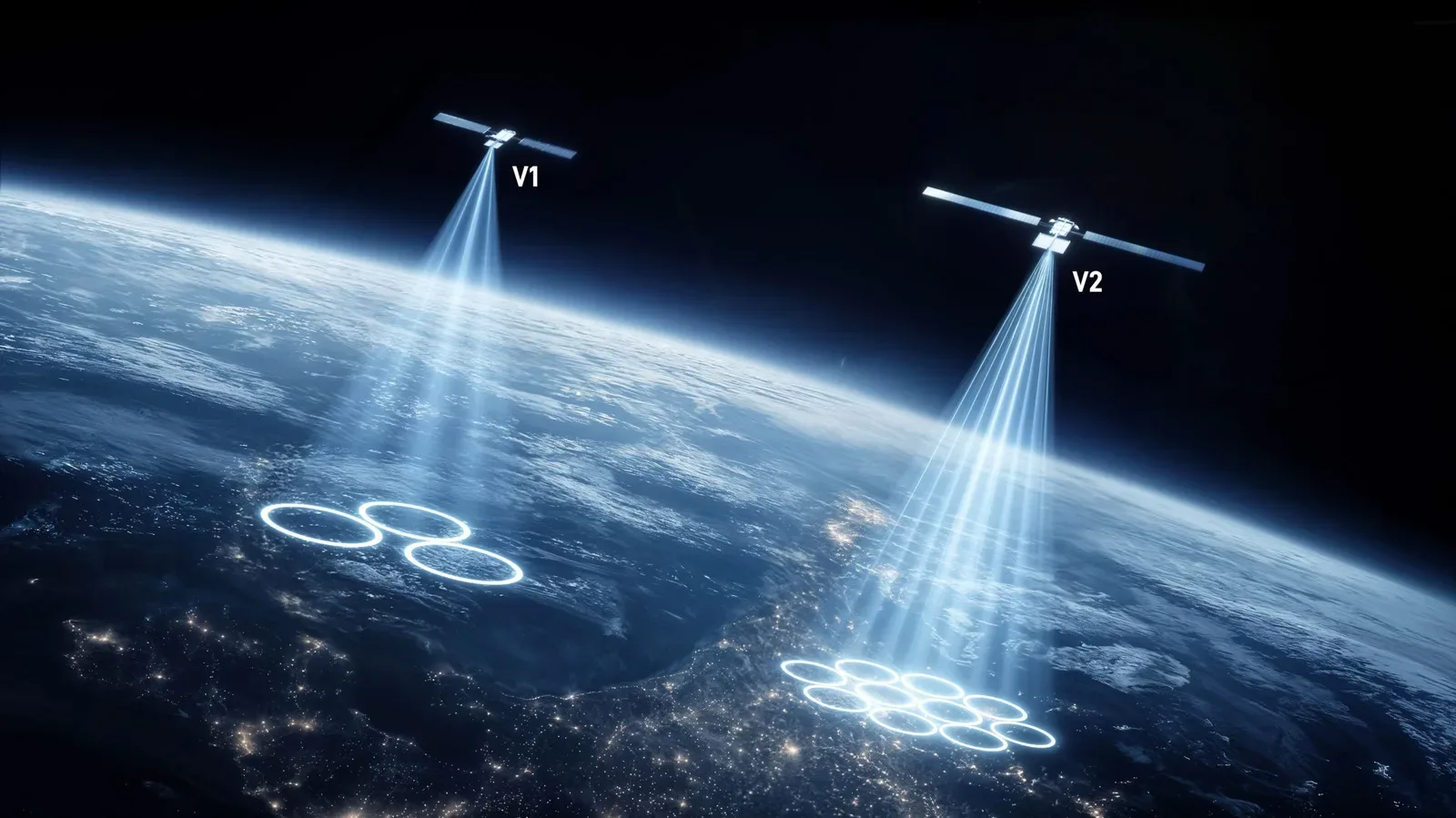
The company is also pointing to its next-generation satellite plans. The FCC has authorized SpaceX to deploy 15,000 Starlink Mobile Gen2 satellites optimized for the 2 GHz spectrum. SpaceX says those satellites can provide more than 100 times the bandwidth of its current satellite generation.
Bandwidth is the amount of data a network can carry over a given period. More bandwidth can support more data traffic, whether that capacity is used across additional customers, more demanding services or wider areas. SpaceX’s claim about a more-than-100-fold increase describes the projected capability of the Gen2 generation relative to its current satellites; it should not be read as a promise that every individual customer will automatically receive speeds 100 times greater.
The 2 GHz optimization and the proposed 800 MHz acquisition also illustrate why a single-band explanation would be incomplete. The disclosed plans involve different spectrum ranges with different roles. SpaceX connects Gen2 with high-capacity satellite service, while it identifies the lower 800 MHz band as the answer to the specific problem of reaching devices through walls and other obstacles.
What approval would mean—and what remains unanswered
FCC approval is the immediate gate for the Grain Management transaction. Until that occurs, the licenses are not part of SpaceX’s completed spectrum holdings. Regulatory review is therefore not a side note; it is the next necessary stage in the company’s stated mobile-carrier strategy.
If approved, the acquisition would give SpaceX access to a nationwide low-band spectrum portfolio of up to 14 MHz paired in the 800 MHz range. That alone does not answer every operational question. The available information does not specify how Starlink Mobile will be sold, which plans may be offered, whether service will be directly branded to consumers, or when indoor-capable mobile service might arrive.
It also does not change the fact that established carriers possess wider spectrum portfolios. SpaceX’s case is instead that this particular acquisition, together with its Gen2 constellation and existing spectrum activity, creates a path to a more competitive hybrid network.
For prospective customers, the practical promise is easy to understand: connectivity in remote places backed by better prospects for indoor signal. For SpaceX, the harder work is turning that promise into an authorized, deployed and dependable service. The agreement with Grain Management marks a meaningful spectrum step, but its real importance will depend on FCC action and on what SpaceX ultimately builds with the licenses.