Some of the coldest engineered environments on Earth are not tucked away in a polar station or a science-fiction cryosleep pod. They are in quantum-computing labs, where a processor may need to operate at temperatures below 15 millikelvin: more than 180 times colder than deep space, which is roughly 2.7 Kelvin.
That number is startling largely because it sounds upside down. Space is supposed to be cold. Yet a carefully built laboratory system can be colder still, approaching absolute zero—the lower boundary on temperature. The reason is not spectacle. It is survival.
For a major family of quantum computers, the useful computing components are qubits, and qubits are notoriously easy to disturb. Heat is one of the disturbances engineers must fight. If too much energy reaches the processor, qubits can lose the delicate states and relationships that a quantum calculation needs. The result is more errors, not a faster machine.
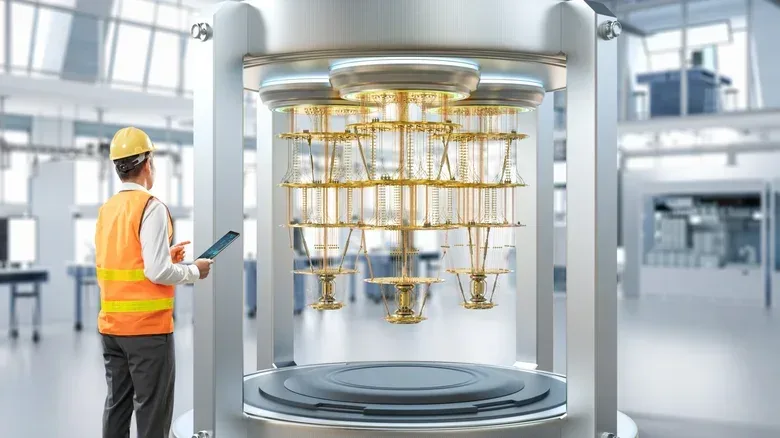
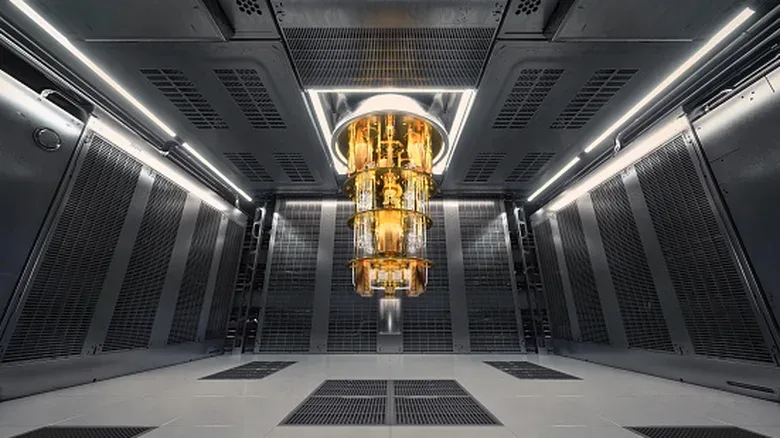
So the towering, chandelier-like apparatus seen around many quantum processors is not a decorative enclosure. It is part of the computer. It is an elaborate attempt to give an extremely sensitive processor a quiet enough place to do its job.
The basic problem: bits are switches; qubits are fragile states
Conventional computers use bits. A bit has one of two values: 0 or 1. That simplicity is not a weakness; it is why digital systems can store, copy and process information so reliably.
A qubit, by contrast, can occupy states between the familiar 0 and 1 endpoints. A practical analogy is a dimmer rather than a light switch. A qubit also has another information-carrying property that can be described as a direction. This gives quantum systems a richer set of possible states than an isolated classical bit.
Qubits can also be linked. In such a connection, information learned about one qubit is connected to information about the others. That relationship is central to why quantum computing has attracted so much attention. A quantum algorithm can be designed so that possible outcomes behave somewhat like waves: unwanted answers cancel, while the wanted answer is reinforced.
That is not a promise that quantum hardware will replace ordinary computers. Quantum computers are not presented as universally faster machines for everyday workloads. Their prospective advantage is for particular kinds of problem, including simulating molecules in ways that could help with work such as drug development.
But the very properties that make qubits useful also make them vulnerable. An outside disturbance does not simply make a single component a little noisy in the way a dusty controller button might misbehave. It can disrupt qubit states and their interactions. The loss of that usable quantum behavior is called decoherence.
Why heat is an enemy, not an inconvenience
Heat is energy expressed through motion. Add energy to matter and its tiny constituents move or vibrate more. That is ordinary physical behavior, but it creates an extraordinary engineering constraint when the information-bearing part of a computer is highly sensitive to energy.
A qubit can be knocked out of its intended state by very small disturbances. More energy in the system increases the chance that its calculation will be corrupted. Cooling therefore is not merely about making a machine efficient or stopping a chip from overheating. It is a route to reducing the thermal activity that can scramble quantum information.
That distinction matters when interpreting headlines about ultra-cold quantum hardware. The low temperature does not mean the computer has solved the broader reliability challenge. It means the machine is attempting to create one of the essential conditions for reliable operations. A processor with more qubits is not automatically more useful if those qubits cannot retain their states accurately enough.
In gaming terms, qubits are less like durable inventory slots and more like a coordinated puzzle sequence where one stray input can throw off several moving pieces. The cold room is there to stop the environment from pressing buttons on the puzzle.
What a dilution refrigerator is doing
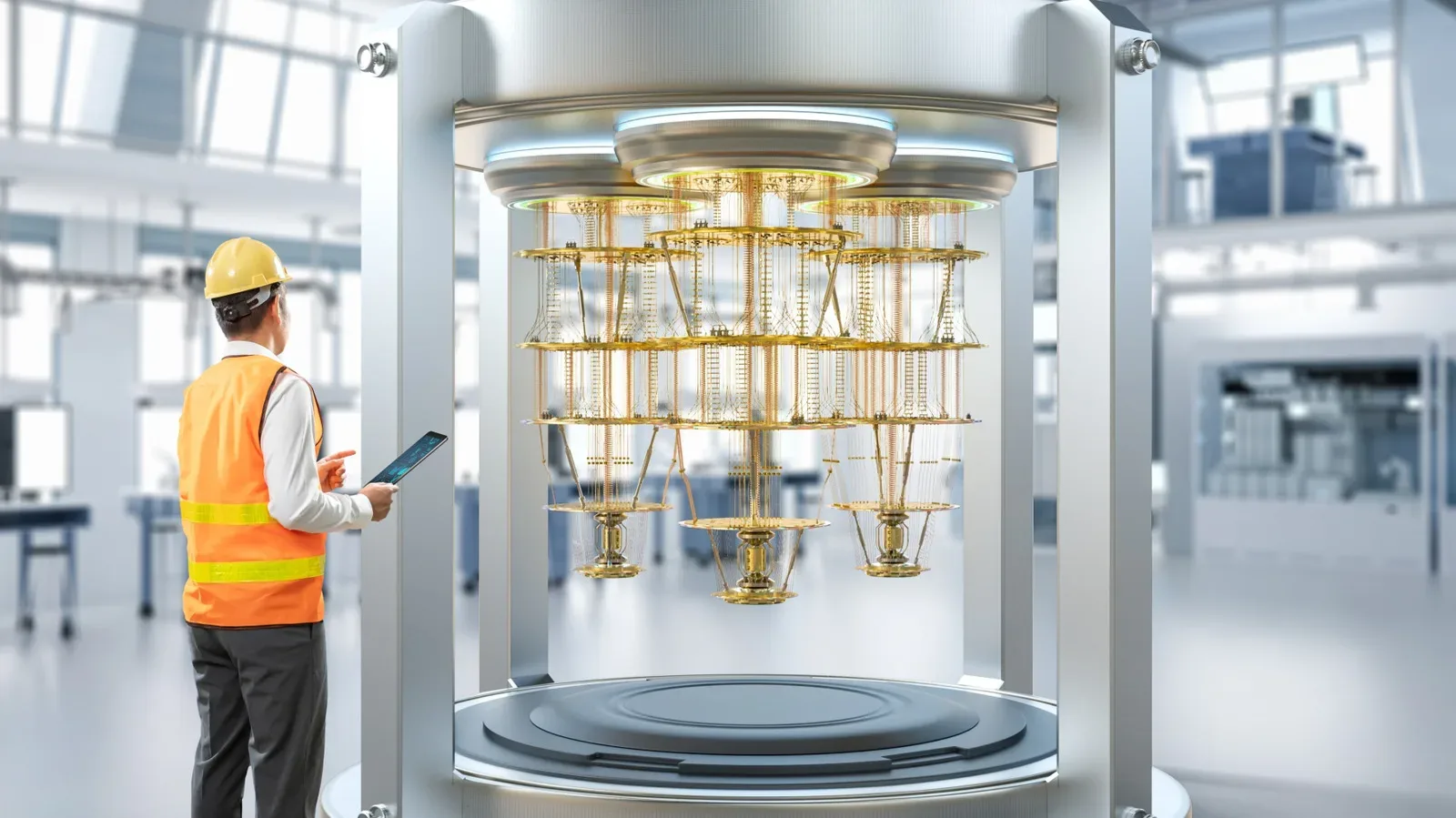
For systems that use this approach, the visual centerpiece is a dilution refrigerator. It is generally built as a descending stack of metal stages, with each level colder than the one above it. The upper area is at room temperature, while the processor sits at the coldest point near the bottom.
IBM’s latest modular cryogenic system is described as reaching below 15 millikelvin. A millikelvin is one thousandth of a Kelvin, which helps put the scale in perspective: the machine is working a tiny fraction above absolute zero.
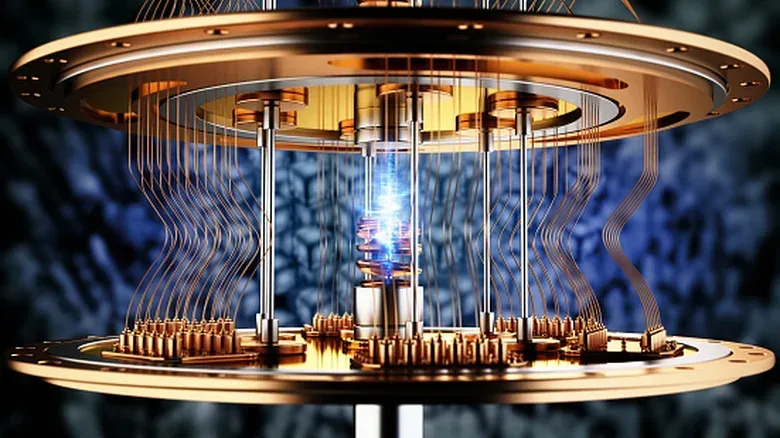
The refrigerator’s architecture creates a difficult trade-off. Qubits need control, and that control requires wires coming from warmer, room-temperature equipment. Wires conduct heat. Every wire therefore represents a possible route by which warmth can travel downward toward the processor.
This is the scaling paradox. More qubits can mean more wiring, while more wiring can mean more heat arriving where heat is least welcome. It is not enough to make a cold location once; engineers must keep it cold while connecting and operating an increasingly complex machine.
That practical constraint is why a quantum computer’s exterior can look disproportionate to the processor it contains. The surrounding hardware is carrying out a vital support role: separating temperature stages, managing the connection between warm controls and cold qubits, and keeping the computational core in a stable environment.
Not all quantum machines use the same cooling playbook
Ultra-cold refrigerator stacks are a major approach, not the only one. Different quantum-computing designs place the hardest engineering problem in different locations.
Neutral-atom machines, including systems made by QuEra, use lasers to cool individual atoms in a small vacuum chamber to microkelvin temperatures. That is colder than a conventional refrigerator can reach. Crucially, the chamber walls and surrounding equipment can remain at room temperature. Because there is no comparable cold stack that must be threaded by control wiring, much of the wiring-heats-the-processor issue is avoided.
That does not remove the challenge; it changes it. Neutral-atom systems must contend with the task of trapping large numbers of individual atoms.
Photonic machines use particles of light as qubits. Many of their components operate at room temperature, although their single-photon detectors generally still require cooling. Their central difficulty is correspondingly different: reliably detecting individual photons.
The useful takeaway is that “quantum computer” is not one fixed machine shape. Some systems need a dramatic cryogenic stack. Others rely on laser-cooled atoms or light-based components. None gets a free pass. A design can reduce one bottleneck only to confront another involving control, scaling or measurement.
The practical stakes go beyond a very expensive freezer
The cooling challenge is foundational because the potential uses of quantum computing are consequential—and uneven. For targeted scientific calculations, such as molecular simulation, quantum techniques could eventually provide a dramatic advantage. But the same technology is also relevant to cryptography.
Public-key encryption protects systems people use every day, including logins and Bitcoin. A sufficiently capable, trustworthy quantum computer could break cryptographic schemes that are widely used today. That is a future risk, not an immediate consumer emergency: today’s quantum machines are in the range of hundreds to low thousands of qubits.
Estimates underline the distance still to travel. A 2025 estimate from Google Quantum AI placed the resources needed to crack a standard RSA-2048 key at under one million noisy qubits, substantially reduced from an estimate of 20 million in 2019. A 2026 Google paper placed Bitcoin’s signature scheme below 500,000 qubits. Those figures should not be read as a countdown timer. They are estimates for a difficult technical target, and the gap between current hardware and those numbers remains very large.
There is also a defensive response already in motion. In August 2024, the National Institute of Standards and Technology finalized its first post-quantum encryption standards and described them as ready for immediate use. For organizations managing accounts, devices and sensitive data, the sensible lesson is not panic about tomorrow’s passwords. It is that cryptographic transitions take time, so planning should begin before the threat becomes practical. Everyday device protection is still worth treating seriously now; even routine settings deserve attention, as with a quick privacy check before using public Wi-Fi.
Why “colder than space” is only one milestone
The phrase makes for a memorable benchmark, but it should not obscure the actual story. Getting below 15 millikelvin demonstrates that a lab can create an environment far colder than deep space. Keeping a growing quantum processor useful inside that environment is the longer, more complex mission.
Engineers need to limit heat while delivering control signals. They need qubits that hold their intended state long enough to complete meaningful work. They need ways to scale hardware without creating a plumbing-and-wiring problem that undermines the low-temperature design. And they need systems that can produce trustworthy results rather than merely perform isolated quantum operations.
For now, the refrigerator is not background equipment. It is one of the central arenas in which quantum computing is being decided. Before quantum processors can make their biggest promises matter to medicine, encryption or other specialized tasks, they have to win a much colder fight: preserving information at temperatures where even deep space would seem comparatively warm.