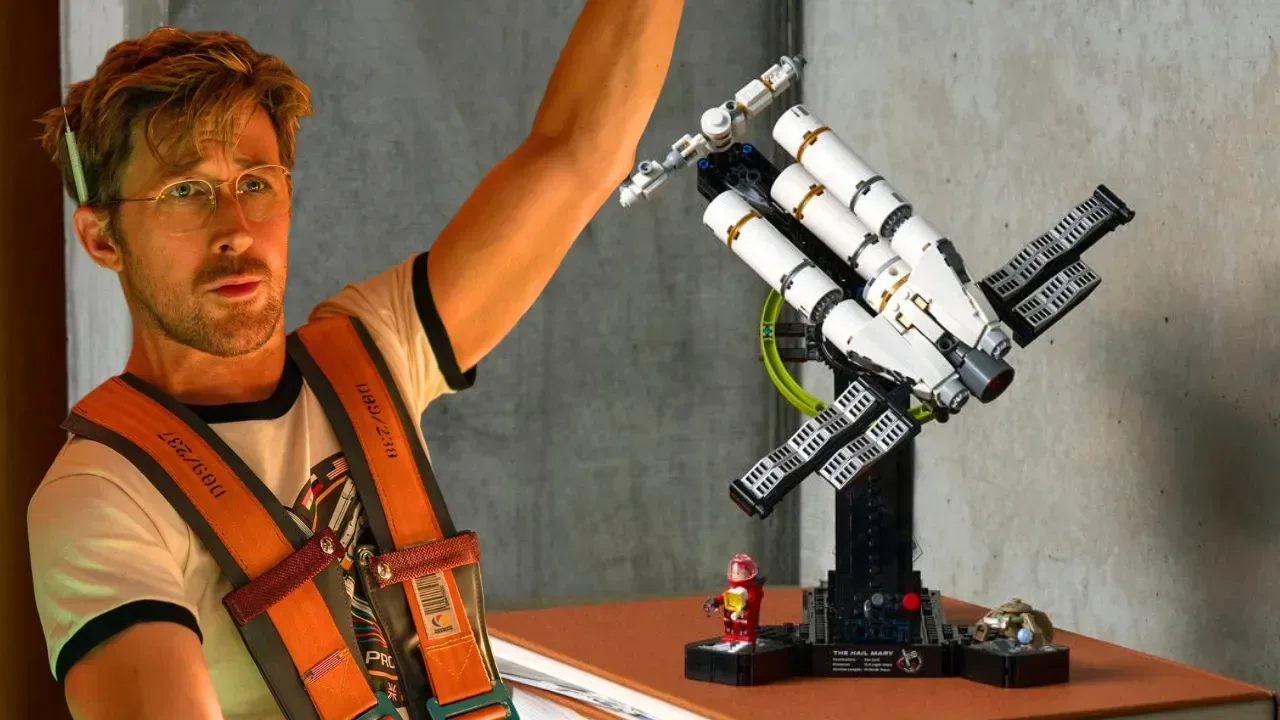

Project Hail Mary: Journey Among the Stars will launch on November 12 for PICO, Android XR and Meta Quest 3/3S. Developed by Maze Theory, the mixed-reality title expands the science-fiction universe created by Andy Weir and places players aboard the Hail Mary for an original chapter set during its journey from Tau Ceti to 40 Eridani A.
The premise is immediately suited to mixed reality’s particular trick: turning a player’s room into part of the setting. Rather than presenting the Hail Mary solely as a virtual spacecraft viewed through a headset, the experience blends the ship with the player’s physical surroundings. In practical terms, that means the game’s central appeal is not simply being in a spacefaring story, but having its systems, objects and environment share space with the room around the player.
Players take the role of Ryland Grace and work with Rocky as the mission becomes increasingly uncertain. James Ortiz reprises the role of Rocky. The stated gameplay revolves around diagnosing failing systems, devising scientific solutions with the materials at hand, handling the ship and its cargo, and trying to keep the mission operational.
Pre-orders are now live. Early adopters are set to receive the Limited Edition Gold Xenonite Collection: three digital mixed-reality sculptures depicting Rocky, Grace and the Hail Mary ship.
An original chapter aboard the Hail Mary
Journey Among the Stars is positioned as an untold episode rather than a straightforward retelling of the novel’s events. Its location aboard the Hail Mary while it travels between Tau Ceti and 40 Eridani A gives the project a clearly defined narrative space: a crew and vessel already committed to a daunting voyage, with equipment problems and dwindling certainty turning routine management into a survival concern.
That framing matters for an adaptation. An original chapter can use the setting, characters and mission stakes without asking players to merely reenact a pre-existing sequence beat for beat. It also makes room for the kind of interaction the announcement describes: examining failures, managing resources and improvising responses. Those are actions that naturally give a player something to do in an XR environment.
The available details do not specify a campaign length, progression structure, locomotion options, control schemes or whether the experience can be played entirely in virtual reality. They do establish the intended fantasy, however: players are not distant observers of the Hail Mary mission. They are responsible for maintaining the ship while collaborating with Rocky.
What “mixed reality” means here
Mixed reality is an umbrella term for digital content that is presented in relation to a user’s real-world environment. In this case, the stated approach is to blend the Hail Mary with a player’s physical space. It differs from a purely virtual setting, where the headset view replaces the room with a fully digital world.
Related coverage includes Project Hail Mary: Journey Among the Stars Sets November 12 XR Launch.
For a spacecraft-management scenario, that can make ordinary surroundings part of the fiction. A wall, floor or table can become the contextual backdrop for shipboard elements and the digital sculptures included with early pre-orders are specifically intended to be displayed in mixed reality. The approach potentially gives the game a more domestic, hands-on character than a conventional screen game: mission hardware and characters may feel as though they have arrived in the player’s own space.
There is a sensible caveat. The announcement identifies the creative direction but does not detail how individual tasks will use room mapping, hand tracking, controllers, passthrough views or spatial boundaries. Prospective players interested in those specifics should treat the platform list and mixed-reality premise as confirmed, while waiting for more technical information about the final experience.
Science problems and ship management at the center
The announced activity list points toward problem-solving rather than combat as the core of the experience. Diagnosing a failed system means identifying what is wrong; improvising a scientific solution suggests using available knowledge and materials to make progress despite constraints. Managing the ship and cargo adds a logistical layer, where the condition of the vessel and what it carries both matter to the wider mission.
Those are broad descriptions, not a promise of a particular simulation depth. Still, they indicate an experience built around pressure, observation and decision-making. A failing system is compelling in a space story because there is little margin for error: the ship is the mission’s shelter, workshop and means of travel. Making the player responsible for its upkeep is an efficient way to turn the setting’s danger into interactive stakes.
Rocky’s involvement should also be important to the game’s tone. The announcement says players work alongside the character, with James Ortiz returning to the role. That gives the experience a named creative connection to this corner of the universe rather than treating the partnership as an abstract plot point.
Platforms and the pre-order digital sculptures
The launch covers three platform families: PICO, Android XR and Meta Quest 3/3S. Meta Quest 3/3S refers to the Quest 3 and Quest 3S headset line, while Android XR refers to the Android-based extended-reality platform. PICO is another XR hardware ecosystem. The multi-platform release means the experience is not confined to one headset brand, although the announcement does not provide a full model-by-model compatibility list beyond those named platforms.
The Limited Edition Gold Xenonite Collection is a digital pre-order incentive, not a physical collectible. Its three sculptures represent Rocky, Ryland Grace and the Hail Mary, and can be displayed in mixed reality. For players who enjoy the idea of keeping story-world objects present after a session, that reward is closely tied to the title’s core format rather than being a conventional menu-bound cosmetic.
It is also worth separating confirmed bonus content from assumptions about the main game. The three sculptures are confirmed for early adopters, but no further pre-order tiers, physical editions or additional in-game items have been detailed in the information currently available.
A cinematic universe enters the XR space
Maze Theory is developing the project within the cinematic world shaped by Phil Lord and Christopher Miller, with Weir’s novel as its foundation. A newly released video featuring Ryan Gosling highlights taking control of the Hail Mary, reinforcing the game’s emphasis on the ship itself as the player’s immediate responsibility.
For XR players, the key proposition is therefore quite specific: an original Project Hail Mary story segment that turns the Hail Mary into a spatial, interactive environment and frames scientific improvisation as the route through escalating trouble. It is a different route into science fiction than a traditional flat-screen adventure, even as it shares the broad fascination with far-off travel found in projects such as Astral Dive’s upcoming PC and console spacebound deckbuilding journey.
Project Hail Mary: Journey Among the Stars arrives November 12 on PICO, Android XR and Meta Quest 3/3S.