The NFL season’s first Sunday is built to make everything feel settled: familiar theme music, familiar graphics, familiar voices explaining why a defense just turned a routine third-and-four into an advanced course in human despair. Yet the men behind several of the league’s most prominent broadcast booths are heading into a notably unsettled period.
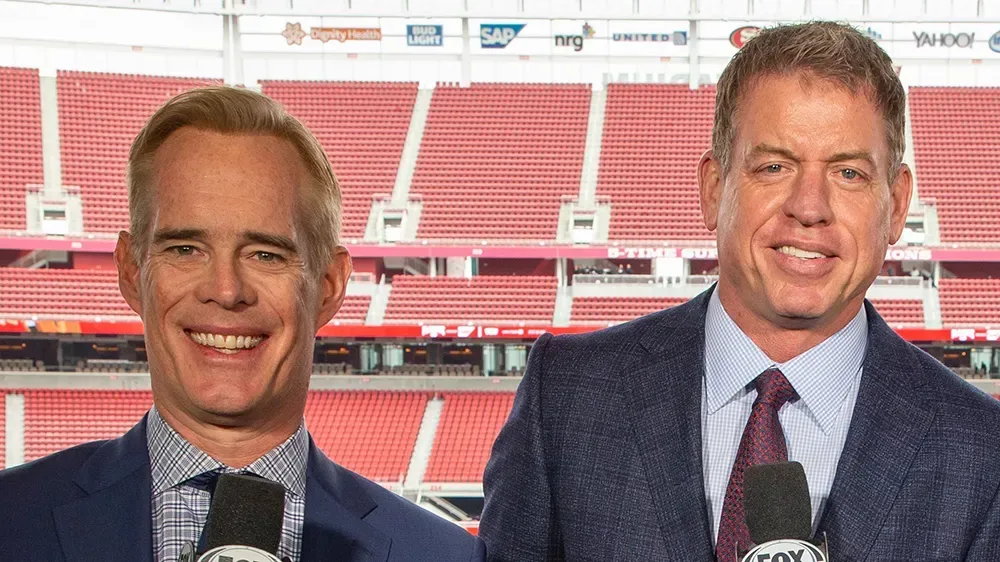
Joe Buck and Troy Aikman at ESPN, Al Michaels and Kirk Herbstreit on Amazon’s Thursday Night Football, and Greg Olsen at Fox are all facing contract situations that could reshape how NFL games sound after the current season. Their futures are not identical, and a looming expiration does not automatically mean a departure. Still, the timing creates a rare convergence of major decisions for media companies that spent heavily to acquire both NFL packages and the stars entrusted with presenting them.
For viewers, announcer contracts can seem like background business: the sort of thing discussed only after a broadcaster suddenly vanishes from a game and someone’s uncle asks whether they were traded. For networks and streaming services, however, elite booth talent has become central to the value and identity of an NFL package. The people calling the game are part of the product, particularly when a company is trying to establish its importance to the league.
Why the NFL booth became prime real estate
The current era took shape after the NFL’s major 11-year media-rights agreements were reached in 2021. The deals increased the premium on every component of football coverage. Companies did not merely want the right games; they wanted voices with stature, credibility and enough familiarity that an audience knew it had arrived at a major event before the opening kickoff.
CBS had already demonstrated how dramatically the market could move. Tony Romo’s transition from former Dallas Cowboys quarterback to CBS analyst made him a major figure in the booth after he showed a conspicuous ability to anticipate plays. CBS subsequently signed him to a multiyear agreement in 2020 reportedly worth roughly $17 million annually. That deal helped establish a new ceiling for a role that had once carried less of the sports-TV payroll’s glamour than the big studio desk.
The result was a broadcast equivalent of free agency. ESPN brought Buck and Aikman over from Fox in 2022 to handle Monday Night Football. Amazon hired Michaels and Herbstreit to lead its new Thursday Night Football presentation. Fox, meanwhile, signed Tom Brady, a move that altered Greg Olsen’s place in its lineup.
Top NFL booth personnel are now believed to command somewhere in the range of $15 million to $20 million per season. Those numbers illustrate how much the job has changed. A lead analyst is no longer simply a former player offering color between snaps. The top role involves representing a network’s investment, setting a game’s emotional temperature and helping make a weekly telecast feel indispensable.
ESPN has a powerful case for continuity
Among the possible decisions, ESPN’s situation with Buck and Aikman may be the easiest to read, even if no renewal is automatic. The network’s move to secure the pair helped strengthen its standing with the NFL after years in which Monday Night Football had cycled through booth arrangements that received far less enthusiasm.
The contrast was sometimes stark. During the 2018-19 season, ESPN used former defensive tackle Booger McFarland in an elevated sideline chair positioned near the line of scrimmage. The experiment became an enduring example of how a broadcast innovation can become the thing viewers remember more vividly than the actual game.
With Buck and Aikman, ESPN gained a veteran partnership already associated with marquee NFL coverage. The network’s schedule improved, ratings rose, and ESPN’s current rights agreement also includes Super Bowls. ABC is scheduled to televise a Super Bowl on February 14, 2027, its first such broadcast in around two decades. That alone gives ESPN a compelling reason to keep its lead booth intact through another enormous assignment.
Negotiations with Buck and Aikman have already begun. The final terms and outcomes remain unknown, but the logic of retaining a team that has helped elevate the package is clear. In the weirdly precise economics of sports television, a high salary can look less extravagant when it helps protect an investment measured in billions.
Amazon’s schedule question is also a workload question
Amazon’s booth presents a different set of calculations. Michaels is understood to be working year to year, while Herbstreit’s football calendar is exceptionally demanding. Beyond Amazon’s NFL coverage, Herbstreit remains a major ESPN college-football voice and a regular presence on College GameDay.
That arrangement gives Amazon an experienced duo with instant name recognition, but it also underlines the reality that broadcast staffing cannot be considered in isolation. A decision about one leading role can affect scheduling, production plans and the broader talent ecosystem across multiple companies.
The streaming company has every reason to value continuity for a weekly NFL franchise that must feel like a destination rather than merely another tab in a crowded app menu. At the same time, the expanding cost of live-sports rights means every company has to assess whether its talent outlay remains sustainable. That scrutiny is not necessarily a judgment on performance; it is the math that follows when premium games become ever more expensive.
The wider entertainment business is confronting similarly complicated questions about technology, presentation and audience confidence, including debates around generative-AI use in game marketing covered in this industry report. NFL broadcast negotiations are a distinct issue, but they share the bigger theme: media companies are trying to preserve quality and trust while deciding where resources deliver the greatest value.
Fox, Greg Olsen and the Tom Brady variable
Fox’s circumstances are especially intriguing because Olsen has already experienced the abrupt change that can come with an elite hire. After Buck and Aikman moved to ESPN, Olsen rose to Fox’s top NFL team. When Brady arrived, Olsen shifted back to the network’s second team.
Olsen has been candid about wanting a place on a top pairing, an ambition entirely understandable for someone who has already worked in that position. Fox is also said to value his work and his willingness to navigate a changing lineup professionally. That makes Olsen a consequential name in any future booth shuffle, whether that means a renewed opportunity at Fox or interest elsewhere.
Brady is not described as imminently leaving his role, but his many business commitments have fueled questions over whether he will stay in a full-season broadcasting position for years. That uncertainty does not amount to a forecast. It does mean Fox must think beyond one season, as all networks do when building a top announce team.
CBS has its own unresolved storyline
CBS could add another wrinkle. Romo is expected to miss at least the opening games of the season following an arrest over the summer for allegedly operating a vehicle while intoxicated near Milwaukee. The network has not provided a timeline for his return.
In the meantime, CBS has moved former NFL player and studio analyst J.J. Watt alongside Jim Nantz on its top team. Whether that is a temporary answer or the start of a longer-term change has not been established. But a successful run for Watt would naturally expand CBS’s choices at a moment when other high-profile booth contracts are coming into focus.
That is the central complication for everyone involved: one decision can create another opening. If an incumbent moves, a network changes course, or a new voice proves ready for the largest stage, the market can move quickly.
The league relationship matters as much as the ledger
Rights costs may force executives to search for savings in production and talent, but NFL partners also have reasons to avoid disrupting a broadcast product that works. The league has an option to renew its current 11-year media deals after the 2029 season. Networks and platforms therefore need to keep delivering games in a way that supports their relationships with football’s most valuable domestic sports property.
There may also be future talent waiting beyond the present class. Travis Kelce, for example, has a substantial media profile through his podcast and could become a natural broadcasting candidate whenever his playing career ends. That possibility is only speculative, and retirement decisions belong to Kelce, not a hypothetical television depth chart. Still, it shows why companies will be watching the next generation as carefully as the established stars.
For now, the contracts, negotiations and potential changes are the real story. Football broadcasting has become a high-stakes roster game where salaries, schedules, league ties and viewers’ attachment to familiar voices all matter. The quarterbacks will still take the snaps, but the people narrating those snaps may soon be considering very different playbooks.