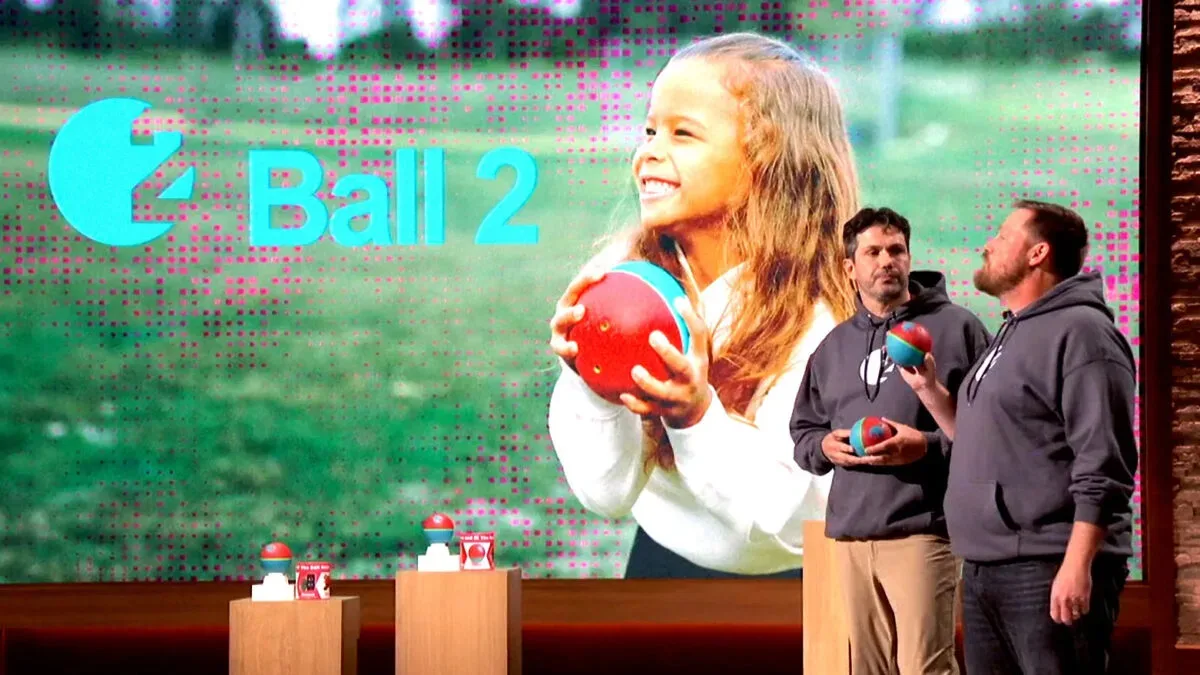
MrBeast has made his Shark Tank debut with a $250,000 investment in Ball 2, a sensor-equipped ball pitched as a smarter, app-connected take on the familiar playground object. The deal gives James Stephen Donaldson, better known as MrBeast, a 55% stake in the company behind the product.
Ball 2 was presented by cousins Andrew Brown and Kevin Langdon. Their core idea is straightforward, even if the product’s name deliberately sounds like a sequel to an object that never needed one: put sensors inside a ball, collect information from the way it is thrown, rolled, bounced and moved, then send that information to a companion app.
The bigger pitch is that artificial intelligence can use that activity to devise games on demand. Rather than selling a ball for one fixed sport or activity, the founders presented it as a flexible play device whose software can suggest or generate new ways to use it.
That proposition found an unusually fitting backer in Donaldson. Other investors on the panel raised doubts about whether shoppers would immediately understand why this ball deserves attention beside ordinary, familiar alternatives. Donaldson, whose career has been built around understanding what spreads quickly online, was more enthusiastic. He agreed to invest $250,000 for majority ownership.
What Ball 2 is claiming to add to a ball
At the center of Ball 2 is motion data. Sensors inside the ball are intended to detect physical actions such as rolling, throwing, bouncing and shaking. Those readings are then reported to a companion app.
That distinction matters. The ball itself is the input device; the app is where the product’s activities, feedback and game concepts would be presented. In practical terms, the pitch depends on the physical object and software feeling like one experience rather than two separate things: a toy that happens to have an app, and an app that happens to require a toy.
The founders said AI can be instructed to make games on the fly. Here, “AI” appears to mean software used to formulate or adapt activity ideas based on prompts and tracked motion, not that the ball independently understands a sport or a player in the human sense. The available details do not establish what specific games it can make, how consistently it recognizes different actions, whether its suggestions are curated, or what data is retained by the app.
Those unanswered questions are important because “AI-powered” is not a product category by itself. For a family deciding whether a connected ball is worth choosing over a standard foam ball, the visible result needs to be simple: it should make play more immediate, more varied or more social. The technical layer only earns its place if it creates an activity people want to repeat.
Related coverage includes MrBeast Takes 55% Stake in AI-Powered Ball 2 on Shark Tank.
The Shark Tank demonstration was simple—and revealing
Donaldson and fellow investor Lori Greiner tested Ball 2 during a live demonstration by competing to see who could shake it more. Donaldson won and said the device worked better than he expected, calling the result cool.
It is a small demonstration, but it communicates the company’s most accessible promise. A connected ball has to recognize that it is being handled and convert a physical motion into a measurable outcome. A shake-off is an easy way to show that the system is registering activity in real time.
It also hints at the challenge. A product can successfully detect a shake and still need to answer the far larger question: why does that detection become a game people will choose over everything else available to them? The panel’s skepticism focused largely on this marketing issue, not merely whether the object can function.
Langdon acknowledged the difficulty directly: a Ball 2 placed next to a conventional ball on a retail shelf could be a hard sell. Visually, the technology is not necessarily self-explanatory. A normal ball instantly communicates what it does. Ball 2 must communicate its physical use, its app connection and its AI-generated-game proposition in a few seconds.
The real product may be the explanation
Consumer technology often faces a “shelf test.” Can someone understand why it is different without a lengthy video, a staff demonstration or an existing interest in the brand? Ball 2 may face that test more sharply than many connected devices because it shares the form of one of the most universally recognizable toys there is.
That is both an advantage and a problem. Its familiar shape makes the product approachable: there is no intimidating controller to learn, no unusual accessory to assemble and no mystery about the basic physical interaction. But that same familiarity makes its premium proposition harder to see. If the ball looks broadly like other balls, its story has to do the work.
The Shark Tank panel’s reaction suggests the founders will need to demonstrate a clear moment of value. That might be the satisfaction of seeing a throw or bounce logged by the app, the surprise of a newly generated challenge, or a game format that gets several people moving together. None of those outcomes can be assumed merely from the presence of sensors. They need to be understood quickly by parents, kids and anyone else the company hopes will pick it up.
The companion-app model creates a second consideration: the overall experience depends on the software remaining easy to use. Anyone assessing app-connected gear should think about the full setup, including phone or tablet compatibility, account requirements, updates, privacy information and the practical reliability of the connection. That broader setup is worth considering with any device that pairs physical activity with a screen; the same principle applies to the home gear discussed in this guide to the home-network equipment behind a smoother game night.
No details were provided about Ball 2’s network requirements, supported devices, privacy practices or app features beyond the tracking and AI game-generation premise. Those will be meaningful details to watch as the product moves beyond the pitch.
Why MrBeast may see an opening where others saw a hurdle
Kevin O’Leary did not back the company and suggested its prospects would depend on a viral moment. Greiner was also skeptical about consumer interest. Donaldson’s decision to take the deal makes sense in the narrow context of that concern: a product that may be difficult to explain from a shelf is potentially much easier to explain in a short, visually clear video.
Ball 2 has a premise built for a demonstration. Throw a ball, watch an app respond, accept a challenge, compare scores or ask for a fresh game. The product does not need a detailed technical lecture to produce a clip. If the experience is compelling, the story can be shown rather than explained.
That does not make virality a substitute for long-term appeal. Attention can introduce a product, but repeat use determines whether buyers continue to see value in it. For Ball 2, repeatability is tied to the quality and variety of the games it can create, how accurately it tracks movement and whether the app avoids becoming a barrier between people and play.
Donaldson’s investment is therefore more than a verdict on the ball’s sensor package. It is a bet that a connected toy can turn its unusual concept into a shareable, understandable moment—and that this can lead to sustained consumer interest.
A majority stake changes the shape of the deal
The $250,000 investment came in exchange for 55% of the company. That is a majority stake, meaning Donaldson will hold more than half of the ownership described in the deal. For Brown and Langdon, the funding and association with a massive online entertainer may offer a route to attention that their product otherwise would struggle to buy or earn.
For Donaldson, majority ownership gives the deal a different character than a small promotional tie-in. It places him in a controlling ownership position in a company whose success will depend heavily on presentation, audience awareness and a reliable consumer experience.
The founders accepted after briefly looking at one another, then celebrated the agreement with “beast ball!” The moment captured the obvious promotional overlap between the product and its new investor. Whether that branding becomes a lasting advantage, however, will rest on the Ball 2 experience itself—not simply the novelty of adding “AI” to a ball.
Battery concerns are circulating, but remain unverified here
An online post quoted during discussion of the episode claimed that Ball 2’s battery is neither rechargeable nor designed to be replaced. That is a potentially significant claim for any sensor-equipped physical product, especially one designed for active use, but it is not established by the other available details.
Until the company provides product specifications, it should be treated as an unverified concern rather than a confirmed feature. Battery design would affect durability, maintenance and the product’s practical lifespan, so it is a reasonable area for consumers to seek clarity on before making any buying decision.
For now, the facts that are clear are the pitch’s essentials: Ball 2 is a sensor-filled ball that reports movement data to a companion app; its creators say AI can generate games; and MrBeast has invested $250,000 for a 55% stake. The remaining test is whether that formula can make a very old form of play feel genuinely new.