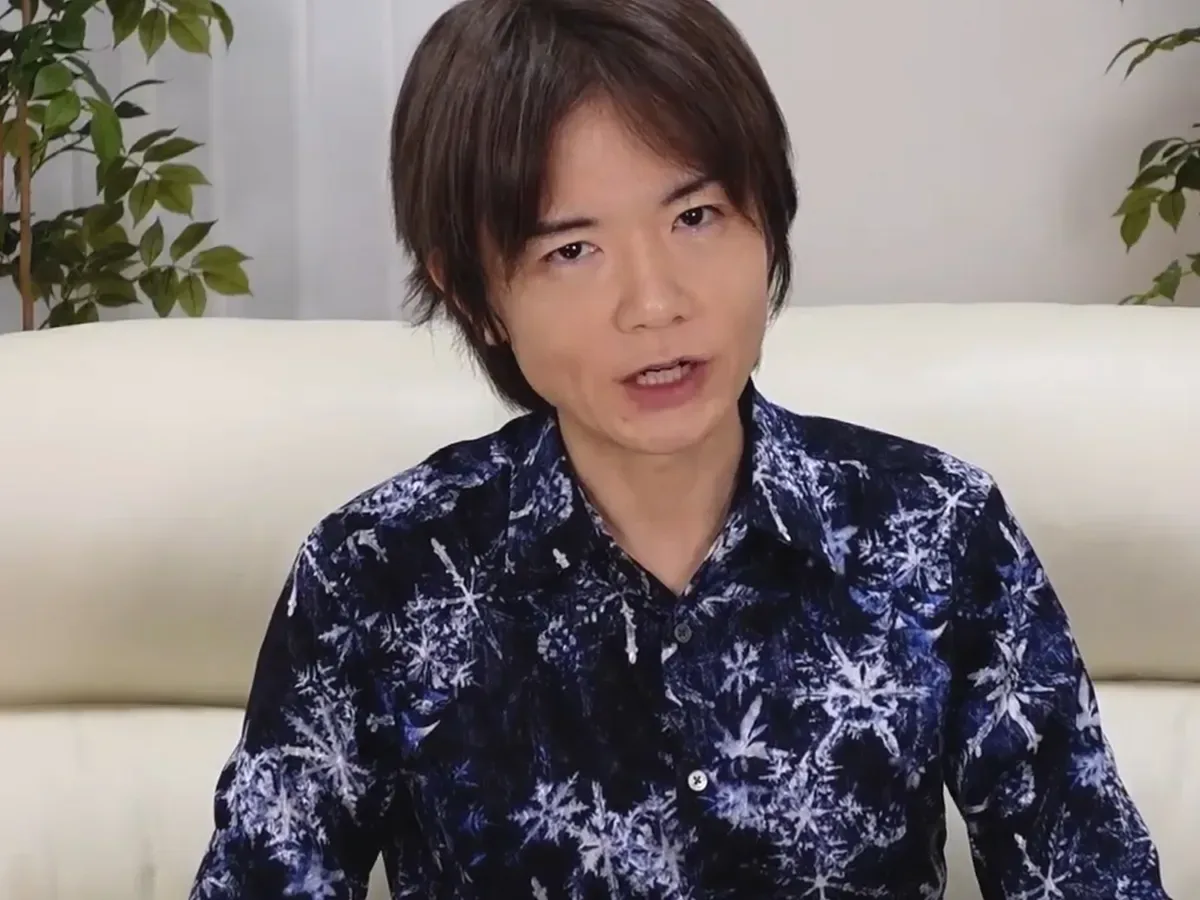
More games does not automatically mean more games worth playing. That is the core of Masahiro Sakurai’s argument about generative AI and game development: the technology may help drive the number of releases dramatically higher, but a larger catalogue can also make it harder for any individual game to be noticed, understood or financially viable.
The creator of Super Smash Bros. discussed the prospect while considering the rise in games released on Steam since 2010. The comparison presented to him was stark: 275 releases in 2010 versus 19,000 in a recent year. Sakurai’s expectation is that the number will continue rising, with AI contributing to that increase. His more cautionary point was that many of those projects could become “unprofitable titles” amid a volume of work no player could reasonably track in full.
That is not quite the same as predicting that AI will make games disappear, nor is it a claim that every AI-assisted project is inherently bad. Rather, Sakurai’s concern is about abundance without distinction. If production becomes easier, more works can be made. But if many of them recycle familiar systems, themes and formats without a compelling reason to exist, the extra supply may increase competition for attention without creating equivalent demand.
The discoverability problem behind the numbers
Discoverability is the practical challenge of helping people find a game among the many other games competing for their time. It encompasses storefront visibility, word of mouth, social-media conversation, trailers, recommendations and the simple ability for a player to recognize what makes one release different from another.
Sakurai’s concern starts there. A catalogue containing thousands of releases does not merely offer players more choice; it also imposes more sorting work. Nobody can inspect every new game, so audiences rely on signals: a trusted developer, a distinctive visual identity, a convincing premise, a community recommendation or an already-established genre appeal. A flood of superficially similar projects can make those signals more important, not less.
For developers, the implication is severe. Shipping a game and being discovered are separate problems. A tool that reduces the effort needed to produce basic assets, prototypes or variations may lower one barrier, while doing little to solve the other. In a crowded marketplace, a project still needs an identity that players can describe to someone else.
Steam’s scale is central to the discussion because it illustrates how radically the volume of PC releases has already changed. The platform has long been an important route for smaller teams and independent developers, but an open and busy release environment also means attention is finite. As one recent industry discussion around Valheim’s Steam Early Access launch underlines, release strategy and financial reality can be closely connected. More games entering the same space can make those decisions still more consequential.
Why Sakurai separates imitation from authorship
Sakurai’s remarks are especially focused on the kind of work he believes will be easy to reproduce. He pointed to simple puzzle-style concepts: tasks such as restoring objects to a store display, putting screws back in place, or searching for a needle in a haystack. He also cited Needle in a Haystack Simulator as an example within that territory.
Related coverage includes Masahiro Sakurai Says AI Game Boom May Lead to a Flood of 'Unprofitable Titles'.
There is no suggestion that simple games or puzzle games lack value. Simplicity can be a strength, and a familiar rule set can be the foundation for excellent design. The distinction Sakurai draws is between a premise that can be copied at the level of its system and a work shaped by an individual creative direction.
In game-design terms, a system is a set of rules and interactions: how objects behave, what the player can do, how success is measured, and how one action leads to another. Systems can be identifiable and reusable. “Find a tiny object hidden in a large scene,” for example, is a readily understandable structure. A developer can build different versions of that structure by changing the setting, art or objects involved.
But a finished game is more than its base system. Its pacing, tone, visual language, controls, level design, audio, narrative framing and the relationship between its mechanics all influence the experience. Sakurai’s argument is that mass production is likely to favor the easily recognized surface and the already-demonstrated formula. It may be capable of generating work that resembles existing work, while struggling with the next unpredictable move from a creator who changes their own approach.
ICO and Shadow of the Colossus as Sakurai’s example
To explain what he sees as the human part of creation, Sakurai referred to Fumito Ueda and the atmosphere associated with ICO and Shadow of the Colossus. He allowed that AI might study and make something similar to those games’ established qualities. Yet he argued that it could not anticipate what Ueda might decide to make next, or what artistic character that future work might have.
This is the most important nuance in Sakurai’s position. His standard is not whether a tool can produce a recognizable approximation of an existing aesthetic. It is whether it can originate a new creative path before that path is available as an example to study.
That claim rests on a distinction between iteration and original direction. Iteration means revising, recombining or varying known ideas. Original direction, as Sakurai uses it, is the decision to pursue an idea, mood or design language that has not already been established. The latter is difficult to reduce to a prompt because it involves taste, judgment and willingness to depart from what has worked before.
“AI refers to ‘things that have been created so far,’” Sakurai said, contrasting that with things that have not yet been created.
It is a deliberately humanistic view of games. Sakurai sees lasting value in people who can “forge their own path” and develop a flavor that belongs to them. In an environment full of quickly made imitations, that quality becomes more visible, not less.
What “unprofitable” means in a crowded market
When Sakurai predicts many AI-driven releases could be unprofitable, the phrase should not be read as a financial forecast for any specific game or studio. No sales figures, production budgets or platform-revenue data were attached to his remarks. It is an assessment of market pressure: if too many releases compete for a limited pool of player interest, many may fail to earn enough to justify the effort behind them.
That can affect creators at every scale. Small teams may face a greater burden to explain their game’s purpose quickly. Players may spend more time filtering storefront pages and less time taking chances on unknown work. Platform holders and curators may face heavier pressure to improve search, recommendation and moderation systems.
It also complicates the idea that sheer speed is a reliable advantage. A game can be made faster, but if thousands of similarly pitched titles arrive at roughly the same time, speed may help create a crowd rather than help a project rise above one. The scarce resource becomes not content but attention.
For audiences, Sakurai’s argument is ultimately not a call to reject novelty or experimentation. It is a reminder to look past the novelty of how a game was made and toward what it actually offers: a memorable idea, deliberate execution, a strong point of view or a design that invites people to keep talking about it after the initial curiosity fades.
AI mods add a separate complication
The conversation arrives as AI-driven mods have drawn attention across gaming communities. Players have used such tools to move games into web browsers, mash together unrelated games, and create apparent “new” games from pre-existing properties. These projects can be eye-catching because they compress what once sounded technically difficult into a shareable novelty.
They also illustrate Sakurai’s point about reproduction. Combining familiar material can generate a surprising first impression, but surprise alone does not establish depth, coherence or long-term appeal. A technical demonstration, a meme and a complete game are not interchangeable categories. The latter has to sustain interaction, communicate rules, make choices meaningful and deliver a consistent experience over time.
There are practical questions beyond creative quality as well. Mods built around existing properties inherently depend on material their makers did not originate. Sakurai did not address the legal or platform consequences of that trend in these comments, so those questions remain separate from his main point. His focus was creative: mass-produced resemblance does not carry the same value as work guided by a creator with an evolving vision.
A reminder that tools are not the whole product
The games industry is also confronting layoffs and a shift by major companies toward AI-first production approaches. That backdrop makes debates over AI feel inseparable from jobs, creative control and the future shape of game development. Sakurai’s perspective does not settle those questions, but it does offer a clear measure for evaluating the output.
The question is not simply whether AI can generate something playable, or whether it can mimic an established game’s atmosphere. The harder question is whether the resulting work has a reason to command attention when players have an overwhelming number of alternatives.
For Sakurai, the answer lies with people who bring a distinct sensibility to their work. AI may increase the quantity of games, he argues, but creators capable of producing the unexpected will matter even more in an era where familiar-looking work is easy to multiply.