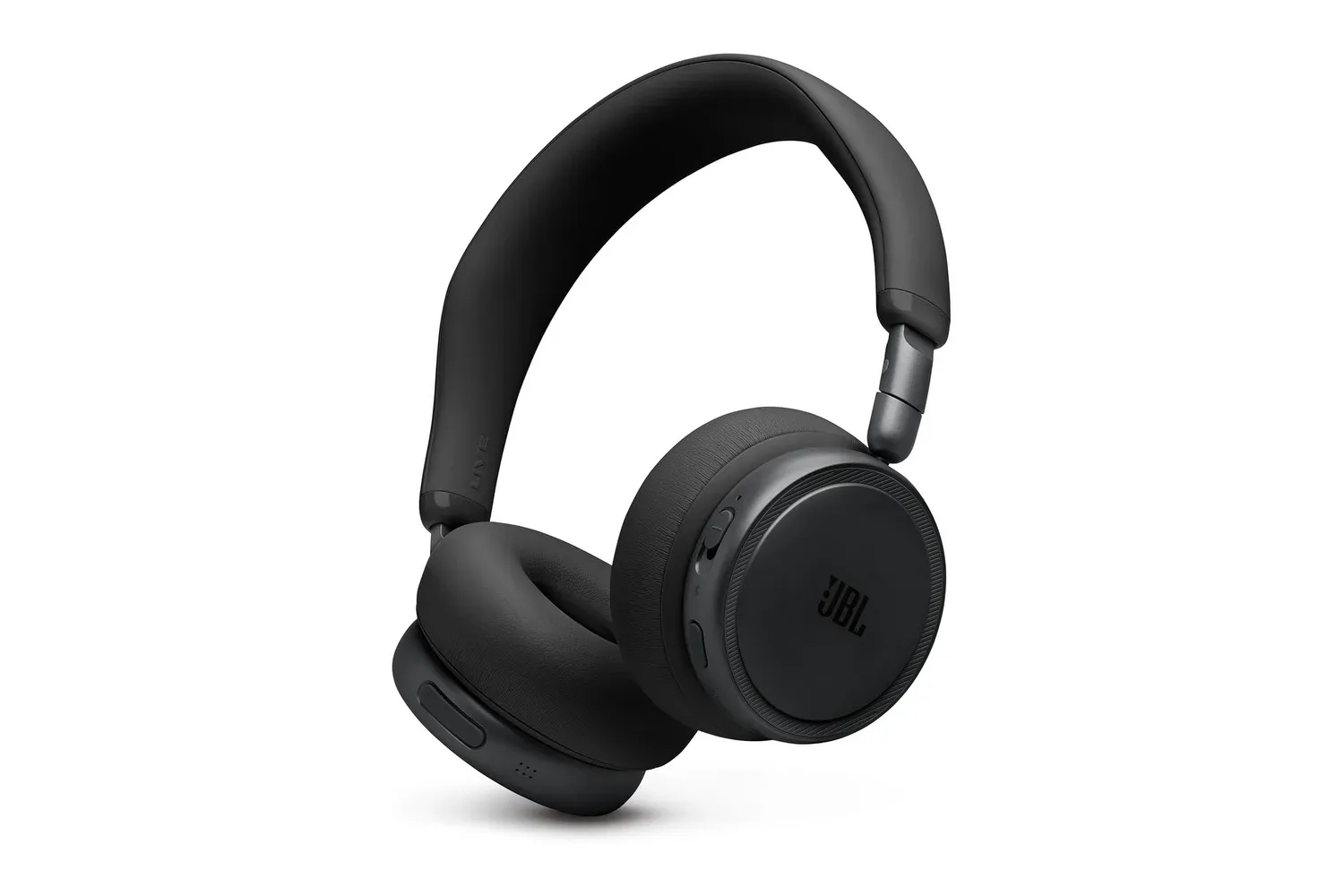
JBL’s Live 680NC noise-canceling on-ear headphones are listed at $80, a reduction from a stated regular price of $160. That is an $80 difference, or 50% off. The model combines a folding on-ear design with a feature list aimed at people who move between music, calls, travel and computer work: adaptive active noise canceling, wired and wireless listening, Bluetooth multipoint, and a claimed maximum battery life of 80 hours.
For gamers, the appeal is less about a purpose-built competitive headset and more about flexibility around the game. The Live 680NC is positioned as a portable everyday headphone that can handle a commute, a laptop session, a phone call, and movie or game audio without becoming another bulky item in a bag. Its on-ear form factor is an important distinction: the earcups sit on the ears rather than enclosing them, while the hinges allow the headphone to fold down for transport.
The listed $80 price places the emphasis on evaluating the features that will matter in a buyer’s own routine, rather than assuming every headline specification has the same practical value. Battery claims change depending on whether noise canceling is enabled, for example, and technologies such as spatial processing or personalized audio can be useful options without replacing good source audio, a comfortable fit, or reliable device switching.
What the Live 680NC is offering
At the center of the design are 40mm drivers. A driver is the speaker component inside each earcup that turns an electrical audio signal into sound. JBL says these drivers deliver its Signature Sound, including deep bass and clear vocals, and identifies the headphone as compatible with Hi-Res Audio in wired and wireless use.
Hi-Res Audio compatibility is a format and playback capability claim, not a guarantee that every stream, game, film, or recording will suddenly contain more detail. The benefit depends on the audio source and the listening chain. Still, cable listening is a useful inclusion for someone who wants a wired option at a desk, on a flight, or when conserving battery. The headphone charges through USB-C and can also be used with a cable for Hi-Res Audio-compatible listening.
JBL also lists Spatial Sound, which takes stereo material and processes it into a more three-dimensional presentation for movies and games. That is separate from the audio formats and positional mixes built into a game itself. In plain terms, it is a listening mode designed to alter the sense of space from left-and-right stereo sound; whether a listener prefers it will be personal and may vary by game, film, music track, and volume level.
Another audio option is Personi-Fi 3.0, JBL’s personalized sound-profile system. The stated goal is to tailor sound based on how an individual hears. Personalization features can be worth exploring for listeners who find a default tuning too bright, too bass-heavy, or otherwise not to their taste. They are not necessarily a one-time “best” setting, though: someone switching between dialogue-heavy video, music, and games may prefer different results from the same headphone.
Adaptive noise canceling is the headline feature
The Live 680NC uses True Adaptive Noise Canceling 2.0, which JBL says monitors the environment continuously with four microphones and adjusts its calibration in real time. Active noise canceling, usually shortened to ANC, uses microphones and processing to reduce portions of outside sound before they reach the listener. It is particularly relevant for sustained environmental noise, such as transit, air travel, or an office backdrop.
Related coverage includes JBL Live 680NC Headphones Drop to $80 With ANC and 80-Hour Battery Claim.
The practical point of the “adaptive” label is that the headphones are intended to respond as surroundings change rather than relying only on one fixed cancellation behavior. JBL specifically identifies sounds such as engines, conversations, and car horns as the kinds of background noise the system is intended to filter.
Noise canceling should not be treated as a promise of silence, and it is not a substitute for awareness where awareness matters. JBL includes two modes that deliberately bring the outside world back into the experience:
- Ambient Aware allows external sound through so the listener can better hear what is happening nearby.
- TalkThru lowers music volume to make a conversation possible without taking the headphones off.
Both options can be adjusted through the JBL Headphones app. For a person using the Live 680NC during a workday, that makes the modes more than a travel feature. Ambient sound can be preferable when anticipating a delivery, sharing a home workspace, or waiting for an announcement. TalkThru is the more direct answer to brief interruptions: instead of pausing a game or pulling off the headset for a quick exchange, the audio level is reduced to make speaking easier.
Battery figures depend on ANC use
JBL claims up to 80 hours of playback with ANC disabled and up to 50 hours with ANC enabled. Those are meaningfully different figures, and prospective buyers should use the one that reflects how they expect to listen. Someone buying the Live 680NC specifically for flights, trains, busy rooms, or calls may use noise canceling frequently and should focus on the 50-hour claim. Someone mostly listening in quieter places may get more value from the longer ANC-off figure.
The company also claims that a five-minute charge can provide up to four hours of playback. A full USB-C charge is said to take about two hours. Fast-charge claims are especially practical for a headphone intended for bag use: a short charge before leaving can matter more than having a large maximum battery number if the device was left uncharged the night before.
Battery life is always a usage-dependent measure rather than a fixed promise for every owner. Volume, enabled features, call time, connection behavior, and noise-canceling use all affect real-world endurance. The supplied figures are therefore best read as JBL’s stated maximum playback estimates under the relevant ANC setting, not as a guarantee for every listening pattern.
Device switching and call features could matter as much as sound
The Live 680NC supports Bluetooth 6.0, LE Audio, Auracast, and multipoint connectivity. Of those terms, multipoint may be the easiest to understand in day-to-day use. It allows the headphone to connect to two devices at once, letting a user move between, for instance, a computer and a phone without repairing each time.
That can be especially handy for a laptop game or video session interrupted by a phone call, or for someone who changes between schoolwork and mobile listening throughout the day. It is a convenience feature, but one that can remove a repeated annoyance from a multi-device setup.
LE Audio is Bluetooth’s lower-energy audio architecture, while Auracast is designed for broadcast-style audio sharing. Their presence makes the Live 680NC more forward-looking on the connectivity side, though usefulness will depend on the other devices and services a listener actually uses. A feature’s presence in headphones does not by itself mean every phone, PC, or public audio system will support the same capability.
For voice calls, JBL lists Perfect Calls 2.0, using two microphones and an AI-trained algorithm to help make the wearer’s voice clearer. That is relevant for students, commuters, and remote workers who need one headphone for casual listening and calls. It is not a claim that outside noise disappears from a call altogether; it is a voice-processing approach intended to improve intelligibility.
A portable alternative for players who do not want a dedicated gaming headset
The Live 680NC is not presented as a dedicated gaming headset with a boom microphone, console-specific controls, or game-only surround branding. Instead, its gaming relevance comes from the wider mix: spatial sound processing, a foldable build, long stated battery life, cable listening, and a two-device connection feature that could suit PC-and-phone users.
That distinction should help set expectations. Buyers who need platform-specific voice-chat features, a fixed desk microphone solution, or the isolation of a full over-ear model may want a different category of product. Buyers who want one foldable set for music, movies, travel, calls, and occasional gaming may find the on-ear approach more aligned with their needs.
The price cut also arrives amid a broader early-season focus on consumer tech discounts, including other early Black Friday device deals. As always with sale pricing, it is sensible to verify the current listing, included accessories, seller, return terms, and whether the discount remains active before ordering.
Who should consider the $80 listing?
The strongest case for the JBL Live 680NC is a listener who values portability and adaptable listening modes. The folding frame is geared toward backpacks and carry-on luggage, while the claimed 50 hours with ANC on means the headphone is positioned for extended use between charges. The 80-hour ANC-off claim provides an additional option for listeners who prioritize endurance over isolation.
Its most useful features are likely to be the ones that solve a recurring situation: adaptive ANC for travel or shared spaces, Ambient Aware for walking or waiting on announcements, TalkThru for quick conversations, multipoint for computer-and-phone switching, and quick charging for days when planning fails. Audio extras including Hi-Res compatibility, Spatial Sound, and Personi-Fi 3.0 broaden the package, but personal fit and preferred sound are still central to whether an on-ear headphone is the right pick.
At the stated $80 sale price, the Live 680NC’s proposition is straightforward: a foldable, everyday on-ear headphone with a substantial claimed battery range, adaptive noise control, and features designed to avoid repeatedly disconnecting, removing, or recharging it.
Shop the products
Check current price, model and availability at the retailer.