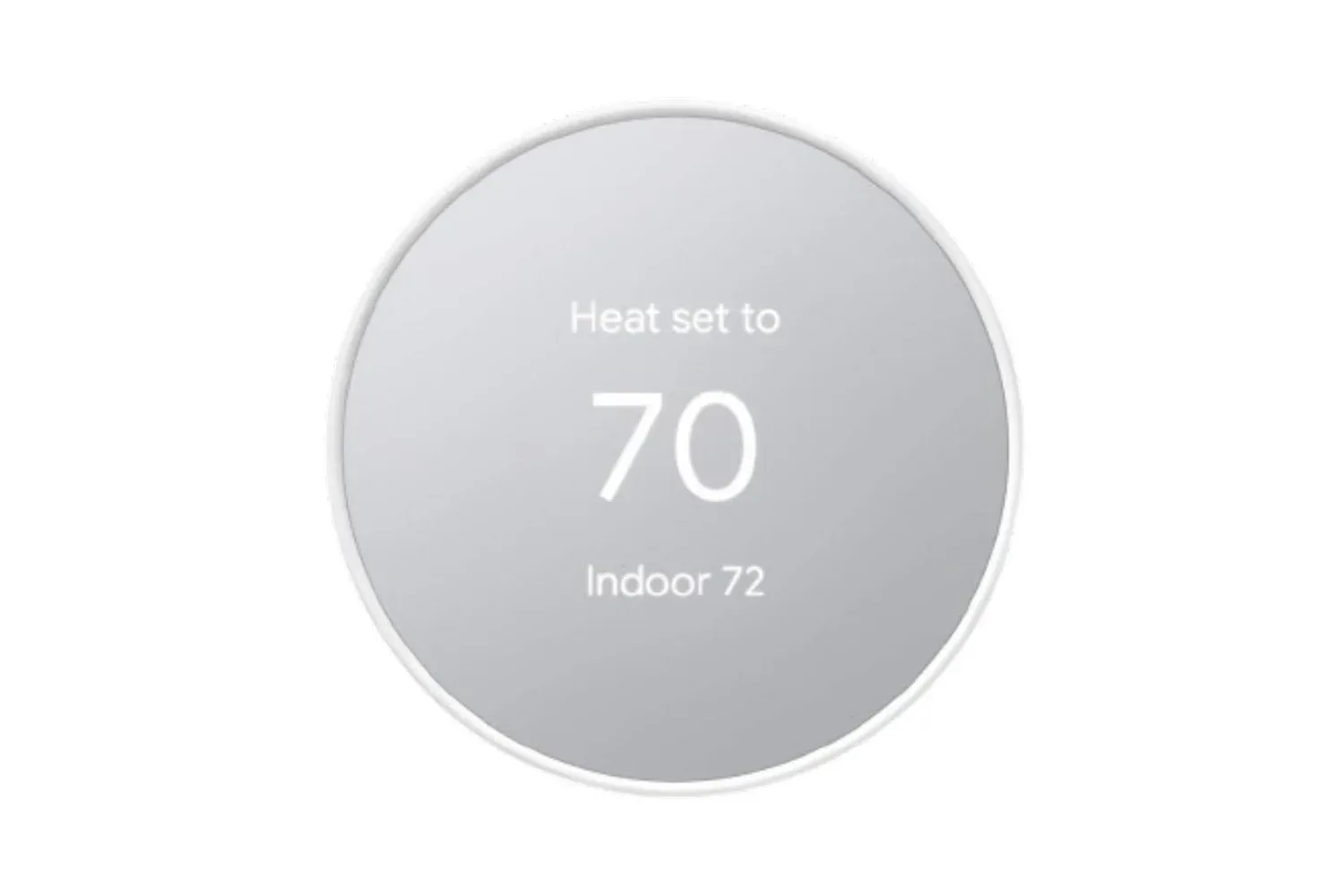
Amazon has listed the Snow version of the Google Nest Thermostat at $79, a $51 reduction that works out to 39% off. The Charcoal and Sand versions are also discounted, though each is priced higher at $90. Standard shipping is free on the listed offers.
For shoppers looking at an early seasonal sale, the headline number is straightforward: the Snow model is under $100 before any possible energy-provider incentive. That distinction matters. A retailer discount is immediately reflected in the listed purchase price, while a utility rebate depends on the buyer’s provider, location and eligibility. Anyone counting on a rebate should confirm its terms with their energy provider before treating it as part of the final cost.
The thermostat’s appeal is not simply that it can replace a conventional temperature control. Its stated feature set centers on remote management, automation and tools intended to identify schedule changes that could reduce heating or cooling when a home is empty. For a household that regularly changes its routine, those capabilities may be more useful than a lower sticker price alone. But installation compatibility remains the decisive check before ordering.
What is discounted, and what is not guaranteed
The $79 offer applies specifically to the Snow finish. That is the 39% discount and $51 saving cited for the current Amazon listing. Shoppers who prefer Charcoal or Sand can still find a price reduction, but their listed price is $90—$11 above the Snow unit.
Pricing and availability can change, particularly around promotional periods. The practical takeaway is not that every version costs $79, but that the Snow version is the one attached to that price at the time of the listing. Buyers should also avoid assuming a local rebate will automatically apply just because a smart thermostat is on sale.
A rebate is an incentive offered by an energy provider that can reduce the effective ownership cost after meeting that provider’s requirements. The supplied deal information encourages customers to check whether an incentive is available; it does not establish which providers participate, how much they offer or whether a particular household qualifies.
Automation features in plain terms
Once installed, the Google Nest Thermostat can be managed from away from home through its app. That remote access is useful for ordinary adjustments—changing the target temperature before returning home, for example—without needing to be at the thermostat itself.
The app also includes Quick Schedule, a feature for creating routines around heating and cooling. In practical terms, a schedule sets different temperature behavior for different times. Instead of repeatedly changing the controls manually, an owner can set a routine intended to match when the household is typically active or away.
The thermostat can also turn itself down when the home is empty, an approach intended to avoid maintaining the same heating or cooling settings in an unoccupied space. This is an automation feature, not a guarantee of a particular utility-bill reduction. The eventual impact will depend on a household’s schedule, its equipment and how the system is configured.
Another feature, Savings Finder, suggests potential changes to the schedule that may save energy. It is best understood as a recommendation tool: it looks for ways to adjust scheduled behavior, then presents those suggestions to the owner. Notifications in the app can also alert the user when something appears to be wrong, giving owners a prompt to investigate rather than relying entirely on silent background automation.
Voice control is available through Google Assistant or Alexa for times when using the app is less convenient. That provides another input method, rather than changing the thermostat’s core job of controlling a compatible heating and cooling system.
The compatibility check that should come before checkout
Smart-home controls can sound like a simple swap, but the existing wiring and HVAC setup determine whether that swap is viable. The Google Nest Thermostat is described as working without a C wire in most homes. A C wire, short for common wire, is wiring used to provide power in many thermostat installations. The important qualifier is “most homes,” not every home.
There are specific setups the thermostat will not support: systems using stranded wires, wires joined with wire nuts, or wiring labeled 110V or 120V. Those exclusions should be treated as hard stop signs rather than minor setup inconveniences.
- Stranded wires: The thermostat is not compatible with these wires.
- Wire-nut connections: Systems in which wires are connected with wire nuts are excluded.
- 110V or 120V labels: The thermostat will not work with systems carrying those labels.
Checking the current thermostat and its wiring before purchase is therefore more valuable than focusing only on the advertised percentage off. If any of those conditions are present, this model is not the right fit. If the setup appears compatible, buyers can then weigh whether its scheduling, away-from-home adjustment and voice-control options meet their needs.
How to evaluate the $79 listing
The best reason to choose this deal is not merely that smart thermostats are generally associated with energy-conscious scheduling. It is that the Snow model combines a $79 listed price with remote controls, Quick Schedule, automatic adjustment while away, Savings Finder suggestions and support for Google Assistant and Alexa—provided the home’s system is compatible.
Conversely, buyers should not mistake the promotional price for a universal bargain. Someone who needs Charcoal or Sand will see a $90 price rather than $79. Someone with unsupported wiring should not buy on the assumption that installation can be improvised. And someone estimating savings should separate the known Amazon price from any potential rebate that has not been verified with their provider.
The wider seasonal-deal context is also worth keeping in perspective. Amazon’s hardware promotions are not limited to thermostats; for example, an Apple TV 4K pre-order listing at Amazon shows the retailer’s other technology offers can have their own product-specific conditions. The useful comparison is not between unrelated gadgets, but between the exact finish, listed price and installation requirements attached to each purchase.
For the Nest Thermostat, the order of operations is clear: inspect the home’s existing system, confirm that it does not fall into the stated unsupported categories, check for any applicable energy-provider rebate, and then verify the live price for the desired color. Buyers who can use the Snow model and have compatible equipment are looking at the lowest listed option of the three finishes mentioned here.
Shop the products
Check current price, model and availability at the retailer.