Story spoilers for Grand Theft Auto V and GTA IV: The Lost and Damned follow.
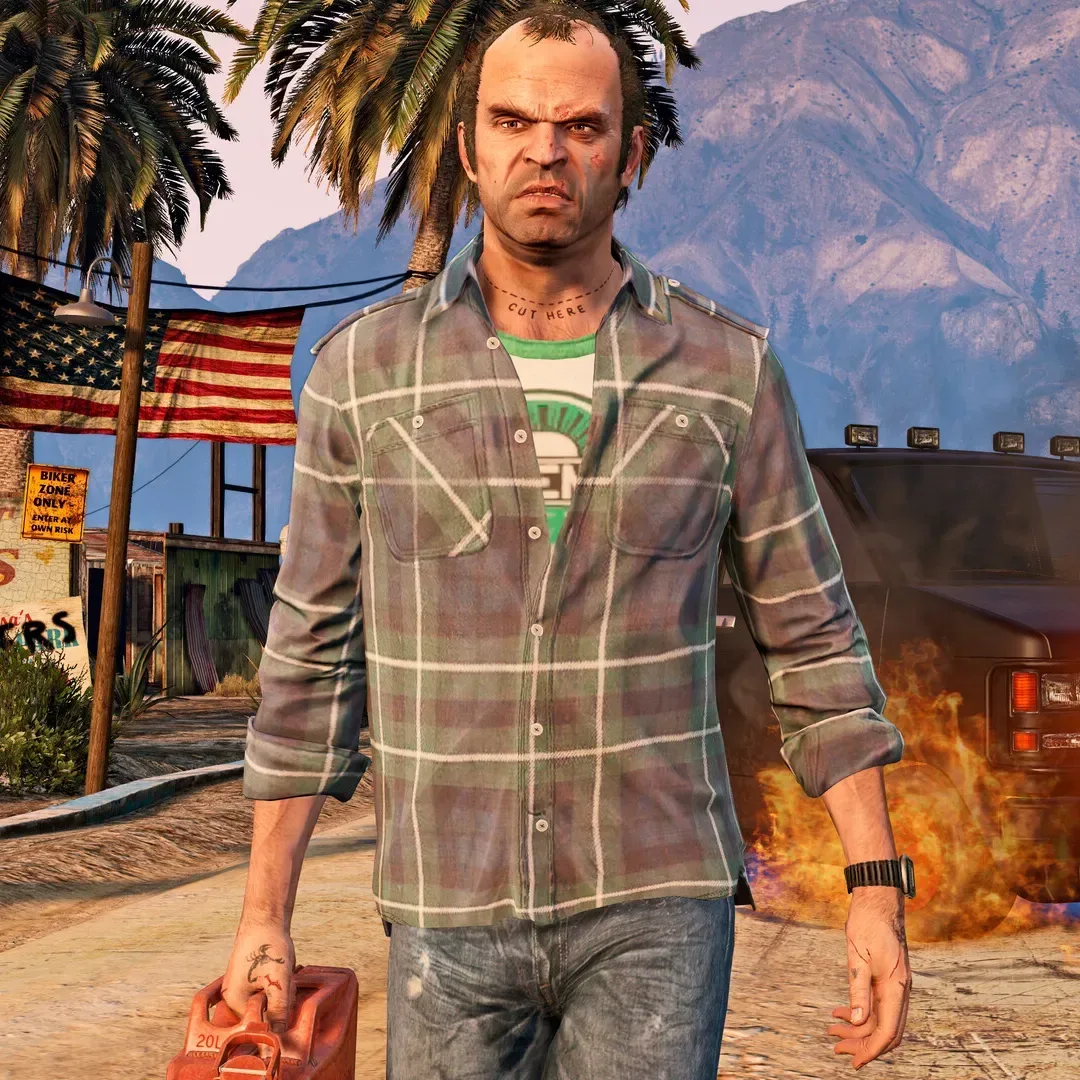
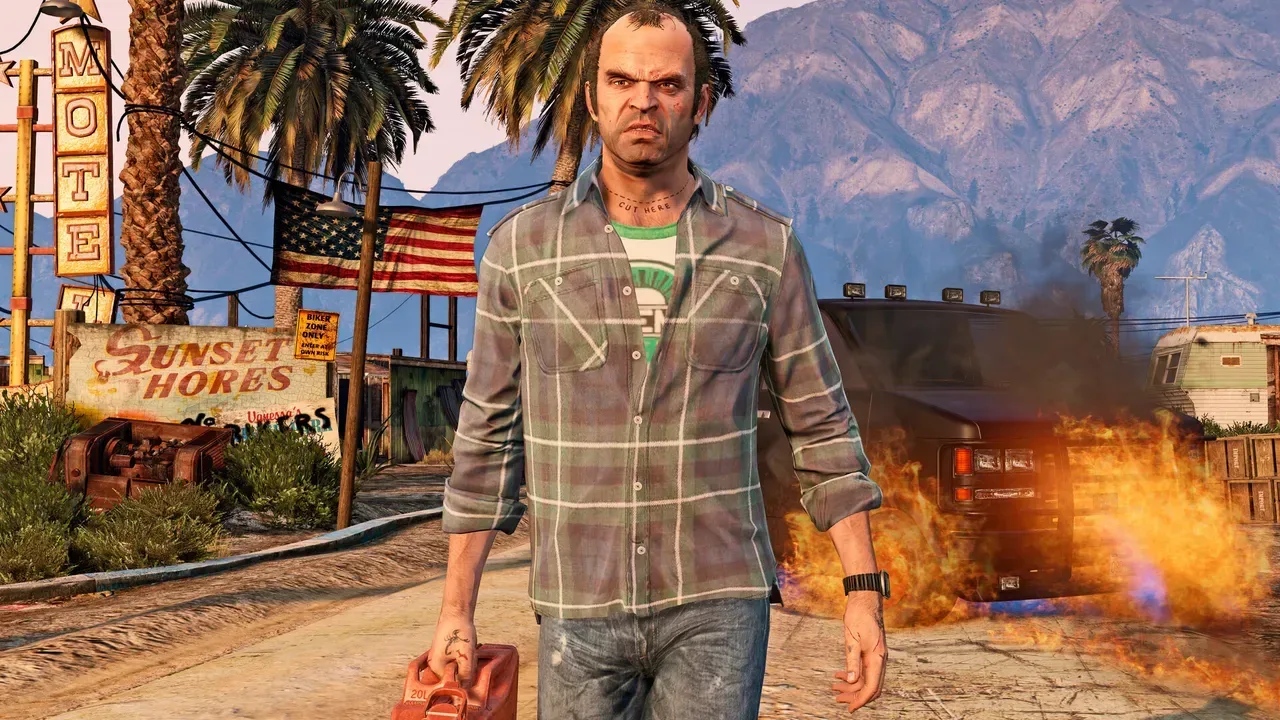
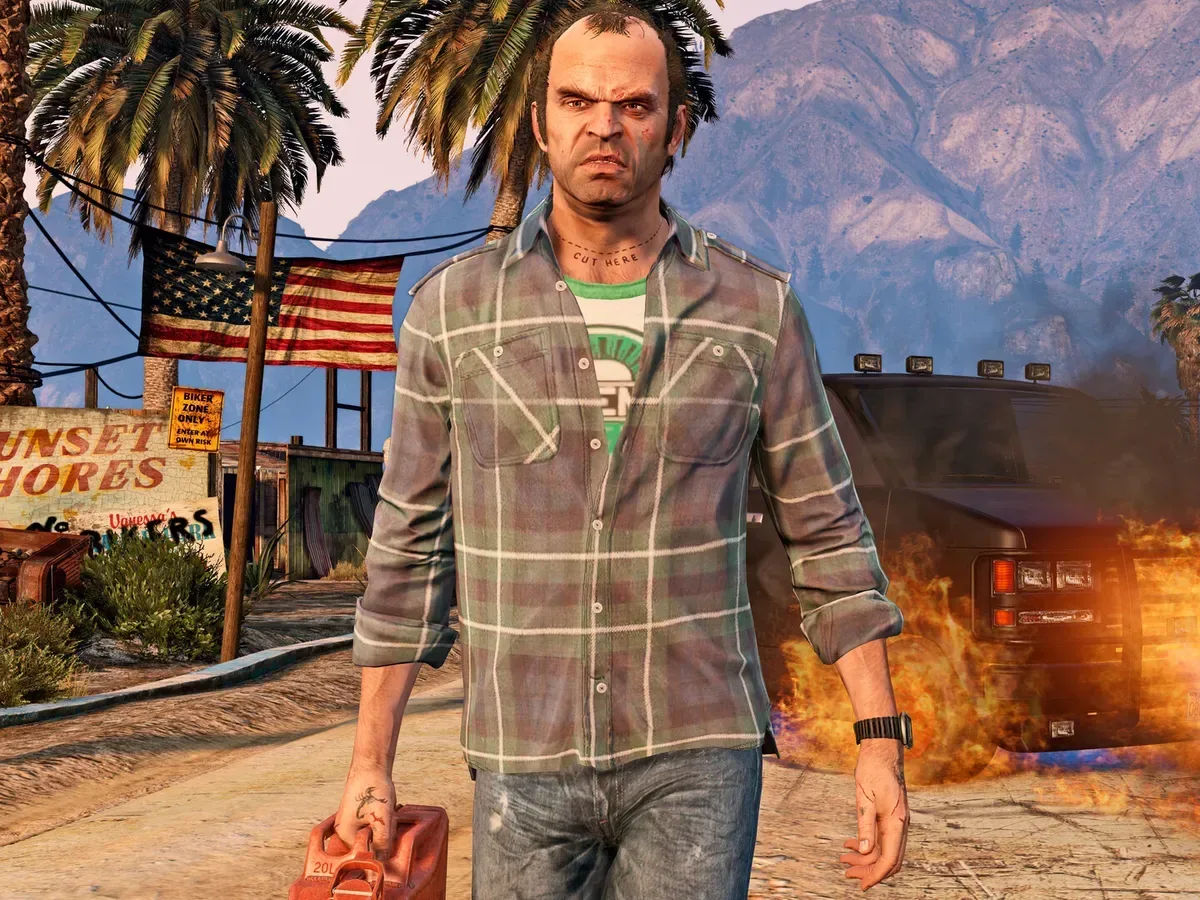
Grand Theft Auto V is full of big, immediately legible spectacle: explosive chases, shifting protagonists, sharp character introductions and a Los Santos built for detours. Yet one former Rockstar designer’s recollection points to a much quieter kind of craft. After Trevor Philips kills Johnny Klebitz during Trevor’s introduction, Trevor’s jeans can carry blood spatter rising from the cuff of his boot. More unusually, that stain was designed to diminish gradually as a player continued through the game.
Matt Freedman, who spent almost nine years at Rockstar after beginning as a level designer on Max Payne 3, says he added both the clothing decal and the system governing its cleanup. A decal, in this context, is a visual layer applied to a character model to represent a localized mark such as dirt, damage, or blood. It is a small asset on its own. The complicated portion was making it behave as a continuing consequence rather than a one-scene effect.
The result is precisely the sort of detail many players can plausibly miss. GTA 5 lets players change its protagonists’ clothing in shops, and Trevor may be put into a new outfit soon after the scene. Even players who retain his default clothes may not focus on the bottom of a jeans leg while driving, fighting, or moving through missions. Freedman himself suggested that virtually nobody noticed it. The point, however, was not necessarily to create a detail that demanded attention. It was to make the game’s world remember what the player had just seen and done.
A brutal scene with a persistent visual consequence
Trevor’s first major appearance establishes his volatility with extraordinary force. Johnny Klebitz is not simply an incidental victim: he was a protagonist in GTA IV expansion The Lost and Damned. Trevor’s attack leaves Johnny dead and physically disfigured, then the story moves forward at GTA 5 speed. Rather than treating the event as something that exists only inside a cutscene, Freedman wanted a trace of it to remain on Trevor once gameplay resumed.
That distinction matters. A cinematic can show a character emerging bloodied, but a standard visual state can disappear as soon as the game hands control back to the player. Keeping blood on the jeans ties the authored scene to the playable world. It says, in a subtle visual language, that Trevor has carried the aftermath with him.
The stain was not intended to last forever. Freedman describes an algorithm that slowly cleaned it over the course of play. An algorithm is simply a defined set of rules a game follows—in this case, rules that determine how the blood appearance fades. The exact triggers, duration, and technical implementation have not been detailed, so it would be a mistake to treat the effect as a real-time simulation of fabric cleaning. What is established is the design goal: the visual mark should recede gradually rather than vanish the instant the mission ends.
Why respawning made the tiny effect harder
The most revealing part of the anecdote is not that Rockstar put blood on a trouser cuff. It is that the effect had to survive a system that ordinarily resets a character’s condition.
Related coverage includes Former Rockstar Designer Reveals GTA 5's Nearly Invisible Trevor Detail.
When a player dies and respawns, games commonly create or load a fresh version of the player character model. This is practical: injuries, bruises, cuts, temporary damage states, and other short-lived effects are frequently removed as part of returning a character to a clean playable state. GTA 5 behaves this way with visible wounds. For Trevor’s jeans, though, that default cleanup would have broken the continuity Freedman wanted.
So the blood effect needed to retain its particular stage of fading when Trevor respawned. If the stain had become half-cleaned before death, it should not suddenly return at full strength or disappear entirely after the respawn. That means the game had to preserve some state: information representing where the gradual cleanup had reached, then apply the corresponding look to the replacement character model.
This is a useful example of the difference between a decorative asset and a persistent game state. A decorative asset can be placed once and forgotten. Persistent state must remain consistent as a game transitions between missions, deaths, character instances, and other changes. The stain is visually modest, but its intended behavior touched the broader question of what the game remembers about a player’s journey.
Freedman’s account also offers a straightforward reminder that polish is often invisible because it works. Players may not stop to identify a cuff mark or compare it before and after a respawn. They may simply feel that the scene flowed naturally into the open world. The continuity does not require recognition to do its job.
Respecting interactions, not just outcomes
Freedman framed the work around player consideration. He has said that the player is, in a meaningful sense, the ultimate person a developer is accountable to: someone may arrive at a game after a difficult day and deserves an experience made with care. That philosophy guided more than the GTA 5 stain. He also said he spent additional time on Max Payne 3 ensuring that interactions a player had performed continued to be respected later in a level.
“Respect” can sound vague in game-design discussions, but here it has a concrete meaning. If the game presents an interaction as meaningful, its systems should avoid contradicting or forgetting it without good reason. The player’s action does not always need to alter the plot. It can be acknowledged through a changed object, a maintained effect, a persistent environmental state, or simply a response that remains coherent after a checkpoint or reload.
Trevor’s bloody jeans are a narrow example, but a clear one. The player cannot prevent the story event that creates the stain. Nevertheless, the game does not immediately erase the scene’s physical evidence. The mark follows the character into normal play and fades through an intentional rule set. It is a small acknowledgment that the cutscene and the game world are part of the same experience.
Freedman also singled out Nintendo’s work on interactive, responsive worlds as an example of design that values player choices and time. The comparison is about responsiveness, not an assertion that every game needs the same degree of simulation. A responsive world can be built from many modest, carefully chosen rules. The relevant question is whether the game follows through on expectations it creates.
Not every detail needs to become a feature list
There is a temptation, particularly around enormous open-world games, to turn every obscure detail into a checklist item. The bloodstain story pushes in another direction. Its value is not that players should now inspect Trevor’s trousers as a formal challenge, nor that it is a hidden reward. It is an illustration of a developer choosing to spend time on continuity despite knowing most people might never identify the work.
That choice does not establish that every granular detail is automatically good design. Extra systems can create bugs, consume development time, or compete with more visible priorities. But this case explains why certain details resonate long after a game’s release: they express a consistent creative instinct. The issue is not whether an individual cuff decal is technically impressive in isolation. It is whether it supports the fiction, preserves an event’s weight, and avoids making the world feel like it resets whenever the camera turns away.
Rockstar games are often discussed through their striking simulations and eccentric environmental details. In Red Dead Redemption 2, for instance, horse anatomy changes in colder mountain conditions, a frequently cited—and frequently joked-about—example of environmental reactivity. The Trevor detail is less flamboyant, but arguably more connected to narrative continuity. One concerns a world’s environmental conditions; the other concerns the lingering visual consequence of an act central to a character introduction.
What it suggests as attention turns to GTA 6
The story arrives while anticipation remains high for GTA 6, which is expected to have an enormous launch. Attention around that release is already large enough that other game makers have adjusted communications to avoid the noise, as seen when Pocketpair held back Palworld 1.1 and Palfarm news during GTA 6 launch week.
Still, a former developer’s account of GTA 5 should not be read as a promise of a specific GTA 6 system. There is no basis here to claim that Trevor’s fading-jeans logic returns, that a comparable mechanic will be present, or that every character action will leave permanent evidence in the next game. Development teams, technologies, priorities, and individual design decisions change.
What the anecdote does establish is a useful lens for reading the fascination around Rockstar’s work. Players return to these games not only for the mission structure or the headline-scale sandbox, but also for the possibility that apparently minor actions have been considered. Discovery comes from finding a rule, response, or retained consequence that was not explicitly advertised. Sometimes it is a feature visible at a glance. Sometimes it is a bloodstain, quietly fading from a cuff, that survives a respawn because someone thought the world should remember.