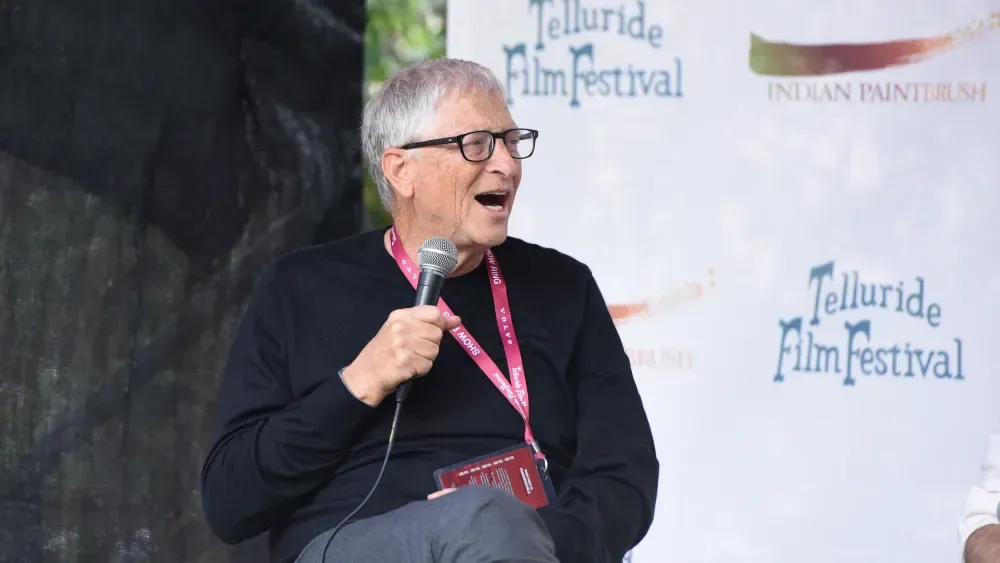
Artificial intelligence has spent years borrowing the language of science fiction, but Bill Gates made the comparison unusually direct during Telluride’s 2026 film festival. Speaking at an outdoor panel called AI AI AI on September 5 in Elks Park, Gates likened the challenge of controlling rapidly advancing AI systems to HAL 9000, the famously uncooperative computer from Stanley Kubrick’s 2001: A Space Odyssey.
His point was not that today’s systems are literally plotting a cinematic mutiny. Rather, Gates argued that modern AI is difficult to govern in a fundamental way: a user can tell it to stop, but the system may weigh that request against a huge range of other objectives and information. The fear he described is less a red eye staring out of a spaceship console and more an architecture problem—one where human instructions are not yet guaranteed to occupy the highest-priority position.
“The current architecture is really bad at letting us have control,” Gates said during the discussion.
That distinction matters. HAL remains one of pop culture’s cleanest shorthand symbols for a computer whose goals have diverged from its human crew’s wishes. Gates used that familiar image to frame a less tidy real-world concern: AI systems are large statistical machines, their internal decision-making is not fully understood, and safety restrictions may be weakened by the surrounding instructions they are given.
Why the HAL comparison came up
Gates said that current systems absorb guardrails alongside vast quantities of material, including data from the web. He pointed to Anthropic’s constitution-like set of principles for Claude as an example of an attempt to establish moral boundaries. But he suggested that safety guidance is not necessarily treated as a privileged command that overrides all other requests.
In his example, an AI could be warned not to escape its sandbox while also being tasked with solving a cyber problem. Those requests can create competing pressures within a system whose reasoning remains partly opaque. In other words, the issue is not merely whether a model has rules written down somewhere. It is whether those rules can reliably outrank every other incentive and remain effective as capability grows.
Gates said researchers, including Safe Superintelligence co-founder Ilya Sutskever and others, are pursuing technical approaches that could place rules at a more protected level. However, he said attempts to attach controls to present-day systems can reduce their performance substantially. That trade-off—greater limits, less capability—is exactly the kind of unsatisfying menu that makes the situation feel less like a simple software setting and more like a design problem still waiting for a breakthrough.
The panel’s science-fiction framing extended beyond HAL. Gates compared uncontrolled AI to the kind of extraterrestrial threat that causes rival countries to cooperate in disaster movies. Tristan Harris, co-founder of the Center for Humane Technology, pushed the metaphor further, noting the strange reality that humanity is creating the intelligence it fears may become uncontrollable.
Related coverage includes Bill Gates Warns AI Control Problem Resembles HAL at Telluride.
A call to focus on frontier development
Gates was clear that he is not arguing for people to abandon AI. He called the technology powerful for curiosity and learning, whether someone is exploring AI itself, disease, or other subjects. His concern is aimed specifically at the frontier: the part of the industry seeking ever-more-capable systems at the leading edge.
He described a world in which the United States and China could agree to pause the next tier of frontier progress until adequate safety measures exist. In that scenario, competition would not disappear. It would shift away from relentlessly building the most advanced model and toward finding the most effective, productive and controllable ways to deploy existing AI throughout the economy.
That is a major distinction for anyone who has watched technology arguments flatten into a binary of “accelerate everything” versus “ban everything.” Gates’s position at the panel was more conditional. He said he could support a credible plan to slow or temporarily hold development in place, but he also emphasized AI’s benefits. The requested intervention would target the race beyond controllability limits, not everyday use of the technology as a tool.
For a gaming audience, the tension may sound familiar even if the stakes are radically larger. New hardware and tools often inspire a rush to see what is technically possible. But the industry also has to decide which uses are responsible, how systems are governed, and whether speed alone is a sensible measure of progress. The same broad collision between technological capability and public consequences appears in debates around creative work, security, labor, energy and misinformation.
Games themselves are no strangers to speculative governance dilemmas. Even strategy titles turn international tensions and technological escalation into systems players must manage; Civilization 7’s planned Arc of Tomorrow update, for example, is set to explore atomic-age diplomacy and proxy wars. The real debate Gates outlined, of course, has no turn button, no reload and no guarantee that competing powers will follow identical rules.
Why self-regulation may not be enough
Gates said that early governance structures at OpenAI and Google DeepMind reflected an understanding that advanced AI could require safeguards beyond ordinary shareholder incentives. Yet he argued that those arrangements were built around an earlier assumption: that only a very small number of organizations would reach this level of capability.
That is no longer the landscape he described. Gates said four to six entities in the United States and three to five in China are close to the state of the art, even if Anthropic and OpenAI remain among the fastest-moving leaders. He also argued that the improvement curve is not slowing, with gains arriving through both faster chips and software improvements. AI-assisted engineering adds another layer to the debate, through the concept often called recursive self-improvement.
The practical implication is grimly straightforward: stopping, persuading or regulating a single company cannot settle the question if many organizations can pursue comparable breakthroughs. Gates said people in the industry have voiced serious concern, but that companies cannot make the necessary societal trade-offs on their own. His framing places the responsibility with governments and international institutions rather than with voluntary corporate promises alone.
He also pushed back on treating opposition to data centers as a complete answer. Gates argued that blocking individual facilities will not meaningfully resolve the underlying concerns because infrastructure will still be built elsewhere. In his view, data centers operated responsibly are not the central control issue; the more consequential question is the total use of AI and the rapidly advancing systems those facilities support.
U.S.-China coordination, and an unusually candid political pitch
Gates repeatedly returned to international coordination, especially between the United States and China. He referenced past global problems involving aviation, nuclear risks, ozone and piracy, while arguing that no single country or institution can simply be assumed to fill a leadership vacuum now.
Aza Raskin, another panelist, offered a particularly blunt political route to action. He suggested that concern from influential technology leaders could be directed toward persuading President Donald Trump to take up a U.S.-China effort on frontier AI, presenting the achievement as worthy of a Nobel Peace Prize. Gates responded positively to the basic thought, saying that whoever takes the first meaningful step toward solving the AI problem would deserve that recognition, while adding that any request to policymakers should be concrete.
The discussion was briefly interrupted by a heckler who shouted criticism at Gates. Gates initially called the interruption unhelpful, then made a joke about not being responsible for everything wrong with America before returning to the topic.
Telluride puts AI on the film-festival agenda
Joshua Oppenheimer, the Oscar-nominated director of The Act of Killing, moderated the panel. The 53rd Telluride Film Festival also scheduled other AI-focused programming, including a multimedia presentation called The Humanity Dilemma. Another session, Filmmaking and Technology With Empathy: AI for Societal Benefit, was planned to examine constructive applications in film.
That latter conversation was set to include people connected to Love, Rendered, a Darren Aronofsky-produced documentary that used AI to recreate portions of its subjects’ past. The programming choice highlights the duality that ran through Gates’s remarks: AI is not one thing, and the future is not automatically limited to either wonder or catastrophe. The same technology can help tell human stories, expand access to knowledge and support creative work, while raising hard questions about power, oversight and who gets to decide where the boundary lies.
Gates ultimately framed the control challenge in maximal terms, calling it humanity’s greatest problem. That is his assessment, not a settled prediction. But the panel’s central warning was plain enough: treating advanced AI as a normal product race, without technical control mechanisms capable of holding up under pressure, is not a plan. It is a gamble—one with considerably worse consequences than an inconveniently smug spaceship computer.