Apple’s new iPhone Handoff feature in iOS 27 is beginning with a carrier-by-carrier rollout, and AT&T is not yet joining the first wave. The carrier says it sees potential in the capability, but its public position remains centered on the eSIM activation and transfer options it already provides across compatible devices.
That is a meaningful distinction for iPhone owners considering the feature. iOS 27 can include iPhone Handoff, but using it depends on the mobile carrier supporting it. T-Mobile and Deutsche Telekom are the first carriers offering the service. Apple has also said that Verizon and EE will add support later in 2026. AT&T, by contrast, has not provided a launch date or a commitment that support is on the way.
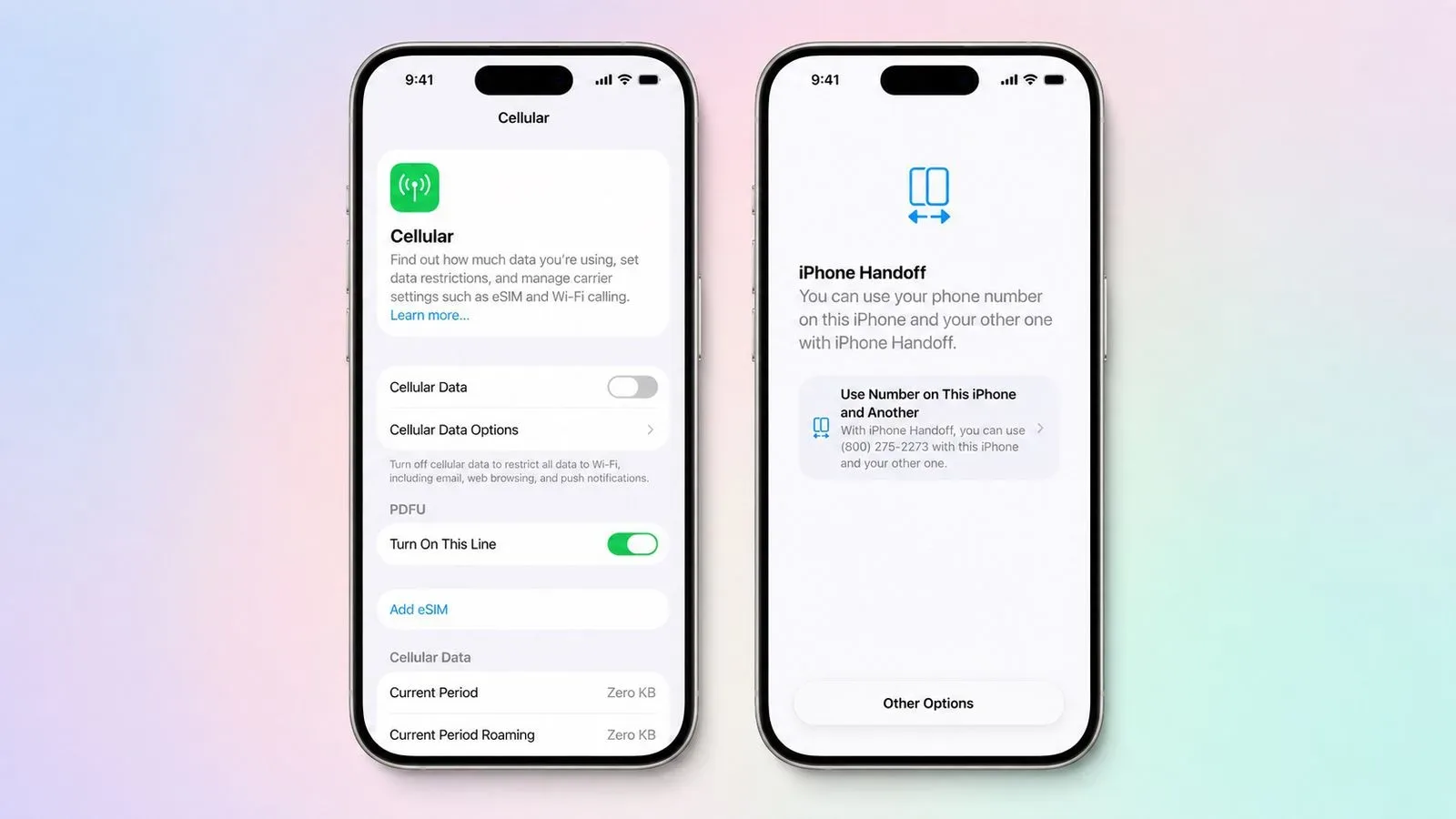
iOS 27 was released on September 14. iPhone Handoff lets a customer switch between two iPhones while using the same phone number on both devices. It is a different proposition from a conventional device move: rather than treating a new handset as a replacement that takes over a line, the feature is designed around moving between two iPhones tied to one number.
What AT&T actually said
AT&T’s response is cautious rather than categorical. The company acknowledged that capabilities such as iPhone Handoff could have potential, while stressing its focus on innovations that simplify life and keep customers connected with confidence. It specifically pointed to its existing eSIM activation and transfer options.
“While we see that there could be potential in capabilities like iPhone Handoff,” an AT&T spokesperson said, “our focus remains on delivering innovations that make life simpler and keep customers connected with confidence.”
The important practical reading is that AT&T has not announced imminent support. At the same time, it did not say that iPhone Handoff will never be available on the network. For now, an AT&T customer should view the feature as unsupported, not as confirmed for a future date.
That restrained answer also underlines a familiar reality of phone features that touch a mobile number: the operating system can supply the interface, but carrier participation determines whether a particular service works. A capability may appear in iOS settings and still require the customer’s network to enable it.
iPhone Handoff versus eSIM transfer
The reference to eSIM matters because it describes the path AT&T says it already supports. An eSIM is an embedded SIM: the digital equivalent of the subscriber module traditionally supplied on a removable card. Activating or transferring an eSIM moves mobile service onto a compatible device.
An eSIM transfer is useful when someone is changing phones and wants the new device to become the active phone on their line. iPhone Handoff, based on Apple’s description, addresses a more specific two-device scenario: switching between two iPhones while retaining the same phone number on each.
Those ideas overlap because both concern service activation, but they are not interchangeable. The former is an existing route for setting up or moving a line. The latter is a carrier-supported iOS 27 feature for using one number across two iPhones and switching between them. AT&T highlighting the first does not mean it has enabled the second.
For customers, that means the wording should not be mistaken for a workaround announcement. AT&T has not described its existing eSIM options as an alternative that replicates iPhone Handoff. It has simply pointed to the tools it currently prioritizes.
The carriers that have moved first
T-Mobile is offering iPhone Handoff in the United States for $5 per month. The carrier says the feature is available through iPhone settings on any iPhone running iOS 27, and that it is ready from day one on the iPhone 18 Pro lineup and iPhone Duo.
Deutsche Telekom is also offering the feature. Its stated price is €6.95 per month, although that charge applies only to plans that do not already include multi-SIM functionality.
Multi-SIM generally refers to a plan arrangement that can associate a customer’s mobile service with more than one SIM or device. Deutsche Telekom’s pricing caveat is therefore significant: the monthly cost is not described as a universal fee for every customer. Whether an additional charge applies depends on the customer’s plan and whether multi-SIM functionality is already included.
In the United States, T-Mobile’s $5 monthly price establishes a clear example of how a carrier may treat iPhone Handoff: as an optional recurring service rather than a standard iOS feature included automatically with all plans. Nothing in AT&T’s statement establishes a potential price, eligible plan list, device list, or eventual availability date for its customers.
Why the feature may appeal to two-iPhone owners
The clearest audience is someone who deliberately uses two iPhones and wants a single phone number to follow whichever handset they are using. The source material does not lay out every usage rule or technical behavior, so prospective users should avoid assuming details beyond Apple’s core description. What is confirmed is the ability to switch between two iPhones while using the same number on each device.
That could make the service appealing to people who keep separate phones for different parts of their day, or who prefer a second iPhone without treating it purely as a replacement device. But interest does not automatically create compatibility. Customers need both an iPhone capable of running iOS 27 and a carrier that offers iPhone Handoff.
There is also a cost question. The price is not solely an Apple decision. T-Mobile’s monthly charge and Deutsche Telekom’s plan-dependent charge show that the commercial terms can differ by provider. Anyone who regards two-phone flexibility as essential should check their carrier’s exact eligibility and billing terms before assuming that iOS 27 alone unlocks it.
What AT&T customers can do now
AT&T has directed attention to existing eSIM activation and transfer choices, so those remain the supported options referenced by the carrier. For a conventional move from one compatible device to another, that is the relevant route AT&T has identified.
For iPhone Handoff specifically, the sensible position is to wait for a direct AT&T update. The carrier has not published a timetable, monthly price, plan qualification, or setup process. Until it does, users should not assume that a setting in iOS 27 guarantees service on an AT&T line.
- Want to replace one iPhone with another? AT&T points to its existing eSIM activation and transfer options.
- Want to use iPhone Handoff between two iPhones? AT&T has not committed to supporting that service yet.
- Considering a carrier with support today? T-Mobile offers it in the US for $5 per month; Deutsche Telekom offers it under its stated plan conditions.
- Waiting for another major carrier? Apple has said Verizon and EE will add support later in 2026.
What is confirmed—and what remains unknown
The confirmed picture is relatively simple. iOS 27 introduced iPhone Handoff; the feature concerns switching between two iPhones using the same phone number; T-Mobile and Deutsche Telekom are the initial carrier providers; Verizon and EE are expected later in 2026; and AT&T has expressed interest without promising a rollout.
The unknowns are equally important. There is no AT&T launch date, price, list of supported plans, or statement that it will ultimately participate. There is no basis yet to treat the carrier’s mention of “potential” as an announcement.
For the moment, iPhone Handoff illustrates how a new Apple feature can be available in software while the real-world experience remains fragmented by network support and plan terms. Owners of eligible iPhones can update to iOS 27, but whether they can use this particular service comes down to their provider. That broader Apple ecosystem is still evolving elsewhere too, as seen in Apple Podcasts Subscriptions’ planned video perks.
AT&T’s answer leaves the door open, but it is not a green light. Customers who need same-number switching between two iPhones now will need to evaluate currently supported carrier options. Everyone else has a straightforward status update: AT&T is watching the feature, while continuing to emphasize the eSIM tools it already has.