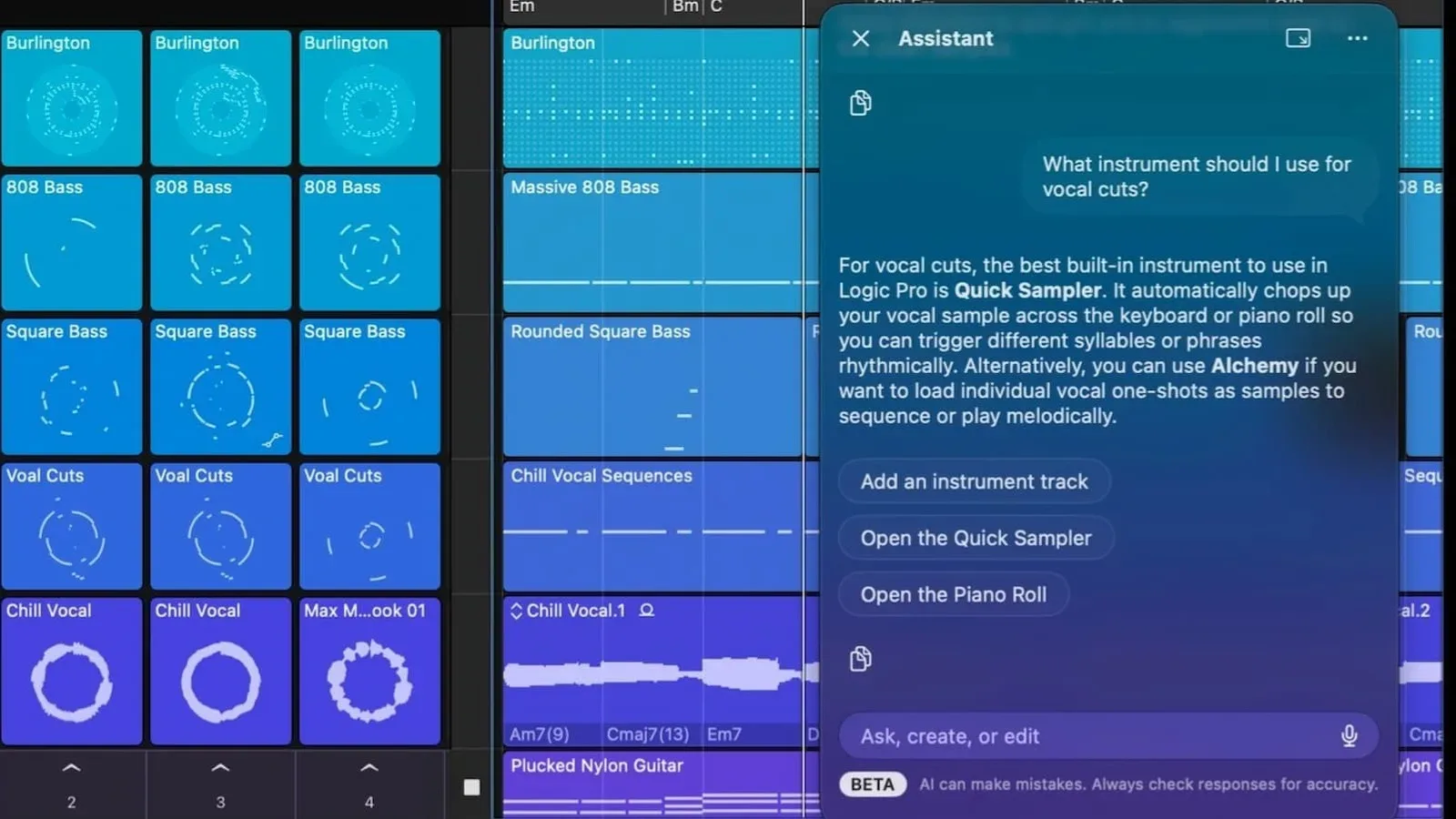
Apple has begun offering $50 “intelligence usage packs” for Logic Pro users who hit their regular monthly allowance for the music-production app’s AI features. The packs are available to people with an active Apple Creator Studio subscription in the US, UK, Canada, Brazil, France, Germany, India and Mexico.
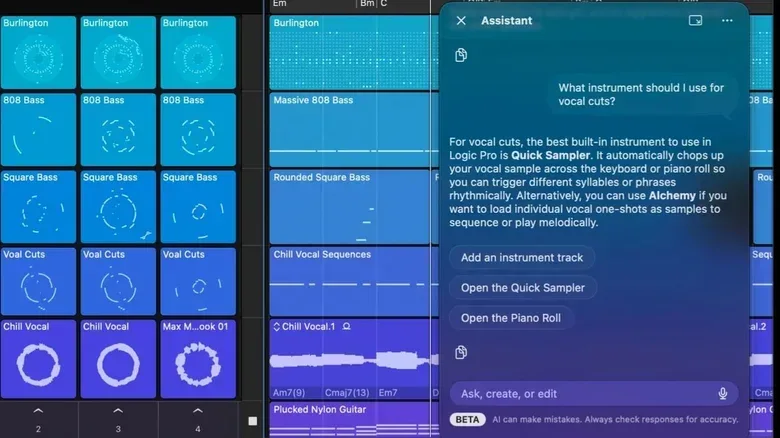
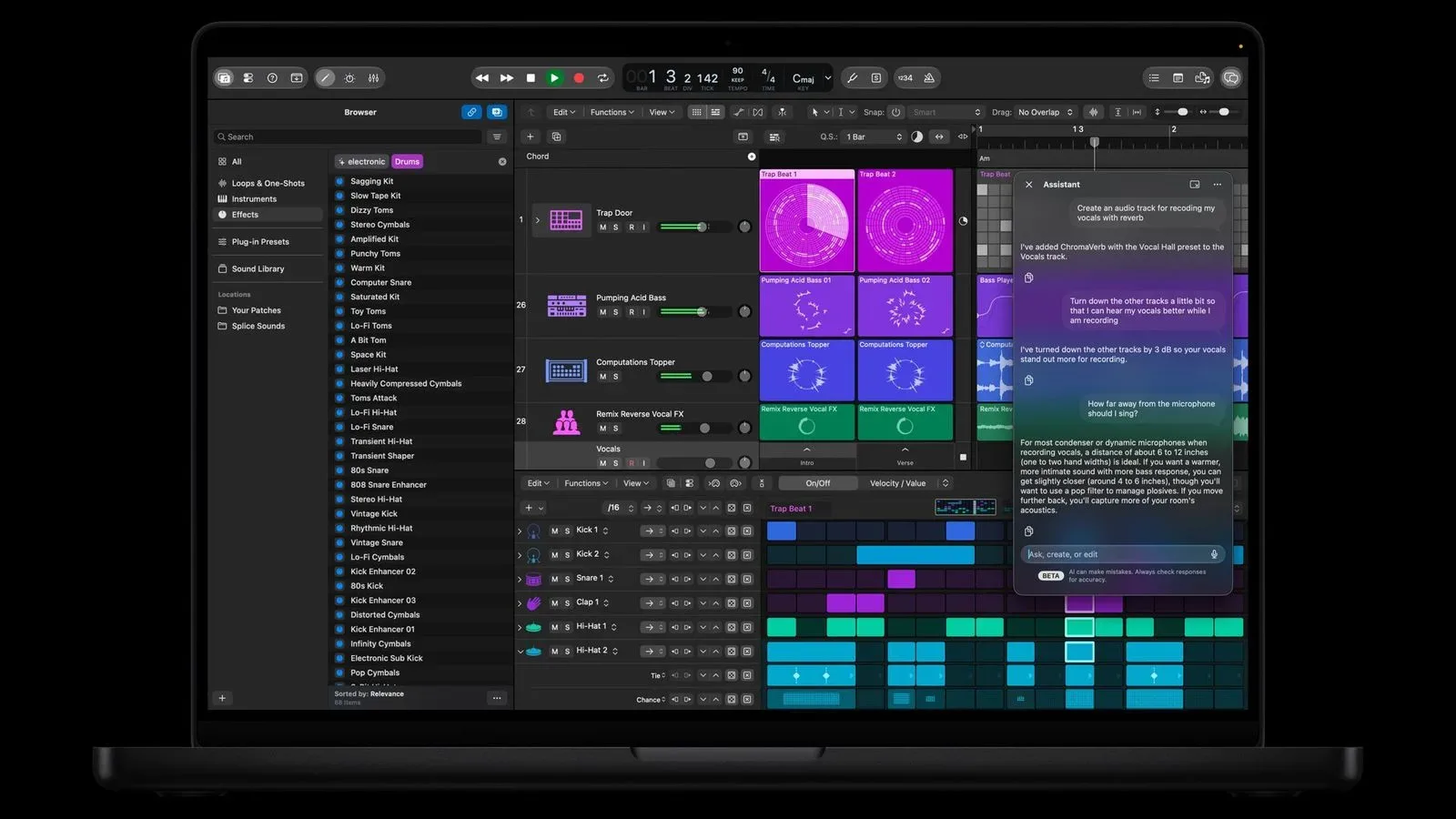
The change matters because it puts a visible price tag and a clear limit-management system around an AI assistant that Apple added to Logic Pro last month. The assistant uses Apple’s own models as well as third-party models, and is intended to help creators move through production work: beginning a song, preparing a vocal track from a single prompt, navigating workflows, or refining an existing project.
In short: the assistant is not presented as an unlimited button that comes with the app forever. Users receive a standard monthly allocation, and a $50 pack provides additional capacity once that allowance is spent. It is a notably different proposition from buying the app itself, subscribing to Creator Studio, or purchasing an ordinary feature expansion. This is an add-on for continued access to a metered AI function.
Where Logic Pro users can see their remaining AI usage
Logic Pro includes a built-in route for checking usage. On the Mac menu bar, users can open Logic Pro, choose Intelligence Features, then select Show Usage. The resulting window includes a Buy More Usage button, which leads to the intelligence usage-pack purchase option.
That placement is useful in practical terms. A creator does not have to guess why an AI action is unavailable or hunt through a separate account-management page. The app surfaces the meter alongside the features that depend on it.
“Usage” here is worth distinguishing from a conventional software entitlement. Buying an app generally grants access to the version purchased, while a subscription commonly grants access for as long as payments continue. An intelligence usage pack instead adds a finite reserve tied to the use of relevant AI features. Apple has not detailed a public unit system in the information available here, so users should not assume that every request, prompt, song setup, or project refinement consumes the same amount.
How the additional usage is applied
Apple says paid additional usage is only consumed after a user has reached their monthly limit in a given month. That creates an important order of operations: the monthly allowance is used first, then the purchased balance is tapped for applicable features.
Unused purchased usage also rolls over from month to month, but it is not permanent. It expires 12 months after purchase. For a creator whose AI needs vary with a release schedule or an active project, that rollover could be more flexible than a short reset window. It means a pack is not necessarily lost just because a user has a quiet month. But the 12-month expiration is equally important: this is capacity to plan around, not a durable balance to forget about.
- Monthly allowance: the regular AI-feature limit attached to the user’s eligible setup.
- Usage pack: a $50 purchase that supplies additional AI capacity after the regular monthly amount has been exhausted.
- Rollover: unused purchased capacity carries into later months.
- Expiration: unused purchased capacity expires 12 months after it was bought.
- Consumption order: paid additional usage applies only after the month’s standard limit is reached.
The account rule is a major limitation for shared studios
An intelligence usage pack is tied to the Apple Account that bought it, and Family Sharing is not supported. That is straightforward for an individual producer working under one account. It is more complicated for a household, team, classroom, or small studio where people may expect paid access to be shared.
The immediate practical implication is that prospective buyers should check which Apple Account is active before purchasing. A pack bought on one account cannot be treated as a shared household reserve through Family Sharing. Anyone planning workflows around Logic Pro’s assistant will want to keep that account-level restriction in mind, particularly when a project moves between collaborators or machines.
This does not establish how every collaborative workflow will behave, nor does it indicate that all creators need multiple packs. It does establish the ownership boundary Apple has chosen: the purchased balance belongs to the purchasing Apple Account, rather than a Family Sharing group.
Why an on-demand pack model stands out
Apple Creator Studio apps are available through a subscription or as one-time purchases. The new pack system sits beside those choices rather than replacing them. A user may have access to Logic Pro yet still encounter a monthly ceiling for certain AI capabilities, then have the option of paying for more usage when needed.
That separation makes sense as a way to distinguish the core creative software from features that rely on AI models. It also changes the buying question for users. The relevant issue is no longer solely “Do I own or subscribe to Logic Pro?” It can also become “How often will I rely on the assistant after the included monthly limit is gone?”
For light use, the regular allowance may be sufficient. For someone who relies on prompting the assistant during intensive writing, arrangement, vocal-preparation, or project-refinement periods, the $50 pack becomes a contingency cost. Since unused purchased usage can carry forward for 12 months, the model appears geared toward topping up when necessary rather than requiring a separate recurring AI subscription at a fixed interval.
That does not automatically make it cheaper or more expensive than a recurring alternative. Apple has not provided enough detail here about the volume of work a pack represents, the precise monthly limit, or how individual features are measured. The value calculation depends on those missing numbers and on a creator’s own pattern of use.
What Logic Pro’s AI assistant is meant to do
The assistant is positioned as a production helper rather than a replacement for the creative choices involved in making music. Apple describes uses including starting a new song from a prompt, setting up a vocal track from one prompt, helping users navigate production workflows, and refining an active project.
“Production workflow” is broad language, but in this context it means the sequence of tasks involved in turning musical ideas and recordings into an organized project. Starting a song concerns the earliest setup stage; preparing a vocal track concerns a more specific production task; refining an active project concerns changes once work is already underway. The assistant is therefore being framed across several stages, from blank project to revision.
Its use of both Apple models and third-party models is also notable. A model, in this context, is the underlying AI system that processes a prompt and generates or assists with an output. Apple’s description does not specify which model handles each task, how requests are routed, or whether every assistant capability has the same usage cost. Those details should not be inferred from the fact that multiple model sources are involved.
What may come next for Creator Studio apps
Logic Pro is the first Creator Studio app confirmed to support intelligence usage packs. Apple has not announced that the same mechanism is available in Final Cut Pro or Pixelmator Pro. Still, those apps are part of the Creator Studio lineup, making them the most obvious candidates if the system expands.
For now, that remains an expectation rather than a confirmed rollout. The concrete facts are narrower: Logic Pro supports the packs, eligible Creator Studio subscribers in eight listed countries can buy them, and the purchased usage has a 12-month expiry. Users of other Creator Studio apps should not assume they can purchase or use the same packs until Apple explicitly adds support.
The development also arrives as Apple has indicated that Siri AI has daily usage limits and that expanded access will be offered through iCloud+ plans, though fuller details of that arrangement have not been provided. Together, the two cases point to AI access being managed separately from basic software access. Logic Pro offers the clearer example so far: a standard limit, an in-app meter, and a paid route for continuing once that limit has been reached.
What creators should check before buying
- Confirm that the Apple Account in use is the one intended to own the additional usage.
- Verify that the account has an active Creator Studio subscription and is in one of the currently eligible countries.
- Open Intelligence Features > Show Usage in Logic Pro to check the existing allowance before purchasing.
- Remember that the pack is for relevant AI features after the monthly limit, not a blanket upgrade to every aspect of Logic Pro.
- Factor in the 12-month expiry if buying for an upcoming project rather than immediate use.
The broader creative-software question is whether metered AI becomes a routine project expense. For now, Apple’s answer in Logic Pro is deliberately bounded: AI help comes with a monthly allocation, extra access costs $50 per pack, the balance can roll forward, and it remains attached to one Apple Account. As music-making tools increasingly blend software controls with prompt-driven assistance, creators will have to budget not only time and subscription costs, but potentially the usage behind the assistant itself. That conversation also lands in a music industry already focused on how digital platforms structure compensation and access, as seen in recent support for hip-hop pioneers.