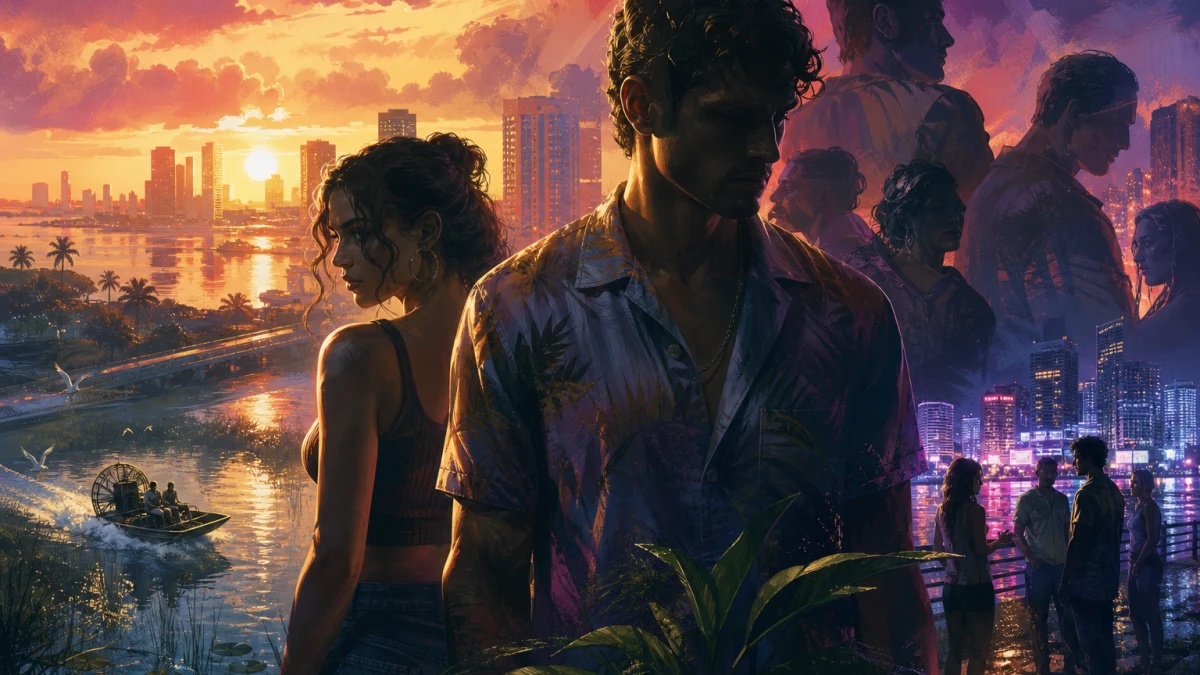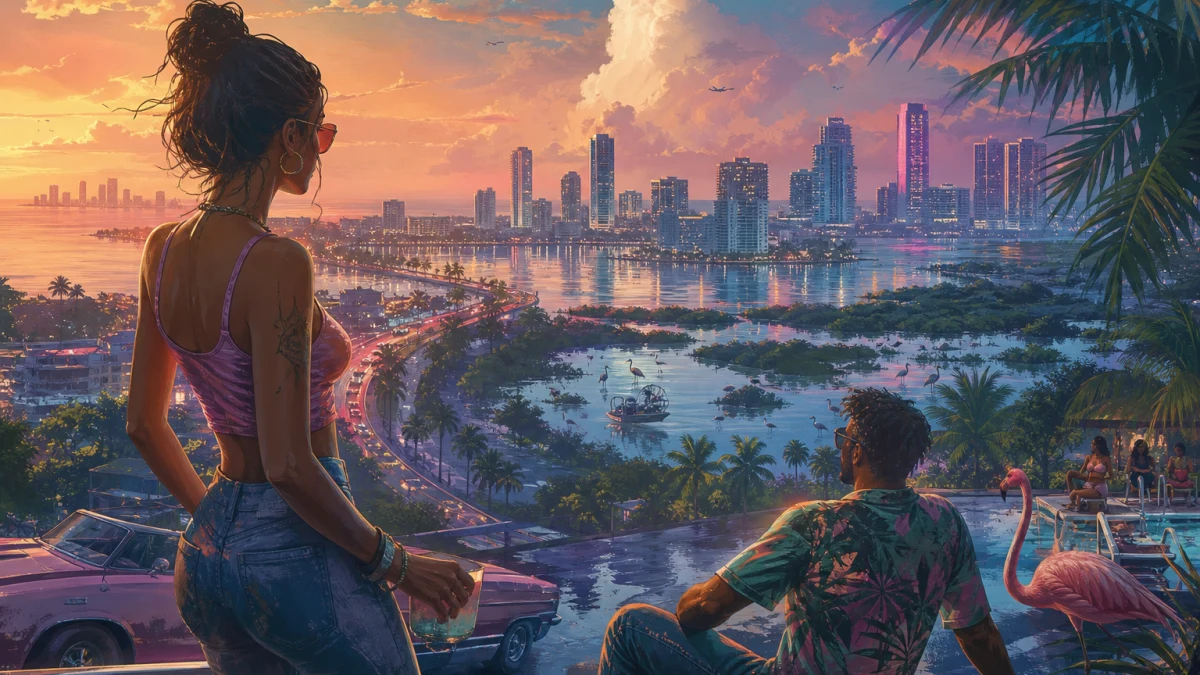
Grand Theft Auto VI is returning to Vice City, but Rockstar is not presenting Leonida as a literal recreation of Florida or as a factual portrait of the people who live there. The official material builds a heightened fictional state from recognizable images: bright beaches, nightlife, coastal wealth, rural roads, online fame, conspiracy thinking, and criminal opportunity.
That distinction matters. Leonida’s characters are exaggerated creations operating inside a crime story, not evidence that real Floridians are inherently reckless, irrational, corrupt, or absurd. The satire works by placing familiar public images into impossible combinations and asking what happens when every part of life becomes a performance, a hustle, or a potential source of attention.
Across Rockstar’s trailers, character profiles, screenshots, and extended-look presentation, GTA VI appears less interested in mocking one specific community than in examining systems that turn behavior into content and notoriety into money. Its targets include influencer culture, aspirational wealth, conspiracy media, tourism branding, and the unstable boundary between legitimate business and criminal capital.
Evidence note: This analysis includes editorial inferences drawn from Rockstar’s official descriptions, trailers, screenshots, and extended-look presentation. Those interpretations are not additional confirmed gameplay features. The exact depth of any in-game social-media system, and the identities or inspirations behind brief trailer figures, remain unconfirmed.
Leonida Is a Fictionalized Stage, Not Florida Reporting
Rockstar presents Leonida as a fictional state containing Vice City and several surrounding regions. The setting is recognizable as a heightened version of South Florida, but that recognition is part of the joke rather than a claim of documentary accuracy.
The official material presents Vice City as a place with a polished, sunny surface and a darker criminal world underneath. Jason Duval and Lucia Caminos are pulled into a criminal conspiracy that extends beyond their immediate plans, making the contrast between paradise branding and danger part of the central story setup.
The game is not saying that Florida’s beaches, businesses, or communities are secretly criminal. It is using the collision between tourism imagery and organized crime to create a fictional world where the promise of paradise is constantly undermined by people trying to exploit it.
- Confirmed: Leonida is a fictional state that includes Vice City and other named regions.
- Confirmed: Rockstar frames Vice City through a contrast between public appeal and criminal danger.
- Inference: That contrast functions as satire of branding, tourism, and social dysfunction rather than factual reporting about Florida.
The Bright-Surface Joke
Rockstar’s official framing presents Leonida as an intensely attractive destination. Sun, water, nightlife, and spectacle make the state look like a place designed to be photographed and sold. Yet the same descriptions place criminal conspiracies and dangerous ambitions beneath that surface.
That tension has existed throughout the Grand Theft Auto series, but GTA VI updates it for a culture in which image management is nearly as important as physical territory. A beach, nightclub, recording studio, or property is not merely a location. It can also be a brand, a business, a backdrop, or a way to disguise where money came from.
The result is satire aimed at the gap between presentation and reality. Leonida can advertise itself as an escape while its characters compete for money, status, and attention. The setting’s exaggerated cheerfulness does not make real Florida a punchline; it gives Rockstar a visual language for showing how public image can conceal exploitation.
When Public Behavior Becomes Content
The trailers use phone-screen, social-media, and livestream-style imagery to show unusual public behavior through the eyes of an audience. The footage does not simply depict people doing strange things. It presents those moments as material to be recorded, shared, watched, and potentially monetized.
That framing changes the role of the spectator. In an older version of GTA satire, a radio host or television presenter might tell players what a culture believed about itself. In GTA VI’s promotional footage, the audience appears to participate directly by filming and circulating spectacle.
The official footage therefore suggests a Leonida where people experience events through layers of recording and performance. A bizarre incident is not finished when it happens; it continues as a clip, a reaction, or a piece of online identity.
That is an interpretation of the trailers, not confirmation that the game contains a fully interactive social-media system. Rockstar has not publicly explained the exact depth, permanence, or player control of any in-game social feed. The promotional presentation establishes a theme and a style, but it does not by itself establish a complete gameplay system.
- Shown: The trailers use phone and livestream-like presentation.
- Inference: Leonida’s public life is increasingly shaped by filming, reposting, and spectatorship.
- Unconfirmed: The exact player control and persistence of any social-media feature.
Cal Hampton and the Business of Paranoia
Cal Hampton is one of the clearest examples of Rockstar turning a modern media habit into a character. His official profile describes a man shaped by private browsing, intercepted communications, online rumors, and the suspicion that seemingly impossible claims might be true.
The joke is not that everyone in Florida believes conspiracy theories. Cal is a specific comic character whose worldview has been reorganized by internet paranoia. His habits make suspicion both a personality trait and a media environment. The online world is not simply something he visits; it determines what he considers plausible.
That distinction makes the characterization more useful than a generic stereotype. Cal represents the loss of a stable boundary between information, rumor, entertainment, and fear. His paranoia is funny because it is excessive, but it also reflects a recognizable problem in modern attention economies: uncertainty can be more engaging than evidence.
Rockstar has not stated that Cal stands for one real person, political movement, or Florida subculture. The official description supports reading him as an exaggerated portrait of conspiracy culture and private digital habits, not as a sociological conclusion about real residents.
Boobie Ike and the Criminal-to-Legitimate Wealth Pipeline
Boobie Ike’s official profile connects street activity with a broad business empire that includes real estate, a strip club, and a recording studio. That combination turns a character biography into a miniature map of Leonida’s economy.
Boobie’s businesses occupy different cultural registers. Property suggests long-term legitimacy and investment. A nightclub evokes entertainment and status. A recording studio connects the operation to celebrity and cultural influence. Together, they show how criminal money can move through institutions that appear respectable, glamorous, or entrepreneurial.
The satire here is not a factual claim that Florida businesses are fronts for crime. It is about the ambiguity of success in a world where the source of capital can be hidden behind a polished public identity. Boobie does not need to be a direct parody of a real businessman for the idea to work. His role dramatizes the way modern wealth is often judged by visibility and scale rather than by its origin.
That also places GTA VI’s crime story inside a broader aspiration narrative. The goal is not simply to steal. It is to own property, control nightlife, shape music, and become difficult to distinguish from a legitimate power broker.
Dre’Quan Priest and the Hustle Economy
Dre’Quan Priest is presented as a hustler pursuing success in music after dealing on the streets to make ends meet. His profile places survival, ambition, and entertainment entrepreneurship on the same unstable path.
Dre’Quan’s story makes the word hustle do several jobs at once. It can mean finding money under pressure, building a career, exploiting an opportunity, or trying to convert local reputation into a commercial future. The satire comes from how quickly those categories overlap in Leonida.
This is not an argument that musicians or independent businesses are inherently criminal. Rockstar is constructing a fictional economy in which the route to success is improvised and morally compromised. Music is not separate from crime; it is one of the arenas in which money, identity, and influence are negotiated.
Dre’Quan also helps prevent the satire from being reduced to beachside eccentricity. Leonida is not only a collection of odd viral personalities. It is a place where people pursue recognizable goals—security, recognition, wealth, and creative control—through unusually unstable means.
Real Dimez and the Conversion of Notoriety
Real Dimez offer perhaps the most direct link between criminal behavior and online fame. Rockstar describes Bae-Luxe and Roxy as performers who turn shakedowns, rap tracks, viral videos, and social-media attention into a route toward celebrity.
Their official setup treats notoriety as a form of capital. A criminal act can produce fear, but it can also produce a story. A story can become a video, and a video can become an audience. The audience then creates opportunities for more money and more visibility.
That sequence is the heart of the satire. Rockstar is not simply making fun of people who use social media. It is examining the conversion of attention into economic value, even when the attention comes from behavior that would traditionally damage a person’s reputation.
Real Dimez therefore fit the wider Leonida pattern: performance is not an optional layer placed on top of life. It is part of how characters seek power. Their music and videos may be creative expression, but they are also tools for building a public identity and monetizing infamy.
The Keys Fantasy and Brian Heder
Brian Heder is officially framed as an older drug runner connected to smuggling in the Keys, boat-yard operations, property arrangements, and the delegation of dirty work. His profile places organized crime inside imagery associated with coastal leisure.
That combination gives Rockstar another version of the bright-surface joke. The Keys can represent relaxation, water, boating, and escape, while Brian’s activities reveal a darker infrastructure beneath that lifestyle. The setting does not make coastal communities criminal; it gives the game a comic contrast between the fantasy of getting away from everything and the practical business of moving illegal goods.
Brian’s age and experience also suggest that Leonida’s criminal economy is not created entirely by the protagonists. Jason and Lucia enter a world with established relationships, older operators, inherited methods, and businesses that have learned to coexist with respectable appearances.
The satire is consequently about concealment and convenience. A relaxed setting can become a cover for exploitation because people are willing to believe in the image it sells.
Raul Bautista and a Culture of Risk
Raul Bautista is described as a seasoned bank robber who searches for people willing to take increasingly dangerous risks. His role expands GTA VI’s satire beyond regional imagery and into a broader question: why do people continue escalating when the rewards are uncertain and the consequences are obvious?
Raul’s world treats risk as both a personality test and a recruitment tool. The person willing to attempt something more dangerous becomes valuable, marketable, and potentially famous. That logic resembles the attention economy in the trailers, where extreme behavior attracts an audience.
The connection does not mean the game is equating criminal robbery with ordinary ambition. It does suggest that Leonida rewards escalation. Characters compete to be bolder, richer, more visible, or more reckless than the people around them.
Raul therefore links the fictional state’s different comic worlds. The same appetite for attention that drives online performance can also drive criminal planning. In both cases, the promise of a larger payoff encourages people to accept greater exposure.
Why Leonida Needs More Than Vice City
Rockstar’s official media identifies contrasting spaces including Vice City, the Leonida Keys, Port Gellhorn, Grassrivers, Ambrosia, and Mount Kalaga. That variety is important to the satire because Florida’s public image is not limited to one beach or one skyline.
Vice City supplies glamour, nightlife, tourism, and dense urban spectacle. The Keys add coastal leisure and smuggling routes. Port Gellhorn suggests a less polished and more forgotten edge. Grassrivers brings wetlands and rural activity into the same fictional state. Ambrosia adds an industrial dimension, while Mount Kalaga expands the world into wilderness and outdoor recreation.
These places should not be treated as official one-to-one statements about real regions. Their value is thematic. Each location offers Rockstar a different version of the Florida image: the destination, the escape, the backwater, the workplace, the wetland, and the protected wilderness.
The regional spread also prevents Leonida from becoming a single joke. Modern Florida is represented through competing fantasies, and Rockstar can satirize the friction between them. The place marketed as paradise is also a workplace, a home, a supply chain, a criminal route, and a landscape that cannot be reduced to tourist imagery.
Where Satire Stops and Stereotype Begins
The safest way to discuss GTA VI’s Florida satire is to focus on mechanisms rather than populations. The official evidence supports analysis of attention, branding, paranoia, criminal capital, property, music, nightlife, and risk. It does not support claims that real Floridians or particular communities behave like Leonida’s most extreme characters.
That boundary is especially important when discussing figures seen briefly in trailers. Fan labels and comparisons to viral personalities may be useful shorthand in online conversation, but they are not official character names or proof of a real-world target. A trailer image can establish that Rockstar showed a scene; it cannot establish who inspired it or what broader group it represents.
The same caution applies to gameplay. A livestream-style edit or phone-screen image shows how Rockstar wants the world presented. It does not automatically confirm a complete social-media system, persistent online reactions, or player control over every piece of content.
Leonida’s exaggeration works because it compresses contradictions. Its characters can be ambitious and exploitative, creative and criminal, successful and paranoid. Real people are more complicated than those comic constructions. Treating the fictional extremes as evidence about Florida would flatten the satire instead of understanding it.
- Attribute criminality and absurdity to fictional Leonida characters.
- Do not identify trailer figures with real people without official confirmation.
- Do not treat presentation style as proof of a complete gameplay system.
- Discuss institutions, incentives, and media habits rather than stereotypes about residents.
The Florida Joke Is Really About Performance
Taken together, Rockstar’s official descriptions and footage suggest that GTA VI’s deepest joke is not simply that Florida is strange. It is that modern life increasingly rewards people for turning themselves, their crimes, and their surroundings into performances.
Cal turns uncertainty into identity. Boobie Ike turns criminal capital into a business empire. Dre’Quan turns survival into an entertainment hustle. Real Dimez turn notoriety into an audience. Brian Heder hides exploitation behind coastal ease. Raul Bautista turns escalating danger into a test of value.
Those characters are not representatives of entire communities. They are comic instruments that let Rockstar examine how money and attention move through Leonida. The state’s beaches, clubs, properties, roads, wetlands, and online spaces become stages where characters sell versions of themselves.
That is why the fictional setting can feel recognizably Floridian without being a factual portrait of Florida. Rockstar borrows the imagery of a famous public identity and pushes it until the contradictions become impossible to ignore. Leonida is sunny because it needs to be marketable, dangerous because someone is always exploiting that marketability, and funny because nearly everyone is performing for an audience—even when nobody can agree on what is true.
GTA VI’s official material presents Leonida as a fictional exaggeration built from recognizable South Florida imagery, not as a report on real Floridians. Its satire comes from collisions: tourism and crime, wealth and secrecy, music and hustling, paranoia and media, leisure and exploitation.
The strongest reading of the game’s Florida humor is therefore structural rather than stereotypical. Rockstar is examining how attention becomes currency, how criminal money adopts legitimate appearances, and how people pursue recognition in a world that rewards increasingly extreme performances.
Until Rockstar explains more about the systems behind its social-media imagery and trailer scenes, those interpretations should remain interpretations. What is already clear is that Leonida’s satire is aimed at the machinery of modern spectacle—and at the fictional characters willing to turn every part of life into content.
Sources
- Grand Theft Auto VI — Official Rockstar Games site
- Only in Leonida — Official Rockstar Games character and setting profiles
- Grand Theft Auto VI: An Extended Look — Rockstar Games Newswire
- Grand Theft Auto VI official screenshots — Rockstar Games
- Grand Theft Auto VI Trailer 1 — Rockstar Games
- Grand Theft Auto VI Trailer 2 — Rockstar Games