Rockstar’s official GTA VI video material now offers more than a first impression. Trailer 1 introduced Lucia, Leonida, and the game’s social-media-saturated tone. Trailer 2 expanded the story around Lucia and Jason while showing more of Vice City and the wider state. The August 27, 2026 Extended Look went further, presenting a long mixture of gameplay and cinematic material captured from the game on PlayStation 5.
The useful way to read those videos is not as a checklist of every object visible for a fraction of a second. It is to separate what Rockstar has directly established from what the footage merely suggests. The trailers confirm a dual-protagonist crime story in a broad fictional state, but they do not confirm every gameplay system that viewers have inferred from a HUD element, a transition, or a single scene.
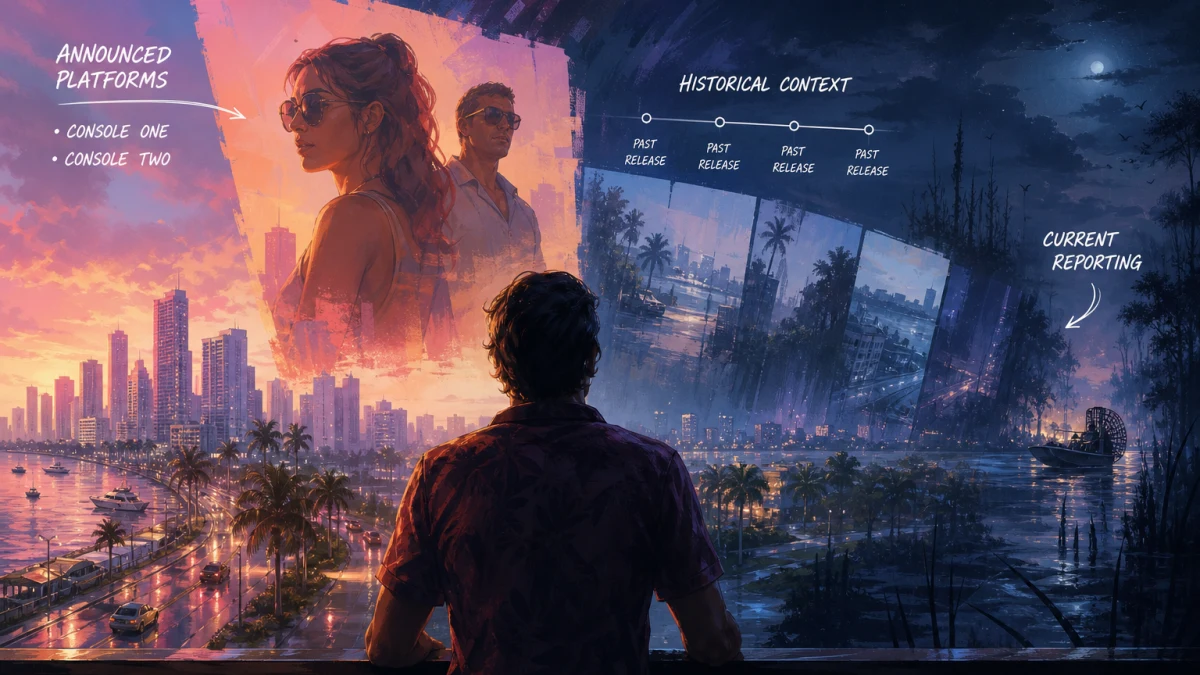
This guide focuses on the details that meaningfully define GTA VI while keeping those boundaries clear. It also reflects Rockstar’s current official position as of October 1, 2026: the game is scheduled for November 19, 2026, on PlayStation 5 and Xbox Series X|S, and Rockstar currently describes it as a single-player experience.
Evidence note: This article focuses on confirmed and officially shown material, but it also explains unconfirmed interpretations around the six-star display, social-media-style footage, disguises, combat prompts, wildlife counts, performance, and possible gameplay systems. Those interpretations are not confirmed features unless Rockstar has directly shown or announced them.
What counts as official GTA VI trailer evidence
Rockstar’s official GTA VI media page currently lists three major videos: Grand Theft Auto VI Trailer 1, Grand Theft Auto VI Trailer 2, and Grand Theft Auto VI: An Extended Look. The same page also contains nine shorter clips, including character videos for Jason Duval, Lucia Caminos, Cal Hampton, Boobie Ike, Dre’Quan Priest, Real Dimez, Raul Bautista, and Brian Heder. Those clips are official promotional material, but they are separate from the three major videos examined here.
Trailer 1 premiered on YouTube on December 4, 2023, while Rockstar’s Newswire post carrying the announcement is dated December 5, 2023. Trailer 2 was released on May 6, 2025. The official YouTube listings identify runtimes of approximately 1 minute 31 seconds for Trailer 1 and 2 minutes 47 seconds for Trailer 2.
Rockstar labels the newest major video an Extended Look rather than a conventional Trailer 3. That distinction matters because the presentation is substantially longer and more focused on gameplay scenes, but it still combines different kinds of footage. Rockstar says the Extended Look was captured entirely from in-game footage on PlayStation 5. Take-Two used similar language for Trailer 2, saying all of that trailer’s footage was captured on PlayStation 5.
Those statements identify the source of the material. They do not mean every transition is uninterrupted player-controlled gameplay, nor do they confirm a universal frame rate, resolution, performance mode, or final technical configuration.
The videos are therefore strongest as evidence for what Rockstar wants viewers to see: the protagonists, the setting, the tone, the kinds of activities that appear in missions, and the visual density of the world. A visible interface element or isolated animation is weaker evidence for the complete rules of a system.
- Confirmed: Rockstar officially lists Trailer 1, Trailer 2, and An Extended Look as its three major GTA VI videos.
- Confirmed: the Extended Look was captured from in-game footage on PlayStation 5.
- Confirmed: Rockstar’s official site currently lists November 19, 2026, as the release date for PlayStation 5 and Xbox Series X|S.
- Not confirmed by the videos: final performance modes, frame rate, resolution, or every underlying gameplay rule.
Jason and Lucia are the center of the story
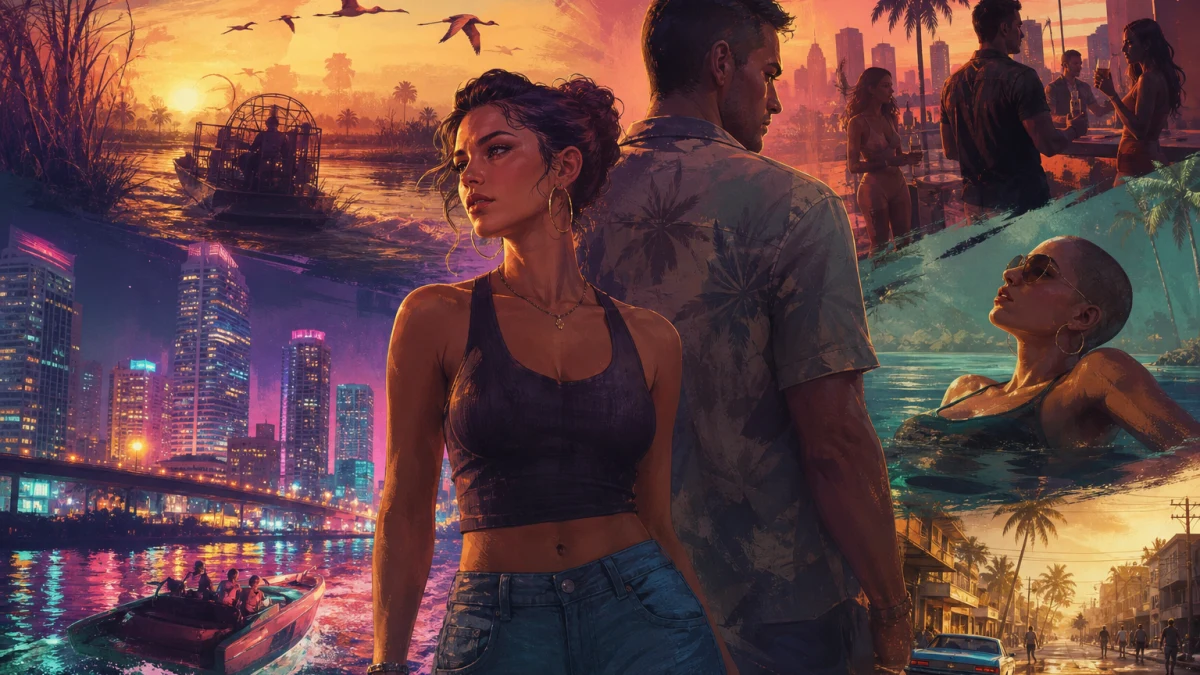
The most important confirmation across the trailers is that GTA VI is built around Jason Duval and Lucia Caminos. Rockstar’s official story setup says the pair are forced to rely on each other after an easy score goes wrong. The official synopsis places that relationship inside a criminal conspiracy stretching across the state of Leonida.
Trailer 1 makes Lucia the immediate focal point. It introduces her through prison imagery, public attention, and scenes that establish the game’s Florida-inspired criminal culture. Trailer 2 gives Jason a comparable narrative presence and makes the partnership between the two characters much clearer.
The footage presents Jason and Lucia as collaborators rather than two unrelated playable characters who happen to share a map. They are shown together during criminal work, transportation, escapes, and more personal moments. That does not reveal the complete structure of the campaign, but it does establish the partnership as the story’s defining relationship.
The Extended Look reinforces that reading by showing both characters taking part in different jobs and sequences. They do not appear to be locked into one identical role. Instead, the footage uses their separate positions and movements to make the criminal operation feel like something they are building together.
That conclusion is stronger than the claim that the trailers prove a particular relationship system, loyalty meter, branching structure, or mission outcome. Rockstar has established the partnership as a narrative foundation. It has not published the full campaign design behind it.
- Confirmed: Jason Duval and Lucia Caminos are the central protagonists.
- Confirmed: the official setup describes a criminal conspiracy across Leonida.
- Officially shown: the pair work together during robberies, escapes, transportation, and other criminal activity.
- Not confirmed: the full campaign structure, mission count, relationship mechanics, or exact consequences of their partnership.
Vice City is the anchor, but Leonida is the larger subject
GTA VI takes place in the fictional state of Leonida, with Vice City presented as its main urban center. The trailers make clear that Rockstar is not returning to a city-only setting. Alongside Vice City’s towers, nightlife, traffic, beaches, and crowded streets, the footage shows wetlands, waterways, islands, rural roads, and less developed areas.
That broader geography is one of the most meaningful details in the marketing. Trailer 1 moves quickly between public spectacle, coastal scenes, roads, wildlife, and city life. Trailer 2 expands the range of environments, while the Extended Look gives the setting more practical context through missions, pursuits, and travel.
The result is an official presentation of Leonida as a connected region with contrasting communities and landscapes. The videos do not establish the exact map size, travel times, number of settlements, or boundaries of every area. Aerial shots and rapid edits should not be treated as measurements.
What they do establish is the intended scope of the setting. Vice City remains the recognizable center, but the game’s identity is tied to the spaces around it as much as to the city itself. Rockstar’s official synopsis reinforces that point by describing the criminal conspiracy as stretching across the state rather than being confined to Vice City.
- Confirmed: the setting is the fictional state of Leonida.
- Confirmed: Vice City is the principal urban location named in Rockstar’s material.
- Officially shown: beaches, wetlands, waterways, rural roads, islands, and urban districts.
- Not confirmed: map dimensions, total landmass, travel times, or the final number of named locations.
A world filtered through phones, livestreams, and public spectacle
Trailer 1 introduces Leonida through a distinctly contemporary media culture. The video includes vertical phone clips, livestream-style footage, local-news presentation, and people recording incidents in public. These images are not just decoration. They establish how the setting sees itself and how quickly private behavior can become public entertainment.
That presentation fits Rockstar’s broader portrayal of a state where crime, celebrity, nightlife, and online attention overlap. The trailers repeatedly show people documenting events rather than simply watching them. This gives Leonida a different texture from a setting presented only through traditional cutscenes or radio reports.
However, the footage does not confirm a fully playable social-media application, a livestreaming business, or a specific online popularity system. It shows social-media-style culture and presentation. It does not explain whether players can operate accounts, publish content, manage followers, or influence a formal algorithm.
The distinction is important because the videos support a strong thematic conclusion without proving a particular feature. Rockstar is clearly using phones, recordings, and public spectacle to frame the world. The exact mechanics behind that culture remain undisclosed.
This is also a useful example of the difference between an officially shown idea and a confirmed gameplay system. The cultural presentation is visible. A player-facing social network is not.
- Officially shown: phone clips, livestream-style material, news coverage, and public recording.
- Inference: media attention is an important part of Leonida’s tone and satire.
- Not confirmed: a fully playable social-media app or a formal follower, popularity, or algorithm system.
Wildlife, crowds, traffic, and the promise of a busy world
The official footage repeatedly emphasizes density. Crowds fill streets and nightlife spaces. Roads carry heavy traffic. Boats and aircraft appear alongside pedestrians, beaches, residential areas, and commercial districts. The Extended Look adds more examples of populated spaces and activity continuing around the protagonists.
Wildlife is part of that visual identity. The trailers visibly include alligators, flamingos, dolphins, birds, and other animals. Those appearances support the idea that Leonida’s natural environments are not empty scenery. Wetlands and coastal areas are presented as active parts of the setting.
But individual animals shown in a trailer cannot establish a final species count or a complete wildlife roster. They also do not confirm spawning rules, hunting systems, ecological simulation, or the exact role animals play in missions. Rockstar has shown the presence and variety of wildlife, not the finished design of every related system.
The same caution applies to density. Busy roads and crowds demonstrate what the footage contains, but they are not a guarantee that every area will maintain the same activity level in all circumstances. The strongest claim is visual: GTA VI is being presented as a world defined by simultaneous urban, coastal, rural, and natural activity.
That matters because several existing claims about precise animal totals or universal density go beyond the evidence. The trailers are strong evidence of variety and presentation, not a technical specification sheet.
- Officially shown: alligators, flamingos, dolphins, birds, and other wildlife.
- Officially shown: crowds, traffic, boats, aircraft, beaches, nightlife, and commercial spaces.
- Not confirmed: a final animal count, complete species list, ecological simulation, or universal crowd and traffic density.
What the Extended Look shows about character switching and mission flow
The Extended Look provides the clearest official evidence yet of how GTA VI can move between Jason and Lucia. It visibly shows both characters under player control in different sequences. One transition rapidly shifts from Lucia to Jason through a high-altitude camera movement before returning to street-level play.
That presentation suggests Rockstar wants character changes to feel integrated into the world rather than limited to a static menu. The footage connects the switch to an unfolding situation, then drops back into action. It is a meaningful demonstration of presentation and control, although it does not establish every circumstance in which switching will be available.
The video also shows the protagonists taking on different types of work. Visible scenarios include robbery, protection, delivery, and other criminal jobs involving clients. Some sequences use disguises or changed outfits, including work connected to security and client-facing situations.
These scenes establish variety in the footage, not a complete list of mission categories. They also do not prove that every mission supports free-form disguise play, that all jobs are repeatable contracts, or that players can switch characters whenever they want.
The safe conclusion is that Rockstar is showing Jason and Lucia moving through a criminal network with different clients, roles, and approaches. The larger progression structure remains unannounced.
- Officially shown: control of both Jason and Lucia.
- Officially shown: a rapid character transition from Lucia to Jason.
- Officially shown: changed outfits and disguises in selected sequences.
- Not confirmed: unrestricted switching, a complete contract system, or disguise support in every mission.
Combat, pursuits, and the visible wanted display
The Extended Look includes vehicle chases, gunfights, police pursuit, and shooting from moving vehicles. It also shows weapon swapping and firearms being picked up during combat. A visible combat focus or slow-motion effect appears during one sequence, adding another layer to the footage’s presentation of action.
One pursuit includes a six-star wanted display. That is a real, visible interface element in the official footage, so it is fair to say that Rockstar has shown a six-star indicator in GTA VI. It is not fair to use that alone as proof of the exact behavior of law enforcement, the escalation rules, or the structure of the finished wanted system.
The Extended Look also includes a combat prompt during a fight involving Lucia. The prompt confirms that at least one such interaction appears in the footage. It does not establish how frequently quick-time events will occur, whether they are limited to specific scenes, or whether the final game will use them broadly.
The footage also appears to show focus-based combat presentation and highlighted enemy areas. Those visual elements may represent player-facing systems, but the trailer does not provide enough information to define their duration, resource rules, upgrade path, or availability across the campaign.
Together, these sequences show the kind of action Rockstar is willing to reveal: armed confrontations, vehicle-based combat, pursuit pressure, close-quarters encounters, and a more visible interface than the trailers had previously shown. They leave the underlying balance and rules open.
- Officially shown: gunfights, pursuits, vehicle shooting, weapon swapping, and picked-up firearms.
- Officially shown: a six-star wanted display during one pursuit.
- Officially shown: at least one combat prompt and a visible slow-motion or focus-style combat effect.
- Not confirmed: the complete wanted system, police behavior, resource rules, or the frequency of quick-time events.
Water travel, racing, parachuting, and activities beyond shootouts
GTA VI’s official footage presents Leonida as a place to move through by more than cars. The Extended Look shows fanboats, jet skis, canoes, swimming, and underwater activity. Those images give the wetlands, coastlines, and waterways practical importance rather than treating them as distant scenery.
The footage also includes racing on a dedicated track with cars and motorcycles. A parachute or base-jump sequence appears over Vice City. These moments broaden the range of activities Rockstar is willing to show and reinforce the contrast between criminal work, recreation, and spectacle.
What they do not provide is a complete activities list. A vehicle appearing in a trailer does not automatically confirm a standalone minigame, a progression ladder, or a freely available activity throughout the map. A racing scene confirms that racing is depicted; it does not reveal the number of tracks or how the activity fits into the campaign.
The same principle applies to water and aerial movement. The videos confirm that these forms of travel and action exist in the footage. They do not define every vehicle category, challenge, mission type, or access rule.
This is where the phrase “shown in the trailers” is more accurate than “confirmed as a full feature.” Rockstar has shown the activity taking place. It has not published the complete rules surrounding it.
- Officially shown: fanboats, jet skis, canoes, swimming, and underwater activity.
- Officially shown: car and motorcycle racing on a dedicated track.
- Officially shown: a parachute or base-jump sequence over Vice City.
- Not confirmed: a complete activities menu, progression system, or availability of every activity everywhere.
The music and presentation are part of the evidence
The first two trailers use music as a major part of GTA VI’s identity. Trailer 1 is built around Tom Petty’s “Love Is a Long Road,” while Trailer 2 uses The Pointer Sisters’ “Hot Together.” The songs help establish the contrast between open-road movement, nightlife, heat, celebration, and danger that runs through the footage.
Those choices are meaningful because Rockstar’s trailers often use licensed music to communicate tone rather than simply accompany action. The songs are confirmed parts of the official videos, but they do not by themselves confirm the full radio soundtrack or the final lineup of stations and artists.
Rockstar has since separately announced Grand Theft Auto VI: The Album, which is different evidence from the trailer music and should not be folded into a claim about the complete in-game radio experience. The trailers alone establish the songs used in those promotional videos.
The presentation itself also matters. Trailer 1’s fast social clips, Trailer 2’s character and location emphasis, and the Extended Look’s longer gameplay sequences show Rockstar progressively widening the viewer’s understanding of Leonida. The marketing has moved from atmosphere to character context and then to visible interactions.
Even so, “in-game footage” should not be treated as a promise that every shot is a continuous playable moment. Cinematic framing, edited transitions, and controlled demonstrations can all be created from game assets. The correct reading is that the footage reflects the game’s visual and interactive presentation without documenting every final condition.
- Confirmed: Trailer 1 uses Tom Petty’s “Love Is a Long Road.”
- Confirmed: Trailer 2 uses The Pointer Sisters’ “Hot Together.”
- Not confirmed by the trailers alone: the complete radio lineup or soundtrack.
- Confirmed: Rockstar describes the Extended Look as captured from in-game footage.
What the trailers still do not confirm
The official videos answer important questions, but they leave several major subjects open. Rockstar’s current product page describes GTA VI as a single-player experience. That is stronger and more current than simply saying the trailers do not announce GTA VI Online. Rockstar has not, in the official material examined here, announced a GTA VI multiplayer mode, its features, or its launch timing.
The videos also do not confirm a PC version, final performance options, frame-rate targets, resolution modes, or platform-specific settings. PlayStation 5 capture tells us where the shown footage was captured. It does not guarantee a particular performance profile in the finished release.
Likewise, the trailers do not prove the final map size, a precise animal total, a complete wanted-system redesign, a universal disguise mechanic, or a full social-media feature set. They show examples. Examples can be important without becoming promises about every mission or every hour of play.
The footage also does not establish that every visible activity is a standalone minigame, that every client job is repeatable, or that all shown mechanics are available freely outside the demonstrated scenes. A trailer can show a controlled sequence without explaining how often players will encounter it.
Finally, trailer music and visible characters do not establish the complete cast list, every faction, every named location, or the entire radio lineup. Those details require separate confirmation from Rockstar or another reliable primary source.
- Confirmed by Rockstar’s current product page: GTA VI is described as a single-player experience.
- Not announced in the official material examined here: a GTA VI multiplayer mode or GTA VI Online.
- Not confirmed: a PC release, frame rate, resolution, or performance modes.
- Not confirmed: exact map size, final animal count, complete wanted-system rules, or full social-media mechanics.
- Not confirmed: the complete soundtrack, cast, mission structure, or progression system.
The clean takeaway from Rockstar’s official footage
The clearest reading of the trailers is that GTA VI is a story-led crime game built around Jason and Lucia’s partnership across Leonida. Vice City is the anchor, but the official footage gives equal thematic weight to wetlands, beaches, rural roads, islands, waterways, and the communities beyond the skyline.
Rockstar is also presenting a world where public spectacle is constant. Phones, livestream-style clips, news coverage, crowds, traffic, wildlife, nightlife, and criminal activity overlap. The Extended Look then connects that setting to visible play: switching between protagonists, taking on different jobs, changing disguises, fighting, escaping, racing, traveling by water, and moving through the air.
That is already enough to distinguish GTA VI’s confirmed identity from the speculation surrounding it. The trailers support a broad, contemporary, character-driven crime adventure. They do not yet provide a complete manual for every system.
The most responsible conclusion is therefore also the most useful one: Rockstar has shown a world and a story framework with considerable breadth, while carefully leaving many rules unexplained. The evidence is strongest when it describes what appears on screen and weakest when it tries to extrapolate an entire feature from one moment.
For now, the reliable picture formed across the three major videos is consistent: Jason and Lucia are at the center, Leonida extends well beyond Vice City, and the visible ambitions reach far beyond a simple city tour. The final scope of those ambitions will require more than trailer footage to confirm.
- Confirmed: GTA VI’s official footage centers on Jason and Lucia.
- Confirmed: Leonida extends beyond Vice City into varied natural and regional environments.
- Officially shown: a wide range of criminal, combat, travel, and recreational activities.
- Still open: the full rules, scope, frequency, and structure behind many of those activities.
Rockstar’s official trailers establish more than atmosphere, but less than a complete feature list. They confirm the protagonists, the setting, the central criminal partnership, and a broad set of activities visibly occurring in the world.
The most responsible conclusion is also the most useful one: GTA VI is being presented as a connected Leonida experience where Jason and Lucia’s story drives movement between urban crime, public spectacle, natural environments, and high-risk action. The footage is substantial evidence of direction and presentation. It is not permission to turn every visual detail into a finished-system promise.
As of October 1, 2026, Rockstar’s official position is that GTA VI is a single-player game coming to PlayStation 5 and Xbox Series X|S on November 19, 2026. Everything beyond that confirmed foundation should be described according to the strength of the evidence: announced, officially shown, inferred, or still unconfirmed.
Sources
- Grand Theft Auto VI — Official Rockstar Games Site
- Grand Theft Auto VI — Official Rockstar Video Library
- Grand Theft Auto VI: An Extended Look — Now Playing
- Grand Theft Auto VI Trailer 1 — Rockstar Games Newswire
- Grand Theft Auto VI Trailer 1 — Rockstar Games YouTube
- Grand Theft Auto VI Trailer 2 — Rockstar Games YouTube
- Grand Theft Auto VI: An Extended Look — Rockstar Games YouTube
- Rockstar Games Releases Trailer 2 for Grand Theft Auto VI — Take-Two Interactive
- Grand Theft Auto VI Pre-Order Details — Rockstar Games Support
- 16 new GTA 6 details we learned from the big Extended Look gameplay video — TechRadar