Grand Theft Auto VI’s map has become one of the game’s biggest pre-launch talking points, but the available evidence is less precise than many fan graphics suggest. Trailer screenshots, community reconstructions, alleged development material and estimated measurements are often presented together, even though they do not carry the same level of authority.
Rockstar has confirmed that GTA VI takes place in the fictional state of Leonida, with Vice City at its center and several named locations beyond the city. Its official material presents a broad setting that includes urban streets, islands, wetlands, industrial areas, coastal locations and a national park.
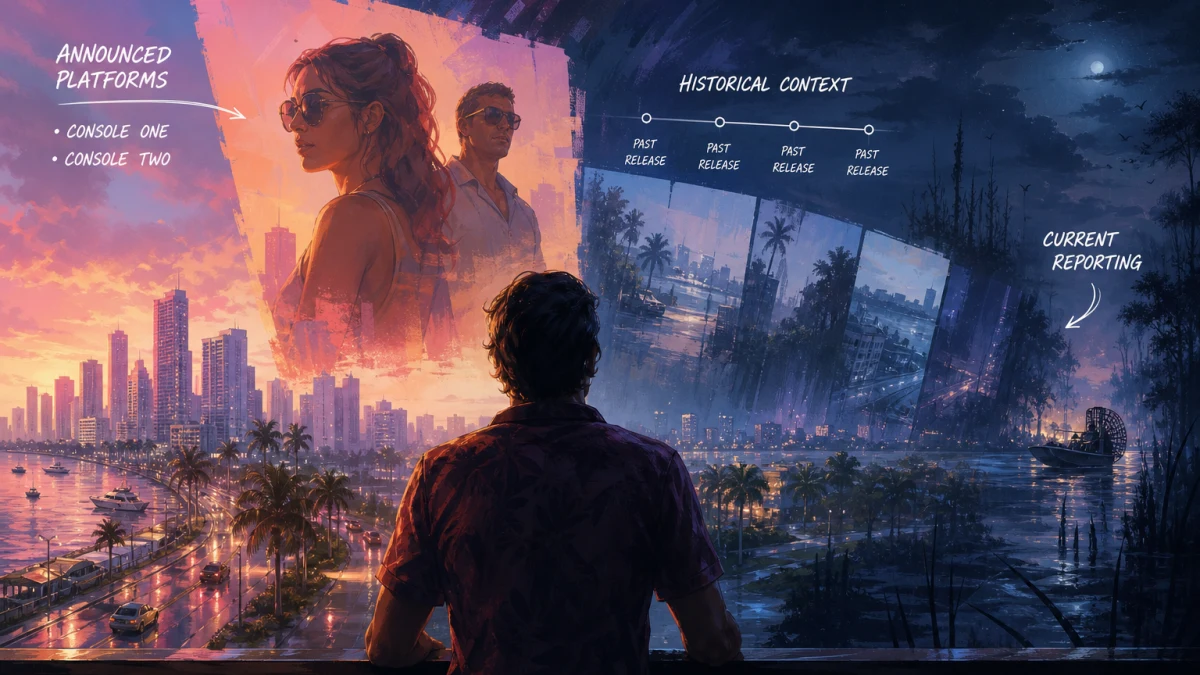
What Rockstar has not published is an exact measurement. There is no official square-kilometre figure, square-mile total, acreage estimate or scale bar in the current official material. A September 30, 2026 report citing an interview with Rockstar studio head Aaron Garbut describes Leonida as approximately twice the size of GTA V’s map, but that comparison should not be turned into a precise technical specification.
Evidence note: This article discusses a credible reported comparison that Leonida is approximately twice the size of GTA V’s map, along with community estimates and fan-map theories. Rockstar has not officially published Leonida’s area, scale or complete regional boundaries, so precise numbers and reconstructed maps remain unconfirmed.
The short answer: Leonida is broad, but its exact area is unknown
The safest description of GTA VI’s world is that Leonida is a large, multi-region setting extending beyond Vice City. Rockstar’s own website describes the game as taking place in the state of Leonida, home to the neon-soaked streets of Vice City and beyond. Its official media pages also organize screenshots under several named destinations.
The unsafe version is any statement that gives Leonida a definitive area without identifying an official Rockstar measurement. Numbers such as 125 square kilometres should currently be treated as community estimates. They may come from fan-made overlays, guessed outer boundaries, comparisons with earlier games or measurements of promotional artwork, but none of those methods establishes the size of the final retail map.
The current reporting about Leonida being approximately twice the size of GTA V’s map is useful context. It suggests a significant expansion in overall scope, but it does not provide a surveyed area, a coordinate system or a technical definition of what was included in the comparison. It also does not prove that every measurable part of Leonida will be exactly twice the size of an equivalent part of GTA V.
- Confirmed: GTA VI is set in Leonida.
- Confirmed: Vice City is part of the wider Leonida setting.
- Credible reporting: Leonida is approximately twice the size of GTA V’s map.
- Not confirmed: an exact square-kilometre, square-mile or acreage figure.
- Not confirmed: that the map is exactly twice as large under every possible measurement.
What Rockstar has officially shown about Leonida
Rockstar’s official presentation makes clear that GTA VI is not confined to a single urban area. The company’s description places Vice City inside Leonida, while the official “Only in Leonida” page invites visitors to explore several destinations across the state.
That material supports a setting with substantial environmental variety. The available official screenshots show dense city scenes, coastal areas, waterways, rural environments, industrial spaces, islands and northern wilderness. These images establish the range of environments Rockstar wants players to associate with Leonida, but they do not form a complete atlas of the game world.
Promotional images also cannot establish every road connection, coastline shape or regional border. A screenshot taken in Grassrivers confirms that Rockstar uses the Grassrivers name for part of its presentation. It does not reveal the complete size of Grassrivers or show exactly where it begins and ends.
This is the central distinction in the map-size discussion: official material can confirm that a destination exists without confirming its full footprint. Rockstar has shown enough to establish the broad character of Leonida, but not enough to support a definitive measurement derived from screenshots alone.
- Officially confirmed: the setting is Leonida.
- Officially confirmed: Vice City is one part of Leonida.
- Officially shown: multiple environments beyond the city.
- Still unknown: the complete road network, outer boundary and regional borders.
The six officially labeled destinations
Rockstar’s official media page currently organizes screenshots under Vice City, Leonida Keys, Grassrivers, Port Gellhorn, Ambrosia and Mount Kalaga National Park. Those labels are significantly stronger than names that appear only on fan-made maps or social-media posts.
Vice City is the major urban setting and the location most closely associated with the game’s marketing. The Leonida Keys are also supported by Rockstar’s character material: Jason Duval is described as having worked for local drug runners in the Keys. That gives the region a confirmed connection to his background, although it does not define the Keys’ exact size or geography.
Grassrivers, Port Gellhorn and Ambrosia are all official Rockstar labels displayed alongside promotional screenshots and destination links. Their presence confirms that Rockstar intends players to recognize those names as part of Leonida’s world. Mount Kalaga National Park is likewise identified in Rockstar’s official media and location material.
The labels do not automatically tell us what type of administrative or gameplay units these places are. Rockstar has not explained whether each name represents a county, city, town, ecosystem, tourism identity, broad geographical region or a combination of those categories. Nor has it published a complete map showing how the six destinations connect.
That uncertainty matters because fan maps often draw firm borders around officially named places. A map may show Ambrosia as a precisely bounded district or connect Port Gellhorn to another location with a detailed highway route. Unless Rockstar has shown or named that specific border or road, the drawing remains an interpretation rather than confirmation.
- Vice City: officially named and presented as part of Leonida.
- Leonida Keys: officially named and linked to Jason’s background.
- Grassrivers: an official Rockstar destination label.
- Port Gellhorn: an official Rockstar destination label.
- Ambrosia: an official Rockstar destination label.
- Mount Kalaga National Park: officially identified by Rockstar.
- Exact borders, road connections and administrative status: not officially published.
What the “twice the size of GTA V” comparison actually means
A September 30, 2026 report from MeriStation says Aaron Garbut described Leonida as approximately twice the size of GTA V’s map in an interview with Game Informer. The report also presents Leonida as Rockstar’s largest map to date. That is credible reporting worth acknowledging, but it should remain clearly attributed and described as an approximate comparison.
The comparison gives players a useful sense of ambition without answering every technical question. To turn it into a precise area figure, readers would first need to know exactly how GTA V’s map was measured. Different calculations might include or exclude water, inaccessible terrain, offshore spaces, mission-only areas, interiors and the game’s outer boundary.
The word “size” can also describe more than surface area. It may refer to the overall scale of the world, the distance between destinations, the breadth of the production or the amount of geography represented. The report does not provide a map projection, a surveyed boundary or a square-kilometre total.
The word “approximately” is equally important. It signals that the comparison is not a promise of a 2.00 multiplier. Treating it as exact creates false precision that the reported statement does not support.
The responsible use of the comparison is therefore straightforward: Leonida is being described as substantially broader than GTA V’s setting. The statement does not establish a specific area, guarantee twice as much content or prove that every region will be twice the size of a previous GTA location.
- Useful context: Leonida is reportedly much larger in overall scope than GTA V’s map.
- Unsafe conversion: multiplying an assumed GTA V area by two and calling the result official.
- Still open: what Rockstar included in the comparison and how the finished map should be measured.
The Goodtime State poster is not a surveying document
Rockstar’s September 24, 2026 Newswire post promotes a double-sided souvenir poster showcasing the Leonida landscape as part of the Goodtime State – Vice City Collection. That makes the poster official merchandise and potentially useful promotional context.
It should not automatically be treated as an in-game navigation map. Rockstar’s description presents it as a souvenir poster, not as a technical document containing a scale bar, coordinates or exact distances. The company does not state that the artwork is geographically to scale.
A stylized poster can prioritize readability, composition and branding. A coastline may be enlarged so that it is visible. A road may be simplified to make the artwork easier to understand. A location may be shifted or spaced out for design reasons. None of those choices would necessarily describe the playable world’s exact geography.
The poster could still offer official clues about names and the broad way Rockstar wants Leonida understood. Those clues should remain limited to what the artwork actually establishes. If the poster labels a place, that can support the use of the name. It cannot, by itself, establish a region’s area, travel distance or exact position relative to every other destination.
The same principle applies to the official screenshot page. A location label is valuable evidence that Rockstar uses the name. It is not proof that the image shows the whole region or that the visible terrain represents its outer boundary.
- Confirmed: Rockstar is selling a Leonida landscape poster as merchandise.
- Not confirmed: that the poster is drawn to scale.
- Not confirmed: that the poster can be used to calculate distances or boundaries.
- Best use: treat it as official promotional context, not a technical map.
How fan maps create the illusion of certainty
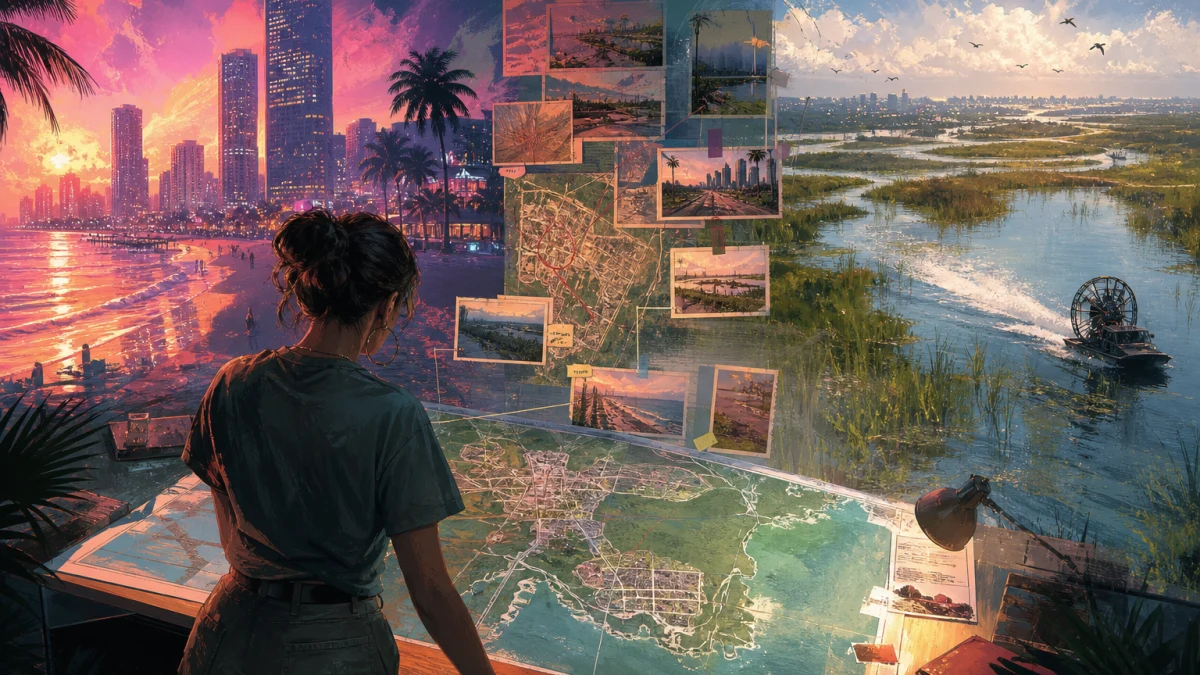
The GTA mapping community performs useful investigative work. Fans compare trailer frames, screenshots, officially named destinations, visible road features and real-world Florida geography. They then assemble those clues into proposed reconstructions of Leonida.
The difficulty begins when a reconstruction does not clearly separate evidence from interpretation. A fan map may combine official names with guessed roads, assumed borders, speculative towns and details carried over from an earlier version of the theory. Once everything appears on one polished graphic, the confirmed and unconfirmed elements can look equally authoritative.
Area estimates have the same problem. Measuring a community map produces a number, but the result depends on the map’s scale, the assumed outer boundary and the features counted as part of the playable world. If any of those inputs changes, the total changes too.
A claimed figure such as 125 square kilometres is therefore not meaningful as an official specification unless Rockstar confirms the boundary and methodology behind it. It may be an interesting community estimate, but the label matters.
Calling a map a “fan reconstruction” or an area figure a “community estimate” does not dismiss the work. It tells readers which parts come from Rockstar and which parts come from interpretation. That distinction is especially important before launch, when the final in-game map is not available for independent measurement.
- Official names can appear on unofficial maps without making the rest of the map official.
- Road layouts, borders and unlabeled locations remain speculative unless Rockstar supports them.
- Exact area figures require a reliable scale and a clearly defined boundary.
- A polished graphic is not evidence of official status.
Why leaked or early-build maps cannot settle the issue
Alleged development maps and recovered files are particularly weak evidence for the final map-size question. Even authentic development material can represent an older build, an internal planning tool, a partial world, a test area or content that was later changed.
The existence of a road, coastline or region in an early asset would not prove that it remains in the launch version. The absence of an area from an early build would not prove that Rockstar removed it permanently. Development material captures a moment in production, not necessarily the final retail boundaries.
There is also a clear editorial reason not to build this article around hacked, stolen or illicitly recovered material. Official trailers, Rockstar’s destination pages, the official screenshot archive and properly sourced reporting provide enough evidence to describe the broad setting without relying on compromised files.
For readers, the practical rule is simple: an alleged leak cannot upgrade a precise map theory into confirmation. At most, responsibly sourced reporting about development material can illustrate that plans change. It cannot certify the finished game’s dimensions.
This is why a leaked or allegedly recovered map should not be used to support claims about exact road networks, final region borders or the completed size of Leonida. Those claims require official confirmation or reliable post-release measurement, neither of which is available here.
- Early-build material may be incomplete or outdated.
- A leaked road or region is not confirmation of the launch map.
- Illicitly obtained material should not be treated as publication evidence.
- Official material remains the proper basis for confirmed pre-launch claims.
Map area is not the same as playable experience
Even if Rockstar publishes a final area figure, that number would not fully describe how large GTA VI feels to play. A map can include water, steep terrain, protected areas, inaccessible edges and low-density stretches. Another world with the same surface area can feel much larger if destinations are spread out or roads are winding.
Density matters as much as raw dimensions. Vice City may contain far more activity per block than a rural or wetland region. A wilderness area can offer a different kind of exploration without adding the same quantity of roads, buildings or interiors as a city.
Travel time is another separate measurement. A large world may be quick to cross because of highways, shortcuts or fast vehicles. Conversely, waterways, traffic, weather and winding roads can make a smaller area feel more expansive.
Interiors and mission spaces complicate comparisons further. A top-down map measures the world’s footprint, but it does not necessarily capture the amount of accessible interior space or the density of activities within that footprint.
For that reason, “twice the size” should not be converted into a promise of twice the missions, twice the activities or a fixed amount of driving time. Rockstar’s official material supports a large and varied setting, while the final lived scale will depend on design and systems that have not all been documented.
- Surface area does not equal content volume.
- Land area does not equal playable area.
- Density and travel time are separate from map dimensions.
- The reported comparison does not promise twice as many missions or activities.
Map-size claims that remain unconfirmed
Several popular claims go beyond the available evidence. The idea that Leonida measures approximately 125 square kilometres is not an official Rockstar figure. If mentioned, it should remain labeled as a community estimate rather than a confirmed fact.
There is also no retrieved official confirmation that the final game includes additional states or cities outside Leonida. The state’s broad presentation may invite speculation about what lies beyond the named destinations, but readers should not be told that unannounced locations are part of the launch map.
Vice City’s share of Leonida has not been given as a percentage. There is no official basis for saying that Vice City occupies a particular fraction of the state or a specific multiple of Los Santos. Screenshots can demonstrate the city’s character and density, but they cannot establish its percentage of the total world.
The existence of six official destination labels should also not be treated as a complete list of every playable town, island, district or sub-area. Rockstar’s media page identifies those destinations, but it does not publish a complete administrative atlas.
Finally, the reported twice-GTA-V comparison should not be inflated into an exact technical promise. It is useful perspective, not a substitute for an official measurement.
- 125 square kilometres: unconfirmed community estimate.
- Additional states or cities beyond Leonida: unconfirmed.
- Vice City’s percentage of Leonida: unconfirmed.
- Six named destinations as the complete map: unconfirmed.
- An exact 2.00-times measurement: unconfirmed.
What readers can safely say right now
The strongest evidence supports a clear summary: GTA VI is set in Leonida, a broad fictional state centered on Vice City and containing multiple officially named destinations. Rockstar has shown enough environmental variety to establish that the game is not confined to one urban area.
The official material currently supports discussion of Vice City, the Leonida Keys, Grassrivers, Port Gellhorn, Ambrosia and Mount Kalaga National Park. It does not publish the full borders of those destinations or explain exactly how they are classified within Leonida.
Current reporting adds that Leonida is approximately twice the size of GTA V’s map. That comparison should be attributed, kept approximate and treated as relative context. It does not replace an official measurement and should not be expanded into claims about exact square kilometres, content totals or travel times.
Until Rockstar releases a technical map, scale bar or direct area figure, the honest answer is that Leonida’s broad shape and named destinations are becoming clearer while its exact dimensions remain unknown. Fan mathematics can organize clues, but it cannot turn guesses into specifications.
In other words, GTA VI’s map may be enormous, but “enormous” is currently better supported than any precise number.
- Use Rockstar’s names when discussing confirmed destinations.
- Describe fan measurements as estimates, not facts.
- Treat the twice-GTA-V comparison as approximate reporting.
- Do not present promotional artwork or community maps as technical documentation.
Rockstar has confirmed the important outline of Leonida: Vice City sits inside a wider fictional state that includes the Leonida Keys, Grassrivers, Port Gellhorn, Ambrosia and Mount Kalaga National Park. Its official material supports a varied, multi-region setting rather than a city-only map.
What Rockstar has not confirmed is just as important. There is no official square-kilometre figure, no published scale bar and no definitive public map showing every border and road. The reported comparison with GTA V offers useful perspective, but it should not be mistaken for an exact measurement.
For now, the responsible conclusion is that Leonida is officially broad and credibly reported to be much larger than GTA V’s world, while precise fan numbers remain theories. The map’s real size will not be settled by a polished reconstruction or a souvenir poster. It will be settled by Rockstar’s documentation and, ultimately, the finished game.
Sources
- Grand Theft Auto VI — Only in Leonida
- Grand Theft Auto VI — Official Screenshots and Regional Labels
- Grand Theft Auto VI — Mount Kalaga
- Pre-Order The Goodtime State – Vice City Collection Now While Supplies Last
- Rockstar Games Announces Grand Theft Auto VI
- Es oficial: el mapa de GTA 6 será el doble de grande que el de GTA 5