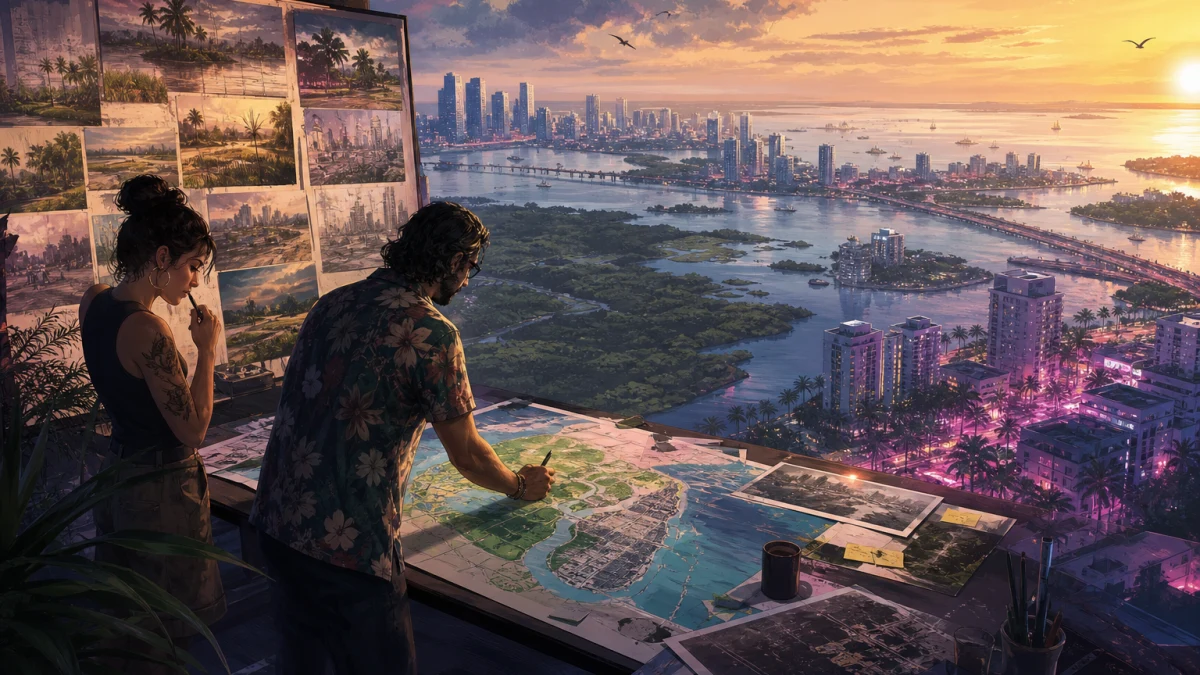
GTA VI was not always planned as the Florida-inspired adventure Rockstar is preparing to launch. According to a recent Bloomberg report and follow-up coverage, the project once carried the code name “Project Americas,” reflecting an early ambition to include substantial areas of both North and South America.
That history is useful context, but it is not a playable feature list. Rockstar has not published a complete record of everything removed, redesigned or retained during development. The most defensible conclusion is narrower: Project Americas was an early, much broader direction for the game, while the officially announced release has been shaped around Leonida, a fictional state containing Vice City and several distinct surrounding regions.
This distinction matters because online discussion has often treated the Project Americas name as proof that GTA VI still contains South American cities, a second country or a ready-made expansion plan. The available evidence does not support those conclusions. South America belongs to the reported history of the project, not to the confirmed launch description.
Evidence note: This article uses current reporting about Rockstar’s early Project Americas concept alongside official GTA VI material. Claims about hidden South American locations, deleted map sections, future Project Americas expansions or unrevealed launch content remain unconfirmed and should not be treated as facts.
What “Project Americas” reportedly meant
Project Americas was an early GTA VI concept built around a substantially wider geographic scope than the game Rockstar has publicly presented. Speaking to Bloomberg, Rockstar North co-studio head and GTA VI lead developer Rob Nelson said that staff members traveled to Miami for an initial research trip in 2015. At that stage, the game was known internally as Project Americas, with the aim of featuring parts of North and South America.
That wording describes an ambition, not a completed continent-sized map. The reporting does not say that Rockstar finished a fully playable version of multiple countries and then removed most of it. An early concept can include broad destinations, themes and geographic goals long before a studio has solved the production, technical and narrative problems required to make those places work together.
The name itself should also not be read as a formal subtitle or a promise to players. Rockstar’s public marketing has not presented GTA VI as a game spanning the real-world Americas. Its official pitch is centered on Jason Duval, Lucia Caminos and a criminal conspiracy unfolding across the fictional state of Leonida.
The distinction between a concept and a finished feature is especially important with a project as large as GTA VI. A studio may explore several possible settings before deciding which one can support the desired story, density and level of detail. Project Americas tells us where Rockstar’s thinking began; it does not provide a complete map of every location that was ever considered.
- Confirmed by current reporting: Rockstar explored an early concept called Project Americas.
- Reported scope: the early ambition included parts of both North and South America.
- Not confirmed: a completed multi-country map, specific South American cities or a list of cut missions.
Why the Florida research still matters
The 2015 Miami research trip fits the direction players can now see in Rockstar’s official material. GTA VI’s announced setting draws on South Florida’s beaches, wetlands, highways, nightlife, suburbs and urban density, but transforms those elements into the fictional state of Leonida.
The research should not be confused with a promise to reproduce every real location. Grand Theft Auto settings are built as satire and compression. They combine recognizable regional traits with invented names, characters, institutions and geography. Leonida is therefore better understood as a constructed game world inspired by Florida than as a literal digital survey of the state.
This is one of the clearest ways the early concept appears to have survived: not necessarily through a specific unrevealed country, but through the decision to build a broad regional setting around Vice City. Rockstar’s official site describes a conspiracy stretching across Leonida rather than restricting the story to a single urban district.
The official screenshots and location pages show or name several areas beyond Vice City, including Port Gellhorn, Ambrosia, Grassrivers, the Leonida Keys and Mount Kalaga National Park. That does not establish the final size of the map, nor does it prove that every named location is equally large or freely accessible. It does show that “scaled back” does not mean “reduced to one city.”
- Officially shown or named: Vice City and multiple Leonida regions.
- Reported development context: Rockstar conducted Florida research early in production.
- Still unconfirmed: a one-to-one recreation of real Florida or every location used during research.
The biggest survivor may be the idea of a broad living world
It would be too strong to say that a particular unrevealed country or city survived from Project Americas. It is more defensible to say that some of the original ambition appears to have survived in another form: a world expected to feel broad, varied and active across different environments.
Rockstar’s official presentation emphasizes more than Vice City’s skyline. The released material moves through coastal spaces, rural roads, industrial areas, wetlands, islands and northern wilderness. Those places give Leonida geographic variety without requiring Rockstar to announce a second nation.
Reporting on development has also focused on the scale of the supporting world. Rockstar has discussed the challenge of creating enough pedestrian activity, dialogue and detail to make Leonida feel alive. Coverage of the Bloomberg report said that the quantity of non-player characters and ambient material became a major production challenge, while other reporting described dedicated writing resources for pedestrian dialogue.
That work helps explain why a regional setting can still produce a huge development burden. A map does not become convincing simply because its roads and buildings exist. The people, conversations, routines, weather, wildlife and ambient events have to support the illusion that the setting continues beyond the player’s immediate view.
This is an inference from the announced material and reporting, not a claim that Rockstar has described density as a direct replacement for the original continental plan. The evidence supports a change in emphasis, but it does not document every internal design decision.
- Officially shown: Leonida contains several different environments and destinations.
- Credible reporting: NPC density and ambient writing created major production demands.
- Inference: the surviving ambition is more visible in world depth and regional variety than in confirmed continental travel.
Why the scope changed
The Project Americas story is closely tied to GTA VI’s unusually long development, but it should not be reduced to a single explanation for every delay. According to current reporting, Rockstar’s early plan involved developing GTA VI while Rockstar San Diego was heavily involved in Red Dead Redemption 2. As Red Dead Redemption 2 grew in scale, the wider company had to commit more of its staff and attention to completing that game, pushing GTA VI’s development further back.
That account helps explain why the 2015 concept did not immediately become the release players are waiting for. It does not mean that Rockstar stopped working on GTA VI altogether, nor does it establish that Red Dead Redemption 2 was the sole reason for the game’s long schedule. Major projects change direction for several overlapping reasons, including staffing, technology, production priorities, narrative decisions and the amount of content a studio can finish to its quality standard.
The reported narrowing of Project Americas therefore sounds more like a process of refocusing than a simple cancellation of one map. Rockstar had to decide what kind of experience it could build to the standard expected of a new Grand Theft Auto game. A wider setting would multiply the demands on travel, mission design, art production, writing, animation, performance and world simulation.
The public record still does not identify every internal milestone or every reason behind every schedule change. Project Americas provides context for GTA VI’s long development, but it is not a complete production diary. It also should not be used to convert anonymous map claims or old fan theories into documented Rockstar plans.
- Credible reporting: the original direction was broader and was later narrowed.
- Credible reporting: Red Dead Redemption 2’s scale affected how Rockstar allocated its development resources.
- Not established: one definitive cause for all delays or a complete list of discarded content.
What the official Leonida material confirms
Rockstar’s official GTA VI site describes a story involving Jason and Lucia, whose criminal partnership becomes entangled in a conspiracy stretching across Leonida. That framing places the announced game firmly inside the fictional state rather than presenting a journey across multiple real-world countries.
The official site and location material expand the setting beyond Vice City. Rockstar has presented or named Port Gellhorn, Ambrosia, Grassrivers, the Leonida Keys and Mount Kalaga National Park, alongside Vice City itself. These names matter because they establish a regional setting with contrasting communities and landscapes.
The official material also presents Leonida as more than a backdrop. Rockstar’s trailers and screenshots show urban streets, waterways, rural areas, beaches and wilderness, while its promotional pages emphasize characters and places across the state. Those materials support the idea of a concentrated but varied setting.
Rockstar’s current official launch information lists November 19, 2026, for PlayStation 5 and Xbox Series X|S. The company’s public release material does not describe a North-and-South-America map, a second country or a Project Americas mode.
That absence is not proof that no additional surprises exist. Marketing can withhold details, and the game has not released yet. It is simply the boundary of what can be called confirmed. Withheld information should not be converted into evidence for a specific theory.
- Confirmed: the announced setting is Leonida.
- Officially shown or named: Vice City and regions including Port Gellhorn, Ambrosia, Grassrivers, the Leonida Keys and Mount Kalaga National Park.
- Confirmed: the current launch information lists November 19, 2026, for PlayStation 5 and Xbox Series X|S.
- Not confirmed: South American locations or a continent-spanning launch map.
What did not necessarily survive
The evidence does not identify which individual locations, missions or characters were removed when the project changed direction. That means claims about a particular city being “cut from Project Americas” need separate support. The fact that a place appears in an old report, fan map or leak does not establish that it belonged to Rockstar’s official plan, much less that it was playable.
The same caution applies to alleged South American content. Project Americas reportedly had a North-and-South-America ambition, but the final public description does not name a South American country or city. Rockstar has not said that such areas remain hidden in the launch build.
Nor does the early code name confirm a post-launch expansion. Rockstar has not announced a Project Americas story chapter, a GTA Online map based on the old concept or a future trip outside Leonida. The name describes an early development direction, not a roadmap.
This is also why leaked or anonymous material should not be used to fill the gaps. Even authentic early footage would show a point in development, not necessarily the final product. Unverified material is weaker still, especially when it is being used to make precise claims about what was cut or retained.
The same rule applies to future Rockstar projects. Recent comments about the tools and team built during GTA VI potentially allowing faster development are statements about production capability, not a promise that unused Project Americas material will return in downloadable content, GTA Online or another game.
- Unconfirmed: specific South American cities or countries remain in the launch game.
- Unconfirmed: Project Americas will return as downloadable content or a GTA Online location.
- Unsupported: treating every rumored location as part of Rockstar’s documented early plan.
What the story reveals about GTA VI’s scale
The value of the Project Americas reporting is not that it proves a secret map. Its value is that it shows how Rockstar’s ambition had to be translated into a shippable world. The studio appears to have moved from a very broad geographic idea toward a concentrated setting where density and detail could carry as much weight as raw distance.
That trade-off is visible in the way Rockstar talks about Leonida. The emphasis is not only on how far players can travel, but on what they encounter while doing so: distinct communities, crowded streets, wildlife, weather, side activities and a large amount of ambient dialogue. Those elements can make a region feel expansive even when its borders are fictional and its geography is carefully curated.
This approach also helps explain why “survived” is the wrong word for some parts of the story. A theme can survive without a location surviving. The ambition to portray a broad cross-section of modern American life may remain in Leonida’s variety, even if the reported early plan for a much larger continental setting does not.
The current evidence does not allow a more precise reconstruction. Rockstar has not published a before-and-after map, a list of removed countries or a development timeline showing when each region was abandoned. Any article that presents such a list as fact would be going beyond the available record.
The useful answer is therefore qualitative rather than cartographic. Project Americas appears to have begun with a larger geographic idea, while Leonida represents the publicly confirmed form that Rockstar chose to develop and ship. That distinction is more reliable than trying to match rumors to a supposed original map.
- Inference: Leonida preserves some of the early ambition through regional variety and density rather than confirmed continental travel.
- Confirmed: Rockstar’s official material presents multiple environments and communities across Leonida.
- Not documented: a complete before-and-after map or a list of every removed location.
The evidence-based answer before launch
Project Americas was reportedly an early, much broader vision for GTA VI, with substantial North and South American territory under consideration. Rockstar’s 2015 Miami research trip took place during that phase, before the project had settled into the Leonida setting publicly shown today.
Rockstar later shaped the game around Leonida, a fictional Florida-inspired state that includes Vice City and a substantial collection of surrounding regions. The publicly named areas include Port Gellhorn, Ambrosia, Grassrivers, the Leonida Keys and Mount Kalaga National Park. Those locations show that the final announced setting remains regional and varied, even if it is not officially described as spanning multiple countries.
What survived is not publicly documented as a list of countries, cities or missions. The strongest confirmed continuity is conceptual: Rockstar is still building a large, varied world intended to feel alive across urban, rural, coastal and wilderness spaces. The official material supports that conclusion without requiring speculation about a hidden continent.
What did not survive—or whether anything from South America remains at all—cannot currently be answered from official information. Nor can Project Americas be used to predict an expansion, an online map or a future chapter.
For readers trying to separate fact from fan theory, the clean conclusion is simple: Project Americas helps explain why GTA VI’s development became so demanding and why its final scope matters, but Leonida is the setting Rockstar has actually announced. Until Rockstar says otherwise, South America belongs to the project’s reported history, not the confirmed launch map.
- Project Americas: credibly reported early concept.
- Leonida: officially confirmed current setting.
- South American launch content: unconfirmed.
- Project Americas expansion: unannounced and unconfirmed.
The Project Americas name is meaningful, but it is not a secret feature label. It points to an early ambition that Rockstar reportedly narrowed while building the dense, varied Leonida now shown in official material.
GTA VI’s final announced world may still contain surprises, but the available evidence does not justify claims about hidden South American cities, a completed cut map or a planned expansion based on the old concept. What survived most clearly is Rockstar’s attempt to make one fictional state feel broad enough to contain many different versions of modern life.
Sources
- GTA 6 was delayed for years after Rockstar scaled back “Project Americas”
- Grand Theft Auto VI — Official Site
- Grand Theft Auto VI — Official Screenshots and Locations
- Pre-Order Grand Theft Auto VI on June 25
- Newswire — Grand Theft Auto VI
- Rockstar opens its doors: the making of GTA VI, according to Bloomberg