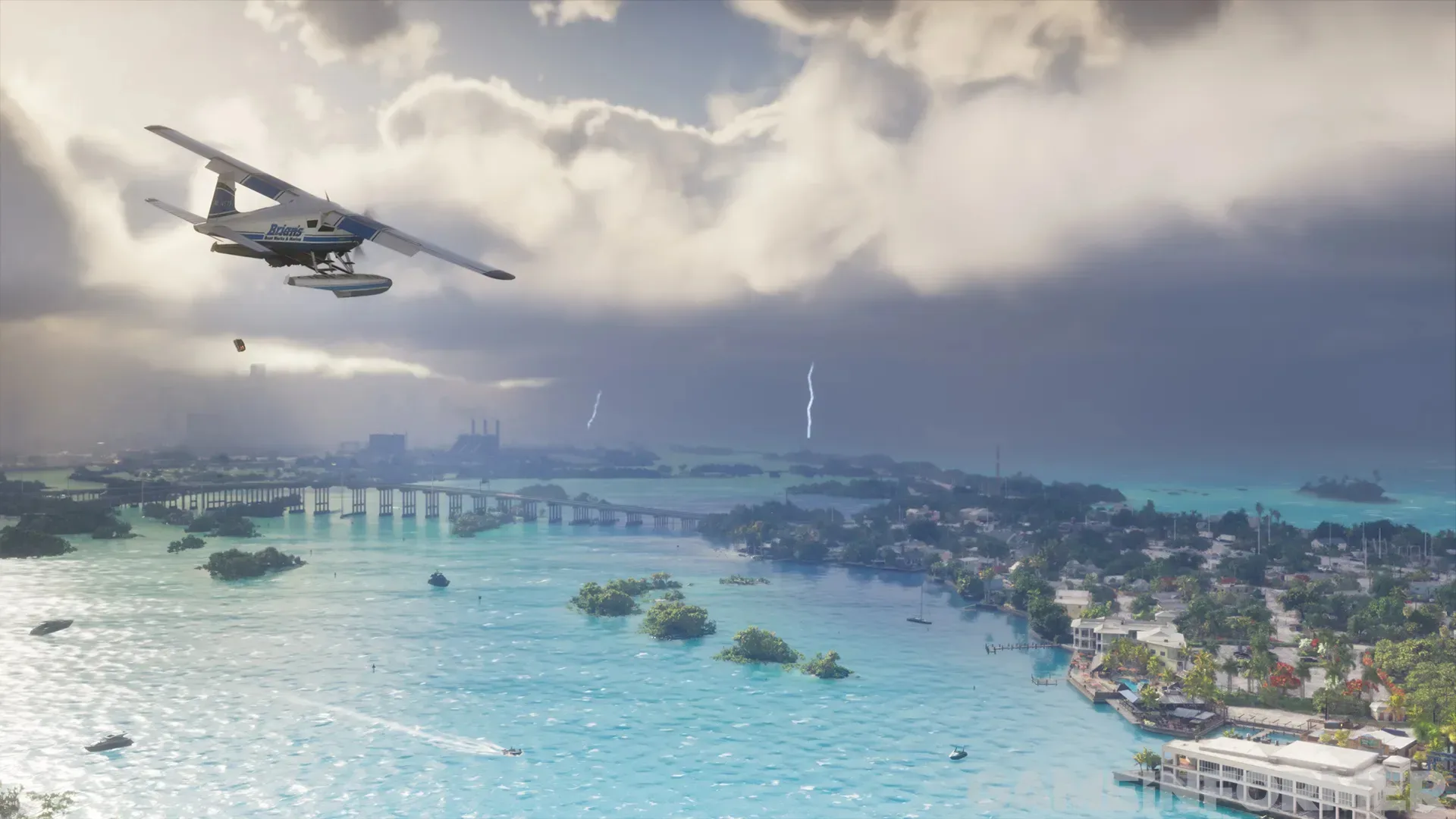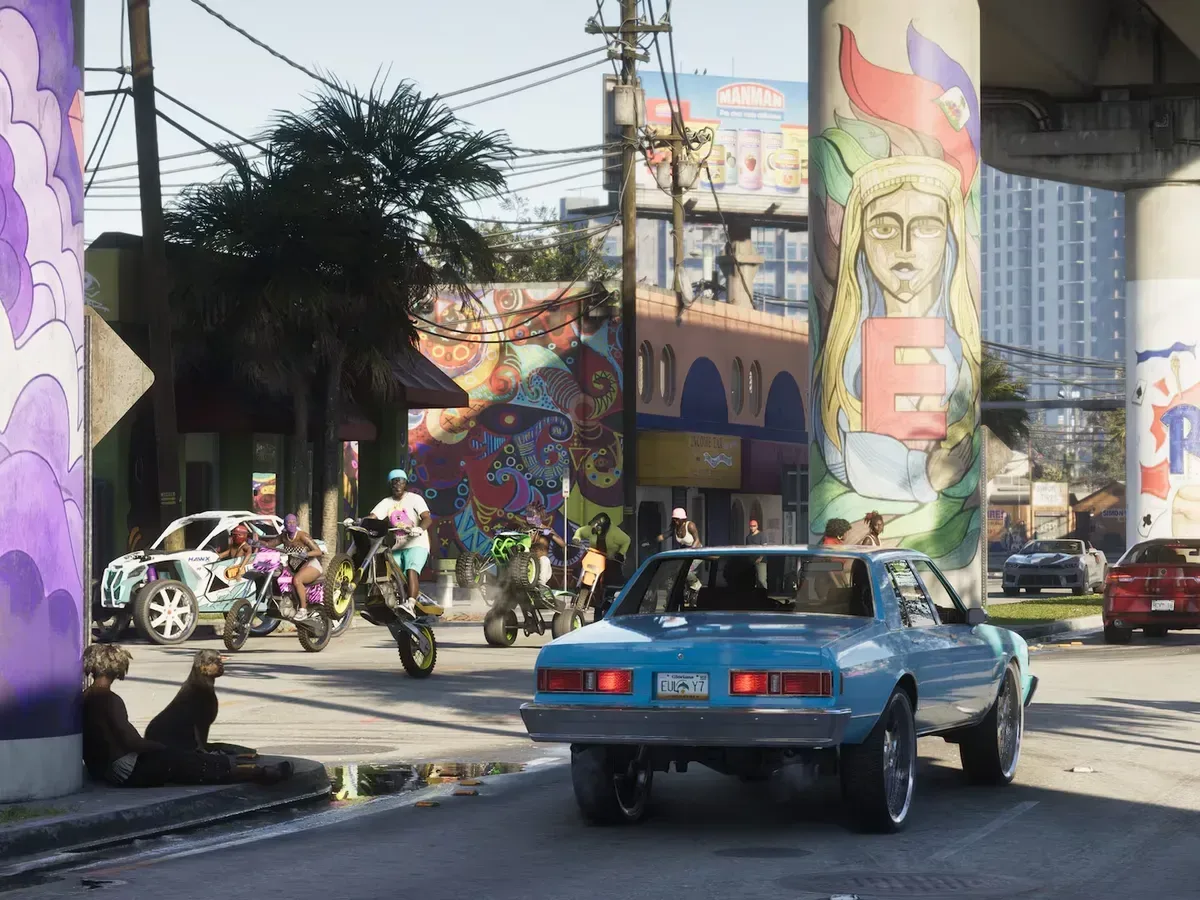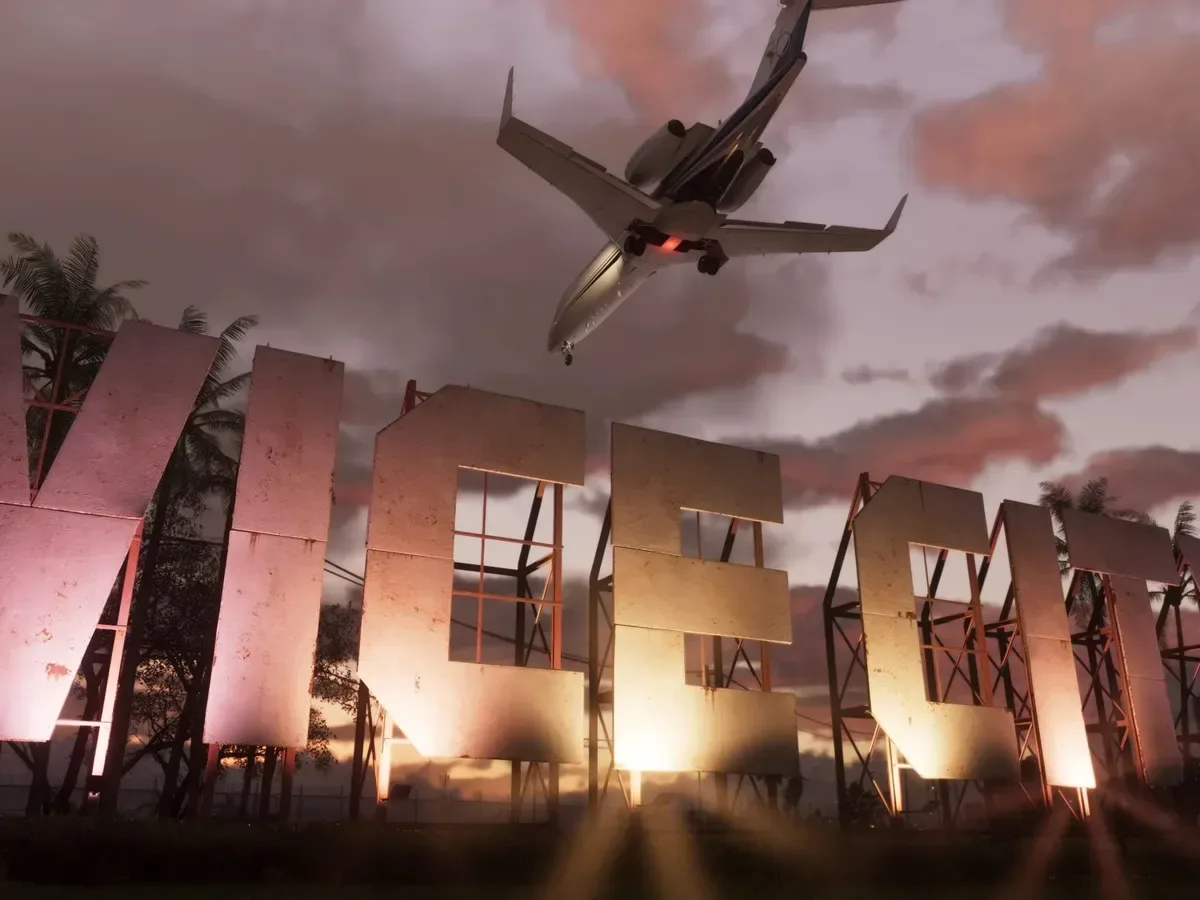
Grand Theft Auto 6 is set to make Leonida’s forecast considerably more threatening than the usual video-game drizzle. Rockstar has confirmed that the open world will simulate tropical storms and hurricanes alongside localized rainfall, moving cloud formations and wet environmental surfaces that remain after a storm has passed.
The details put weather closer to being a map-wide system rather than a simple visual filter. Rain in one part of Leonida may not mean rain everywhere else, while a storm’s aftermath can remain visible in the form of damp ground and persistent puddles. Rockstar also says the game will feature rainbows under suitable lighting conditions.
That is a particularly fitting direction for Leonida, GTA 6’s Florida-inspired setting. The newly confirmed extremes—tropical storms and hurricanes—suggest Rockstar is not treating the setting’s climate as background decoration. At the same time, players should be careful not to assume unconfirmed consequences: flooding, falling trees, damaged buildings and changes to driving or missions have not been detailed.
A more local and lasting weather system
Owen Shepherd, Rockstar’s vice president of art for lighting and rendering, said the weather technology has been re-engineered to make conditions “much more localized and persistent.” He also described fully dynamic cloudscapes rolling across the map.
In straightforward terms, localized weather means conditions can vary from place to place rather than changing identically across the entire world. A player may encounter rainfall in one area while a nearby location is clear and sunny. Persistence, meanwhile, refers to effects that do not immediately vanish when the rainfall stops. The reported examples are wet ground and puddles left behind after showers.
The distinction matters because it can make travel through an open world feel less stage-managed. Rather than watching a universal switch flip from sunny to rainy, players could see cloud cover arrive, rain affect a particular region and the landscape retain visual evidence that the storm occurred. Dynamic cloudscapes are the sky-side component of that idea: cloud formations move across the world instead of functioning as a fixed backdrop.
Rockstar’s stated rain details extend beyond the water itself. Recently soaked surfaces will remain wet, puddles will persist after a storm, and lighting can produce realistic rainbows in the appropriate circumstances. Those touches are visual, but they can make the time immediately after rain as distinct as the storm itself—whether players are walking a street, driving through the city or looking across the wider landscape.
What the hurricane description actually confirms
The more dramatic part of Rockstar’s update is the confirmation of simulated tropical storms and hurricanes. Shepherd described a weather state built from heavy clouds, strong winds, dense atmospheric effects and substantial rainfall. He also pointed to water running from roof edges and lampposts, thunder rumbling, and lightning illuminating clouds.
Related coverage includes GTA 6's Leonida Will Face Tropical Storms and Hurricanes.
Atmospherics is a broad rendering term for the visual qualities of air and weather—such as haze, rain density, cloud volume and the way light behaves through those conditions. In a storm sequence, it is one of the tools that can make distance, visibility and the scale of the sky feel different, even before considering the rain falling around the player.
The announced details therefore support a specific expectation: hurricane conditions should look and sound materially different from ordinary rain. Heavy cloud cover, wind, intense precipitation, surface runoff, thunder and lightning are all part of the stated picture. The report does not establish how frequently these events occur, how long they last, whether they are scripted or naturally occurring, or whether players can influence them.
It also does not establish physical destruction. The phrase that these storms will wreak havoc on the environment is evocative, but Rockstar’s concrete examples focus on rainfall, wind, clouds, water runoff, wet surfaces, thunder and lightning. Until the developer shows the system in action or provides more specifics, it would be premature to claim that hurricanes will flood roads, knock down structures or alter the map permanently.
Scale raises the technical ambition
GTA 6 is expected to have a map three times larger than the worlds of both Grand Theft Auto V and Red Dead Redemption 2. That scale makes regional weather especially notable. A large world provides room for a storm front to move across an area while another district remains dry, which is precisely the kind of contrast a localized system is designed to deliver.
It is important, however, to separate scale from a feature guarantee. A bigger map does not by itself prove that every storm will be simulated at the same level in every location, nor does it tell us how visible changing weather will be during every activity. What Rockstar has confirmed is the intention to support moving cloudscapes and localized, persistent conditions across Leonida.
For players, the immediate practical implication is observational rather than mechanical. Those who enjoy free-roaming may have more reason to pay attention to the sky, revisit locations after a downpour, or travel between regions to see different conditions. Photography-minded players may find the combination of wet streets, puddles, dramatic clouds, lightning and possible rainbows useful for creating contrasting scenes. None of that requires a new gameplay rule to be valuable; it is a consequence of an open world that visibly changes around the player.
Weather may also strengthen the identity of Leonida. The setting’s climate has already been framed as varied and prone to sharp shifts, and tropical weather gives Rockstar a way to express that character visually across both everyday moments and major storms. The new details complement other Leonida information, including the focus on weather, wildlife and player choice discussed in our look at GTA 6’s wider world design.
What remains unknown before launch
There is currently no video demonstrating GTA 6’s storms, rainfall persistence or hurricane simulation. That leaves several meaningful questions open:
- Whether rain and standing water affect vehicle handling or pedestrian behavior.
- Whether tropical storms and hurricanes arrive dynamically, occur during particular story moments, or use a mixture of both approaches.
- Whether strong winds have physical effects on vehicles, vegetation or loose objects.
- Whether storms can interrupt activities, change mission conditions or affect access to areas.
- How long wet ground and puddles remain, and whether their appearance changes with new weather or time of day.
These are sensible questions prompted by the announcement, not features Rockstar has confirmed. The available information provides a compelling visual and environmental baseline, but it does not yet define the gameplay systems attached to it.
Still, the confirmed features point to a weather model with more continuity than a brief rain animation. If Leonida’s cloudscapes travel across the map, rain remains on surfaces after it stops, and tropical systems bring an escalation of wind, rain, thunder and lightning, GTA 6 could make checking the weather part of simply moving through its world.
Grand Theft Auto 6 launches November 19.