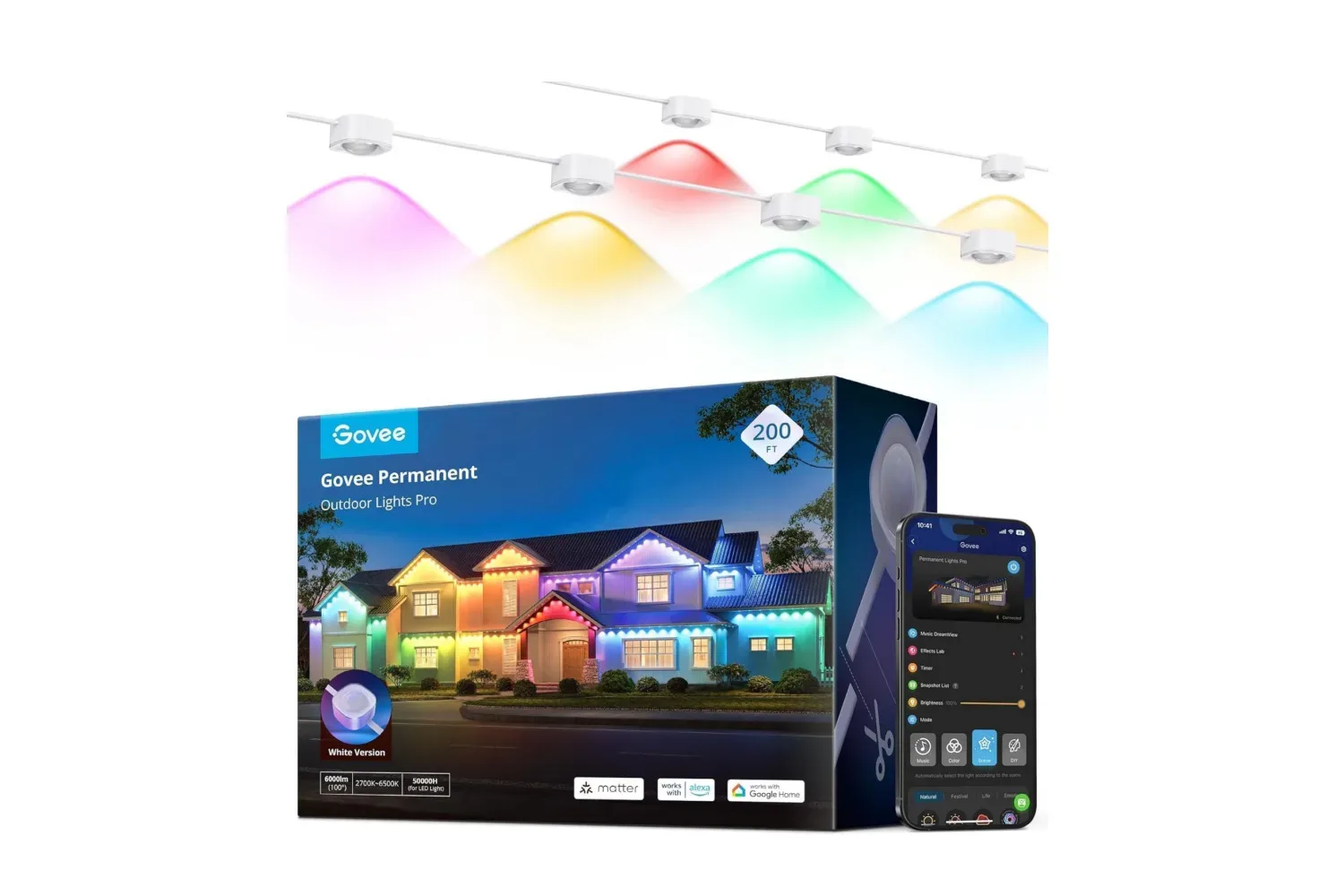
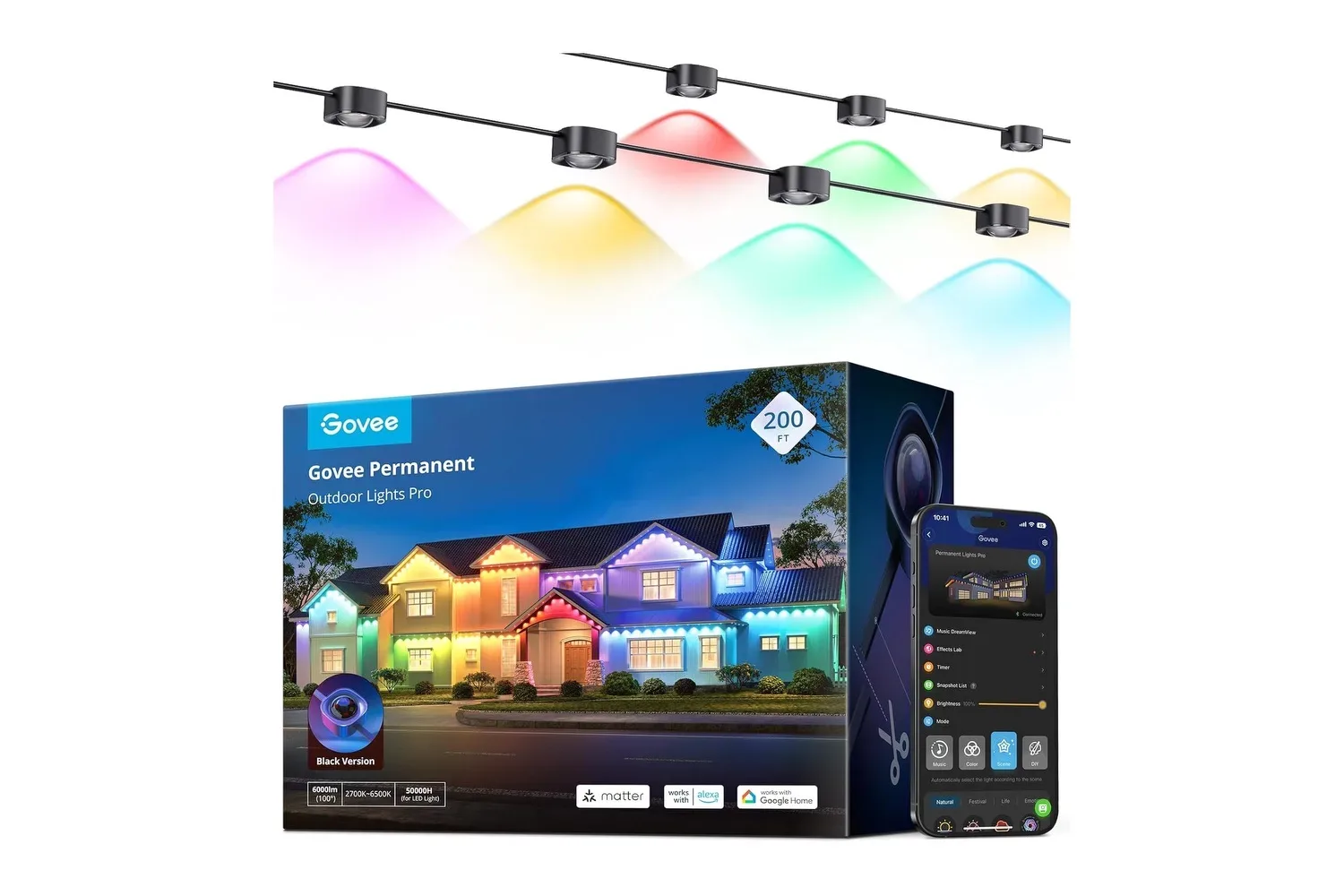
Govee’s 200-foot Permanent Outdoor Lights Pro package is listed at $450, reduced from $760. That is a $310 difference, or 41% off the stated regular price, for a roofline-focused smart-lighting system intended to remain installed throughout the year rather than being put up and removed for each holiday season.
The kit is positioned as a single setup for two very different jobs: color-heavy holiday displays and everyday exterior accent lighting. It includes 120 LEDs across 200 feet, with color emitters alongside dedicated warm and cool white LEDs. The distinction matters. Rather than relying on colored LEDs to approximate white, the system includes separate white lighting hardware intended to produce more natural-looking white illumination across a 2700K-to-6500K adjustment range.
For households that want a programmable exterior without routinely climbing a ladder to hang temporary strings, the central appeal is permanence. The lights are designed to mount along a roofline, then change appearance through app controls, automation, or compatible voice-control platforms. A calm warm-white porch setting can be replaced by holiday colors without changing the physical installation.
What the 200-foot kit includes—and what the specifications mean
At 200 feet, this is the larger roofline run described for the Permanent Outdoor Lights Pro. Govee says the package includes the components needed for installations longer than 150 feet, including the required driver module. Since homes vary substantially in roof shape, the headline length should be treated as available coverage rather than a guarantee that every property will fit without planning. Corners, peaks, gaps, cable routing, and the position of the control hardware all affect a real installation.
The lights can be trimmed to suit a specific roofline, which is useful when a full 200-foot run would leave excess length. That flexibility should not be mistaken for a reason to skip measurement. Cutting a permanent lighting run is a consequential step, so buyers should map the route and account for the installation points before committing to a final layout.
Each light is rated for up to 50 lumens. Lumens measure the amount of visible light produced, but they do not by themselves say how a roofline will look from the street. Mounting height, fixture spacing, ambient lighting, surface color, and the selected color or white-temperature setting influence the visible result. The supplied figure nevertheless gives prospective buyers a useful indication that these are intended as decorative and accent fixtures, including lighting around pathways and porches, rather than a substitute for a dedicated floodlight.
The white-light temperature range runs from 2700K to 6500K. The “K” stands for Kelvin, a scale used here to describe the appearance of white light rather than its physical heat. Near 2700K is commonly perceived as warmer and softer, while 6500K appears cooler and more daylight-like. This means the kit can lean toward a subdued evening accent or a crisper white exterior look, in addition to its color modes.
Color effects are more than a single-string color change
Govee identifies the lighting as RGBWWIC. In practical terms, the RGB portion refers to red, green, and blue color lighting; the added white elements provide separate warm and cool white output. The IC portion denotes individually controllable lighting sections, allowing multiple colors to appear along the run at the same time instead of forcing every light into one uniform color.
That architecture is the reason a roofline can support multicolor patterns and moving effects, rather than simply switching from all-white to all-red or all-green. The companion app includes 75 preset scenes and tools for making custom scenes with selected colors and motion effects. Music-reactive operation is also included, allowing effects to respond to audio during a gathering.
The practical advantage of dedicated white LEDs is just as important as the headline color count. Many color-capable products can render a white-like color by combining red, green, and blue. This kit’s distinct warm and cool white emitters are intended to avoid the noticeably tinted or orange-looking result that can occur when a product tries to make white purely from its color channels. For a house that will use the system outside the holiday window, that makes the everyday setting a core part of the package rather than an afterthought.
For event-oriented programming of a different kind, November 20 also brings The Horror Game Awards’ worldwide stream, an occasion where a darker custom exterior palette could suit a watch party. The lighting kit’s app-based color controls are built for exactly this kind of rapid seasonal or occasion-based change, though the available scenes and custom controls should be considered separate from any official event affiliation.
Weather ratings and operating limits deserve close attention
Permanent exterior equipment must contend with sun, rain, dust, and seasonal temperatures, so the stated durability specifications are significant. The control box carries an IP65 rating, while the lights themselves are rated IP67. An IP rating, or Ingress Protection rating, describes resistance to solids and water under its defined test conditions. The first number addresses protection from dust and other solid particles; the second concerns water.
On the figures provided, IP65 for the control box means it is protected against dust and water jets, while IP67 for the lights indicates dust protection and a higher stated water-resistance classification. Those numbers should not be simplified into a universal claim that every part of the system can be treated identically. The controller and the light string have different ratings, and the installation needs to respect the equipment’s instructions, cable connections, and placement requirements.
The lights are also described as UV-resistant and able to operate from -4°F to 140°F. UV resistance matters for a product that may remain exposed to direct sunlight year after year. The stated temperature range provides a defined operating boundary, not an assurance that every climate, roof material, or local weather condition will produce the same long-term result. Buyers in very hot, very cold, or unusually exposed locations should compare their local conditions with those limits before treating a permanent install as a simple fit.
Installation is designed to be fixed, not temporary
The mounting method uses VHB adhesive tape and clips, with additional adhesive included in the package. Govee says each light can take roughly eight seconds to install, and segments connect through waterproof screw connectors. That claimed per-light figure describes the act of mounting an individual light, not the entire job. Measuring, cleaning the mounting surface, laying out cables, working around roofline changes, connecting segments, and configuring the finished system are all separate parts of a permanent installation.
VHB refers to a very-high-bond adhesive tape format. It is an appropriate detail to consider because adhesive performance depends heavily on preparation and the surface to which it is applied. A roofline product also involves elevated work. The hardware may reduce repetitive seasonal hanging, but it does not remove the need for careful up-front planning or safe access during the initial fitment.
The waterproof screw connectors matter because the system is made from joined sections. They are intended to secure the connections while preserving the weather-oriented design of the run. Buyers should confirm the planned path before making any cuts and before finalizing where the controller will sit, particularly on a long installation that exceeds 150 feet and uses the included driver module.
App, voice, automation and motion options
Control is available through Wi-Fi and Bluetooth, as well as the Govee Home app. The system also lists compatibility with Amazon Alexa, Google Assistant, Apple HomeKit, and Matter. Matter is a smart-home interoperability standard meant to help compatible devices work across supported smart-home ecosystems. In day-to-day use, that can mean controlling the lights alongside other compatible home devices rather than keeping all operations isolated to a single lighting app.
Voice control is useful for simple changes, while schedules are more relevant to a permanent exterior product. The lights can be programmed to turn on at a chosen daily time, including around the time a household normally arrives home. A separately sold Govee Outdoor Motion Sensor can also trigger the lighting when somebody approaches the front door.
Those options give the kit a role beyond a December display. One person might reserve elaborate multicolor scenes for holidays and gatherings, then use a steady warm-white schedule for ordinary evenings. Another may prioritize approach lighting through the optional sensor. The important practical point is that the motion sensor is not included, so buyers interested in that behavior need to factor in the separate accessory.
The deal in context
At $450, the listed sale price puts this 200-foot, 120-LED package $310 below its stated $760 regular price. The three-year warranty adds a defined period of coverage to a product meant to stay outdoors, though it is not a substitute for checking the applicable warranty terms and installation guidance.
This is best viewed as a long-term exterior-lighting purchase rather than a disposable holiday string. The value proposition rests on installing once and then moving between dedicated white accent lighting, seasonal palettes, custom animations, scheduled operation, and voice or smart-home controls. For buyers whose roofline suits a 200-foot run and whose local conditions fall within the listed operating range, the sale reduces the upfront cost of that permanent approach. For anyone who only needs a brief one-season decoration, the mounting commitment and size of the system remain considerations even at the reduced price.
Shop the products
Check current price, model and availability at the retailer.