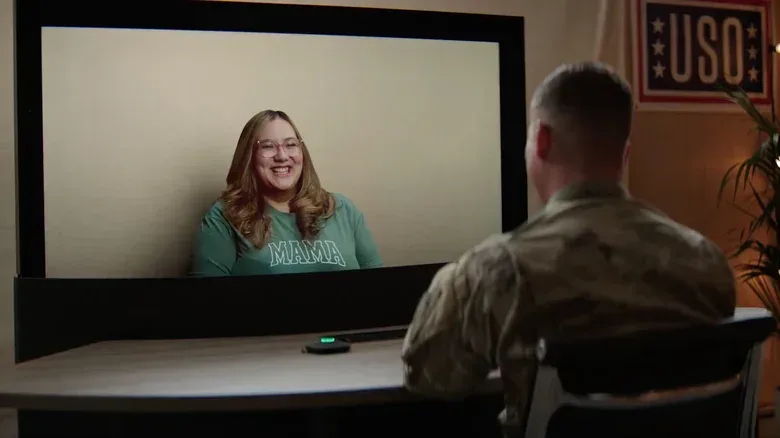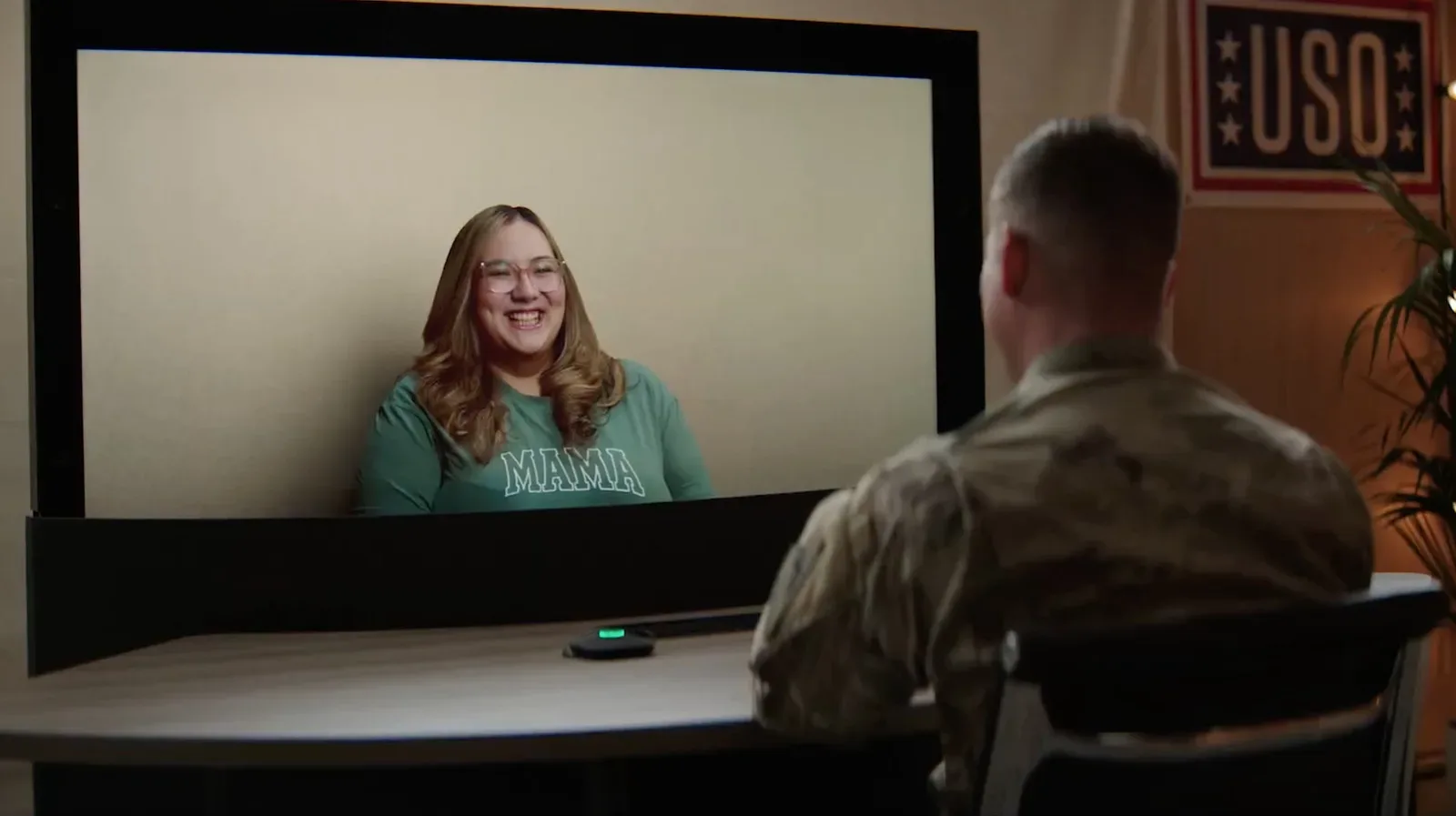
Google’s Beam 3D video conferencing technology is being deployed at 20 United Service Organizations locations around the world, giving active military personnel a new way to speak with family members from afar. It is a serious use case for a system built to make remote calls feel less like two people trapped in tiny rectangles and more like a shared, face-to-face conversation.
Beam is the new name for the technology previously known as Project Starline. Its central promise is ambitious but easy to understand: instead of a conventional flat video image, the system presents a real-time, lifelike 3D representation of the person on the other end of the call. For families separated by service and distance, even a modest improvement in a conversation’s sense of presence could matter a great deal.
From a Fort Bliss pilot to 20 USO sites
The wider USO deployment follows a pilot that linked a Beam installation at Fort Bliss, Texas, with another system in Poland. That test demonstrated the technology across the kind of geographic separation for which it is intended, and Google has released a promotional video showing soldiers using the platform.
The announcement confirms deployment at 20 USO locations, but it does not identify every location, specify when each installation will become usable, or establish how access will be scheduled. Those are meaningful practical details for any service intended to connect military members and their families. A high-end conferencing rig can be exceptionally compelling and still have limited reach if demand, appointment windows, staffing or available facilities are constrained.
Still, the move from a single pilot connection to a 20-location deployment is notable. It places Beam in a setting where video calling is not merely a corporate convenience or a flashy demonstration. The purpose is personal communication across long distances, where seeing a relative as naturally as possible is the point rather than an added feature.
What makes Beam different from an ordinary video call?
Beam combines six cameras, AI-assisted video models and a specialized light display to render participants as lifelike 3D images in real time. It also uses head tracking and spatial audio. Each part addresses a limitation of conventional video conferencing, which typically turns a person into a flat, fixed image inside a screen.
Six cameras and AI-assisted video models
Multiple cameras capture more visual information about a person than a single webcam generally can. Beam’s AI-assisted video models then help create the 3D presentation from that captured information. In plain terms, the system is working to give the remote participant shape and depth rather than presenting only a front-facing image.
That does not mean a call becomes science-fiction teleportation, despite the temptation to describe every three-dimensional display as a hologram and immediately wait for somebody to say “Help me.” Beam is a sophisticated conferencing system, not a physical relocation device. Its achievement is the visual impression that someone is present at life size, delivered in real time.
Head tracking
Head tracking follows where a viewer is positioned and adjusts the displayed perspective accordingly. That is important because human perception expects nearby objects and people to shift in appearance as we move. When the perspective responds to the viewer, the display can better preserve the sensation of looking at a person across from them rather than at a static picture.
Spatial audio
Spatial audio is designed to make sound seem located in space. In this context, it works alongside the visual presentation so that a speaker’s voice is connected more naturally to their apparent position. Audio cannot manufacture closeness on its own, but it can prevent a convincing visual image from being undercut by voice that seems detached from the person speaking.
The elusive ingredient: eye contact
One of the persistent oddities of video calls is eye contact. People usually look at the other person’s on-screen face, but a camera sits elsewhere, so the remote participant may perceive them as looking slightly away. That small mismatch is familiar enough that most users stop noticing it, but it can make conversations feel subtly less direct.
Beam is designed to improve that sense of mutual gaze. Earlier impressions of the system described the person on the other end as life-sized and gave the strong sense that the two people were making eye contact and holding it. The three-dimensional effect was also described as convincing when the participant held an apple within the frame, an everyday object that makes depth and scale easier to judge than a face alone.
For a deployment centered on communication with loved ones, that quality may be more consequential than the system’s sheer novelty. A familiar face, a hand gesture and an object held toward the camera are all basic things on a normal call. If a 3D setup makes them register more naturally, the conversation can feel less mediated by a device.
Why the USO setting fits the technology
Video calls are already an established way to keep in contact across borders and time zones. Beam does not replace the accessibility of a phone call or standard video chat; the available details instead point to a more specialized experience involving substantial capture and display hardware. That makes a shared-location deployment sensible. The USO sites can host the purpose-built systems rather than expecting individual users to own complicated equipment.
The trade-off is straightforward. A conventional call is portable, immediate and familiar. Beam appears intended for moments when a person can travel to a participating location and wants a more immersive conversation. Those are different tools for different circumstances, and neither needs to invalidate the other. A brief standard call can still be invaluable; a more spatial, life-size conversation may be especially meaningful when the chance to connect is limited.
It also offers a reminder that the most important applications of immersive display technology may not be games, movies or novelty filters. The technical work—capturing a person from multiple angles, modeling them in real time, tracking a viewer and placing sound—serves a simple social goal: making a distant person feel a little less distant.
Does this mean Beam is headed everywhere?
Not necessarily. The USO rollout is an expansion beyond the Fort Bliss-to-Poland pilot, but it does not confirm an imminent mass-market launch or a broader consumer rollout. Google has not provided those details here, and the equipment described is clearly more involved than an ordinary laptop webcam.
That uncertainty is worth keeping separate from the significance of the deployment itself. Twenty locations are enough to show a practical use outside a lab-style demonstration, while still being far from the scale of a ubiquitous communications platform. For now, Beam’s story is one of targeted placement: advanced 3D conferencing directed toward people for whom long-distance conversations can carry unusual emotional weight.
As other communications technologies compete on coverage, connection quality and convenience—issues also relevant in the difference between Starlink and 5G home internet—Beam is attempting to compete on presence. The question is not only whether people can connect, but whether the connection can better approximate being in the same room. Its USO deployment gives that question a particularly human test.