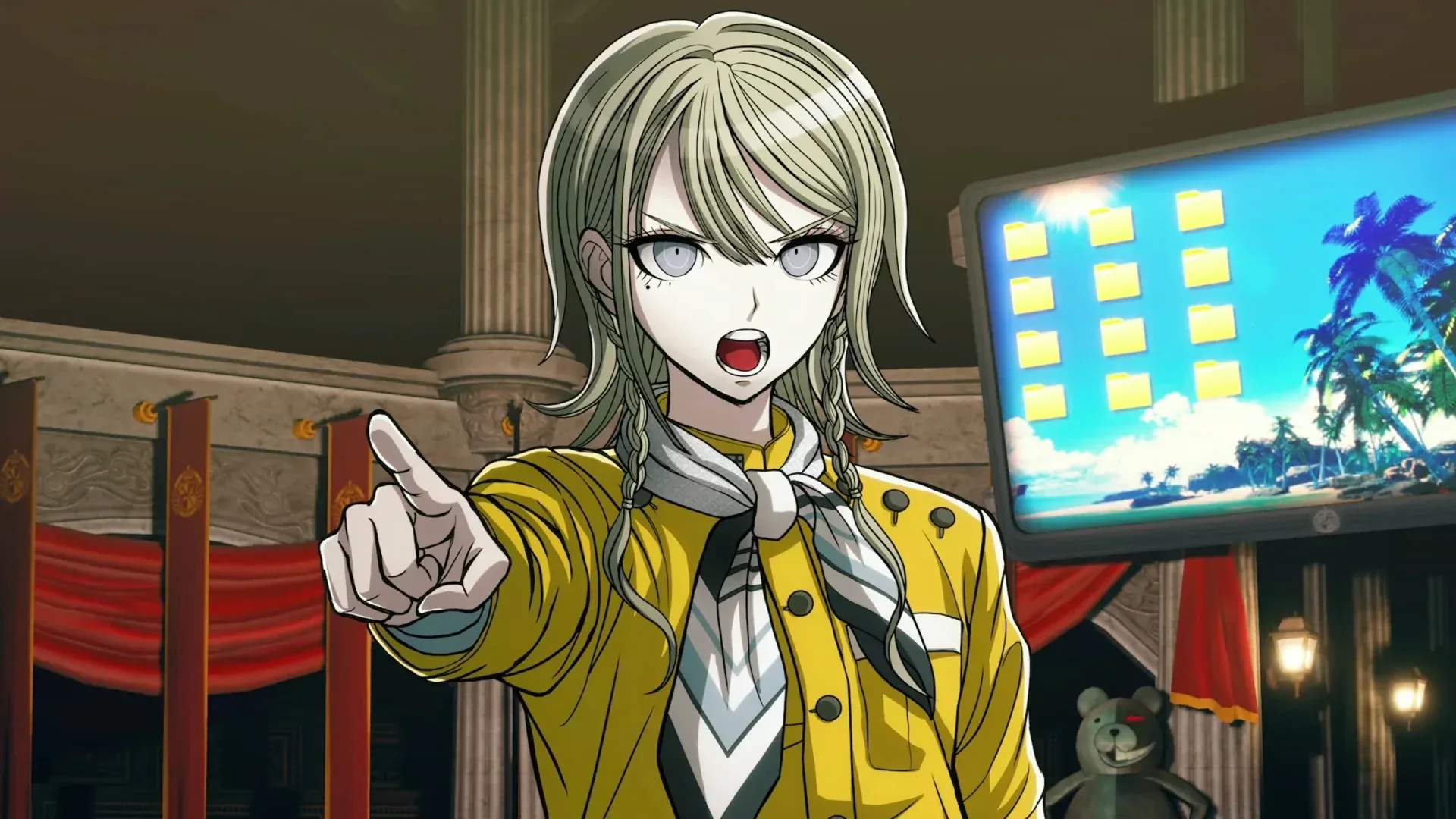
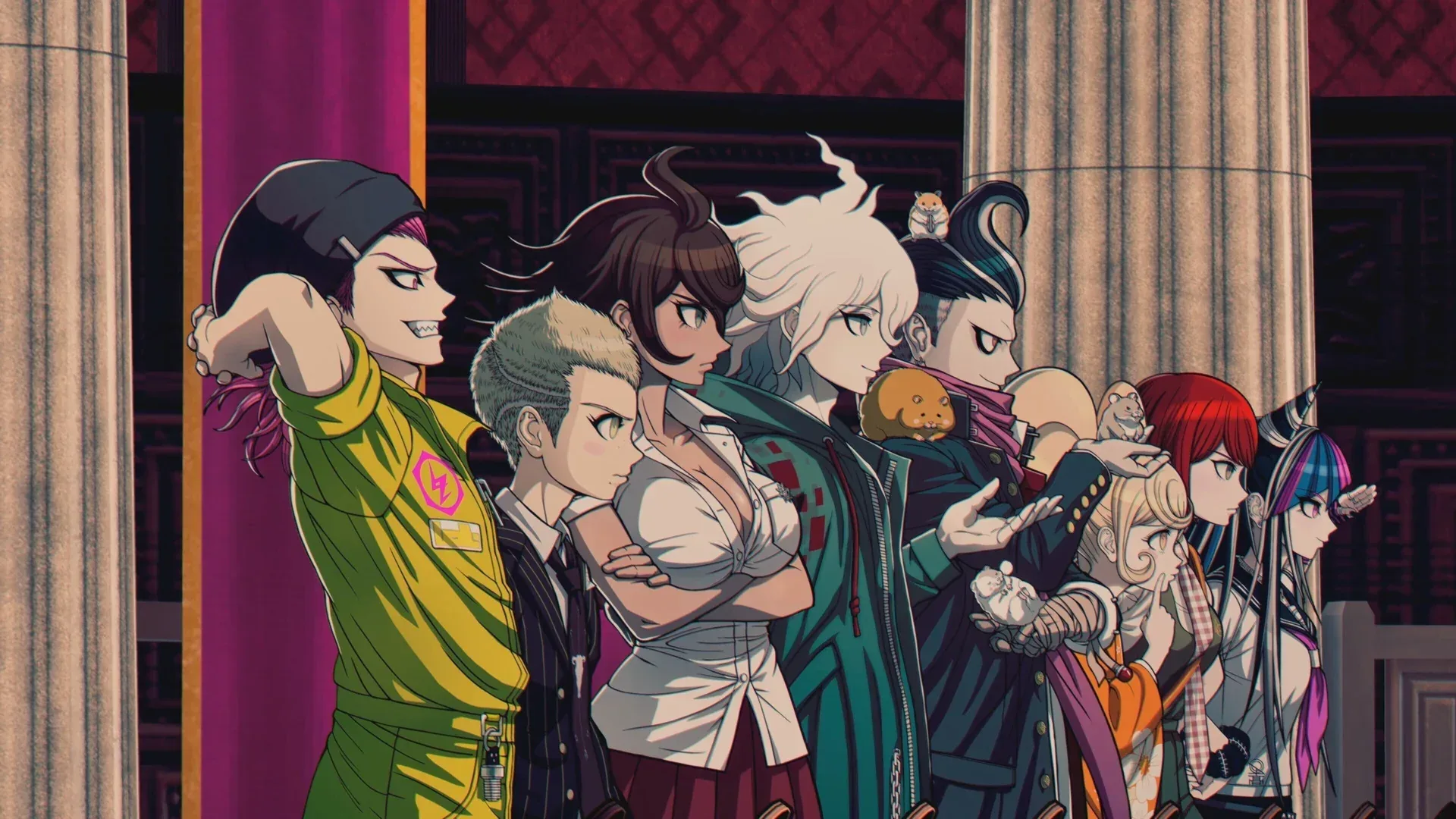
Danganronpa 2×2 is already inviting a very particular kind of pre-release detective work: not merely comparing a remake’s new visuals with the original, but trying to work out who dies first in its new murder-mystery route. The game includes a remake of Danganronpa 2: Goodbye Despair, alongside Slayhem, an alternate route with a new sequence of murders, different culprits, the returning cast, and one additional character.
That premise changes the usual trailer-viewing routine. For a conventional remake, fans might focus on art direction, character models, menus, or how faithfully familiar scenes return. Slayhem offers an unknown case structure, so players are scrutinizing trailers and screenshots for signs that a character may be absent, alive, implicated, or headed for a particularly ominous Monokuma set piece.
There is no confirmed first victim or culprit in the material available. That distinction matters. What is circulating is fan inference: close reads of promotional footage, not a verified solution to the opening case. And in a series built around deception, evidence from marketing deserves an especially large asterisk.
Why Slayhem makes familiar characters uncertain again
The core setup of Danganronpa is a closed murder mystery. A group of high-school students is trapped by Monokuma, an evil animatronic teddy bear, and forced into a killing game: murders occur, survivors investigate, and class trials are held to identify the responsible person. The structure makes character survival part of the mystery’s machinery. Every new case alters the group, the available testimony, and the pool of possible suspects.
For people who know Goodbye Despair, a straightforward remake would carry the baggage of prior knowledge. Slayhem, by putting new murders and culprits around the same cast, removes much of that safety. A character’s established fate in the original no longer settles their prospects in the new route. That is the central reason an innocuous line of dialogue or a single group shot can become a subject for frame-by-frame analysis.
The added character also complicates the board. Their presence means the route is not simply a shuffled retelling in which every old narrative function is automatically preserved. It does not prove any particular theory, but it gives the new scenario another variable: someone whose role, alliances, and chances of survival are not known from the original game.
The clues viewers think they have found
Theories are drawing on several categories of apparent evidence. None is definitive on its own, and several can be explained by trailer editing, incomplete scenes, or deliberate misdirection. Still, they show how murder-mystery fans approach an unreleased game when a small amount of footage must carry a lot of narrative weight.
Dialogue that appears to come from a class trial
A voice line that sounds like an argument over a suspect may suggest that the speaker survives until the first trial. In Danganronpa terms, a class trial is the group’s formal debate and deduction sequence after a murder. If a character is clearly participating in that discussion, the natural conclusion is that they are not the victim of the case being debated.
Related coverage includes Danganronpa 2×2 Trailer Clues Have Fans Hunting for Slayhem's First Victim.
But “clearly” is doing serious work there. A promotional trailer can cut audio and visuals together from different contexts. A line might not belong to the scene it is placed over. It may also relate to a later or earlier point than viewers assume. The practical takeaway is that dialogue can establish possibilities, but it cannot securely establish a timeline unless the footage itself makes that timeline unambiguous.
Prominence and absence in promotional material
Fans are also weighing which characters appear repeatedly and which seem unusually absent. A cast member appearing in a substantial number of shots could be read as evidence of early survival; a classmate missing from trial-oriented footage could be read as a warning sign.
That is a reasonable first pass, but promotional prominence is not the same as narrative longevity. Marketing material can foreground popular designs, recognizable personalities, dramatic reactions, or scenes that best communicate the game’s tone. Conversely, keeping a character scarce can be a way to preserve suspense without confirming that they are the opening casualty. Absence is a question worth noting, not a verdict.
Sprites, names, and puzzle interfaces
Other viewers are looking at visual details: whether a character sprite differs from surrounding art, whether a name is visible in a logic-puzzle segment, or whether a user interface seems to narrow down the people involved in a case.
A sprite here means the character artwork used in dialogue scenes, usually changing expression or pose as a conversation unfolds. An unusual-looking sprite could indicate a meaningful condition, a temporary asset, a scene-specific presentation choice, or simply the limitations of a brief trailer frame. It is not automatically a hidden declaration of a death.
Likewise, a name in a deduction interface may look revealing, but viewers need to know what that particular puzzle represents before treating it as evidence. A name could denote a witness, a topic of discussion, a suspect, a victim, or an example used to teach a mechanic. Without the surrounding context, the interface may tell fans that the character is relevant to a scene while saying very little about why.
Execution imagery and Ultimate talents
Potential execution footage is another rich target for speculation. In Danganronpa, executions are stylized punishments whose imagery can be tailored around an individual’s Ultimate talent, the standout specialty that defines a student’s public persona. A trailer image that seems unusually personal to one character can therefore invite a direct conclusion: this must be their execution.
It might be. It might also be an intentionally suggestive montage, a misleading visual association, or material whose actual context is different from the one inferred by viewers. The basic rule is simple: the more perfectly a trailer seems to answer a major mystery, the more reason there is to ask whether it is being used to steer the audience toward that answer.
The series has given fans reason to distrust trailers
This suspicion is not paranoid pattern-seeking without precedent. Danganronpa V3: Killing Harmony, identified as the most recent mainline entry, used altered trailer footage that placed its eventual first victim in situations they did not survive to experience in the final game. That history sharply limits what can be safely concluded from a character appearing to participate in a scene.
The important word is doctored. It refers to footage modified for promotion rather than presented as a straightforward preview of the final story sequence. In a game where the marketing itself can participate in the misdirection, trailer continuity is not necessarily canonical continuity. A character might be shown in a later-looking setting because the edit wants to conceal the actual order of events.
This makes Slayhem theory-crafting entertaining precisely because it resists being solved cleanly. Fans can construct a process of elimination, compare appearances across trailers, and map possible trial participants, but they are trying to solve a mystery with evidence that may have been selected—or changed—to produce the wrong answer.
How to follow the theories without spoiling the game for yourself
For players who want in on the detective work without letting it dominate the eventual playthrough, it helps to separate observations from conclusions.
- Keep a claim labeled as a theory. “This character is absent from a trial-like shot” is an observation. “This character is definitely the victim” is a conclusion that needs much more support.
- Do not assume trailer chronology. Scenes, dialogue, and interface clips may not be presented in the order players will encounter them.
- Treat apparent execution footage cautiously. A tailored visual can be strong bait, especially in a series that understands its audience knows the conventions.
- Be mindful of the original game’s spoilers. Slayhem uses the returning cast but is described as having new murders and culprits; knowledge of the older story is not a guaranteed map for the new route.
- Remember that a good mystery can accommodate several plausible readings. A theory that explains one screenshot but fails against another is not necessarily proof of a hidden answer; it may simply show how little context the footage provides.
There is a broader lesson for any narrative game with a secret-heavy campaign. Fan attention is not just looking for technical upgrades or release-date reminders; it is testing whether the promotion has accidentally exposed story structure. Developers can respond with carefully chosen omissions, disconnected lines, and scenes designed to look more revealing than they are. Danganronpa’s past use of altered footage means viewers have a concrete reason to approach every “gotcha” clue with caution.
That dynamic also separates informed speculation from a spoiler claim. The former can be a communal way to engage with the game’s detective premise before release. The latter pretends uncertainty has disappeared when it has not. For an adjacent example of how creators can address fan response without letting it dictate a narrative, see this look at a director’s comments on fan feedback and story direction.
Release platforms and the remaining unknowns
Danganronpa 2×2 is scheduled for January 17 on PC, Nintendo Switch, Nintendo Switch 2, PlayStation 5, and Xbox Series X/S. Until players can examine the full Slayhem route, the identity of its first victim—and the first culprit—remains unconfirmed.
For now, the trailers offer an appropriately Danganronpa-like pregame: a crowd of amateur detectives examining names, sprites, voices, and ominous imagery, while knowing the clearest-looking clue may be the one most carefully designed to mislead them.