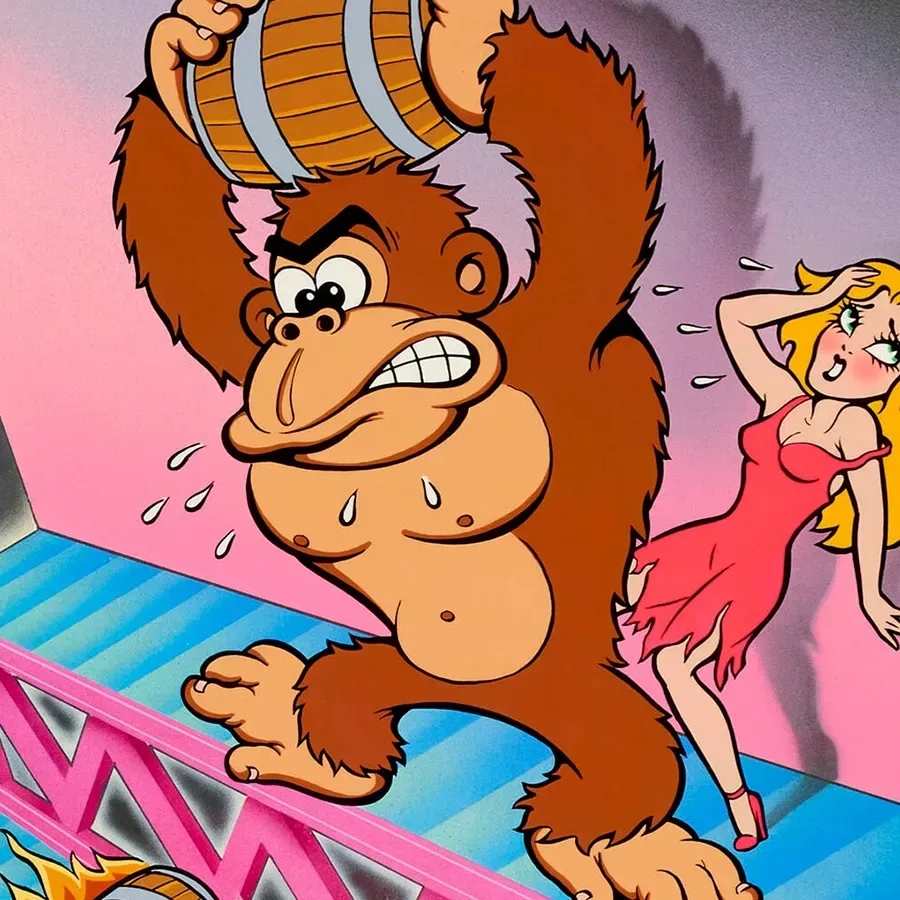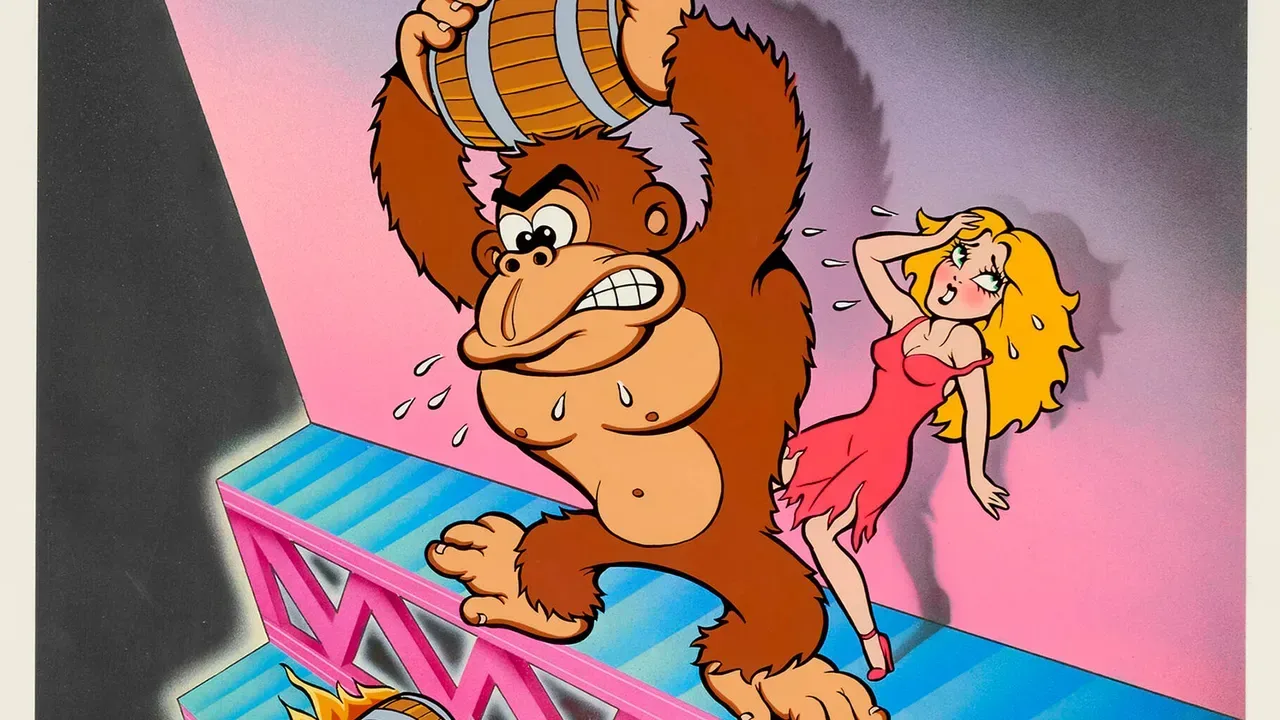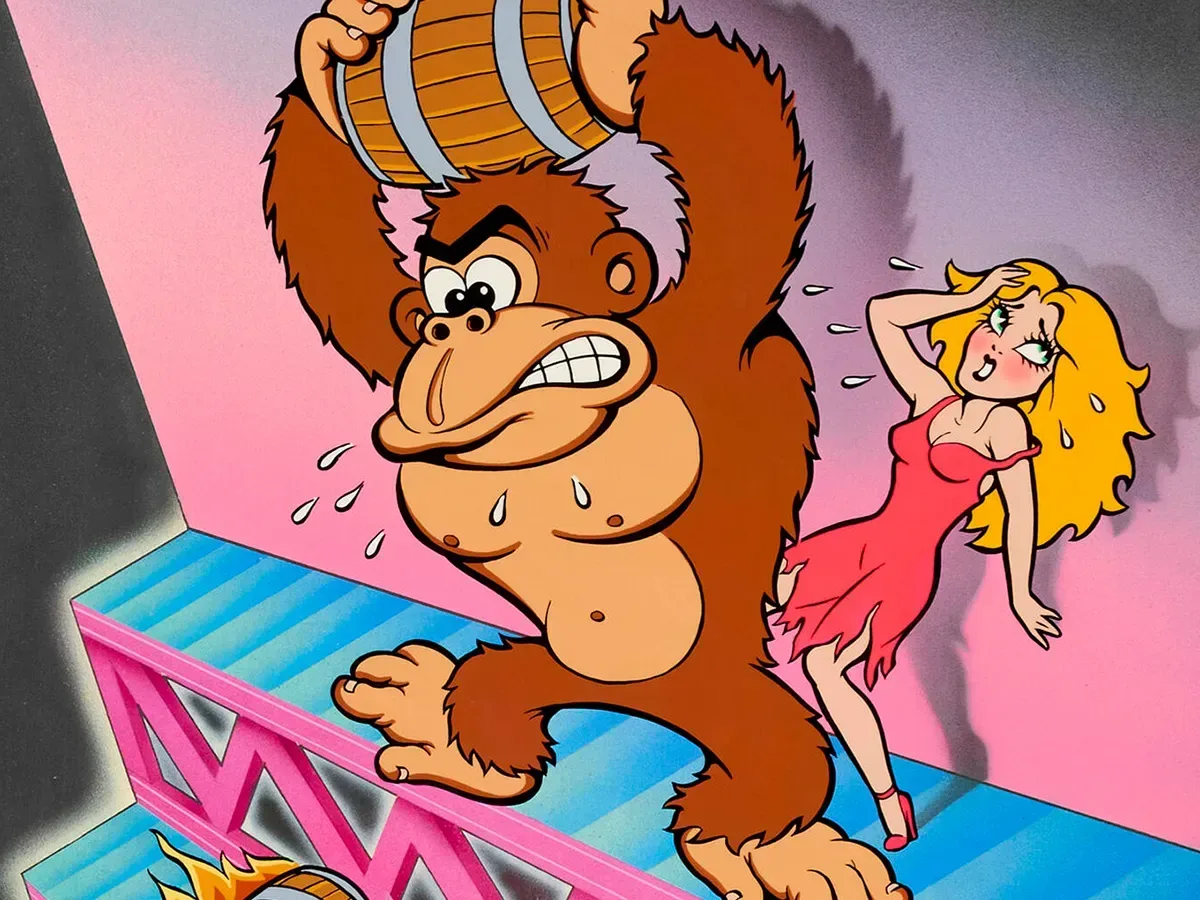
A 1981 promotional poster for the original Donkey Kong has sold for $329,400, a result that establishes a new auction high for original video game art. The significance is not limited to the number: the piece presents Mario at the very beginning of his public history, when the character was still called Jumpman, and it reportedly survived only because a former Nintendo of America employee rescued it from material designated for disposal.
The flyer was created by artist Leslie Cabarga for Nintendo of America’s arcade promotion. Its scene is instantly legible even decades later: Donkey Kong raises a barrel above his head, Jumpman climbs the building toward him, and Pauline waits behind the ape. Those elements are foundational to the game, but the poster preserves them in a pre-iconic form—before Mario’s name became inseparable from Nintendo and before the character’s modern visual identity had accumulated generations of games, merchandise and recognition.
A new benchmark for game art
The $329,400 sale is described as the highest price paid at auction for original video game artwork. It moves far beyond the previous benchmark cited for the original cover art of Prince of Persia, which sold for $63,000 in 2023. The difference is $266,400.
That gap matters because auction records are not simply a ranking of beloved games. They show what bidders are willing to pay for a particular convergence of cultural importance, visual appeal, documented history and survival. This Donkey Kong work connects directly to the arcade game that introduced Mario publicly, depicts its central conflict in a promotional format, and carries a particularly strong preservation story.
In collecting terms, original production or promotional artwork refers to material created for the development, presentation, advertising or distribution of a game rather than a later reproduction made for fans. The distinction can be substantial. A modern reprint can display the same image, but it does not share the same direct production-era connection. Here, the flyer was made as Nintendo of America material for the original arcade campaign.
The disposal story is part of the object’s history
The poster’s path to auction is unusually consequential. Donna Darbous, a former Nintendo of America employee, saved it from a group of items that had been marked for disposal. That account is central to why the sale lands so dramatically: early commercial art and internal promotional material can be vulnerable precisely because it was designed for a short-term purpose. Once a campaign ends, employees may have little reason to view its paperwork, tapes or art as future historical artifacts.
For collectors, this kind of chain of custody is often called provenance. Put simply, provenance is the ownership and history attached to an item. It does not turn every old object into a record-setter, but it can help establish what the object is, where it came from and why it deserves confidence as a period piece. In this case, the reported connection to Nintendo of America and the rescue from disposal give the poster a story inseparable from its value.
It is also a reminder that preservation is not the same thing as predicting a market. The poster was not saved because anyone in 1981 could reliably foresee a six-figure auction result. It was saved before Mario became the face of a multibillion-dollar entertainment franchise. The eventual price reflects how dramatically the cultural meaning of a promotional image can change after the product it advertised becomes historic.
Related coverage includes Original Donkey Kong Poster Sells for $329,400, Setting Video Game Art Auction Record.
Jumpman before Mario
Donkey Kong is a particularly potent place to find early Nintendo material because its imagery already contains the relationship that would echo through a vast number of later games: an oversized Donkey Kong, a determined hero moving upward through danger, Pauline in peril, and barrels as immediate visual shorthand for the challenge ahead.
Yet the flyer’s use of “Jumpman” captures a moment before the hero’s familiar identity had solidified in public. Today, Mario is one of the medium’s most recognizable characters. Seeing him represented at the stage when the arcade game’s premise had to do much of the explanatory work gives the art an archival pull beyond its illustration alone.
That early-state quality helps explain why an arcade flyer can command attention alongside more conventionally celebrated forms of art. It is not merely an image of a famous character. It is an image from before the character’s fame took its eventual shape.
A wider sale of early Nintendo material
The record-setting flyer was part of an auction titled Jumpman: The Beginning of an Icon, a sale focused on historic Nintendo artwork and related material. Several other lots demonstrated interest in the earliest visual language of the Mario series.
- Original Super Mario Bros. artwork featuring Mario and Luigi sold for $17,080, against a $6,000 estimate.
- Original Goomba artwork sold for $10,370, more than twice its $5,000 estimate.
- A first-production 1985 NES copy of Super Mario Bros., graded 8.0 by PSA, sold for $34,160.
- A Nintendo of America employee-orientation VHS tape featuring Mario sold for $3,660, above its $1,500 estimate.
The breadth of those lots is revealing. The sale did not treat Mario history as confined to boxed games or character art. It included production artwork, a graded retail game and an internal employee tape—different categories of physical evidence from the broader process of making, selling and institutionalizing Nintendo’s characters.
The Goomba result is especially telling. The character is an enduring Mario enemy, but the auction interest was in an early illustration rather than merely in its role as a familiar in-game obstacle. That is the appeal of production-era objects: they can record the point at which a visual idea was being communicated, refined or prepared for public use.
Why estimates and grades should not be confused with final value
The sale also offers a useful distinction for anyone following collectibles headlines. An estimate is an auction house’s expected price range or target figure before bidding ends; it is not a fixed valuation and not a guarantee. The Mario-and-Luigi and Goomba pieces both finished well beyond the estimates cited for them, showing that competitive bidding can move results sharply when the right material reaches the right audience.
A grade, meanwhile, is an assessment of a collectible’s condition and related attributes by a grading service. The 1985 Super Mario Bros. copy carried an 8.0 PSA grade. That is distinct from the poster’s significance as original promotional artwork. Grading is often most visible in sealed or collectible games, while artwork is evaluated through a different blend of originality, authenticity, condition, provenance, subject matter and historical place.
Neither label alone explains a headline result. The $329,400 flyer was not presented as a generic vintage gaming item; its importance stems from its status as an original 1981 Donkey Kong promotion with an exceptionally early depiction of Jumpman/Mario and a documented rescue narrative.
What the record does—and does not—say about the market
It would be easy to read one dramatic sale as proof that every old Nintendo item is suddenly a major investment. The evidence supports a narrower, more useful interpretation. Exceptional prices attach to exceptional objects, especially those with a close connection to a pivotal game or character and a persuasive history of survival.
The wider auction provides context rather than a shortcut. A first-production NES game, character artwork and an employee VHS tape all brought very different figures. Their shared Nintendo association did not make them interchangeable. Their form, rarity, condition, direct relationship to Mario history and bidder demand all matter.
Collectors considering historical game material should therefore separate nostalgia from documentation. A piece with a compelling story is more meaningful when the story is supported by its origin and connection to the period. Likewise, a high-profile auction result should be treated as a data point for a particular item, not a universal price guide for every poster, game or promotional object bearing a familiar mascot.
Recent high-dollar sales elsewhere in game collecting have kept that broader market in view, including a PSA-graded 9.6 A++ copy of Super Mario Bros. that sold for $3 million and a Pokémon card collection reported to have sold for $2 million. For more current card-market context, see coverage of Pokémon TCG Pocket’s recent promo reissues and anniversary rewards.
Still, the Donkey Kong poster occupies a distinct lane. It is not a sealed-game record, nor is it a trading-card result. It is a record for original game art, rooted in the earliest public presentation of a character whose identity was still in formation.
A rescue that became an archive piece
The most striking part of the sale may be the contrast between the flyer’s original fate and its present standing. Material marked for disposal is, by definition, material someone once judged expendable. Its survival preserved a small but vivid piece of arcade-era communication: not just the characters, but the way Nintendo of America presented their conflict to players at the time.
At $329,400, the poster’s auction result recognizes the value that can emerge when commercial ephemera outlives its intended purpose. More importantly, it underscores the archival importance of the people who keep such material from vanishing. In this case, an employee’s decision to save one poster protected an image from Mario’s earliest public chapter—and that image has now reset the ceiling for original video game art at auction.