


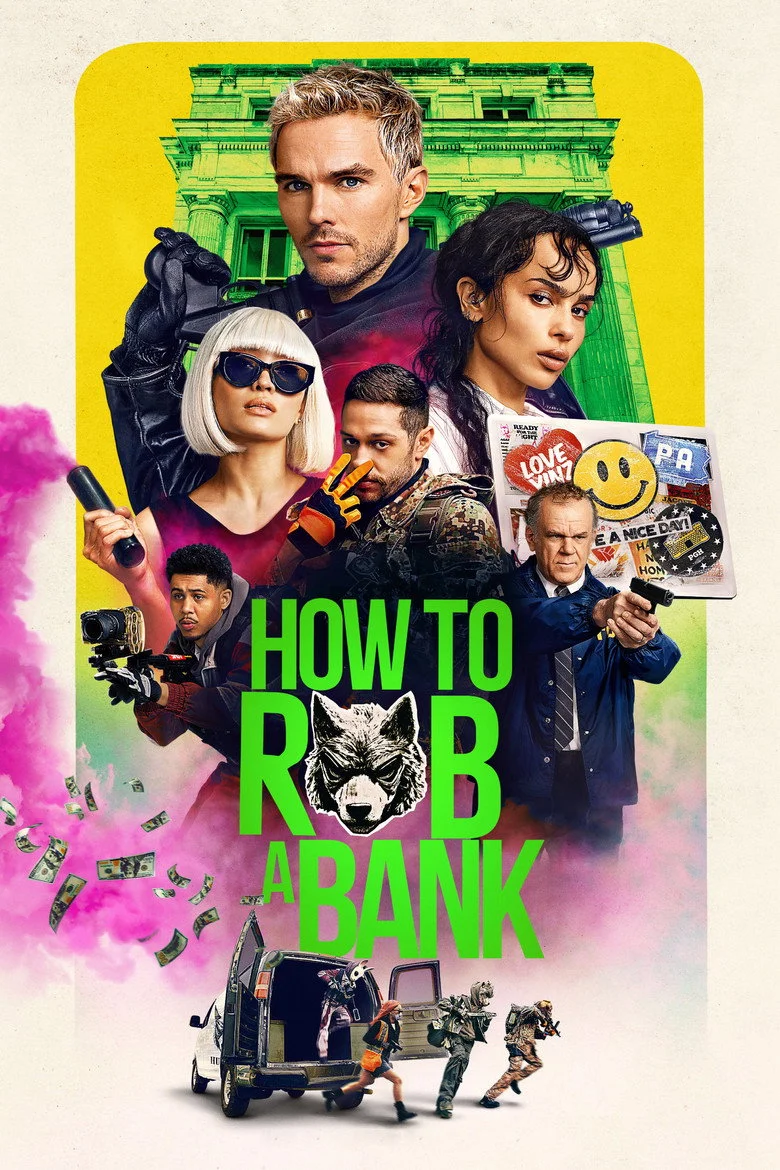
 Nicholas HoultRyan
 Zoë KravitzReagan Gardner
 Anna SawaiEmi
 Rhenzy FelizHugo
 Pete DavidsonVince
 John C. ReillyAgent West
 Christian SlaterWalton
 Tati GabrielleSkyler
 Young Mazino
 Michael Gandolfini
 Sam Lerner
 Thomas C. StuhrVirginia Bank Teller
How To Rob A Bank arrives with the ingredients for a high-energy crime caper: David Leitch behind the camera, a likable ensemble, a crew of bank robbers turning their hold-ups into online instructional content, and an FBI pursuit led by John C. Reilly’s worn-down veteran agent. The film has undeniable surface appeal and sporadic bursts of excitement. Yet its central problem is not a shortage of ideas. It is that the ideas pull in incompatible directions, leaving the film flashy but unsettled.
The premise is knowingly absurd. The Wolf crew package basic bank robberies as internet content, complete with to-do lists and jazzy graphics. That setup gives the film a comic angle on performance, attention and criminality in an online culture. There is a mischievous potential in treating a robbery as both a crime and a tutorial, especially when the criminals’ material is designed to circulate as entertainment.
But the film’s sense of internet culture appears oddly behind the moment it wants to capture. The crew’s videos are presented in a landscape-oriented YouTube idiom, even as the contemporary attention economy is more strongly associated with portrait-first, short-form feeds. That may sound like a small detail, but it affects the movie’s credibility as social-media satire. A film can exaggerate or stylize digital behavior; it still needs to feel like it understands the behavior it is exaggerating. Here, the format undermines the supposed immediacy of the gang’s online persona.
A crime comedy divided against itself
The more consequential issue is tonal. The film starts from fun, jokey criminal mischief, then asks its audience to absorb heavier material about social and economic hardship. Nicholas Hoult plays the crew’s ringleader, whose tragic history is used to explain his recruitment of members portrayed by Anna Sawai and Pete Davidson. Christian Slater appears as a banker positioned as an easy emblem of institutional rot.
None of those ingredients is inherently incompatible with a comic heist movie. Crime stories often gain energy from placing broad entertainment beside frustration with systems of wealth and power. The difficulty is one of balance. How To Rob A Bank seems to want the liberating kick of a playful outlaw fantasy while also making a socialist argument about why its characters strike back. The result, however, is an awkward imbalance rather than a productive tension.
The movie identifies financial institutions as a target, but the stated hardships behind the gang’s anger point toward a broader set of failures: healthcare costs and the lack of support for veterans are among the pressures implied by the characters’ circumstances. That creates a thematic mismatch. If the story wishes to make a serious case for its robbers’ grievances, reducing the opposition to one slimy banker risks making its politics feel too neat for the problems it invokes. If it wishes to remain a buoyant crime romp, the tragic and structural material asks for more gravity than the premise can comfortably carry.
This is where the film repeatedly fizzes rather than detonates. The comic setup, the social critique and the backstory-driven drama do not seem to develop into a single persuasive mode. Instead, they compete for control. The issue is not that a film must choose either fun or seriousness; it is that each shift needs to sharpen the other. Here, the shifts dilute the impact of both.
The pursuers provide the richer material
The most compelling imbalance is dramatic. Reilly’s FBI veteran and Zoë Kravitz’s eccentric computer specialist are characterized in deliberately familiar terms: he is rumpled and experienced; she is quirky and brilliant. Yet Reilly and Kravitz bring depth to those thinly written archetypes. Their work supplies more interest than the robbers receive, even though the film’s premise ostensibly centers on the crew and its actions.
That is a meaningful strength, but also a structural frustration. The film has two actors who can make standard-issue character labels feel more inhabited, only to remove their characters from long stretches of the action. Their absence does not merely reduce the number of scenes with appealing performers. It deprives the film of the perspective that seems best able to ground its wilder tonal impulses.
A brief exchange about Point Break neatly signals the divide in the film’s outlook. Reilly’s character says the 1991 crime classic inspired him to join the FBI, while Kravitz’s says it made her want to rob banks. It is a playful joke, but it also points to a potentially rich two-sided fascination with crime movies: the pull of pursuit versus the allure of rebellion. How To Rob A Bank does not appear to fully capitalize on that contrast, because the characters carrying it are sidelined when the film turns to extended action.
Hoult, Sawai and Davidson are given a more overtly sympathetic framework through the ringleader’s history and the gang’s downtrodden status. But sympathy is not the same thing as dramatic vitality. The film’s difficulty, as presented here, is that its robbers do not become as interesting as their pursuers. The attempted social explanation makes them more legible, but not necessarily more compelling.
Flash is not the same as momentum
Leitch’s action-film credentials are evident in the movie’s visual flash and in its occasional jolts of excitement. Those are real assets for a concept that needs velocity. The gang’s stylized instructional-video packaging also suggests a desire to make criminal spectacle feel designed, branded and performative rather than merely procedural.
Still, visual polish cannot resolve a storytelling problem on its own. The movie keeps changing its emotional and thematic register, so its energy does not reliably build into momentum. A briskly presented idea can still feel stalled when the audience is asked to reset its expectations: are these robbers mischievous internet personalities, wounded victims of a cruel society, or vehicles for a broad anti-bank editorial? The available material indicates that the film never finds a satisfying answer.
That inconsistency also changes how the action lands. The bursts of excitement register as isolated pleasures rather than proof that the film has found its groove. There is enough style to make the movie seem intermittently alive, but not enough coherence to make the style feel like an expression of a settled point of view.
Who should take the risk?
Viewers looking for a glossy, chaotic crime comedy with recognizable performers may find enough to enjoy in the cast, the internet-video conceit and the intermittent action charge. Reilly and Kravitz, in particular, appear to give the film more texture than its stock character descriptions promise.
Those hoping for a sharply observed social-media satire, a consistently playful heist movie or a fully developed critique of economic injustice should temper expectations. The film reaches for all three, and that ambition is more visible than its control. Its interest in people pushed toward financial crime could have given the caper emotional bite; instead, the combination of simplistic villainy, underdeveloped robbers and long absences from its most engaging characters leaves the premise struggling to stick.
For another take on the film’s attempt to join influencer-age style to a larger heist-movie argument, see our related review.