


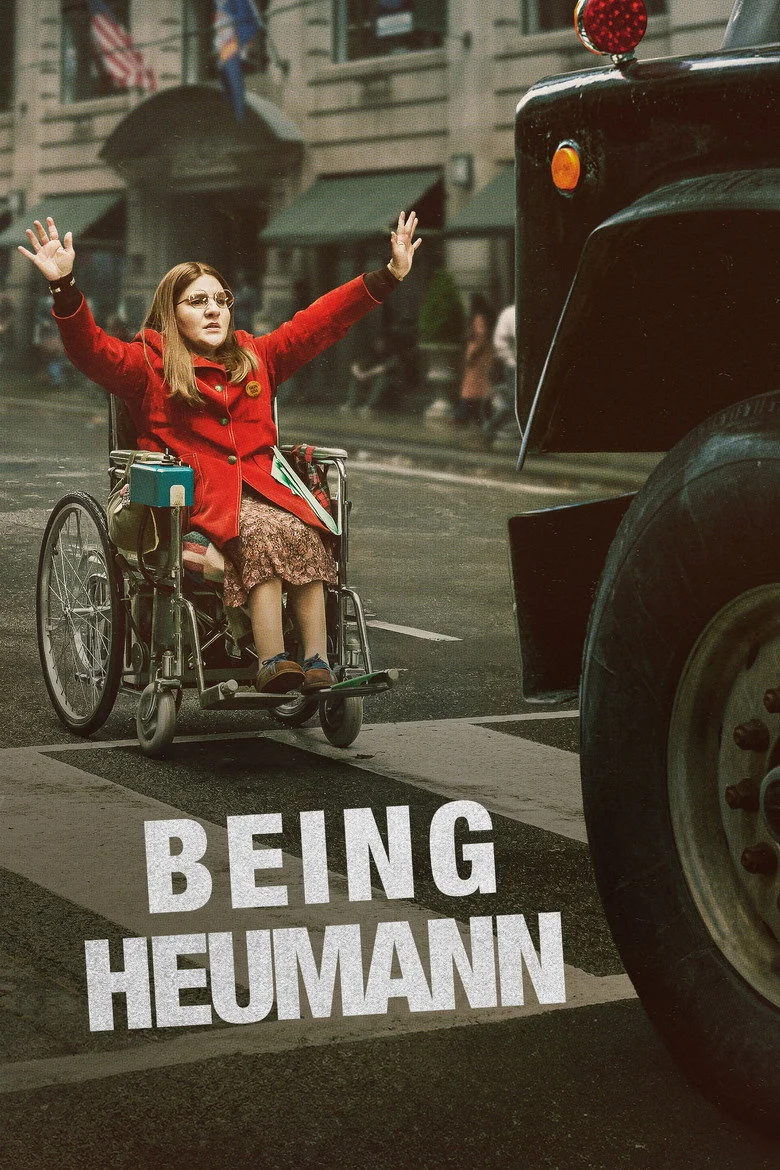
 Ruth MadeleyJudith 'Judy' Heumann
 Mark RuffaloJoseph Califano
 Dylan O'BrienEvan White
 Rob DelaneyCongressman Miller
 Ray FisherChuck Jackson
 Michael Patrick ThorntonEd Roberts
 Daniel DurantSteve McCleeland
 Jon BeaversJim Pechin
 Roberta ColindrezJoni Breves
Being Heumann approaches the fight for disability rights not as a tidy history lesson or a generic tale of personal triumph, but as a confrontation with institutional delay. Set in New York in 1972, Siân Heder’s film follows Brooklyn activist Judy Heumann, played by Ruth Madeley, as she campaigns for the enactment of Section 504, the anti-discrimination provision whose implementation is being held up amid government concerns over cost. That premise immediately establishes the film’s central pressure point: the gap between a right existing in principle and people being able to live with dignity in practice.
When years of bureaucracy yield no meaningful action, Judy and her fellow activists protest outside the offices of Health, Education, and Welfare. The protest develops into a sit-in, with the group occupying the space until its demands are addressed. The setup has the satisfying shape of an underdog drama, but the film’s force appears to come from refusing to treat that shape as sufficient. Its activists are not asking for a symbolic victory or special treatment; they are pressing for the government to act on protections that should already be meaningful. That distinction gives the story its political bite.
Righteous anger, not merely uplift
Heder previously made CODA, and Being Heumann retains some capacity for overt sentiment. At moments, its emotional approach can lean toward schmaltz. Yet the dominant impression is of a filmmaker bringing considerably more heat to this material. The film is described as having real fire and anger, qualities that change how its inspirational elements land. Rather than presenting hardship as an opportunity for a comforting audience catharsis, it locates the hardship in discriminatory systems and protracted official inaction.
That matters especially because disability stories are often reduced to individual perseverance. Here, the story’s drama is collective and civic. Judy’s determination provides a focal point, but the sit-in makes clear that progress is not a lone-hero achievement. It requires organizing, endurance and the willingness to make institutions visibly reckon with people they have treated as an expense or an afterthought. The result is a film whose emotion is tethered to demands for material change.
One of the screenplay’s more pointed ideas concerns the language of “inspiration” itself. Being Heumann recognizes that admiration can be an inadequate response if it ends in applause rather than action. This is a useful thematic corrective for a film built around a stirring real-world campaign. It allows the movie to embrace the galvanizing power of the activists’ struggle while challenging the audience to consider what they are meant to do with that feeling. In critical terms, that self-awareness helps keep the film from becoming merely twee or congratulatory.
Ruth Madeley anchors an unusually grounded ensemble
Madeley’s Judy is introduced as stubborn, an apt quality for a character confronting a system designed to exhaust her. The role calls for more than the familiar rhetoric of cinematic determination: Judy must be able to turn frustration into strategy and conviction into a rallying point for others. Madeley’s presence at the center of the film gives that journey weight.
The wider casting is equally important to the film’s authority. The ensemble includes performers with real disabilities, including Madeley. That choice lends the story a crucial sense of veracity, particularly in scenes where characters describe harrowing experiences and argue for basic dignity and respect. The film’s emotional impact is intensified by the impression that these voices connect to lived experience rather than being treated as abstract dramatic material.
It would be reductive, though, to frame this simply as authenticity functioning as decoration. The casting strengthens the film’s political argument. A drama about disabled people demanding control over the terms of their lives is more persuasive when disabled performers are visibly central to its storytelling. The film thereby aligns part of its method with its message: representation is not an ornamental virtue, but a question of who gets to embody history, speak with authority and occupy the centre of the frame.
Solidarity is the story’s larger subject
The sit-in is not presented as an isolated disability-rights struggle. Being Heumann foregrounds intersectionality and unlikely commonality, bringing Black Panthers into the fight and explicitly connecting the activists’ campaign to the civil-rights movement that preceded it. This is one of the film’s most resonant choices. It broadens the conflict beyond a single group’s grievance and shows how movements can recognize shared stakes without erasing their differences.
The political argument is clear: rights are rarely secured by people waiting politely for recognition, and the alliances that make pressure effective can emerge across communities. The film’s use of the civil-rights context also keeps the story from becoming a vague celebration of togetherness. Solidarity here has a practical purpose. It is part of how people build leverage against a bureaucracy that has failed them.
That emphasis is what makes the film feel more expansive than a conventional campaign chronicle. The legal and institutional details give the narrative a concrete goal, while the coalition around Judy supplies the moral and emotional breadth. The drama is not only about whether one law will be enacted. It is about who is considered worth accommodating, who bears the cost of governmental delay, and what collective action can demand from power.
A simplified antagonist, knowingly handled
The film’s clearest weakness lies with Joseph Califano, the HEW director played by Mark Ruffalo. His part is the most thinly drawn in the story, and Ruffalo plays him with breathless irritation. As a dramatic function, Califano gives the activists a face for the apparatus opposing them. But simplification can narrow a story that is otherwise interested in the complicated overlap of politics, institutions and social movements.
To its credit, the screenplay, adapted by Heder and Rebekah Taussig from Heumann’s memoir, appears conscious of this limitation. A confrontation between Judy and Califano directly acknowledges the temptation to cast somebody as the villain, even as Califano points to his own civil-rights record. That exchange does not necessarily give the character greater depth, but it signals that the film understands the contradiction. The problem is not that it mistakes every individual opponent for an uncomplicated monster; rather, it still relies on a relatively sketchy antagonist to concentrate the conflict.
For some viewers, that may be a minor trade-off. The narrative’s real energy lies with the activists, their persistence and the broader coalition they assemble, not with the private complexity of the official standing in their way. Still, the thinness of Califano means the film’s institutional critique may play more powerfully than its portrait of the person representing that institution.
Why the film’s tone mostly works
Being Heumann has a potentially difficult tonal assignment. It needs to be accessible enough to carry a historical struggle as a compelling drama, angry enough to honor the stakes, and emotionally open enough to make its collective action moving. The occasional sentimentality is the main caveat, particularly for viewers wary of films that smooth political history into uplift. But the anger at the movie’s core seems to prevent that softness from defining it.
More importantly, the film’s sentiment is directed toward solidarity rather than passive pity. The emotional payoff is built around people insisting on respect, not around an audience being asked to feel good about their endurance from a safe distance. That is a meaningful difference. It makes the film’s rousing quality feel connected to its argument, and it gives its crowd-pleasing momentum a firmer ethical foundation.
As a viewing experience, this is best suited to audiences looking for a politically engaged historical drama with an accessible, emotionally direct mode of storytelling. Those seeking a more ambiguous portrait of every power player may find the official opposition underwritten, and the occasional schmaltz may register as a blemish. But viewers receptive to a principled, collective-action story should find much to respond to in its combination of urgency, representation and moral clarity.
Ultimately, Being Heumann makes its strongest case when it refuses to separate inspiration from responsibility. Its depiction of the Section 504 campaign is stirring, but it is not satisfied with being stirring. By centering disabled activists, emphasizing cross-community solidarity and maintaining a current of justified rage, Heder’s drama argues that dignity is not a sentimental ideal. It is something people have had to organize, occupy and fight to make real.