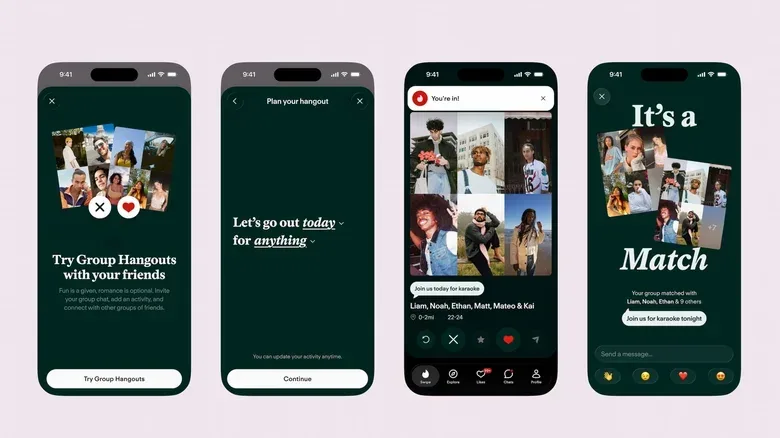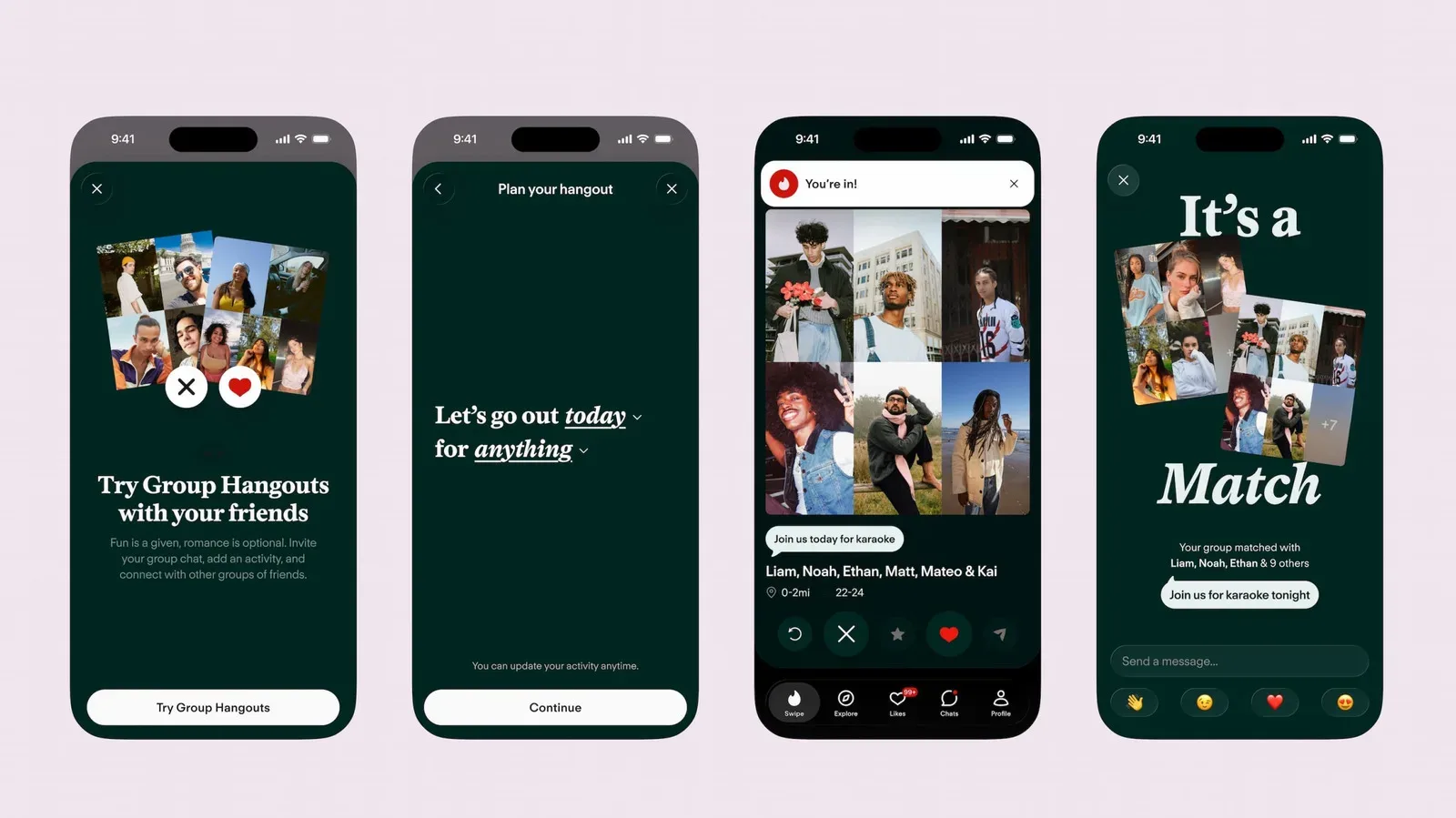
Tinder is adding group hangouts, a new matching format designed for people who would rather not put a first encounter under the bright, interrogative lamp of a one-on-one date. The feature builds on the app’s existing double-date option, but scales the idea into activity-led groups: users form a group, choose something to do, invite friends, and become discoverable to other groups once they have at least three members.
It is a notable change in the social geometry of a dating app. Traditional matching asks two people to assess chemistry before they have shared any real-world context. Group hangouts instead begin with a small social setting and a proposed activity, then leave room for the people involved to decide together whether an in-person meetup makes sense. That does not eliminate the awkwardness of meeting strangers, naturally. It may, however, distribute it more fairly. Nobody has to carry an entire conversation alone while wondering whether they are being charming enough over a tiny coffee-table candle.
How Tinder group hangouts work
The setup is comparatively straightforward. A user first creates a group and selects an activity. Friends can then be invited to join. Once the group reaches three or more people, its profile can appear for other groups to discover, including trios and larger groups.
When two groups match, Tinder opens a group chat. That shared conversation is where members can determine whether they actually want to arrange the hangout. The feature therefore does not appear to force an immediate offline commitment: matching creates a space to talk first, coordinate expectations and see whether the group dynamic feels promising.
- Create a group.
- Pick an activity for the potential hangout.
- Invite friends.
- Reach at least three members to become discoverable to other groups.
- Browse other groups and match if there is mutual interest.
- Use the resulting group chat to discuss whether to meet.
Users can leave either their group or a hangout chat at any time. Tinder says its usual safety features apply to group hangouts as well. That continuity matters: a new social format may feel more casual, but it is still an online meeting tool connecting people who may not know one another.
Why the activity comes first
The most important part of the feature may be the activity selection. An activity is not merely decorative metadata attached to a group profile. It gives the prospective meetup a premise. Instead of opening with the abstract question of whether two groups should meet, the conversation can begin with a more practical question: does this proposed plan sound enjoyable to everyone?
That distinction could reduce the pressure associated with a conventional first date. In a one-to-one setting, every pause can feel meaningful, every choice can seem loaded and both people may feel responsible for creating momentum. A group gathering has more conversational routes, more personalities and a built-in subject beyond evaluating a single stranger’s compatibility. The activity acts as a shared objective, even if the real purpose is simply to meet new people.
There is a familiar parallel in multiplayer games. People often form connections while working toward something together, because the shared task offers a natural rhythm for interaction. That does not make a group hangout a raid party, and no one should be assigning a healer before brunch. But the underlying appeal is recognizable: socializing can be easier when it is anchored by an experience rather than framed as a direct audition. Online communities also regularly have to negotiate trust, conduct and shared expectations, issues illustrated in this report on a World of Warcraft player’s dispute involving gold and RMT concerns.
For Tinder, putting activities at the center could also make a group profile more legible. A person browsing a potential hangout can weigh the proposed plan and the size of the group alongside the people in it. The result is a format that is less narrowly transactional than a standard two-person match, while still giving participants a clear next step.
Double dates offered Tinder a signal
Tinder’s move is informed by the performance of its double-date feature, which arrived last year. The company says roughly 90 percent of people who tried double dates were under 30. It also says matches made through that option exchanged 35 percent more messages.
Those numbers need careful interpretation. More messages are not, by themselves, proof that people had better experiences or formed stronger connections. A double date includes twice as many participants as a conventional one-to-one exchange, so a message count has more possible contributors. Still, the data is meaningful as a behavioral signal: users were willing to engage with a format that lets friends participate in the process.
Tinder’s stated reading is that younger users may be looking for lower-pressure ways to meet people with friends involved. Group hangouts extend that premise. Rather than asking someone to bring one friend and create a paired date, the new system can accommodate a larger cluster of people around a shared plan.
The company also tested group hangouts in Australia, where it says 40 percent of invitations were accepted. That is a useful early measure of willingness to participate, though it does not tell us how many resulting chats became real-world gatherings, how often groups clicked, or which activities proved most popular. An accepted invitation is the start of a potential social interaction, not a guarantee of a successful event.
What “lower pressure” can and cannot mean
Group formats may make an initial meeting feel less intense, but lower pressure is not the same thing as no pressure. In fact, groups introduce their own etiquette questions. Members have to decide who joins, what activity is appropriate, whether the group size feels comfortable and whether everyone has a comparable idea of what the hangout is supposed to be.
That is why the group chat is a consequential piece of the design. It gives participants a place to clarify plans before anyone meets. Practical details such as the activity, timing and who is attending can be discussed in a setting visible to the whole matched group. And because people can leave their group or the chat whenever they like, participation is not presented as irreversible.
There is also a difference between a social buffer and a substitute for good judgment. Bringing friends can make a person feel more at ease, and meeting in a group may offer more conversational support than a solo date. But users should still approach any potential meetup thoughtfully, use the app’s available safety tools, communicate clearly and only proceed with a plan that feels comfortable to them. The existence of a group does not automatically make a situation suitable for every member of it.
A matchmaking feature that looks more like social planning
Group hangouts suggest Tinder is broadening the role of matching from pairing individuals to facilitating a small social plan. The mechanics remain recognizably app-based: profiles appear, groups browse, mutual matches unlock a conversation. Yet the intended encounter is no longer necessarily a date in the conventional two-person sense.
That flexibility may be the point. Some participants may approach a group hangout hoping for romance. Others may simply prefer meeting people in a less formal setting. The feature’s activity-first framing and shared chat leave room for both possibilities without requiring every person to enter under identical assumptions about a one-on-one date.
It also makes the friend group part of the product rather than an unofficial backstage support system. Friends have long helped each other interpret profiles, choose venues and debrief after dates. Tinder’s new feature incorporates that reality directly into discovery and conversation. Instead of one person trying to translate a match to friends later, the friends can be present from the first stage.
Availability begins in selected markets
Group hangouts are rolling out first in the United States and other selected markets, with broader availability planned later. Where the feature is active, users can find it at the top of Tinder’s home screen.
Its ultimate value will depend less on the novelty of putting several people in a chat and more on whether enough local groups use it with clear, compatible plans. A matching system needs participants, and a group system has an additional coordination challenge: several people need to be interested at once. Tinder’s double-date engagement figures and its Australian invitation-acceptance result offer reasons to think there is demand for a more collective option. The wider rollout will show how readily that interest translates across different places and social circles.
For now, the proposition is neatly modest. If the one-on-one first date feels like an overly high-stakes opening level, Tinder is offering a party queue, an activity and a few friendly co-op players before anyone decides whether the next mission should happen offline.