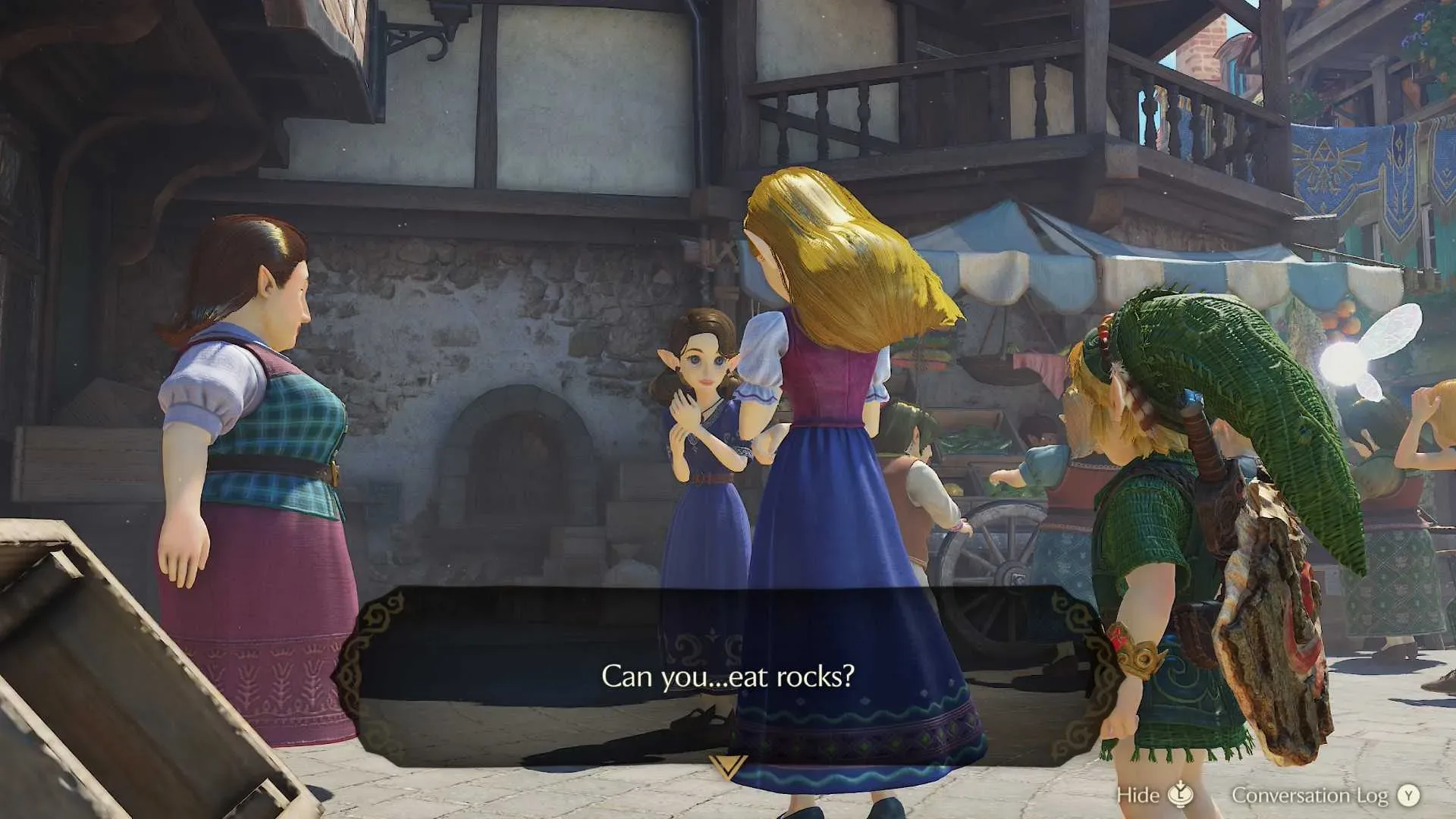
The Legend of Zelda: Ocarina of Time is often remembered in big, clean contrasts: childhood and adulthood, daylight and ruin, a lively Hyrule and Ganondorf’s conquered kingdom. But one of its most unsettling ideas sits in a much smaller gap between those states. It is the short period after Zelda and Impa escape from Ganondorf, but before Link enters the time-spanning portion of his journey.
In that interval, Hyrule Castle Town is still standing. Its people are still there. Shops and familiar faces remain. Yet something has already gone profoundly wrong, and the player can walk among citizens who do not know precisely what happens next.
A remake’s treatment of this sequence has prompted a particular argument: does allowing an injured soldier to live make the game less dark? The answer depends on what “dark” is supposed to mean. The original scene’s directness remains powerful. But the expanded conversations reportedly given to Castle Town’s ordinary residents can produce a different, more collective kind of dread—one rooted not in a single explicit death, but in uncertainty, denial, preparation and helplessness.
The alley soldier and a very direct form of tragedy
In the original game, players who enter the Castle Town back alleys after Zelda and Impa flee can find a soldier collapsed against a wall. He recognizes Link as the boy from the forest and, speaking with difficulty, explains that Ganondorf has betrayed the king. He also confirms Zelda escaped and had intended to leave something for Link.
The scene does more than provide a direction prompt. His final instruction points Link toward the Temple of Time, with the text slowing as the soldier finishes speaking. He then shudders and collapses. Further attempts to interact trigger Navi’s observation that he is no longer moving.
That is a startling encounter because it gives the villain’s takeover a human cost before the game’s most dramatic transformation. Until then, Link has faced monsters, but this is an unambiguously ordinary person suffering because of Ganondorf’s betrayal. There is no boss arena, no grand speech and no rescue available. The player receives vital information and is immediately made to understand that arriving too late has consequences.
It is easy to see why the moment is frequently treated as evidence of the original game’s capacity for grim material. It puts death in an unglamorous place—a back alley—and leaves Link unable to change the outcome.
A changed soldier does not necessarily mean a softer town
In the remake described here, the soldier remains alive. He can repeatedly tell Link to go to the Temple of Time, presenting him as exhausted rather than dying. On its face, that is undeniably a lower-stakes version of the immediate encounter: an irreversible death has become repeatable guidance.
Related coverage includes Ocarina of Time's Castle Town Is More Haunting When Its People Are Still Waiting.
There is a practical design explanation worth separating from claims of censorship or ratings-driven self-restraint. Repeated dialogue that names a destination is a form of player guidance: design intended to keep players moving toward the next required objective. In an adventure game, a character who can repeat the next instruction prevents progress from depending on a player retaining one easily missed line of dialogue.
That function can frustrate players who value the original scene’s finality. It can also coexist with stronger storytelling elsewhere. A single change cannot, by itself, settle whether an entire version is “darker,” “more mature” or less willing to confront difficult themes. Those labels flatten different techniques into one scoreboard.
Explicit suffering is one technique. A town full of people reacting in incompatible ways to an approaching threat is another. The latter may be less graphic, but it is not automatically less disturbing.
Castle Town becomes an interlude of anticipation
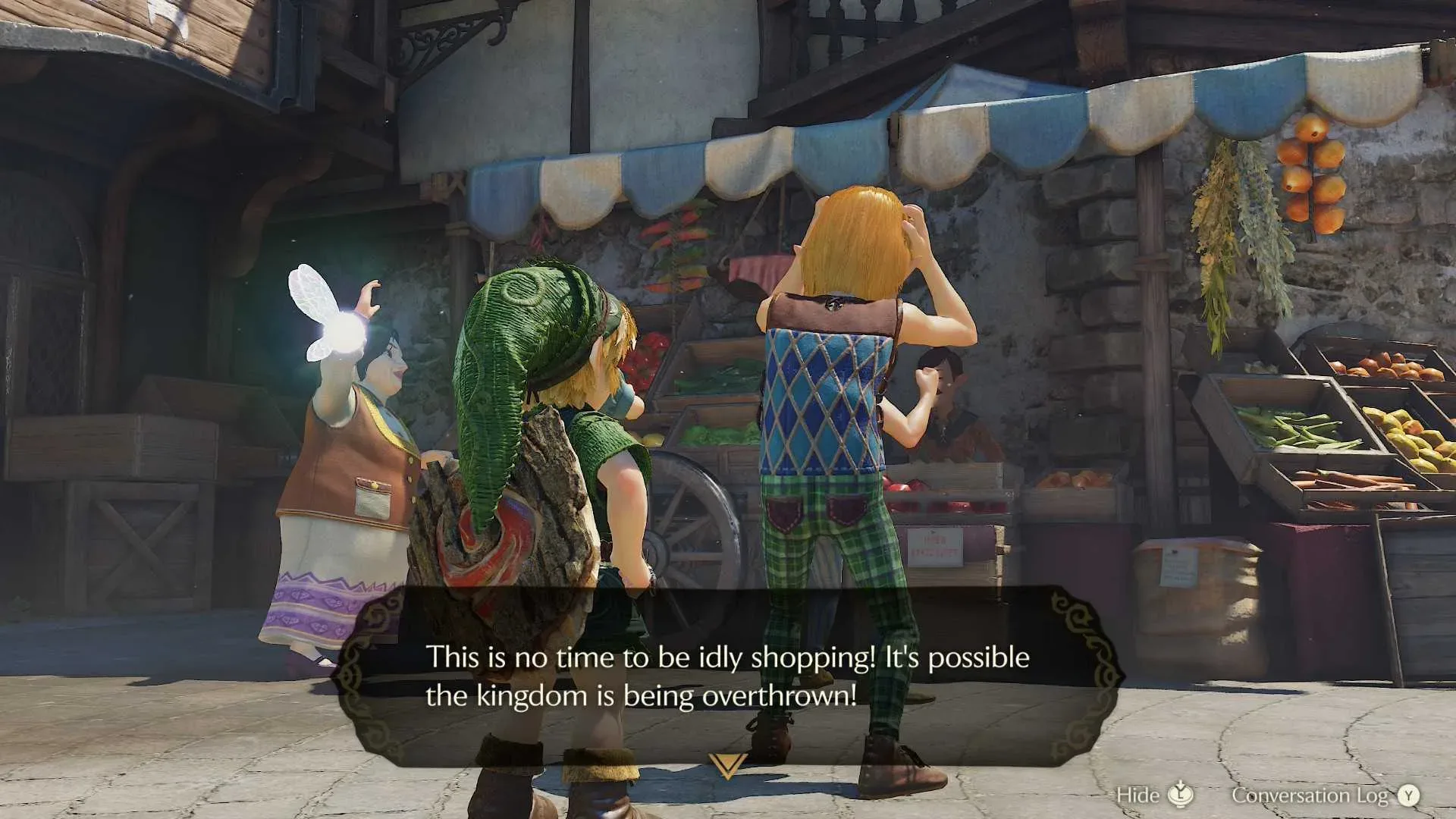
The crucial reported remake addition is not simply that more NPCs have dialogue. It is that the dialogue changes in the narrow period after Zelda’s flight, giving many residents a voice at exactly the moment when the town’s normal life starts to fracture.
In the original, Castle Town already contains people who comment on the recent commotion. Much of that brief, missable dialogue centers on the horse and rider who passed through. Many other figures are primarily there to sell the feeling of a populated square rather than to develop their own reaction to the event.
The remake reportedly gives nearly all of those same residents more to say. The result is not just a clearer quest prompt; it is a community scene. A young girl mentions being warned away from the old man chasing people. Richard’s owner searches frantically for the dog. A wealthy woman wants answers from the guards. One person sees fewer people outside as an excuse to shop, while another contemplates buying supplies in case disaster arrives. Honey and Darling continue dancing while choosing to ignore the sound of horses.
These small reactions matter because none offers a reassuringly complete picture. Some characters grasp that an occupation may be coming. Some want to flee. Some cannot process the danger. Some cling to routine. Some try to turn fear into a solvable errand—shop now, stock up now, ask the guards now—even though the scale of the problem is larger than any individual response.
This is environmental storytelling in the broad sense: narrative delivered through the space, behavior and dialogue that surround the protagonist rather than through a single mandatory scene. Here, Castle Town is not merely the location Link passes through on the way to the Temple of Time. It becomes evidence that the crisis is affecting people at different speeds and in different ways.
The horror is in the gap between warning and aftermath
Players know what waits on the other side of the time shift. When adult Link emerges in Castle Town, the square is ruined beneath dark clouds. Hyrule Castle has become Ganondorf’s seat of power, and Redead occupy what was once a bustling civic space.
That later version of the town implies devastation on a vast scale. Many major Castle Town characters can be found in Kakariko Village, but not everyone makes it there. The presence of Redead—enemies framed as horrifying, health-draining zombies—also supports the grim suggestion that townspeople may have been transformed. The story does not need to enumerate every casualty to make the absence visible.
What the new dialogue can add is dramatic irony. Dramatic irony occurs when the audience has information that characters do not. Link’s player has either seen Castle Town’s ruined future before or understands that Ganondorf’s seizure of power leads somewhere awful. The citizens, meanwhile, are stuck in the immediate present. They hear danger. They see the evidence. But they still debate whether to leave, shop, complain, dance or simply insist that their home will be fine.
One woman’s determination not to leave because she loves the town is especially painful in that context. Her bravado is not foolish merely because she fails to see danger. She does see it, at least in part. She just cannot imagine abandoning a place that defines her life, and responds to the prospect of monsters with a shaky promise to work something out—perhaps even befriend them.
That is what makes the scene feel less like exposition and more like a moment of suspended time. The player is not witnessing aftermath yet. They are witnessing people trying to preserve normality as normality slips away.
Why optional dialogue can carry the heaviest weight
There is a design risk to putting this material in an optional window: plenty of players will head directly for the Temple of Time and never hear much of it. But that missability serves the setting in its own way. A town does not stop functioning simply because a story’s hero has received the next objective. The characters remain there, carrying on conversations the quest does not require.
For players who choose to linger, the payoff is a more specific understanding of what the later ruins represent. The empty adult Castle Town is no longer only a visual switch from cheerful hub to hostile zone. It is the vanished future of the dog owner, the shoppers, the worried residents, the stubborn holdouts and the people who knew enough to consider leaving.
That distinction has practical value for how players interpret remakes in general. A comparison should look beyond headline alterations—such as whether a named NPC lives or dies—and ask what role the surrounding scene now plays. Does it alter navigation? Does it alter characterization? Does it change what the player knows before a major transition? Does it reframe a later location?
On this evidence, the answer is yes. The soldier’s survival may soften one sharp moment, while the town’s expanded reactions deepen the emotional context around it. Neither reading needs to erase the other.
“Darkness” is not a simple tally of deaths
The debate is most useful when it moves away from treating grimness as a quantity. A dying soldier is severe, immediate and unforgettable. A town’s collective half-awareness can be quieter, but it creates a different kind of emotional pressure. One scene says that violence has already arrived. The other asks the player to spend time with people who are beginning to understand that it might.
That second approach also sharpens the game’s central transition from childhood to adulthood. Link’s leap forward is not simply a mechanical change in age or a shift to tougher enemies. It means an entire period of ordinary life has been removed. Castle Town’s pre-time-skip conversations make that loss more personal because they give the town a final chance to speak for itself.
Whether one prefers the original soldier scene or the remake’s broader NPC work is ultimately a matter of taste. The original’s economy has force: it puts one dying man in front of Link and refuses to look away. The remake’s reported approach finds its force in accumulation: a frightened child, a missing dog, anxious residents, misplaced commerce, stubborn loyalty and people continuing their routines while a catastrophe approaches.
Those are not interchangeable moods. But both point toward the same tragedy. Hyrule Castle Town’s fate is upsetting not only because it becomes a ruined battlefield, but because it was recently a place where people expected tomorrow to resemble today. For more Nintendo context, see our coverage of the Zelda 40th Anniversary Switch 2 and Nintendo’s major U.S. hardware week.