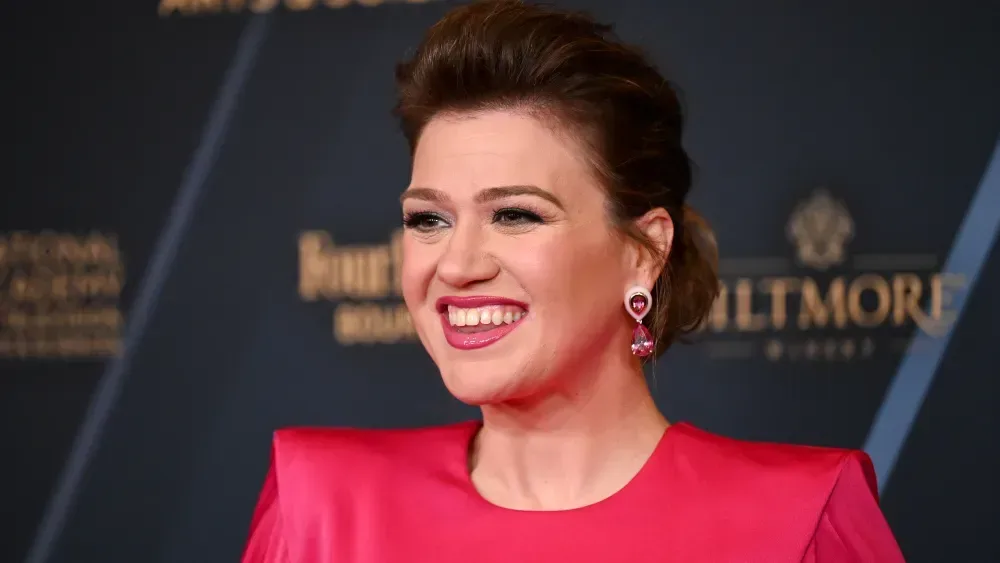
Kelly Clarkson has drawn a boundary that is likely to become harder, not easier, for music platforms to define: artificial intelligence can be creatively valuable without being treated as the same kind of chart competitor as a human artist.
Speaking on the Las Culturistas podcast, Clarkson described herself as an AI supporter, even calling that view “controversial.” Her objection is not to people experimenting with AI, or to the possibility of AI-assisted music. It is specifically to AI artists appearing on the same charts as human performers. Her proposed answer is straightforward: separate charts.
“I love AI,” Clarkson said, while arguing that AI artists should not compete with people on music charts.
The distinction matters because it is more precise than the usual all-or-nothing framing. A conversation about AI in creative fields is often pushed toward two extremes: either technology is a threat that must be excluded entirely, or any distinction between machine-made and human-made work is treated as resistance to innovation. Clarkson’s position lands between those poles. AI can be “welcome to the table,” in her words, while still needing limits and clear differentiation.
What Clarkson is actually proposing
Clarkson’s central idea is a classification rule, not a ban. An AI act might be able to release music, find an audience and occupy a defined space in the wider music ecosystem. But it would not be ranked head-to-head with singers, musicians and other human creators in the same chart category.
A chart is more than a list of popular recordings. It is also a public signal: it frames who is succeeding, who is being discovered, and which performers are being measured against one another. Clarkson’s concern is that an AI creator and a human creator are not comparable entrants when the former can be built around systems that do not share the human performer’s practical limits.
She illustrated that concern with an Olympic comparison: a competition involving robots and people would not be a level test of the same thing. The point is not necessarily that AI work lacks an audience or cannot be musically interesting. It is that the category of competition has changed.
AI artist, AI-assisted artist and human artist are not automatically identical labels
The discussion also benefits from more exact language. An AI-assisted song can mean a human artist used AI somewhere in a process, perhaps as a creative tool. An AI artist, as Clarkson uses the concept, points to an act whose identity or output is substantially generated through AI rather than centered on a human performer.
Those labels are not interchangeable, and Clarkson’s comments do not lay out a technical threshold for deciding where one ends and the other begins. That is the difficult practical question her suggestion raises. If chart systems ever separated AI acts, they would need definitions that audiences, artists and platforms could understand. A broad label could sweep in ordinary creative experimentation. A narrow label could fail to identify projects that are presented as human-style performers but are largely machine generated.
That ambiguity does not make the distinction pointless. It shows why disclosure would be central. Before a ranking system can separate categories, it has to identify what it is sorting.
Her argument is about human recognition, not just technology
Clarkson said she is interested in AI artistically and has fun with it, while also recognizing its potential to help people make things they might otherwise be unable to make. That is an important part of her view. She sees an access benefit: people who cannot do certain things may be able to create through AI in ways that were previously closed to them.
At the same time, she warned against losing “human” in the process. That concern is broader than a debate over one chart placement. When listeners encounter music, they may be responding not only to the recording itself but also to a performer’s voice, choices, biography and perceived relationship with an audience. A separate category would communicate that those expectations remain meaningful, even if listeners also want AI-created material.
Clarkson also emphasized that there can be an appetite for both. That is a less dramatic proposition than declaring one side must defeat the other, but it may be more useful. It acknowledges that audiences can be curious about new forms of creation while still valuing work explicitly tied to human performers.
Why a separate chart would be a major policy choice
Separate charts can sound like a small administrative fix, but they would answer several bigger questions at once. They would tell listeners whether an act is being recognized as a human performer or as an AI-driven project. They could also create a dedicated place for AI music to be measured against similar work rather than forcing it into a category designed around human artistry.
However, separating charts would not eliminate every argument. It would require decisions about eligibility, labeling and enforcement. Who determines whether an act qualifies as AI? Is the test based on the vocal, the composition, the public-facing identity, or the degree of AI involvement? What happens when a human musician deliberately collaborates with AI? Clarkson did not prescribe answers to those details, but her remarks make the need for differentiation the core principle.
There is also a consumer-facing implication. Clear labels can give audiences context without telling them what they are allowed to enjoy. A listener may decide an AI act is compelling, amusing, inventive or uninteresting. But that choice is more informed when the act is not presented in a way that obscures how the music or performer identity was created.
The wider creative stakes
Clarkson’s comments arrive in a period when entertainment industries are wrestling with both the promise and the disruption associated with AI. Her position deliberately preserves room for the promise. She pointed to interesting developments in science as well as artistic possibilities, and said AI is not going away.
That acceptance is what makes her proposed limitation notable. The question is not whether AI will exist in creative spaces; Clarkson treats that as settled. The question is how institutions choose to recognize it. Charts, award systems, credits and other forms of public classification may need to explain the difference between human-led work, AI-supported work and AI-created artist projects rather than acting as if those categories are invisible.
For music audiences, the immediate practical issue is transparency. For human performers, it is whether the systems that confer visibility and competitive recognition continue to identify human achievement as its own category. For people making AI music, a separate chart could be viewed as a distinct lane rather than an exclusion from the table Clarkson says AI should be able to join.
The business context surrounding music also keeps changing beyond the AI debate. Streaming services and their economics remain important to how music is accessed and valued; Pandora’s new subscription pricing is one example of a separate industry change that affects listeners’ relationship with platforms.
A debate likely to outlast one proposal
Clarkson has not argued that AI-generated music must disappear. She has argued for a system that makes the difference legible and avoids asking human artists to compete in precisely the same chart race as AI acts. Her Olympic metaphor makes the concern easy to understand: competition depends on participants sharing a meaningful set of conditions.
Whether separate AI charts become a workable approach will depend on definitions that her comments do not attempt to settle. But the larger principle is clear. AI can be a creative field, a useful tool and an avenue for people who could not previously make certain kinds of work. None of that requires treating it as indistinguishable from human artistry.
That is Clarkson’s core case: welcome AI, explore what it can do, and be honest about what it is. In a culture increasingly shaped by generated content, that differentiation may be as important to audiences as it is to artists.