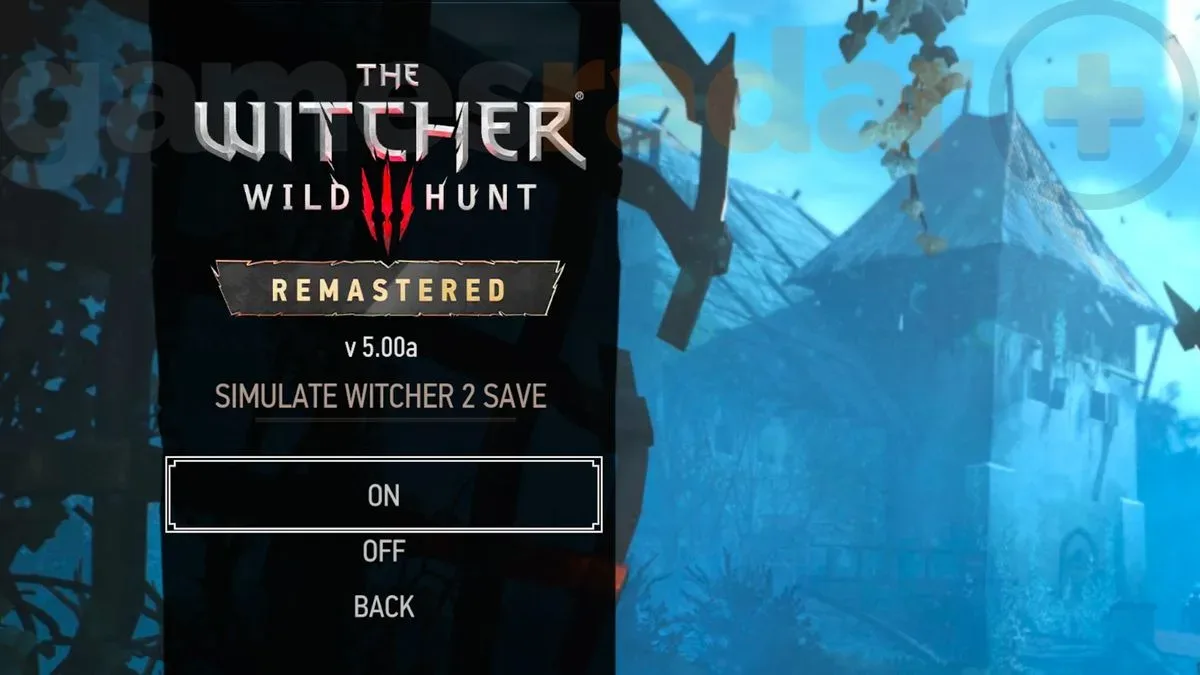
Starting The Witcher 3 Remastered can present Geralt with a deceptively small decision: whether to simulate a The Witcher 2 save. It sounds like an administrative prompt, the sort of question many players might skip on the way to monster contracts, card games and extremely fraught political dinners. It is more meaningful than that.
The setting determines how the game handles several choices from The Witcher 2. Those decisions concern the fates of characters from the earlier story, and they can alter story context and whether some content is available in The Witcher 3 Remastered. Players with an existing save from The Witcher 2 can import it and carry their prior decisions forward automatically. Players without one are not locked out of making those choices: turning simulation on provides another route.
For most people—especially newcomers, or returning players who no longer have an old save—the practical recommendation is simple: choose On. It gives you control over the earlier outcomes instead of accepting a fixed world state, and one final selection can preserve access to Letho and his quest content.
What “simulate a Witcher 2 save” actually means
A save simulation is not an import of a real file. It is a narrative tool that asks the player to establish major choices as though a Witcher 2 playthrough had happened. In other words, the game is filling in Geralt’s history by asking questions rather than reading a saved-game record.
The relevant conversation takes place during Geralt’s visit to Emperor Emhyr’s palace in Vizima. Dialogue choices there allow the player to decide which important outcomes from the prior game apply to this version of the story. That makes the option useful even for someone who has never played The Witcher 2, cannot access an earlier save, or simply wants a different continuity than a past run would provide.
The distinction is worth keeping straight:
- Importing a save transfers the decisions already made in an existing The Witcher 2 save.
- Simulating a save asks the player to select key past outcomes through dialogue in The Witcher 3 Remastered.
- Turning simulation off applies the game’s default set of prior-game decisions.
That terminology can make the menu prompt sound more technical than it is. There is no need to know every plot branch in advance to use the simulation. The game is presenting a shorthand way to establish continuity. It is less about proving you completed the earlier game and more about choosing the background against which this story unfolds.
Why turning simulation on is the safer choice
The strongest reason to enable the setting is content access. Simulation does not merely change a few lines of dialogue; the selected outcomes can affect story beats and whether certain quests are present. Most importantly, it lets the player decide Letho’s status.
Related coverage includes Should You Simulate a Witcher 2 Save in The Witcher 3 Remastered?.
If the player chooses the outcome in which Letho is alive, Geralt can encounter him and complete his quests in The Witcher 3 Remastered. If Letho is considered dead, that material is bypassed. For anyone who wants the broadest possible version of the game on a first run, enabling simulation keeps that decision in the player’s hands.
This does not mean every simulated answer needs to match a canonical or universally “best” Witcher history. These are role-playing decisions. A player who remembers their earlier journey may want to reproduce it. A player coming in fresh may choose the outcomes that sound most interesting. The important practical point is that switching the setting on prevents the game from automatically closing Letho’s path through its default world state.
The Letho choice is the one to watch
Letho is the pivotal consideration because the consequences are direct and clear: choosing him alive makes his interaction and questline available, while choosing him dead removes that section. The decision comes in the final question of the Vizima dialogue sequence.
Players who want to see that content should select the answer establishing that Letho survived. Those who are intentionally role-playing a history in which he died can make the opposite choice, but should do so knowing that it excludes his questline rather than simply changing its dialogue.
That is why “simulation on” is the better recommendation even for people unfamiliar with The Witcher 2. It does not force one particular answer. It gives the player the choice that the off setting would otherwise settle automatically.
What happens if save simulation is turned off?
With simulation disabled, The Witcher 3 Remastered uses a preset collection of Witcher 2 outcomes. Those defaults are:
- Aryan La Valette is alive.
- Henselt is dead.
- Anais was saved.
- Síle de Tansarville died.
- Letho was killed.
The final default is the major drawback for players looking to see as much of the remaster as possible. Because Letho is dead in this preset history, his questline is unavailable. The other defaults establish background continuity, but this one carries the clearest content consequence identified by the game’s setup.
There is nothing inherently invalid about using the defaults. They can be suitable for someone who wants the game to choose a stable background without revisiting older decisions, or for a player deliberately choosing that version of Geralt’s history. But it is not the ideal path for completion-minded players, because it removes an optional quest section before the adventure has properly begun.
A spoiler-conscious way to make the decision
The simulation prompt naturally references events and characters from The Witcher 2, so complete avoidance of prior-game spoilers is not possible if you answer every question with full context. Fortunately, a newcomer does not need a detailed history lesson to make the most useful gameplay choice.
Enable simulation, proceed through the Vizima discussion, and remember the one outcome with a known content gate: keep Letho alive if you want access to his material later. The remaining answers can be treated as role-playing choices. They establish Geralt’s past and may affect context, but a player without experience of the earlier game can select the outcomes that fit the version of the character they want to inhabit.
That approach avoids a common trap in long-running RPG series: mistaking a continuity question for a test. Save simulation is not asking whether you have earned the right answer by playing the predecessor. It is giving you authorship over a compact set of history variables.
Importing an old save versus creating a new history
For returning players, importing an existing The Witcher 2 save is the most faithful method of continuing a personal playthrough. The earlier decisions transfer automatically, removing the need to recreate them in the Vizima dialogue. That is the appropriate option for anyone who remembers and wants to preserve their specific outcomes.
Simulation is the flexible alternative. It is useful if the old save is unavailable, if a player has changed platforms or circumstances and cannot import it, or if they want to begin the remaster with a revised version of Geralt’s past. It also gives returning players a chance to retain desired content even if a former run made a choice they no longer want to carry forward.
In either case, the main principle is the same: the game is determining which Witcher 2 consequences exist in this playthrough. Import is continuity from a file; simulation is continuity assembled through choices.
Practical checklist before leaving Vizima
- Decide whether you have a usable Witcher 2 save. If you do and want its exact decisions, import it.
- If you do not have a save, select “On” for simulation. This enables the dialogue-based choices.
- Answer the Vizima questions as your preferred Geralt. They establish key earlier outcomes.
- Keep Letho alive if you want his questline. This is the decision with the stated impact on available quest content.
- Do not turn simulation off by accident if you want maximum optional content. The default state treats Letho as killed.
Players returning for a remaster may also want to check ownership and upgrade details for other refreshed releases; for example, some remasters have offered limited upgrade windows for original owners. The Witcher decision, however, is about narrative continuity rather than an ownership benefit: it is best handled before the world state is set.
The bottom line for a first playthrough
Choose simulate Witcher 2 save: On unless you have a specific reason to accept the preset outcomes. It works for veterans and newcomers alike, gives control over significant events in Geralt’s history, and—crucially—allows Letho to remain alive so his Witcher 3 Remastered questline can appear.
If an old Witcher 2 save is available and accurately represents the story you want to continue, importing it is the cleanest choice. Otherwise, simulation is the more flexible and content-friendly option. The default-off route is valid as a role-playing preference, but its assumption that Letho was killed means willingly skipping a portion of the game.