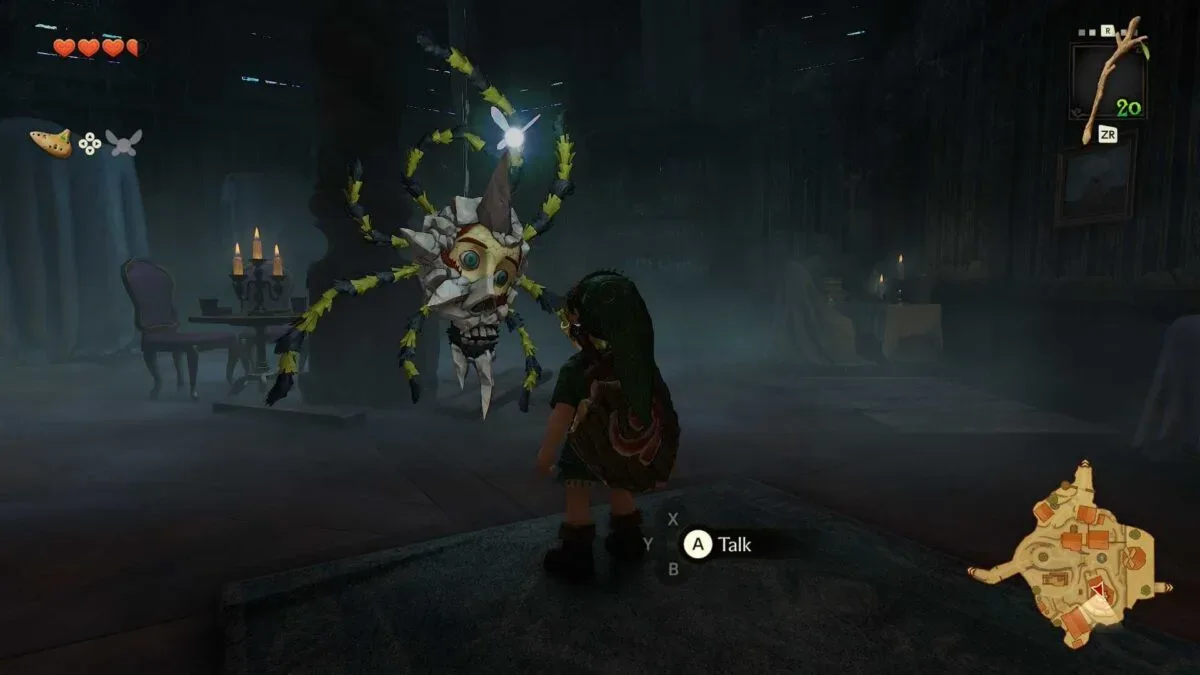
An old Gold Skulltula Token exploit appears to be alive in The Legend of Zelda: Ocarina of Time’s remake, though it is not quite the speedy in-and-out routine some players may remember. Community testing indicates that one Gold Skulltula in a grotto near Hyrule Castle can eventually return after its Token has been collected, allowing the same encounter to contribute Tokens repeatedly.
The important wrinkle is that re-entering the grotto alone does not appear to reset the creature in the remake. Players investigating the behavior found that they needed to reset the relevant loading zones first, such as by changing between child and adult Link or warping to an area with a different loading zone, including Lake Hylia. Once that broader reset occurs, the Skulltula can reappear.
That makes this less of a rapid farming trick and more of a curious workaround for anyone who is short of the completion target. It is also a reminder that old-game glitches can survive in altered forms: the underlying interaction seems intact, while the game’s transition and area-loading behavior makes repeating it more involved.
Where the repeatable Skulltula is found
The setup is in a grotto outside Hyrule Castle. Access is tied to playing the Song of Storms on a plant. Inside the grotto, the relevant Gold Skulltula is positioned behind a wall that must be destroyed with a bomb.
The encounter requires child Link’s boomerang. The boomerang matters twice: first to defeat the Gold Skulltula from a distance, then to retrieve the Token. The unusual part is the timing of that retrieval. Rather than immediately collecting the Token under ordinary conditions, the player uses the boomerang while departing on the room’s flower elevator.
That sequence lets the Token register as collected during the exit while, under the reported conditions, leaving the Gold Skulltula available to return later. For players working through the game’s upgrades and prerequisites, our Ocarina of Time Great Fairy Fountain locations, costs and upgrades guide covers another set of useful world-location objectives.
How the exploit reportedly works
The following is a practical outline of the reported method, not a guarantee that every save state will behave identically:
- Reach the grotto outside Hyrule Castle by using the Song of Storms on the plant.
- Enter as child Link and break the wall hiding the Gold Skulltula.
- Defeat the Skulltula with the boomerang from range.
- Use the boomerang to pull in its Token while leaving the room on the flower elevator.
- Do not expect the Skulltula to be waiting immediately after a simple exit and re-entry.
- Force a more complete area reset, reportedly by switching between child and adult Link or warping to another loading-zone area such as Lake Hylia.
- Return to the grotto and check whether the Gold Skulltula has returned. If it has, repeat the sequence.
A loading zone is the boundary or transition through which a game changes, reloads, or rebuilds an area’s active state. The key discovery here is that the grotto door alone apparently does not make the game rebuild this Skulltula’s state. A larger transition does. In plain terms, the Token is credited, but the enemy’s defeated state is not permanently resolved until the game performs the kind of world-state refresh triggered by a more substantial transition.
Related coverage includes Ocarina of Time Remake Keeps an Infinite Gold Skulltula Token Glitch Alive.
Why early attempts looked like the glitch had been removed
Initial reports showed that the exploit could produce a Token count of 101, but details on the necessary reset were thin. That led other players to try the familiar original-game routine and conclude that it no longer worked when the Skulltula failed to appear after they walked back into the grotto.
Further testing clarified the missing step. One player reported completing the game with 1% still absent, then using the Nintendo Switch Online app’s progress information to identify an uncollected Token in the Hyrule Castle area. On returning after the relevant world transitions, the Skulltula was present again.
That observation changes the interpretation of the glitch. It does not appear to be a completely ordinary respawn, nor a straightforward patch-out. Instead, it seems to be a state-management oddity that only reveals itself after the right kind of reload. It also explains why reports can conflict: two people can follow the same combat and boomerang steps, yet get different immediate results based on whether they have caused the larger reset.
What the 101 limit means
The reported result is not unlimited progress on the game’s visible counter. Although the Token sequence can be repeated, the counter reportedly will not exceed 101. That ceiling is worth keeping in mind for anyone considering the method as a substitute for normal collection.
Practically, the exploit may be useful if a player needs to reach the 100-Token milestone but does not want to locate every distinct Gold Skulltula. Yet it is considerably more laborious than simply revisiting one room: every additional cycle requires the boomerang-and-elevator setup and a wider loading-zone reset. Players seeking a conventional completion run may still find normal exploration simpler, especially if they have only a small number of unique Tokens left to locate.
There is another distinction worth making. A repeatable Token count is not the same thing as recovering a missed unique encounter for completion tracking. The report of a remaining 1% and an indicated Token location shows why players should pay attention to their own progress readouts rather than assume that a number above 100 necessarily settles every completion metric.
An old bug with a longer history
The remake behavior closely resembles a known trick from the original Ocarina of Time. In that version, collecting the Token with the boomerang while exiting on the flower elevator could leave the Gold Skulltula behind for another visit. The remake’s added need for a loading-zone reset makes the routine slower, but the central oddity remains: the game recognizes the Token collection without treating the Skulltula encounter as conclusively gone forever.
There is some historical context for why such a harmless quirk might remain. During work on the 2011 Nintendo 3DS remake, Nintendo developers including Satoru Iwata discussed intentionally retaining certain original-game bugs because staff who had played the earlier version considered them enjoyable and part of the experience. That does not establish that this specific behavior was deliberately preserved in the current remake, and it should not be presented as confirmation of intent. Still, it makes the possibility plausible, particularly because the exploit does not appear to break progress beyond the reported 101 counter limit.
What players should take from it
The safest reading is that this is a community-documented exploit with a specific repeatable setup, not a broadly useful respawn rule for every Gold Skulltula. It depends on one particular grotto, child Link’s tools, the flower elevator exit, and a subsequent larger reset of the game’s loading state.
For those who want to try it, the biggest time-saver is simply knowing not to stop at the grotto door. If the Skulltula is absent after a normal re-entry, move through a substantial world-state transition—changing Link’s age or warping to another area were the reported examples—then come back and check again. If the game follows the behavior documented by players, the creature should return and provide another chance at a Token.
It is a wonderfully peculiar survival story for an old Zelda glitch: a hidden spider, a boomerang, an elevator, and a world reload working together to make one Token do far more collecting than it was ever meant to do.