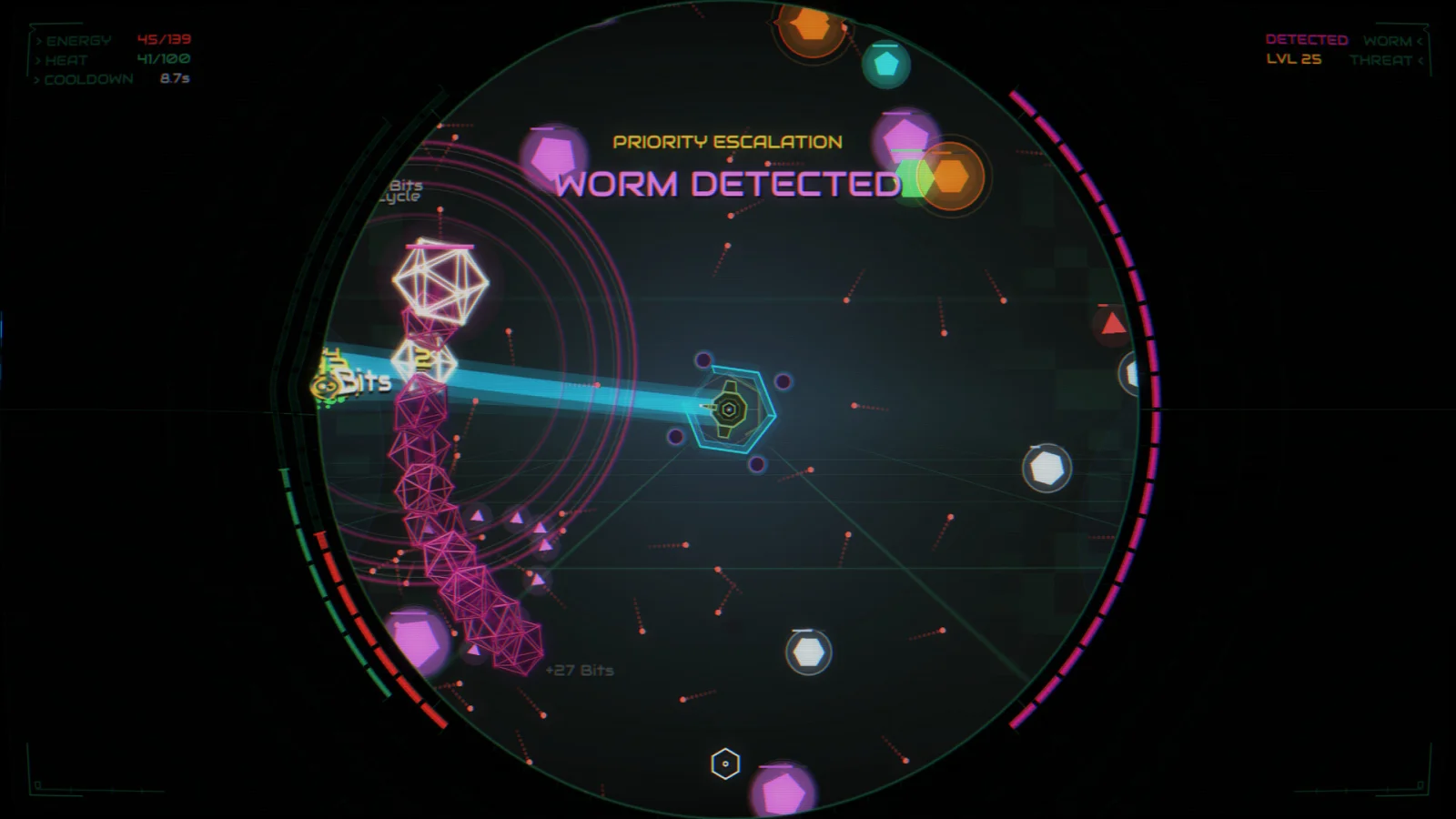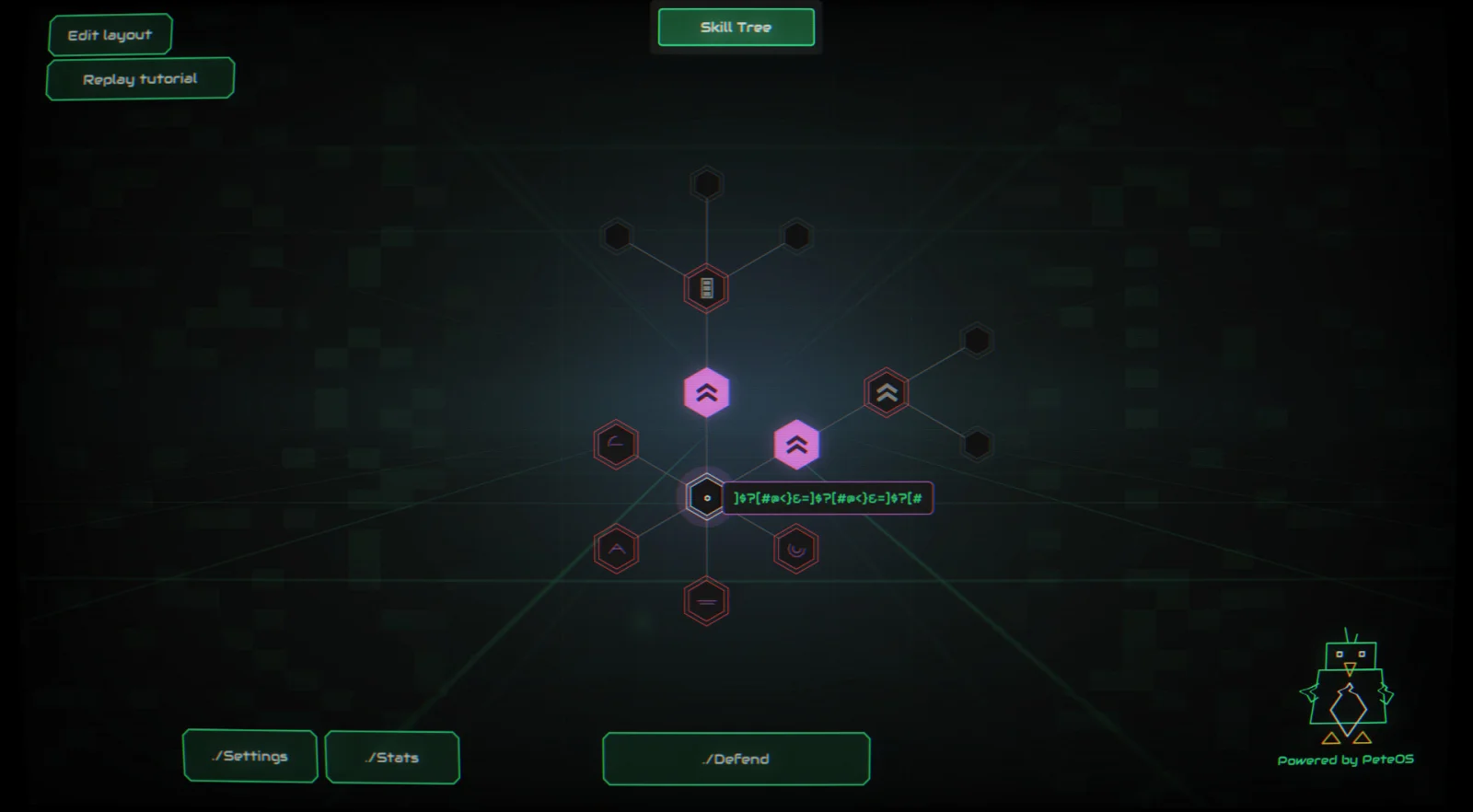
Hex Core is an unscored assessment, not a hands-on review. The available record establishes a clear premise and a substantial progression claim, but it does not support claims about personal play, performance, balance, input feel, or the full quality of its individual systems. Developed and published by Serious Penguin Studios Inc., Hex Core released on July 30, 2026 for Windows, macOS, and Linux. It is presented as a short incremental, clicker-style defense game in which players help the PeteOS operating system repel waves of viruses.
That setup matters because it frames Hex Core less as an attempt to dominate every adjacent genre and more as a focused combination of several familiar pleasures: immediate defensive pressure, repeated resource accumulation, and persistent improvement. The central question is not whether a compact game can contain a large number of upgrades. It is whether the game’s advertised pace and limited scale give those upgrades enough distinct purpose to sustain interest for the intended audience. Available critical observations point toward a game whose strongest argument is clarity: a recognizable loop, short sessions, active virus-clearing, and a persistent sense that another attempt can improve future prospects.
There is also a meaningful boundary to that argument. A player seeking an enormous roguelite, a deep long-form strategy campaign, or a nearly endless idle-game routine may be looking for a different kind of commitment. Hex Core’s compact scope can be a virtue when it prevents progression from becoming a second job. The same economy of scale can narrow the range of novelty available over a longer relationship with the game. That is not a contradiction or an automatic flaw. It is the design tradeoff around which the available evidence most clearly organizes itself.
Established design: viruses, defenses, and persistent advancement
The official description identifies Hex Core as a defense game with incremental and clicker-style elements. Runs generate resources, and those resources feed into a large upgrade tree of more than 900 upgrades. The stated consequences of advancement include new weapons, mechanics, and research paths. This is a significant numerical promise, but the number alone should not be mistaken for proof of depth. A large tree can represent meaningful strategic branches, frequent small gains, long-term goals, or some combination of these approaches. The available information confirms the scale of the upgrade offering, not the exact structure or importance of every choice within it.
Still, the advertised connection between runs and permanent development is an intelligible foundation for an incremental game. Each attempt has a defined role beyond its immediate outcome: it is part of an accumulating effort to make later attempts more capable. Critical observations describe this loop as immediately understandable and emphasize that a player leaves an attempt better prepared for the next one. That is a useful description of the intended rhythm, not verification that every upgrade is equally satisfying or that the curve is balanced across the full game.
Hex Core is also listed with Campaign, Blitz, and Fork modes. The supplied information does not define how these modes differ, how they unlock, or how much content each contains. It would be unsafe to invent those details. Their presence nevertheless suggests that the game is not described solely as a single undifferentiated run structure. Campaign implies a named primary format, while Blitz and Fork are separately identified offerings. Whether those labels create genuinely different decision-making contexts or simply organize the same core systems differently is a question that cannot be settled here.
The official material additionally identifies Kernel Ops tasks, controller support, and several accessibility features. Those are welcome stated considerations, but their practical implementation has not been detailed in the evidence provided. Controller support should not be expanded into claims about interface quality or control schemes. Likewise, the existence of accessibility features cannot substantiate claims about which needs are served, how complete the options are, or whether they address the demands of active play. The accurate conclusion is the narrower one: these elements are listed as part of the product’s design and support profile.
The appeal of a contained progression loop
Available criticism consistently identifies compactness as a core strength. One observation characterizes the game as combining defense, clicker, and bullet-heaven ideas without attempting to reinvent them. Another stresses short sessions, active virus-clearing, and longer-term upgrade planning. Taken together, those observations suggest a design that aims for legibility before novelty. In a crowded area of games built on accumulation, clear cause and effect can matter more than a radically unfamiliar premise. When a run produces resources and resources open future possibilities, the game communicates a simple promise: present effort has a persistent consequence.
For players who prefer finite, purposeful sessions, that proposition may be especially attractive. A compact incremental game can provide the satisfaction of visible growth without requiring the player to absorb an enormous ruleset or commit to a sprawling campaign. The premise also gives advancement a readable fictional wrapper. Viruses threaten PeteOS; defenses are strengthened; the operating system pushes back. The supplied critical observations say the narrative is minimal and keeps attention on progression. That should not be turned into a broad verdict on storytelling quality, but it does clarify the apparent priority. Hex Core’s identity appears to rest primarily on systems and forward motion rather than on an elaborate narrative presentation.
The word “active” is important here. One critic observation says the game begins as an incremental experience that still requires attention before moving closer to a more conventional idle structure later. This is a potentially appealing arc because it can make early engagement feel direct before persistent systems take on more of the work. But it remains an observation rather than a complete mechanical specification. There is no basis here to state how much input is required, exactly when the balance changes, or whether every mode follows the same pattern. What can be said is that the game has been characterized as sitting somewhere between active clearing and later idle-style progression rather than occupying only one end of that spectrum.
That hybrid positioning may help explain why the concept has been read as approachable. Pure clicker games can risk reducing decision-making to repetition; pure defense games can demand constant tactical attention; bullet-heaven games can emphasize immediate survival pressure. A restrained blend could let Hex Core borrow a measure of urgency from one category and persistence from another. Whether that blend is sufficiently distinct for a particular player is conditional on taste. Someone who enjoys multiple familiar systems reinforcing one another may find the combination efficient. Someone who wants a sharply defined genre identity may find the same mixture modest rather than transformative.
More than 900 upgrades: scale needs readable consequences
The more-than-900-upgrade tree is Hex Core’s most conspicuous declared feature. It signals abundance, and it gives the game a potentially long runway of goals even within a short overall framework. Yet upgrade quantity is not synonymous with strategic variety. The meaningful test for any large progression structure is whether new purchases alter priorities, introduce fresh possibilities, or produce satisfying milestones. The official description says upgrades can unlock weapons, mechanics, and research paths, which indicates that at least some of the tree is intended to do more than apply a simple numerical increase.
That distinction creates room for cautious optimism. New weapons and mechanics can change how a player understands a system; research paths can make advancement feel organized around choices rather than a single straight line. However, the supplied evidence does not identify particular weapons, research decisions, synergies, or branching consequences. It cannot establish whether the upgrade tree offers difficult tradeoffs, broad experimentation, or primarily sequential unlocks. The appropriate assessment is therefore about potential design value, not a claim of confirmed complexity.
In a compact game, a large tree can serve two opposing purposes. At its best, it compresses a sense of discovery into a short format. Instead of asking a player to remain in one campaign for dozens of hours, it can keep presenting small targets, mechanical additions, and reasons to return. At its weakest, it can turn the game’s apparent scope into a catalogue whose entries do not sufficiently change the experience. The available critical assessments lean toward the former interpretation by praising progression planning and rapid improvement, but they also identify limited scale as a weakness. Both readings can coexist: the progression may be satisfying within the game’s intended bounds without delivering the breadth some audiences expect from the raw upgrade count.
Players considering Hex Core should therefore read “900-plus upgrades” as a statement of advancement volume, not a guarantee of 900 separate tactical revelations. That is not a criticism of the number; it is a useful way to set expectations. The most favorable fit is likely a player who values a dense ladder of objectives and accepts that the game is officially described as short. The least favorable fit may be a player who needs every major unlock to radically reshape play or who measures value chiefly through an expansive endgame.
A modest scope can be disciplined rather than slight
One supplied critique calls short length and limited scale the clearest weaknesses. That observation deserves direct attention because scope is central to the game’s proposition. “Short” is not an empty label in an incremental game. These games are often associated with prolonged routines, huge compounding systems, and an expectation that numbers will continue climbing for a long time. Hex Core instead explicitly presents itself as short. The value proposition is consequently less about permanent occupancy and more about a concentrated progression arc.
That concentration can be disciplined design. A game does not need to become an endless service to make persistent improvement meaningful. A compact structure may spare players the padding, late-game repetition, and obligation that can accompany larger progression systems. If the path from modest defenses to stronger tools remains understandable, the smaller format could make Hex Core a practical choice for someone who wants a complete incremental-oriented experience with defined limits. Critical observations emphasizing short sessions support that possible use case.
But the limits should not be obscured. Players who primarily want long-form strategy may reasonably expect more sustained planning, broader systemic interaction, or a larger campaign framework than the available evidence demonstrates. Players approaching from roguelites may also expect extensive run-to-run variety, demanding build construction, or a highly developed set of distinct encounters. None of those expectations can be confirmed from the supplied material, and it would be wrong to treat Hex Core as though it promises them. Its defense, bullet-heaven, and incremental influences are better understood as ingredients in a focused package than evidence that it matches the largest examples of any one category.
This is a useful contrast with the design questions raised in an assessment of a bullet-heaven game built around firing arcs. The shared genre language should not be read as a direct comparison of feature sets, quality, or scale. It simply illustrates why broad labels can conceal important differences in what a game asks of the player. Hex Core’s available description puts persistent upgrades and a compact defensive loop at the center of its identity.
What the available reception can and cannot establish
The checked Steam snapshot showed 83 percent positive user reviews from 12 reviews as of September 2026. That is a small and volatile sample, not a broad measure of consensus. It may indicate a generally favorable early response among that limited group, but it cannot reliably settle how the wider audience will respond or how sentiment will develop over time. Small review totals are particularly poor foundations for sweeping claims about replay value, technical reliability, difficulty, or lasting appeal.
The independent critical observations supplied for this assessment are more useful as descriptions of recurring themes than as a substitute for comprehensive testing. They point to a clear loop, active early attention, compact sessions, upgrade planning, minimal narrative emphasis, and a focused blend of familiar genres. They also point to a limit in breadth and duration. These are coherent signals, but they do not establish every player’s experience. Preferences will matter greatly. A player who sees economy of scale as elegant may interpret the same design decisions very differently from one who wants broad mode depth or a prolonged strategic challenge.
Verdict
Hex Core’s documented strengths are conceptual rather than extravagant: a readable premise, persistent resources, a very large advertised upgrade tree, and a stated short-form structure built around defending PeteOS from viruses. The critical picture available is of a focused incremental-defense blend that values momentum over reinvention. Its strongest case is for players who want active virus-clearing and long-term progression planning in a contained format, not for those who require a vast roguelite or an expansive strategy game.
The key caveat is inseparable from the appeal. Rapid progression and modest scale can make Hex Core approachable, efficient, and pleasantly finite; they can also cap variety for players seeking a deeper or longer-lasting systems experience. Campaign, Blitz, Fork, Kernel Ops, controller support, and accessibility features broaden the stated package, but their exact execution remains outside what this evidence can verify. On the available record, Hex Core looks most promising as a deliberately bounded progression game whose value depends on whether its compactness reads as focus rather than limitation.