A focused graphics fix for the PSVita port
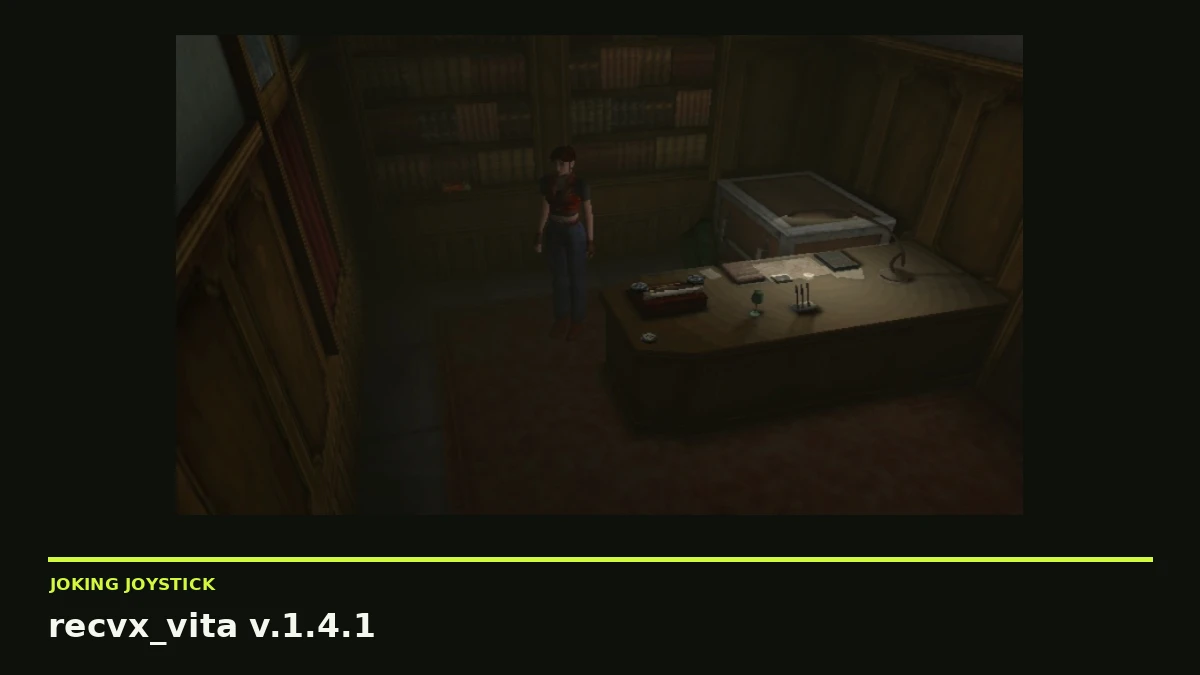
Resident Evil: Code Veronica X Vita has reached version 1.4.1 with a targeted fix for translucent geometry. The update corrects a regression that could cause translucent meshes to fully cover anything behind them, preventing the affected layers from displaying correctly.
Published on November 11, 2026, version 1.4.1 includes the recvx.vpk package and setup.zip. The release notes list no other changes, making this a corrective update rather than a feature expansion.
What the project provides
Resident Evil: Code Veronica X Vita is a PSVita port of the PS2 version of Resident Evil: Code Veronica X, based on a decompilation of that version. It uses a 960x544 internal resolution and supports multisample anti-aliasing up to 4x, with 4x selected by default.
The port includes widescreen support, modern controls, first-person and third-person over-the-shoulder options, and a built-in cheats menu. When modern controls are enabled, the third-person mode supports dual-analog controls. In fixed-camera tank-control sections, flicking the right analog stick performs a 180-degree turn. A separate options menu is available by touching the top-left area of the screen.
Earlier updates added graphics controls
Although version 1.4.1 only addresses the translucent-mesh regression, the previous version added graphics controls that remain part of the current release. Version 1.4 added brightness and color-saturation settings, support for translated computer-screen text, and a reduction in CPU workload through simpler handling of translucent meshes.
The port also offers adjustable fog density, an option to disable motion blur, an option for shadow casting, and a range of post-processing effects. Available effects include CRT, CRT Bleeding, FXAA, Greyscale, LCD 3x, Negative, Sepia, Sharp Bilinear Grid, Sharp Bilinear Scanlines, and Vignette.
Features carried into version 1.4.1
The port includes several play-focused conveniences. Pressing Square while aiming reloads the equipped weapon without opening the Inventory menu, and doors or stairs animations can be skipped with X. The project also lists considerably faster loading times as one of the port’s features.
Players can choose Very Easy, Easy, or Normal difficulty when starting a new game. The built-in cheats menu includes a TAPELESS SAVE option, and the port supports the BioRand randomizer. BioRand use requires generating a randomized version from an ISO and preparing the resulting files with the tools documented by the project.
Language and display support
Version 1.4.1 retains support for French, Spanish, Italian, Russian, Turkish, Brazilian Portuguese, and German. Earlier localization work expanded beyond standard interface text to include image-based text and computer screens.
Widescreen mode is enabled by default, and the port includes adjustments for transitions between widescreen gameplay and 4:3 screens such as menus. Earlier releases also addressed several widescreen camera and geometry problems, including missing walls in specific Art Room views and improperly clipped geometry.
Using the release
The documented setup uses the PSVita package together with prepared game data from the NTSC-U PS2 version of Resident Evil: Code Veronica X. The setup archive includes PC-side preparation tools. The instructions require the source ISO to be named recvx.iso, processed with the preparation script, and followed by copying the generated assets and other required files to ux0:data/recvx.
The setup documentation also lists libshacccg.suprx as a required PSVita system component and Python 3.10 or newer for the preparation step. The final data directory uses recvx.iso, native-assets.psarc, movies.psarc, and the extracted data package. These files are part of the documented preparation process; the PSVita package is not described as containing the original game data.
Version 1.4.1 is most relevant to users who encountered scenes where translucent effects or models appeared to obscure everything behind them. The update targets that specific rendering regression while retaining the port’s existing control, display, localization, and customization features.