A broader and more flexible Vita release
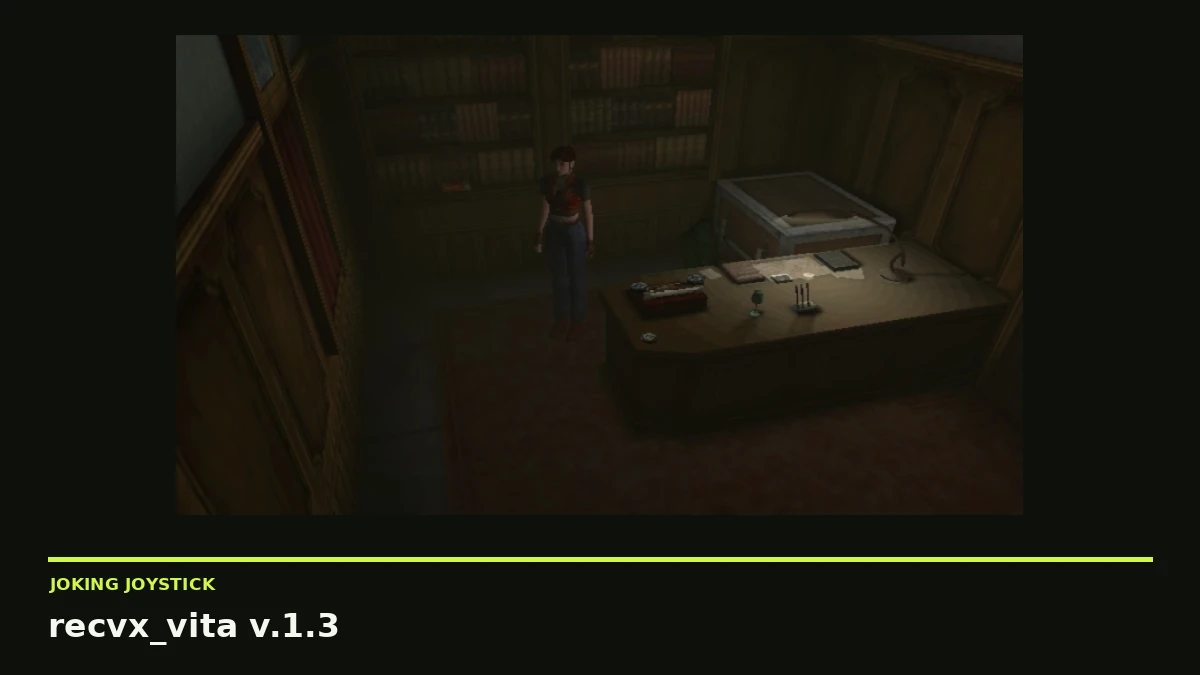
Resident Evil: Code Veronica X Vita version 1.3 is available as a new PlayStation Vita build based on the decompilation of the PlayStation 2 version. Published on November 4, 2026, the update expands language support, adds presentation options and addresses several scene-specific gameplay and rendering problems.
Russian, Turkish and Brazilian Portuguese are now supported alongside the existing French, Spanish, Italian and German localizations. The port also retains features such as modern controls, first-person and over-the-shoulder camera options, widescreen output, customizable fog density, motion-blur control and a built-in cheats menu.
New visual options and presentation changes
Version 1.3 adds a group of optional post-processing effects: CRT, CRT Bleeding, FXAA, Greyscale, LCD 3x, Negative, Sepia, Sharp Bilinear Grid, Sharp Bilinear Scanlines and Vignette. These filters let players change the appearance of the Vita version, from sharper pixel presentation to effects that emulate older displays.
The update also adds an option to hide the black bars at the top and bottom of in-game cutscenes. A custom PlayStation 2 boot animation now plays when the game launches, while widescreen mode uses the PlayStation 3 16:9 background image in the main menu.
Widescreen transitions have also been cleaned up. When the game moves from a widescreen 3D scene to a 4:3 screen such as a menu, the scene should no longer remain cropped to 4:3 for several frames. Two missing-wall problems in specific Art Room cameras have also been corrected when widescreen is enabled.
Performance and graphics adjustments
The project reports a CPU workload reduction of up to 40 percent in this release. MSAA has also been optimized so that its effect on GPU workload is significantly lower, and the MSAA setting can now be changed without restarting the game.
The port renders internally at 960 by 544 and supports MSAA up to 4x, with 4x set as the default in the documented feature list. The new release adds further control over how the game’s image is displayed through its post-processing options.
A lighting issue affecting the robots in the Antarctica base has been fixed. Under certain circumstances, their emitted white light could previously be clipped. The update also corrects the ceiling in the Golden Lugers secret room, which could completely block the camera while Claire attempted to collect the weapons.
Gameplay and cutscene fixes
The Golden Lugers sequence receives another correction: after Claire collects the weapons, the resulting camera view should no longer show only a wall. A separate control issue affecting the C Type scheme has also been fixed, preventing attack and reload from being assigned to the same button.
Chris can now recover correctly after being hit by Alexia’s fire. Previously, inputs could become stuck and leave him trapped in a broken animation. Version 1.3 also improves timing between video and audio during in-engine cutscenes when occasional frame drops occur.
The port continues to offer both traditional fixed-camera controls and modern control options. With modern controls enabled, players can use dual-analog movement in the first-person and over-the-shoulder modes. In fixed-camera tank-control mode, flicking the right analog stick performs a 180-degree turn.
What the Vita port includes
Resident Evil: Code Veronica X Vita is a PlayStation Vita port of the PlayStation 2 version rather than a release for the original PlayStation 2 hardware. Its documented features include widescreen support, faster loading times, selectable Very Easy, Easy and Normal difficulties, and the ability to skip door and stair animations by pressing X.
The port also adds convenience features that alter how the original game is played. Pressing Square while aiming reloads the equipped weapon without opening the inventory, and motion blur can be disabled. A touch option in the top-left area of the screen opens an additional options menu.
BioRand support is included for players using the separate randomizer. The documented workflow requires generating a randomizer version from the game image, preparing its assets with the supplied tools, copying the resulting package to the Vita data directory and enabling the BioRand option in the game.
Preparing the documented Vita setup
The release includes a VPK and a setup archive. The documented setup requires the Vita shader compiler module if it is not already installed, the NTSC-U PlayStation 2 game image named recvx.iso, and the release’s asset-preparation tools. The setup process converts the required game data on a computer before the resulting files are placed in ux0:data/recvx on the Vita.
The README specifies that the prepared folder should contain recvx.iso, native-assets.psarc and movies.psarc, along with the extracted data package. It also documents Python 3.10 or newer and FFmpeg as part of the computer-side preparation process. These are setup requirements for creating the port’s assets, not separate runtime features of the Vita application.
The included release files are recvx.vpk and setup.zip. The release notes do not describe an in-place update procedure, so users should follow the project’s documented setup layout when preparing version 1.3.
A cumulative step forward
Version 1.3 builds on earlier releases that introduced the BioRand randomizer, over-the-shoulder controls, improved loading times, difficulty selection, fog controls, shader precompilation and the Square-button reload option. Earlier updates also added Italian localization and fixed several input, camera, text and rendering problems.
The new release concentrates on presentation flexibility and efficiency while removing a collection of highly specific visual and gameplay faults. Its language additions make the port accessible to more players, the post-processing and cutscene options provide more display control, and the reported CPU and MSAA changes target the cost of rendering on Vita hardware.
With the new build, the project offers a more configurable version of the PlayStation 2 game for PlayStation Vita while preserving its modern-control, widescreen, randomizer and display-customization features.