“R36S” Is a Product Family, Not a Stable SKU
The first mistake in discussing the R36S is to treat the name as if it identifies one fixed console. In practice, “R36S” is a label used across a family of similarly branded vertical handhelds. Many documented configurations share a broadly familiar shell, an RK3326 platform, a 3.5-inch-class display, and a Linux-based menu, yet commercial documents also describe differences in board revision, memory, battery, screen panel, storage arrangement, and supplied software.
That distinction matters because a specification can be accurate for one R36S-branded configuration and misleading when applied to another. A Data Frog manual documents an R36S with an RK3326, a 3.5-inch 640×480 display, Linux, two TF-card slots, and a listed 3200 mAh battery. An alternate manual describes a similar set of headline features but identifies a different distributor or support chain. A trade specification uses still another combination of memory, storage, and bundled-game claims. These documents are evidence of particular products or listings, not proof of a single universal design.
The safest language is therefore variant-specific. “The configuration documented in the Data Frog manual” is more precise than “the R36S has.” “Common RK3326-based R36S units” is more useful than implying that every console carrying the name shares one motherboard. Even the phrase “stock R36S” needs qualification, because the stock software is usually whatever image a particular seller or distributor placed on a particular removable card.
The naming issue becomes clearer when products such as the R36S Plus enter the picture. The R36S Plus is separately marketed with a 4-inch display and Wi-Fi. That does not make its screen, board, firmware, or internal layout representative of the original vertical R36S configuration. The same caution applies to other R36-branded products, including models marketed with additional letters or words. A related name may indicate a product family, a marketing decision, or a genuinely different design; it does not establish shared internals.
There is also a difference between a changed specification and a changed product identity. A retailer might alter the listed storage capacity or bundle a different card without changing the shell. The documented panel, board, and specification variation is consistent with the possibility that later or alternate assemblies retain a familiar exterior while changing display wiring or memory arrangements, but the supplied evidence does not establish a complete revision history. A product marketed under the same name may therefore be physically close to an earlier unit yet require a different operating-system image. Conversely, a differently branded handheld may be electrically similar enough for a community firmware project to support it.
Community firmware records make this variability difficult to ignore. AeolusUX documents additional panel targets for R33S, R35S, and R36S units, while its R36S-DTB repository records continuing device-tree work. dArkOSen-R36S likewise identifies specific hardware targets. The evidence supports panel and target variation; it does not, by itself, establish that every similarly named unit requires a different image.
This is why “clone” is not a sufficient first answer to every inconsistency. Some units may be alternate assemblies, later revisions, or products using a common reference design. Some may be sold under different names but use closely related hardware. The important question is not whether a console feels authentic to an imagined original. It is which board, panel, memory arrangement, and software image the individual unit actually needs.
Retail packaging often encourages the opposite assumption. It may show a large system count, a familiar ArkOS-style interface, and a short specification list that treats the name as a complete identity. Such material can document what a seller advertised, but it cannot resolve the manufacturing history or confirm that another R36S listing uses the same hardware. Game counts and battery language are especially poor identifiers because they can change with the bundled card or marketing template.
A useful description of the R36S is therefore not “one cheap handheld,” but “a recurring hardware and software pattern sold through overlapping channels.” That pattern has a recognizable appeal: a vertical shell, console-like controls, removable storage, and an inexpensive RK3326-based platform. It also has an unusual cost in attention. Before performance, compatibility, or firmware can be discussed responsibly, the unit’s variant must be established.
For readers, this changes the order of operations. The model name is only the beginning. The manual, board markings, supplied card, panel behavior, and firmware documentation provide stronger clues about what a particular console is. The box may say R36S, but that label alone does not tell us which screen timing, device-tree file, memory configuration, or software history lies underneath.
Manufacturer, Assembler, Distributor, and Retailer Are Different Nouns
The R36S also exposes how easily the language of hardware provenance becomes blurred. A chip supplier, a board assembler, a distributor, a firmware maintainer, and a retailer can all appear in the same product trail, but they do not perform the same role. Treating them as interchangeable produces a confident answer where the available evidence supports only a partial one.
Rockchip is the clearest example. Its RK3326 datasheet identifies the company responsible for the silicon platform. It describes the processor’s architecture, interfaces, and supported functions. It does not identify the company that designed a specific R36S board, assembled a particular unit, selected its display panel, installed its battery, or placed the console in a retailer’s warehouse. Seeing “Rockchip” in a specification is therefore not evidence that Rockchip manufactured the handheld.
The same separation applies to the word “manufacturer.” A company named on a manual may be connected to a particular documented configuration, but the manual does not establish whether that entity was the factory, assembler, distributor, importer, or support contact. Another manual for a similar-looking R36S configuration identifies a different commercial contact. Those documents establish different documented channels, not a complete factory history.
Retailer pages occupy a different evidentiary category again. They are useful for recording what was advertised: a screen size, an operating-system label, a claimed number of games, a battery description, or a list of systems. They are not automatically technical documentation, and a retailer may copy specifications from a supplier, reuse a product template, or describe a bundle rather than the console’s fixed hardware. A listing that says “ArkOS” tells us what the seller wants the buyer to associate with the software; it does not establish an official relationship with the ArkOS project.
That distinction is especially important because there is no supplied evidence establishing one official R36S manufacturer across the whole product family. The available documentation points to an unresolved chain. Board markings can help identify a revision. An original manual can connect a configuration to a distributor. A trade sheet can reveal how a supplier described a product at a particular time. None of those sources should be stretched into a universal corporate origin story.
A more careful source hierarchy helps. Physical board markings and documentation that accompanied a specific unit are useful for variant identification. Firmware repositories are authoritative about the software maintained by those repositories and the hardware targets their developers chose to support. Retailer pages are evidence of marketing claims. A silicon datasheet is authoritative about the chip, not the finished console. Each source answers a different question.
This is also where firmware provenance must be kept separate from hardware provenance. Christian Haitian’s repository establishes the ArkOS project and its repository history. Later R3XS images were distributed and adapted by community developers, notably AeolusUX, for R33S-, R35S-, and R36S-related hardware. AeolusUX described those images as community-maintained, and the repository was archived on June 9, 2026. dArkOSen-R36S is a separate community project with its own release history and device selectors. None of those maintainers is thereby shown to have manufactured the consoles.
A firmware maintainer works from the software side of the problem. Depending on the project and release, a maintainer may document board behavior, add or select a device-tree file, address a display-initialization issue, or adjust input and emulator configuration for a supported target. Those examples describe the kind of work recorded in community firmware projects; they do not establish that every cited maintainer performed every action for every R36S variant. Such work can make a community image more suitable for particular hardware, but it does not transfer ownership of the hardware to the developer.
The word “official” should consequently be used sparingly. An official manufacturer statement could establish a relationship. A repository maintained by a named developer establishes responsibility for that repository’s software. A retailer’s menu label establishes only that the label appears on the supplied card or in the listing. These are different forms of evidence, and collapsing them leads directly to the common claim that every R36S ships with “official ArkOS.” The supplied research does not support that claim.
The RK3326 Baseline—and Its Unknowns
The RK3326 provides the most useful common technical reference for many R36S configurations, but it is a starting point rather than a complete performance specification. Rockchip documents a quad-core ARM Cortex-A35 platform with an ARM G31-2EE GPU and interfaces relevant to memory, display, storage, and peripherals. Those facts establish the documented SoC baseline; they do not make every RK3326 handheld the same machine.
A system-on-chip is one component in a finished design. The board must provide memory, power regulation, storage connections, display wiring, input controls, and whatever cooling or heat-spreading arrangement the assembler chose. Software must initialize those components with suitable settings. Even when two products use the same chip, they may differ in memory type or capacity, clock configuration, thermal behavior, governor settings, graphics drivers, panel timing, and storage quality.
That is why the phrase “RK3326 performance” can be misleading. The datasheet describes what the silicon supports, not the frame rate of a specific emulator on a specific handheld. It does not tell us whether a console is running every core at an identical frequency, whether its graphics driver exposes the same functions, or whether its operating system applies the same power and performance settings. It also does not measure controller latency, heat, battery draw, or the behavior of a particular game.
The documented R36S configurations add some context. Manuals identify an RK3326 alongside a 640×480-class display and Linux-based software, while trade material describes differing memory or storage claims. Those documents show how the chip is packaged into an advertised product. They do not resolve every board-level question. A seller’s memory description may refer to a particular configuration, and a different batch may use another implementation while retaining the same headline processor.
Memory is a good example of the gap between a chip specification and a console experience. The processor may support relevant memory interfaces, but the datasheet does not establish the capacity or exact implementation in every R36S. A trade sheet that mentions DDR4 documents an advertised configuration; it does not make that memory description universal. Nor does memory capacity alone predict emulator performance. Drivers, operating-system configuration, graphics access, and the demands of the software workload remain part of the chain.
Display support has a similar dependency. The RK3326 platform includes interfaces for display hardware, but it does not specify the panel fitted to every branded handheld. A panel’s timing and initialization requirements are board-and-software concerns. This is one reason later R36S documentation can require additional device-tree variants even when the processor remains unchanged.
Storage quality is another unknown that the SoC cannot answer. The processor can interface with removable or onboard storage, but it does not determine the reliability of a particular microSD card, the quality of the system image, or the way a seller organized the card. Since the card may hold the operating system, emulator configuration, saves, and user content, storage behavior can affect the apparent stability of the entire console.
Emulation adds another layer. Its demands vary by system and title, and results depend on the emulator build, graphics driver, settings, input configuration, and operating system. It is reasonable to center discussion of an RK3326-based R36S on older retro workloads, but that is an editorial expectation, not a conclusion stated by the Rockchip datasheet. N64, Dreamcast, Saturn, and PSP should therefore be described as variable workloads rather than guaranteed capabilities.
The research packet contains no independent benchmark, frame-rate log, latency test, thermal reading, power measurement, or controlled compatibility spreadsheet. That absence is important. It means the article can explain the hardware’s documented position and the reasons results may differ, but it cannot responsibly attach performance numbers to the R36S family or promise that a named platform will play acceptably across all units and titles.
A useful three-level distinction keeps the discussion honest. First is documented silicon capability: what Rockchip says the RK3326 platform provides. Second is the seller-stated configuration: what a manual, trade sheet, or listing claims about a particular product. Third is measured behavior: what controlled testing shows on a specific unit with specified software and settings. The available evidence supports the first two levels, with qualifications. It does not supply the third.
As an editorial framework, the RK3326 is a useful baseline for explaining both the R36S’s appeal and its likely limits. The processor name narrows the conversation; it does not establish a console-wide emulation ceiling or the breadth of a particular software ecosystem. Those judgments require the board implementation, firmware, emulator, settings, title, and—ideally—measurements for a defined unit.
Screen Panels, DTBs, and the Black-Screen Problem
For the R36S family, the screen is not merely a component that determines image size and resolution. It is part of the hardware-software contract. A console can have the right processor and a seemingly appropriate operating-system image yet fail to show a usable picture if the software describes the board or panel incorrectly.
The relevant description is commonly carried through a device-tree blob, or DTB. A DTB supplies structured hardware information used during system initialization. For this feature, the documented issue is specifically that different R36S boards and panels can require different display and board targets. The DTB is therefore a hardware-description component, not an emulator setting or visual theme.
If an image or DTB targets a different screen arrangement, the unit may fail to initialize its display correctly or may show no usable picture. That causal explanation is an inference from the repositories’ compatibility warnings, not a diagnosis of every black-screen report. It does show why “use any R36S image” is unsafe as a universal rule.
Community firmware records provide unusually direct evidence of this problem. AeolusUX release notes warn that newer R33S, R35S, and R36S units use additional screens. The associated R36S-DTB project records continuing additions and corrections for panel and board variants. dArkOSen-R36S also documents device selectors and target-specific fixes. The supported conclusion is that the product name alone is insufficient to establish one universal display configuration; the repositories do not, by themselves, identify the manufacturing history of every affected unit.
The practical implication is that a firmware image is not just a collection of emulator programs. It is also a hardware-targeted environment. The image may contain multiple device-tree files or a selection mechanism that allows the user or maintainer to identify the appropriate one. Those choices exist because visually similar consoles can expose different initialization requirements.
This is one reason the external shell is a weak compatibility test. Two units can share the same vertical shape, button arrangement, and printed logo while using different panels or board revisions. A device sold later may preserve the familiar casing but change the screen supplier or wiring. A community catalog can identify likely variants, but such catalogs are field references rather than complete manufacturer records. Board evidence and firmware documentation are stronger when they agree.
The reverse situation is possible too. A differently branded product may use a board close enough to an R36S variant that an existing community image supports it. That does not make the products identical, and it does not establish a shared manufacturer. It means that the electrical and software requirements overlap sufficiently for a particular project to target both. Compatibility is a technical relationship, not an authenticity certificate.
Panel variation should not be turned into unsupported visual ranking. The available documentation supports the existence of multiple screens and continuing device-tree work. It does not provide controlled brightness, contrast, response-time, viewing-angle, or color measurements. It is therefore reasonable to discuss initialization compatibility, but not to declare that one panel is universally better or worse on visual quality.
The distinction between a software failure and a hardware failure also matters. A mismatched device-tree selection can make a working panel appear dead at boot. Conversely, a damaged display, bad connector, corrupt storage card, or unrelated power problem can produce a similar symptom. The community documentation establishes a documented class of compatibility problems; it does not turn every blank display into proof of a wrong DTB.
For that reason, variant identification should precede firmware replacement. The relevant clues may include the unit’s board markings, the supplied system image, the panel behavior, the manual associated with the sale, and the device selectors documented by the firmware project. No single clue is guaranteed to settle every case, especially in a product family whose hardware history is incomplete.
There is also a maintenance consequence. As new variants appear, a previously suitable image may not remain suitable for every later unit carrying the same name. Firmware projects may add a panel option, correct a device-tree entry, or separate one board target from another. A release date and project history therefore matter. “The console runs ArkOS” is not enough information; the relevant question is which ArkOS-derived or separate community build, maintained by whom, for which documented hardware target.
The black-screen problem captures the R36S’s broader character. Its low-cost appeal is supported by a community ecosystem willing to identify boards, adapt software, and maintain device-specific fixes. But that ecosystem also reveals the hidden complexity behind a simple product label. The screen is not an isolated display purchased independently of the operating system. It is one part of a particular board-and-firmware combination, and an incompatible image or DTB may prevent correct display initialization or normal boot. That is a possible compatibility outcome inferred from project warnings, not the explanation for every blank-screen report.
Controls: Broad Feature Set, Variant-Sensitive Mapping
The common R36S control inventory is easy to recognize even when the internal hardware is not. Manuals for several R36S-branded configurations describe a vertical handheld with a directional pad, four face buttons, two analog sticks, shoulder buttons, Start and Select, volume controls, a reset control, a headphone output, and two TF-card slots. That combination gives the device a familiar console vocabulary in a compact portrait-oriented shell. It also helps explain why the R36S appeals to people who want something more flexible than a simple four-button retro player.
That inventory should still be treated as documented hardware for particular configurations, not as a guaranteed specification for every product using the name. The controls may be physically present while their behavior depends on the board, operating-system image, front-end, emulator, and game-specific configuration. A button that performs one function in the main menu may be interpreted differently inside an emulator. A shortcut described in one manual may be absent, reassigned, or implemented through another menu in a later or variant-specific image.
The distinction between a physical control and a firmware shortcut is especially important. The D-pad, face buttons, analog sticks, shoulder buttons, Start, Select, volume controls, and reset switch are pieces of the handheld itself. “Select plus Start exits the game,” by contrast, is software behavior. The shortcut exists because the firmware or emulator configuration assigns an action to that combination; it is not a mechanical property of the buttons. Changing the software environment can change the combination, its timing, or whether it works at all.
Common manuals provide examples of this software layer. One documented configuration uses Select plus Start as an exit shortcut and Select plus X to reach RetroArch access or related options. Select combined with shoulder buttons is described for save and load functions. These arrangements are useful clues about how a particular supplied image is configured, but they should not be printed as a universal R36S command table. A different firmware build, emulator core, menu version, or clone board may use another mapping.
That qualification does not make the shortcuts unimportant. They are part of the appeal of a Linux-based front end designed around controller navigation rather than a desktop interface. A user can move between a game and a menu without relying on a keyboard or touchscreen, and the presence of dedicated buttons makes common emulator functions discoverable once the relevant configuration is known. The convenience comes from the software profile installed on the card, not from the R36S name alone.
Dual analog sticks also broaden the kinds of software the layout can address. A D-pad and four face buttons are sufficient for much older console designs, but the sticks and shoulder inputs provide a control vocabulary closer to later consoles and certain arcade or computer-style interfaces. That does not establish that every later platform will emulate acceptably. It means only that the hardware offers more possible input axes and buttons than a minimalist handheld with a single directional pad.
The extra controls can create a second layer of uncertainty. An emulator may expose a different logical order from the labels printed on the shell, and a community image may change an analog-stick assignment or other input mapping. Such a change demonstrates that input behavior can be maintained in software after the console has been sold; it does not, without a specific entry, establish which mapping changed in every R36S configuration.
The reset control deserves the same careful treatment. A reset switch can be useful when software stops responding, but its presence does not make a forced reset equivalent to an orderly shutdown. If the operating system is writing configuration, save, or file-system data, interrupting power can create a different risk from leaving a game through its software menu. The control inventory tells us that a reset mechanism exists in documented designs; it does not define when using it is safe.
Nor do the manuals supplied for this research establish controlled conclusions about ergonomics, durability, or input latency. The portrait shell may look familiar, and its layout may be attractive to readers who prefer dedicated buttons, but the evidence does not support universal claims about comfort, switch life, stick quality, or responsiveness. Those questions require hands-on inspection or explicitly attributed testing. They should not be inferred from the number of controls or from the presence of analog sticks.
The strongest conclusion is narrower and more useful. The R36S control set offers broad physical coverage for a budget retro handheld, while its actual behavior is governed by variant-specific firmware. Readers should separate what they can see on the shell from what the supplied image assigns to each input. When a manual lists Select combinations, those instructions identify one software configuration at one point in the product’s history. They are a starting reference, not a permanent standard for every unit carrying the R36S label.
Storage Is Part of the Product
Removable storage is not a minor accessory in the R36S ecosystem. It is part of the machine’s operating structure. The Data Frog documentation assigns the first TF slot, commonly called TF1, to the system and the second, TF2, to games. Some configurations and firmware arrangements support a single-card layout instead. These differences matter because the card or cards may carry much more than a collection of playable files: they can contain the operating system, front-end settings, emulator configurations, save data, and other user-created information.
Thinking of the supplied card as “the game card” therefore understates its role. In a two-card arrangement, removing or replacing the system card can prevent the handheld from booting even if the second card remains present. In a single-card arrangement, system files and user content occupy the same removable medium, so damage or corruption can affect several functions at once. The exact directory structure and behavior depend on the firmware image, but the general dependency is clear: the R36S uses storage as boot media and maintenance infrastructure.
This arrangement helps explain why two units with similar shells can require different care. A card image intended for one board or panel may not initialize another unit correctly. Firmware projects publish device-specific options because the operating system must know which hardware it is starting. A card that is healthy and readable can still be unsuitable if its image does not match the console’s board or display requirements. Conversely, a correct image can become unreliable if the card itself develops errors or is written improperly.
Several failure routes can therefore look similar to the owner. A damaged or inconsistent card may produce missing menus, corrupted settings, disappearing saves, or a failure to boot. An unsafe shutdown can interrupt a write operation and leave the file system in an inconsistent state. A mismatched image can create a black screen or other initialization problem. A board-specific issue can be mistaken for a bad card. None of these possibilities proves that every card supplied with an R36S is defective. They show why the card should be treated as a component with dependencies rather than as disposable packaging.
The manuals’ shutdown guidance is consequently practical, not ceremonial. Where the operating system provides a shutdown command, using it is generally intended to let software close files and complete pending writes before power disappears. Repeatedly holding the power button or relying on an abrupt reset bypasses that orderly process. The general file-system explanation applies as technical reasoning; the supplied manuals do not establish identical shutdown handling for every R36S image. The risk is not limited to losing the current session. Configuration files, save data, or boot information can be affected if they are being written at the moment of interruption.
Backups are part of sensible maintenance for the same reason. A backup preserves configuration and personal data tied to a removable card. Replacement planning is not simply a matter of buying enough nominal capacity: the replacement image must match the unit’s board and panel target, and the user must preserve lawful personal data and settings. The exact process remains firmware- and hardware-dependent.
Storage capacity claims should be read with similar care. A retailer may advertise a large number of games or a particular card size, but that number can describe bundled files rather than verified compatibility, licensed content, or a tested software library. The research does not establish the provenance or licensing status of bundled material, and this feature does not provide instructions for obtaining copyrighted games, BIOS files, or other protected content. Storage can be discussed as a technical and maintenance concern without treating its contents as evidence of performance.
The two-card design can nevertheless be useful. Separating the system medium from the game or user-content medium may make it easier to preserve one category while maintaining another, depending on the firmware’s organization. It can also make the product’s structure easier to understand: one card is responsible primarily for booting and software, while the other is used for additional content. That division is not universal, however, and a user should follow documentation for the exact image rather than assuming every slot follows the same rule.
Card quality is another area where caution is needed. The supplied research supports discussing inconsistent cards and software corruption as possible support problems. It does not support the blanket statement that every included card will fail, nor does it establish a failure rate. A card may work for a long period, fail early, or remain physically sound while its contents become corrupted through an unsafe interruption. These are different events and should not be collapsed into a universal defect claim.
Storage dependency is one of the R36S’s defining trade-offs. Removable media makes the platform adaptable and gives community developers a practical way to distribute operating-system images. It also makes the handheld more dependent on correct imaging, orderly shutdown, backups, and variant identification than a sealed console with fixed internal software. The card is not an afterthought added to a finished product. It is one of the places where the R36S’s hardware variation, firmware history, and day-to-day reliability meet.
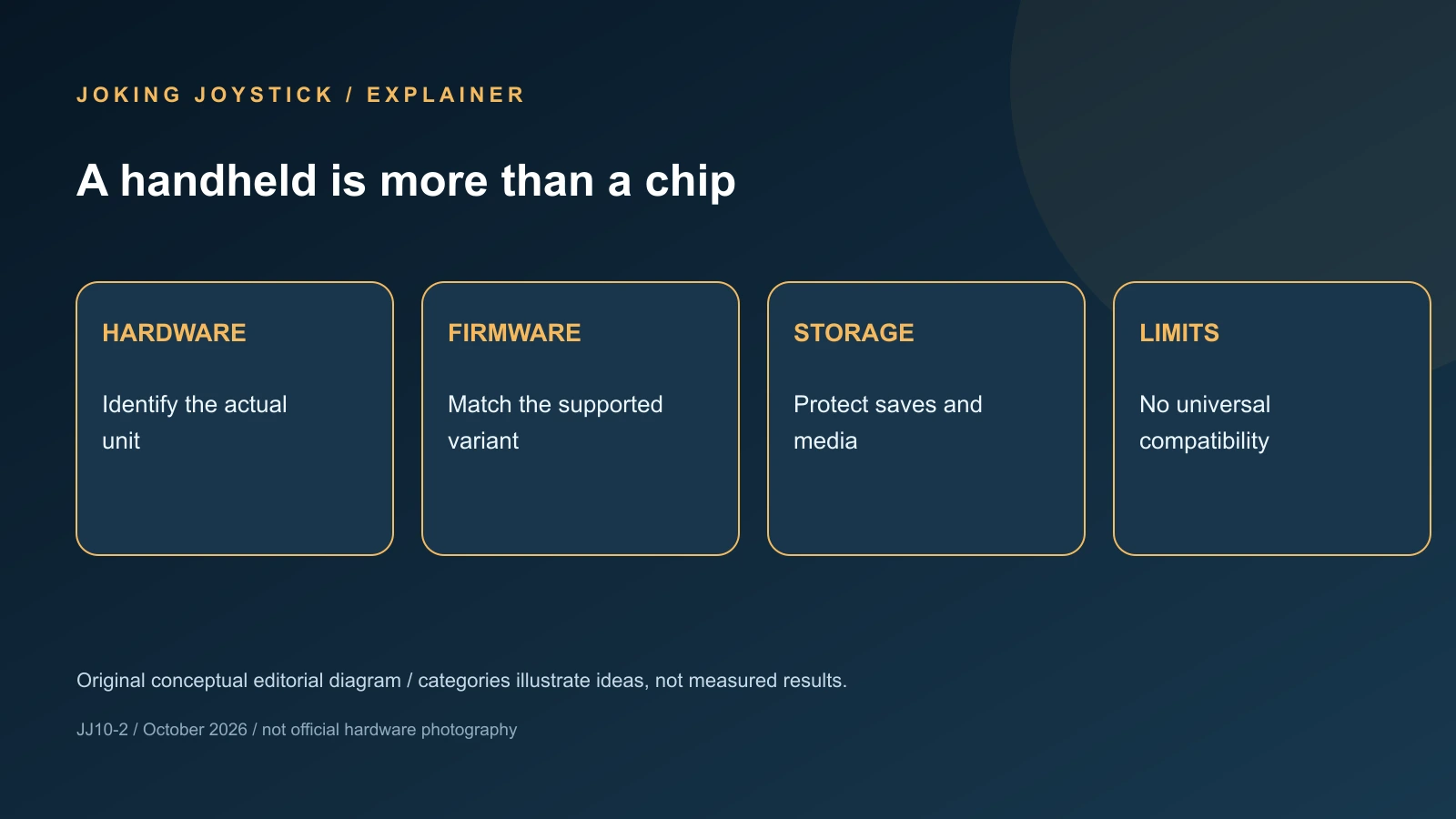
Stock Firmware Versus Community Firmware
The word “ArkOS” can describe several different things in the R36S marketplace, so software provenance needs to be stated explicitly. Christian Haitian’s repository establishes the ArkOS project and its repository history. AeolusUX’s R3XS releases are a separate community-maintained image effort for R33S-, R35S-, and R36S-related hardware, while dArkOSen-R36S is another separate community project with its own releases and selectors. These are related software efforts, not interchangeable names for one official manufacturer system.
A stock card is simply the image supplied with a particular unit. It may use an ArkOS-style menu, carry an ArkOS label, or be advertised as “ArkOS 2.0.” None of those details, by themselves, proves that the card is an official release from the original ArkOS project. It is possible for a retailer or distributor to install, modify, rename, or bundle software without establishing a formal relationship with the project whose name appears in the interface. The menu label identifies an association claimed by the image or seller; it does not settle its provenance.
This distinction matters because community firmware can contain hardware-specific work that a commercial label conceals. AeolusUX’s R3XS releases identify R33S, R35S, and R36S targets, while its related records document panel and device-tree options. The project’s release history therefore shows community adaptation to recognized hardware differences, not evidence that the maintainer designed or manufactured the handhelds. The repository was archived on June 9, 2026, so it should not be described after that date as an actively maintained project.
dArkOSen-R36S represents a different branch of that history. Its release notes and device selectors are maintained as a separate project, with its own choices about supported targets, fixes, and software changes. A device selector in dArkOSen is evidence about dArkOSen’s organization of hardware targets. It does not retroactively establish what the original seller installed, nor does it make dArkOSen the manufacturer of a board that happens to run the project.
The role distinction can be expressed simply:
- The ArkOS repository identifies an upstream open-source software project and its repository history.
- A community maintainer adapts or distributes software for particular hardware targets.
- An assembler or manufacturer builds the physical board and integrates its components.
- A distributor or retailer packages, sells, or advertises a particular configuration.
One company or community may influence more than one layer, but the available evidence does not allow those roles to be merged automatically. A developer can correct a device-tree file without owning a factory. A retailer can ship a modified image without maintaining its source. A board assembler can use software created elsewhere without becoming an ArkOS project maintainer.
The word “stock” is also less stable than it sounds. A seller may change the card image between batches while retaining the same product listing. A later hardware revision may require a different panel option even if the menu appears unchanged. A replacement card may contain a community build that was never present when the unit left the distributor. For support purposes, the relevant facts are the image’s actual identity, version, target hardware, and configuration—not only the label printed on the box or the name shown in a launcher.
Community firmware brings substantial value to a fragmented product family. The cited projects publish hardware-target information, panel or device-tree options, and software release changes for the targets they support. That knowledge can make obscure board differences legible. It also means that the best available technical information may live in a project repository rather than in a seller’s short manual. The article should attribute each particular change to the project and release that documents it rather than treating all repositories as evidence of one combined maintenance program.
But community support has limits. A project can target a board without guaranteeing that every unit sold under a similar name matches the documented target. A release note can identify a correction without proving that all earlier cards were affected. A selector can narrow compatibility without making the clone catalog complete. Users and writers should therefore attribute software claims to the project that made them and avoid presenting community documentation as a manufacturer warranty.
The same caution applies to the word “official.” The supplied evidence does not establish one official R36S manufacturer or show that all R36S cards ship with official ArkOS. It supports a more precise history: an original open-source ArkOS project, later community-maintained R3XS images, a separate dArkOSen project, and commercial products whose cards may borrow labels or configurations from that ecosystem. That history explains both the R36S’s flexibility and its support burden.
Firmware provenance is not academic housekeeping. It determines where a user should look when a display fails to initialize, an input mapping is wrong, or a release adds support for a newly observed board. The seller may know which image was bundled, while the community maintainer may know how that image handles a panel. Neither necessarily knows who assembled every board. Keeping those responsibilities separate produces a more accurate account of what the software can do and who stands behind each claim.
Clone Taxonomy: Useful but Not Definitive
“Clone” is a useful word in R36S discussions only when it describes evidence. Used casually, it becomes a synonym for cheap, unofficial, or suspicious, none of which identifies the hardware. A unit can differ from another R36S through a board revision, a panel connection, a memory arrangement, a stock operating system, or a changed button mapping without fitting a simple authenticity story. The important question is what changed and how that change is documented.
Community references distinguish R36S-related variants through clues such as board markings, memory descriptions, screen wiring, device-tree identifiers, button mappings, and the operating system supplied on the card. These clues are valuable because the exterior shell often remains similar while the software target changes. A board identifier can connect a unit to a firmware option. Differences in panel wiring may be one possible explanation for why one image displays correctly and another does not, but the packet does not diagnose every display difference that way. A stock image can reveal how a seller or distributor classified the device, though it is not conclusive proof of the board’s origin.
Those references are field guides, not manufacturer statements. A community catalog may be assembled from reports, board inspections, firmware history, and developer troubleshooting. It can be highly useful without being complete or definitive. New revisions may appear after a catalog entry is written. Sellers may reuse names across different assemblies. A table may group units by practical firmware behavior rather than by a confirmed factory relationship. Specific labels should therefore be used only when repository records, board evidence, or both support them.
The RK3326 illustrates why a processor name is insufficient for classification. Two consoles can share that SoC and similar shell dimensions while using different memory implementations, display wiring, or device-tree requirements. They may both be described as R36S units and still need different images. The shared chip establishes a technical relationship, not identical firmware compatibility. Conversely, a handheld sold under another brand may be electrically close enough to a documented R36S target that a community build supports it.
That second case does not prove that the two products came from the same factory. Firmware compatibility is not a corporate genealogy. Developers may support multiple products because they expose sufficiently similar interfaces, because a board revision was reused, or because one image can accommodate several device descriptions. A different logo can coexist with close electrical similarity, just as the same logo can conceal a changed panel or board.
Evidence should be considered in combination rather than treated as a hierarchy with one magic clue. The shell can suggest a family but rarely settles the board. The manual can identify a distributor and advertised configuration but may not describe later batches. The card can reveal a software target but may have been replaced. Board markings can be strong evidence of a revision, yet they may require interpretation from a firmware project or hardware reference. A device-tree selector can show what a project supports, but not necessarily why a seller used a particular name.
Memory descriptions deserve particular skepticism. One trade document may describe DDR4 or a particular capacity, while another listing uses a different figure. Such material establishes variation in commercial documentation, not a complete map of every board. A memory claim can help distinguish a product sheet from another product sheet, but it should not be repeated as a universal R36S specification unless independent evidence connects it to the unit being discussed.
Button mappings can also help identify a variant, though they must be interpreted carefully. A change in software mapping may reflect a firmware configuration rather than a different physical board. If a community image records a device-specific mapping alongside a panel or device-tree target, the combination becomes stronger evidence. A single unexpected button behavior, however, does not prove that the console belongs to a separate clone family.
Stock operating systems provide another clue with a limited scope. An image labeled ArkOS, a different community build, or a seller-specific front end can indicate how the unit was shipped. It cannot by itself prove the manufacturer, the board revision, or the legality and provenance of bundled content. Software labels are part of the product history, not a substitute for physical inspection.
A practical taxonomy should therefore describe what is known and leave the remainder open. “An RK3326 R36S variant documented with a different panel target” is more informative than “fake R36S.” “A board listed by the community reference as requiring a separate image, pending confirmation from board evidence” is more honest than assigning a definitive clone name from appearance alone. This language may sound less tidy, but it matches the fragmented evidence.
The classification problem also explains why firmware advice copied from one owner’s experience can fail for another. The two consoles may have the same shell and menu branding but different screen initialization data. One may boot from a two-card arrangement while another was configured for one card. One may expose a mapping corrected by a community update, while another uses a different logical button order. A successful procedure on one unit is not automatically a universal method for the family.
The best-supported conclusion is that the R36S clone ecosystem is a technical field reference rather than an authenticity tribunal. Community repositories and board documentation can make variant differences understandable, especially when device-tree files, panel records, and physical markings agree. They cannot guarantee that every commercial listing has been classified or that every unresolved unit fits an existing category. Readers should use the product name as an initial clue, then seek corroboration from the actual board, supplied documentation, storage image, and firmware target.
What “Emulation Support” Really Means
Retail descriptions often compress several different claims into one phrase: “supports” a system. On a product page, that may mean the front-end has a menu category with a familiar console name. It may mean an emulator or RetroArch core is installed. It may mean the seller has placed files associated with that platform on the supplied card. None of those meanings is the same as proving that a particular title runs correctly, at a consistent speed, with working sound, reliable controls, and an experience most players would consider acceptable.
A more useful way to read the claim is to separate it into four layers. The first is platform listing: the operating system contains a folder, menu entry, or artwork for a console or arcade family. The second is emulator availability: software exists on the card or in the firmware to interpret programs for that platform. The third is per-title compatibility: an individual game starts and behaves correctly. The fourth is acceptable playability: it remains sufficiently responsive and accurate for the person using it. A product listing can establish the first layer while saying little about the other three.
This distinction is especially important on a family of handhelds whose hardware and software can vary between batches. A menu entry may be inherited from a general-purpose Linux front end, and a core may be included without any title-by-title certification. A bundled configuration may also fail to correspond to the board revision or panel in a particular unit. The presence of an option is evidence that software was provided for that category; it is not a compatibility test.
The RK3326 gives the R36S family a documented silicon baseline, but not a universal system guarantee. Rockchip describes a quad-core ARM Cortex-A35 platform with an ARM G31-2EE GPU and relevant memory, display, storage, and peripheral interfaces. The datasheet does not establish the clock settings, graphics driver, thermal behavior, memory implementation, panel timing, or software configuration of every R36S-branded board, nor does it predict how a particular emulator will handle every title.
As an editorial expectation, older 8-bit and 16-bit consoles, handheld systems, arcade software, and many PlayStation-era workloads are the most defensible center of discussion for an RK3326-based device. Neither the SoC datasheet nor the firmware repositories establishes universal playability for those categories. Even here, “sensible center” is not the same as “every game is guaranteed.” Different games can stress timing, sound, graphics effects, memory access, or input handling in different ways. A platform that appears straightforward at the system level can still contain individual titles that expose emulator limitations or configuration errors.
The later systems named by sellers require more caution. Nintendo 64, Dreamcast, Saturn, and PSP should be described as variable workloads rather than as a clean supported-or-unsupported block. Results can change with the title, emulator version, core, renderer, driver, firmware image, performance settings, and input configuration. A community release may add an emulator or update a component without creating a universal guarantee for the entire library. A retailer’s system list cannot resolve those variables.
“Runs” also needs definition. A title may launch to a menu but fail during a demanding scene. It may display an image while producing incorrect audio or graphical artifacts. It may be technically interactive but suffer from timing problems that make it unpleasant to play. It may work after a setting change that is not present in the supplied configuration. These are different outcomes, and a simple system count has no vocabulary for distinguishing them.
The same caution applies to bundled game counts. A seller may advertise 15,000 or more games, or list more than 20 systems, but the number may describe files placed on a card rather than verified, licensed, or individually tested software. Duplicate versions, regional variants, hacks, demos, and files that do not launch can all affect a count. The research does not establish the provenance or licensing status of bundled material, and the presence of a large library is not evidence that the emulator handles every entry well.
Firmware repositories provide more useful evidence than a generic system list when the question is software provenance or hardware targeting, but their documentation still has a defined scope. Christian Haitian’s ArkOS repository identifies the project and its history. AeolusUX’s R3XS work documents particular device targets and panel-related options, while dArkOSen-R36S is a separate community project with its own releases and selectors. Those repositories show how the named projects organize and maintain software; they do not amount to a title-by-title certification program or prove that every seller’s image came from them.
A device-tree selection can affect this interpretation before emulation even begins. If the image does not describe the board and screen correctly, the unit may fail to initialize its display or boot as expected. If the image does boot, an incorrect input mapping or unsuitable emulator configuration can still affect the result. Thus, “the emulator exists” presumes a functioning, correctly matched software environment. It does not erase the variant problem documented by the firmware projects.
There is also a difference between technical possibility and a reasonable buying expectation. The RK3326 baseline makes it reasonable to expect that the R36S ecosystem will focus on older systems and selected later workloads. It is not reasonable to infer that every later-platform title will be smooth, accurate, or convenient simply because a retailer prints the platform name beside a game count. The more demanding the system, the more title-specific and configuration-specific the answer becomes.
The clearest reading of “emulation support” is therefore layered: the menu tells us what the software presents; the emulator tells us what the image attempts to interpret; the individual title tells us whether that interpretation works; and actual playability depends on the combined hardware and software configuration. That framework preserves the R36S’s appeal without turning a broad platform list into a promise the available evidence cannot support.
The Limits Chapter: No Benchmark Theater
A careful account of the R36S has to say what the evidence does not establish. This research contains no independent frame-rate measurements, input-latency testing, battery-runtime test, thermal readings, compatibility spreadsheet, or hands-on inspection of a purchased unit. It therefore cannot responsibly supply a performance table disguised as certainty. The absence of those tests is not a reason to invent approximate numbers or repeat community impressions as if they were controlled measurements.
That boundary matters because budget handheld listings often present precise-looking quantities. A page may advertise “15,000+ games,” “20+ systems,” or “hours” of battery life. The figures are useful as examples of what sellers claim, but they are marketing statements rather than verified results in this research. A game count may describe files bundled with a card. A system count may mean only that a front-end category or emulator is present. Battery language may omit the brightness level, emulator workload, battery condition, and software configuration used to produce it.
Numbers can create an illusion of comparability even when the underlying objects are different. Two listings may use the same R36S name while describing different memory, storage, battery, or board configurations. One may be selling the common vertical model; another may be using the name as part of a broader R36-branded range. If the device itself is not identified, a performance figure attached to one listing cannot automatically be transferred to another. A precise number applied to an uncertain variant is not more reliable than a qualified description.
Advertised game totals are poor substitutes for compatibility evidence. A seller can count files on a card without establishing whether each file launches, whether entries are duplicated, or whether the contents are properly documented. The total also says nothing about settings, accuracy, audio, control mapping, or playability. A count is therefore a marketing quantity, not a compatibility test.
System lists have the same problem at a different level. Listing Saturn, PSP, Dreamcast, or Nintendo 64 demonstrates that the seller wants the product associated with those platforms. It does not establish a consistent result across their software libraries. The RK3326 baseline, emulator version, graphics driver, device-tree target, and per-title behavior all remain relevant. A menu icon is evidence of presentation; it is not a benchmark.
Battery claims require even more context. A runtime estimate depends on display brightness, volume, wireless or peripheral activity where applicable, emulator workload, processor behavior, battery age, charging history, and the software image. The manuals in this research do not provide a controlled runtime test for the R36S family. One documented configuration lists a 3200 mAh battery, but that specification belongs to that configuration and does not establish the battery capacity of every unit sold under the name. Capacity alone would not produce a runtime figure anyway.
The same principle applies to thermals and power consumption. The Rockchip datasheet describes the RK3326 platform, but it does not measure a finished R36S board inside its particular shell. Board layout, clock settings, software governors, ambient conditions, and sustained workload can change the result. Without an independent test of a defined unit and method, claims about heat, throttling, or power draw would exceed the evidence.
Input latency is another tempting area for false precision. The presence of physical controls and a Linux front end does not reveal how quickly a button press travels through the switch, board, operating system, emulator, display pipeline, and panel. A subjective impression may be useful in a hands-on review, but this research contains no such inspection and no controlled latency measurement. It is more accurate to leave that question open than to infer responsiveness from the product’s layout.
Compatibility spreadsheets can also mislead when their test conditions are unknown. A title may have been tested on a different panel variant, a different image, a different emulator core, or a different setting. A result recorded as “works” may mean only that the title reaches gameplay. A result recorded as “slow” may reflect a configuration that a later release changed. Without a documented method and matching hardware, a spreadsheet can be a useful field reference but not a universal verdict.
This does not mean that every question about the R36S is unknowable. Hardware manuals establish what a particular documented configuration claims. Firmware repositories establish which targets and panel options maintainers recognize. The RK3326 datasheet establishes the SoC’s documented architecture. Retail pages establish what sellers advertise. Each source has a useful role when its scope is kept intact. The mistake is combining them into a conclusion none of them individually supports.
The responsible wording is consequently conditional. The R36S is commonly associated with an RK3326 baseline and a software ecosystem centered on older emulation workloads. Later systems are more variable. Advertised counts should be treated as marketing. Battery language is not a tested endurance promise. No stable price, universal compatibility claim, benchmark result, or runtime figure is supported here. Those qualifications may sound less exciting than a leaderboard, but they prevent a product-family problem from being presented as a measured single-device result.
There is also a practical reason to reject benchmark theater: a number can conceal the maintenance burden that determines whether the result is reachable. A mismatched image, incorrect device-tree file, damaged card, or altered control mapping may prevent the user from reaching the same configuration. A benchmark performed on one board revision would not automatically describe another. For this family, identifying the unit and documenting the software environment are prerequisites to meaningful measurement.
The useful conclusion is not that the R36S has no capabilities. It is that capabilities, advertised support, and tested experience are separate categories. A buyer can understand the likely center of the platform without being promised a frame rate, runtime, temperature, or complete compatibility list. Keeping those categories separate is a more honest form of technical explanation than filling every gap with a number.
Battery, Charging, Shutdown, and Reliability Caveats
Battery information about the R36S needs the same variant discipline as its screen and firmware. One documented R36S configuration lists a 3200 mAh battery. That is a specification for the configuration described by that manual, not proof that every unit carrying the R36S name uses the same cell or capacity. Other commercial documents already show that storage, memory, and product descriptions vary, so a battery number should not be detached from the model, distributor, and manual that state it.
Even a confirmed capacity would not answer the runtime question. Runtime depends on brightness, volume, emulator workload, processor behavior, software settings, battery condition, and the particular board. A demanding later-platform workload may draw power differently from a simple 8-bit game. A screen at one brightness level may consume a different amount from the same screen at another. The available research contains no controlled endurance test, so it supports no hours-of-use promise.
One alternate manual adds a specific qualification about the battery indicator: it warns that the gauge may infer charge from voltage and should therefore be treated as an estimate. That is the supported conclusion. The manual does not establish the presence or absence of a particular power-management design, nor does it establish a universal battery-gauge behavior for every R36S.
The warning is also not a diagnosis of every R36S. It belongs to the documented configuration and should be reported as a reason for caution, not as proof that all units have an identical power circuit. The product family’s uncertain provenance makes this distinction important. A similar shell, processor, or menu does not establish the same battery-management design.
Charging advice is similarly constrained by the documentation available. The manuals identify the operational behavior of particular products, but they do not provide a universal electrical profile for every R36S variant. There is no supplied recall, regulator finding, teardown, or controlled test supporting broad claims about unsafe batteries, counterfeit cells, or an inherent fire hazard. Those are serious claims requiring stronger evidence than inconsistent marketplace specifications.
The clearest documented reliability issue concerns how the operating system is stopped. One supplied manual instructs users of that documented configuration to shut down through the system and warns against routinely holding the power button. Because the card can contain active system, configuration, and save data, orderly shutdown is preferable where possible. This is a configuration-specific operational warning, not a universal manufacturer instruction for every R36S.
This is particularly relevant because the microSD card is not merely a place for optional content. Depending on the configuration, it contains the system image, front-end files, emulator settings, save data, and user content. An interruption during a write can affect more than the current game session. It may leave a configuration incomplete, damage a save, or create a boot problem. That mechanism supports careful shutdown advice without proving that a particular card will fail or that every abrupt shutdown causes corruption.
The reset control should be understood in the same context. Its presence can provide a way out of an unresponsive state, but a reset is not equivalent to an orderly software shutdown. A user may have to choose between recovering control and avoiding an interruption, depending on what the device is doing. The manuals and research do not establish a universal rule for every failure situation, but they do support treating forced interruptions as exceptional rather than routine.
A possible risk scenario follows from those two documented cautions: if a user relies on an estimated gauge and continues playing until unexpected power loss, the interruption could occur while the system is writing data. The sources do not establish that this sequence is a characteristic or observed failure pattern of the R36S. It is a general reason to treat the percentage as approximate, use orderly shutdown where possible, and avoid keeping important data on only one removable card.
Backups are therefore a reliability measure, not an admission that a device is guaranteed to fail. A backup can preserve a working configuration, personal saves, and other lawful user data if a card becomes unreadable or an image needs to be replaced. Replacement and recovery remain variant-sensitive: a card image suitable for one board or panel may not be appropriate for another. The existence of a backup does not eliminate the need to identify the hardware before restoring software.
Care should also be taken with the word “reliability.” The available documents support caution about battery indication, orderly shutdown, and removable-storage dependence. They do not provide a failure rate, long-term endurance study, thermal inspection, or universal assessment of component quality. It would be inaccurate to turn the manuals’ warnings into a claim that the R36S is inherently unreliable. It would be equally inaccurate to ignore the operational consequences of a system that relies on removable boot media.
The balanced view is modest but useful. A documented R36S configuration may list a 3200 mAh battery, yet that does not yield a runtime promise or apply automatically to every variant. Its gauge may be an estimate based substantially on voltage. The system should be shut down through its operating system where possible, because the card can contain active system and save data. These facts justify sensible care while leaving unsupported claims about universal battery design, safety, and failure rates aside.
The Value Proposition: A Budget Platform With an Ecosystem Tax
The R36S appeal begins with a familiar combination of physical and software features. The common vertical form, console-style controls, dual analog sticks, Linux-based front end, and removable microSD storage explain the product family’s interest. Community firmware work adds practical documentation about panel selection and device-specific targets. Those attractions coexist with unstable commercial specifications.
Its appeal is not dependent on a fixed price. Retail prices change by seller, region, promotion, bundle, and product variant, so a permanent dollar threshold would give a false sense of precision. The defensible value proposition is instead structural: the R36S can offer a low-cost route into a physical handheld format with a large existing knowledge base. Whether that route is worthwhile depends on how much the buyer values the form and how much maintenance uncertainty they are willing to accept.
The community ecosystem is part of that calculation. Christian Haitian’s repository identifies the ArkOS project; AeolusUX’s R3XS work documents R33S-, R35S-, and R36S-related targets and panel choices; and dArkOSen-R36S maintains a separate release history and device selectors. AeolusUX’s repository was archived on June 9, 2026, so it should not be described after that date as indefinitely active. These sources document software projects, not a single manufacturer.
That knowledge is also the source of an ecosystem tax. The buyer may need to determine which physical variant is in hand, identify its board or panel clues, match an operating-system image, understand the relevant device-tree choice, and preserve the card’s contents. The purchase transaction may be simple; the support path is not necessarily simple. Community software reduces some of the difficulty by documenting variants, but it cannot make an uncertain product family into one standardized device.
The phrase “ecosystem tax” does not mean that every unit demands extensive modification. Some devices may boot and operate with the supplied configuration. It means that the cost of ownership includes attention: reading the correct manual, distinguishing the original vertical R36S from R36S Plus and other R36-branded products, identifying the firmware project, and treating storage as a system component. A buyer who never needs to change the image may still benefit from knowing what image is installed and what hardware it targets.
Variant matching is the clearest example of this hidden work. Community repositories document additional panels and device-tree options because apparently similar units can require different initialization data. A mismatched image may lead to a display or boot problem, while an apparently suitable image may still expose a different control mapping or storage arrangement. The solution is not to assume that every online guide applies to every shell. It is to establish the unit’s evidence before treating advice as universal.
Removable storage adds both flexibility and exposure. A separate system card and game-content card can make the organization understandable, and some configurations support a single-card arrangement. The same design allows the operating system, emulator settings, saves, and user content to be affected by card condition or unsafe shutdown. Replacement and backup are practical maintenance concerns. They are not evidence that every supplied card is defective, but they do distinguish the R36S from a sealed appliance whose software is inaccessible to the owner.
Emulation limits are another part of the value calculation. The RK3326 baseline makes older 8-bit, 16-bit, handheld, arcade, and many PlayStation-era workloads the sensible center of attention, without guaranteeing every title in those categories. N64, Dreamcast, Saturn, and PSP are more variable workloads affected by game, emulator, settings, drivers, firmware, and board configuration. A buyer attracted by a long seller system list should understand that menu presence and emulator availability are not the same as acceptable per-title playability.
The software label also needs to be placed correctly. “ArkOS” in a menu or listing does not prove that the card is an official release from the original project, and a community maintainer is not automatically the handheld manufacturer. The physical product may have been assembled or distributed by a company that is not identified in the supplied evidence. Retailer claims document what is being advertised; firmware repositories document what their maintainers support. Neither category alone resolves the complete product chain.
For technically curious owners, removable media and community documentation may offer more software-level flexibility than some sealed products, because the operating system and configuration are accessible through replaceable storage. That is an editorial comparison, not a universal claim that closed products cannot be adapted, documented, or repaired. The same openness can be frustrating for someone expecting a uniform appliance. The R36S rewards readers who are comfortable distinguishing a board revision from a product name, a firmware maintainer from a seller, and a supported target from a tested title.
The R36S is best understood as a budget platform with an ecosystem tax. Its familiar vertical form, physical controls, removable storage, and retro-oriented software ecosystem create genuine appeal. Its uncertain provenance, variant-specific panels and firmware targets, card dependence, and title-specific emulation limits require judgment. It suits readers willing to identify their hardware and manage storage and software carefully; it is a poor fit for anyone expecting one official specification or guaranteed compatibility.
Related reading and hardware searches
Check the exact item, edition, seller, compatibility, regional fit, price and availability before buying.
Affiliate disclosure: As an Amazon Associate, Joking Joystick earns from qualifying purchases. Search results do not guarantee stock or price.