A broad update for the PlayStation emulator
DuckStation’s latest rolling development build is available under the latest channel, with publication time 2026-11-26T01:40:51Z. It follows v0.1-12777, published on 2026-11-19, and combines changes from both builds rather than presenting every fix as new in the newest package.
DuckStation emulates the Sony PlayStation, also known as the PS1 or PSX, on supported host systems. Its focus is accurate emulation alongside enhancements such as higher-resolution rendering, PGXP geometry correction, save states, controller profiles, texture replacements and modern display options. The listed packages target Windows 10 and 11, Linux AppImage users, and macOS 13.3 or newer. Android support is also part of the project, although the listed assets for this build are desktop packages.
Recorded input macros arrive in the Qt interface
The most user-facing addition in the newer build is input macro support. DuckStation can now record input events, map them to controller bindings and play macro sequences containing button presses, bindings and waits. The Qt desktop interface adds tools to edit and record these sequences.
This is useful for repeatable actions such as rapid-fire inputs, combinations with deliberate delays or other sequences that are awkward to reproduce manually. The feature is separate from ordinary controller presets: a preset maps physical controls to a virtual PlayStation controller, while a macro plays a defined series of mapped actions.
The fullscreen game list gets a substantial redesign
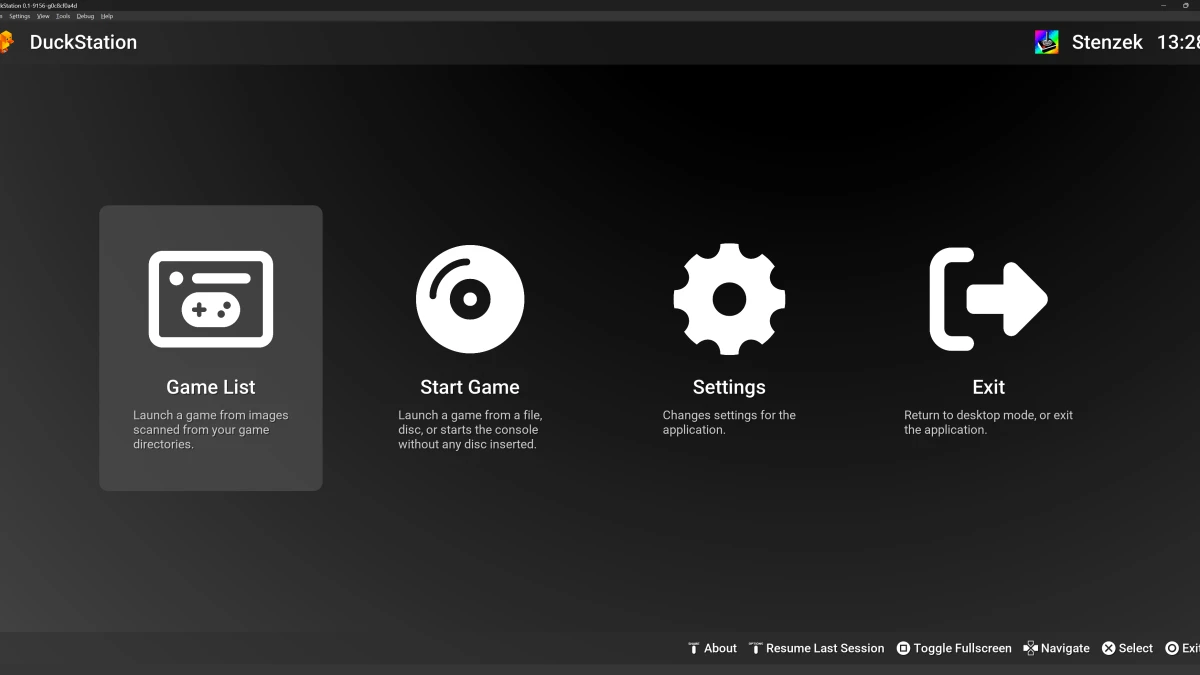
The fullscreen interface now has a revised game-list header, a page-header layout, segmented controls and an expandable search box. A new carousel view gives the library another way to browse, and horizontal drag and fling support improves navigation on touch-oriented or controller-driven interfaces.
Missing cover art can now use generated gradient artwork, monograms and colours instead of relying on a single placeholder treatment. Small game icons use nearest-neighbour filtering, and generated artwork is cached as textures with a limit based on video memory usage. The save-state selector also receives larger previews, a slot list and dashed tiles for empty slots, making available and unused save slots easier to distinguish.
The Qt interface adds a Midnight Amber theme, adjusts several existing theme colours and improves controller-binding feedback by highlighting the relevant part of a controller image. Binding layouts are included for JogCon, DDGo and Pop’n controllers. Game-list settings gain drag-and-drop support, a revised layout and clearer help, while folder actions move into an overflow menu and global folder settings are added.
Texture replacement handling receives many fixes
A large group of changes targets the hardware renderer’s texture replacement system. DuckStation now handles reduced palette ranges more accurately, tracks an additional page for unaligned 8-bit palettes, and fixes cases where writes to video memory were split incorrectly. It also avoids merging video-memory writes that have already been drawn.
Replacement images that fail to load are no longer retried repeatedly, and palette fields used while parsing C16 replacement names are initialized correctly. Other fixes address replacement indexing, missing alias-file error reporting, the timing of original-pixel dumps and replacements spanning multiple video-memory pages. Together, these changes are intended to make replacement texture discovery and caching more predictable for users who maintain replacement packs.
Earlier build improves PlayStation timing accuracy
The v0.1-12777 portion of the update contains extensive GPU, DMA and CD-ROM timing work. The GPU now uses measured costs for polygons, rectangles, lines, fills and video-memory copies, counts command ticks in system-clock cycles, and models the hardware’s 16-word FIFO rather than relying on an older size workaround.
DMA requests are held or released at more accurate points during polygon setup, line rendering, quad processing, parameter waits and video-memory reads. The update also reduces the default maximum DMA slice to 200 ticks and removes game-specific overrides that matched the new default. These changes are intended to improve synchronization between the GPU and other emulated components without depending as heavily on individual game hacks.
Display timing receives additional hardware-oriented corrections. The emulator uses documented NTSC and PAL scanline lengths, selects NTSC through the appropriate GPU command, accounts for interlaced field lengths and updates line-counter behaviour when interlace changes. GPU status reporting, 240p row parity and odd-length video-memory reads are also brought closer to the original hardware model. An optional 2 MB VRAM mode is available as well.
CD-ROM and audio emulation changes model hardware behaviour more closely
CD-ROM handling is another major focus of v0.1-12777. Stop timing now scales with disc angular velocity, motor braking continues in the background after a stop command, and initialization can spin a stopped motor back up after braking completes. Speed changes and seeks can overlap where the hardware allows it, and speed-change timing was retuned against hardware measurements.
The update also improves command and response handling: GetID responses are queued immediately, a new command can replace a second response that has not yet been sent, active status bits are cleared before acknowledging Stop, and ReadTOC is rejected on vC0 mechanisms where it is unsupported. In the newer build, read-speed acceleration is disabled while CD-DA audio is playing, avoiding an inappropriate speedup during audio playback.
SPU changes in the latest build refine sound generation and transfer timing. Noise clocks correctly on quarter- and eighth-period slots, exponential decrease sweeps apply the Phase bit, DMA writes no longer incorrectly mark the status as busy, and RAM transfers are interleaved with sample generation. The DMA FIFO now writes to RAM at the documented 32 cycles per halfword.
CPU, debugging and game-specific compatibility work
CPU and debugger changes address several edge cases. COP0 debug enables and status-only breakpoints are corrected, data breakpoints for LWR and SWR use the effective address, and data-breakpoint and alignment-exception priority is preserved. Execution breakpoints are checked for faults during debug-interpreter fetches, while interrupts enabled through the status register are delayed by one interpreter instruction.
The GTE now handles RTPS and DCPL opcode aliases. PGXP’s CPU path computes more precise MVMVA values and preserves exact halves when clearing bits shifted into packed X data. PGXP-CPU is enabled for Ape Escape and Crime Crackers, and Tekken 3 receives a revised depth threshold. These are targeted compatibility and geometry changes, not a general promise that every game will behave identically across configurations.
The GameDB also removes several older timing or boot workarounds, including overrides for Chrono Cross and full-boot hacks for Lomax and Nightmare Creatures. Tomba!, Tombi! and Ore! Tomba instead receive a forced recompiler instruction-cache setting. Removing workarounds can make the emulation model cleaner, while targeted settings remain available where a documented game-specific requirement exists.