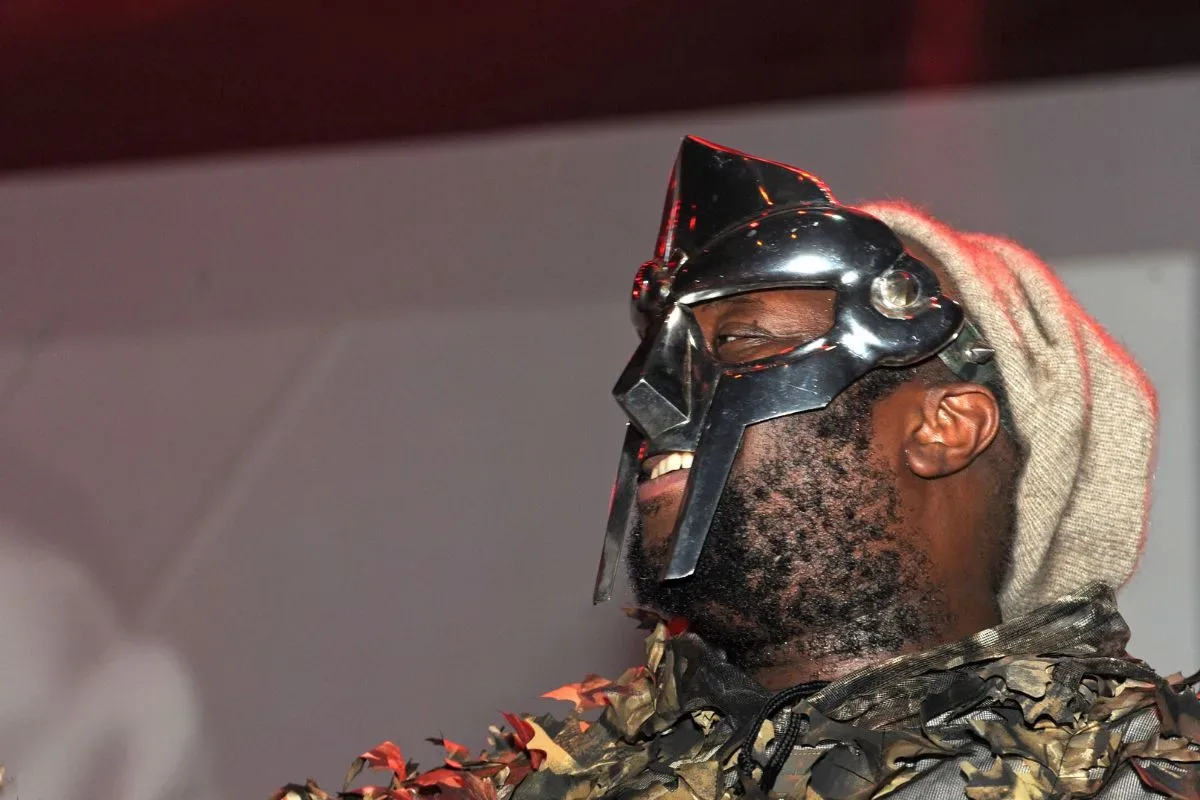
MF DOOM’s visual legacy is getting a new comics-informed interpretation through a Collectionzz Artist Series collaboration illustrated by Sanford Greene. The release is being presented by DOOM’s estate with Rhymesayers Entertainment, bringing a creator known for expressive, character-led comic art to one of hip-hop’s most enduring personas.
The Collectionzz release is scheduled to launch October 29 at 11 a.m. ET. Specific artwork, product formats and prices have not yet been revealed, so prospective buyers should treat the launch as the point at which the practical collecting details become clear. The available information does establish that orders will be handled as preorders, with shipping planned for the week of December 7.
A portrait built around presence rather than just the mask
Greene’s stated goal is not simply to reproduce MF DOOM’s familiar metal mask. Instead, he has framed the image around body language: DOOM is depicted seated like a king, taking in admiration and looking back over the path that led there. It is a particularly fitting approach for an artist whose career repeatedly turns posture, movement and facial expression into storytelling tools.
That distinction matters. A visual treatment is an artist’s interpretive presentation of a subject, rather than a neutral likeness or a piece of archival photography. In this case, the central visual shorthand of the DOOM character remains important, but Greene’s concept appears designed to make the figure feel reflective and powerful at once. The villain persona is given room to receive its due, not merely strike a pose.
For collectors, that makes authorship a major part of the appeal. The eventual objects are not yet identified, and neither are edition details or prices. What is known is that this is an artist-series project carrying Greene’s perspective. That is different from a standard logo-driven merchandise drop: the draw is the overlap between a singular music identity and a comics artist with a distinct way of staging people.
Why Sanford Greene is a natural fit
Greene’s credits span major superhero publishers and creator-owned work, including Marvel’s Power Man and Iron Fist and cover work for Black Panther and Luke Cage. He has also worked with DC, Dark Horse and Image. Across those settings, his body of work has included a long engagement with drawing Black characters with specificity, energy and interiority.
His creator-owned work at Image provides another useful point of context. Greene co-created Bitter Root with David F. Walker and Chuck Brown. The series follows the Sangerye family, monster hunters confronting supernatural threats in 1920s New York. Its Harlem Renaissance setting embeds those conflicts in a period of major Black artistic and cultural activity, while family loss and disagreements over how to confront evil are part of the drama.
That background does not mean the MF DOOM piece is an extension of Bitter Root; no such connection has been announced. It does, however, explain why Greene is well positioned to address a musician whose public identity blended character construction, cultural references and visual symbolism. DOOM was never only a voice on a record. The mask, the villain framing and the deliberate sense of distance were all components of the larger work.
Related coverage includes Sanford Greene Brings MF DOOM’s Legacy to Collectionzz Artist Series.
Greene has already drawn the bridge between rap and sequential art
The new project is also not Greene’s first encounter with hip-hop figures in comics form. He supplied art for Marvel and Mass Appeal’s Legend Has It…, written by Brandon Thomas. That project transformed artists including Nas, Ghostface Killah, Raekwon and Slick Rick into comic-book characters while connecting with Mass Appeal’s album series.
The basic idea behind that kind of work is easy to understand: rap artists can operate as larger-than-life figures, while comics provide a visual grammar for making that scale legible. Costume, silhouette, gesture and setting can communicate mythic status quickly. DOOM’s career is especially compatible with that grammar because the character was already built around a carefully managed persona rather than conventional celebrity access.
There is a wider overlap between comic culture and game culture too, where design language can be as memorable as dialogue. For another example of comics meeting a game-adjacent fighting-property audience, see the announced Street Fighter X Kamen America one-shot. Greene’s DOOM image occupies a different space—a physical art and collecting release rather than a game adaptation—but both demonstrate how recognizable characters can move between mediums without losing the visual cues that make them instantly identifiable.
DOOM’s identity was built through reinvention
The choice to treat MF DOOM as a figure worthy of a throne-like composition reflects the long arc behind the name. Before the mask, listeners knew him as Zev Love X in KMD. He appeared on 3rd Bass’ “The Gas Face” before KMD released its debut album, Mr. Hood, in 1991.
After the death of his brother and KMD member Subroc, he later returned using the DOOM identity. His re-emergence is traced to 1997. Under that name, the musical approach brought rap, R&B and cartoon-derived material into the same creative orbit, while the character and the production aesthetic developed alongside one another.
This history helps clarify why imagery has remained so central to the catalog. The DOOM identity was not an incidental album-cycle costume. It supplied a framework for voice, humor, sampling choices and distance from the expected image of a rapper. The mask became a symbol, but the larger construction was the point: an artist could direct attention toward the work and toward a character whose mythology was built deliberately over time.
Greene’s focus on a reflective ruler therefore reads as an interpretation of legacy rather than a claim that the character needs explanation. It acknowledges a body of work that has continued to attract audiences across communities and mediums. In collecting terms, that is the difference between a nostalgic image and a commissioned piece seeking to say something about why the subject still matters.
What buyers should watch when the release opens
Because the precise items have not been disclosed, it would be premature to assume a print size, material, edition quantity, signatures or any other collecting specification. Those details can substantially affect how a release is evaluated, but none have been provided here. Buyers interested in the collaboration will need to wait for the October 29 product reveal.
- Product format: the announcement does not yet identify what physical items will be offered.
- Price: pricing is due to be revealed at launch, not before.
- Edition information: no run size or numbering details have been stated.
- Order timing: purchases will be preorders rather than immediately shipped stock.
- Fulfillment window: shipping is planned for the week of December 7.
That last point is especially useful for anyone considering the release as a gift or time-sensitive display purchase. “Preorder” means the item is ordered before fulfillment; it does not mean it will leave a warehouse at the moment of purchase. The stated shipping week offers an intended timetable, while the exact launch reveal should supply the remaining particulars needed to decide whether a given item suits a collection.
For now, the confirmed story is the creative pairing: MF DOOM’s estate and Rhymesayers Entertainment have enlisted Sanford Greene for an artist-series interpretation that approaches the masked MC as a fully realized icon. The forthcoming reveal will determine the physical specifics, but Greene’s history in comics and hip-hop-oriented visual storytelling gives the collaboration a clear artistic rationale before a single price tag is posted.