1. Define the Object: What “Marvel Masterpieces” Means
“Marvel Masterpieces” is best understood as a recurring branded program rather than as one continuous trading-card format. The title first became associated with a highly finished painted presentation, but the products carrying it changed companies, artists, card structures, distribution methods, and relationships to physical artwork. A collector assembling the 1992 SkyBox release was pursuing a different object from one sorting the numbered tiers of a 2020 Upper Deck product, or from one seeking a later card marketed through its connection to the 1992 imagery. The name supplied continuity. The objects beneath the name did not remain constant.
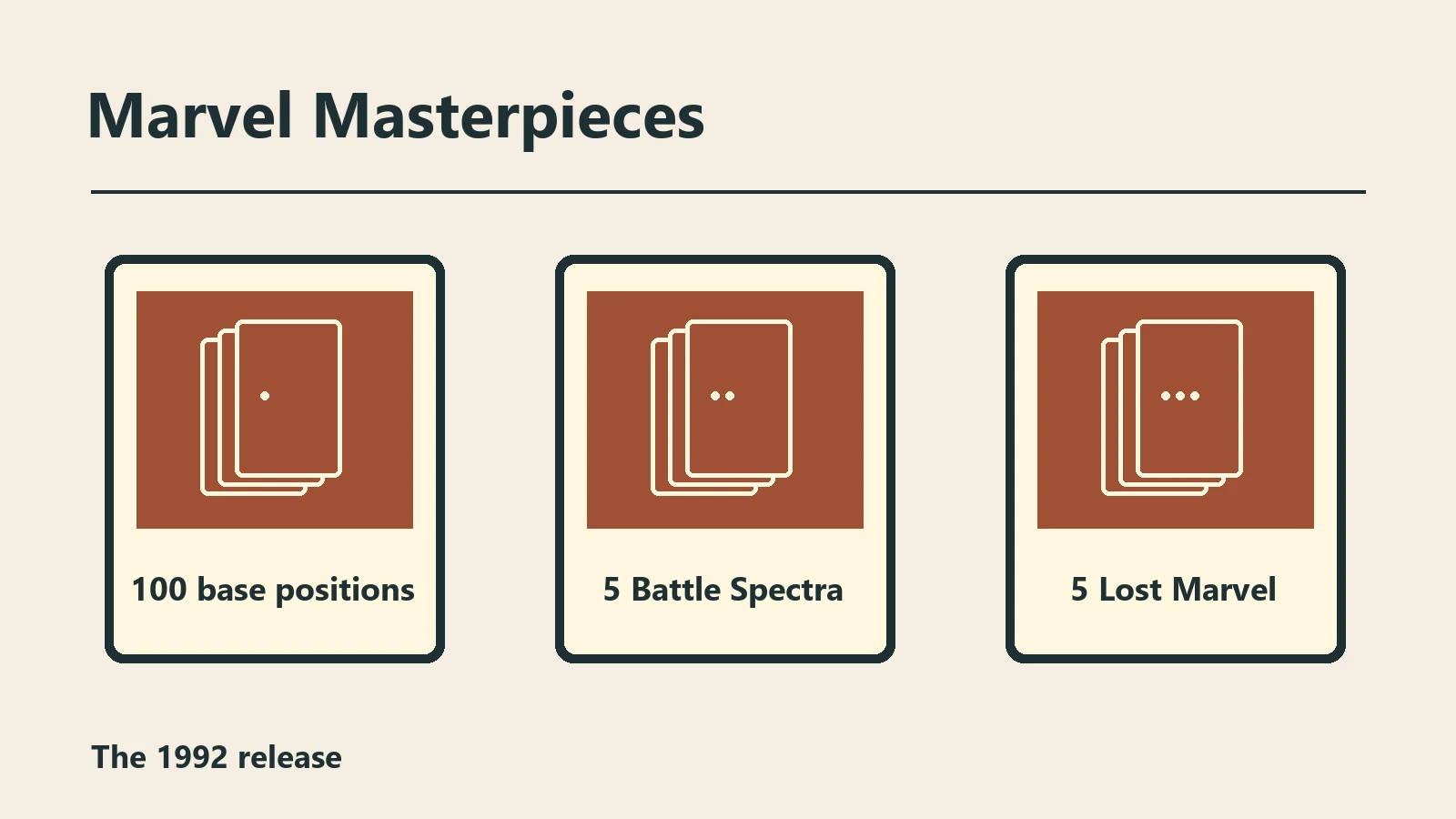
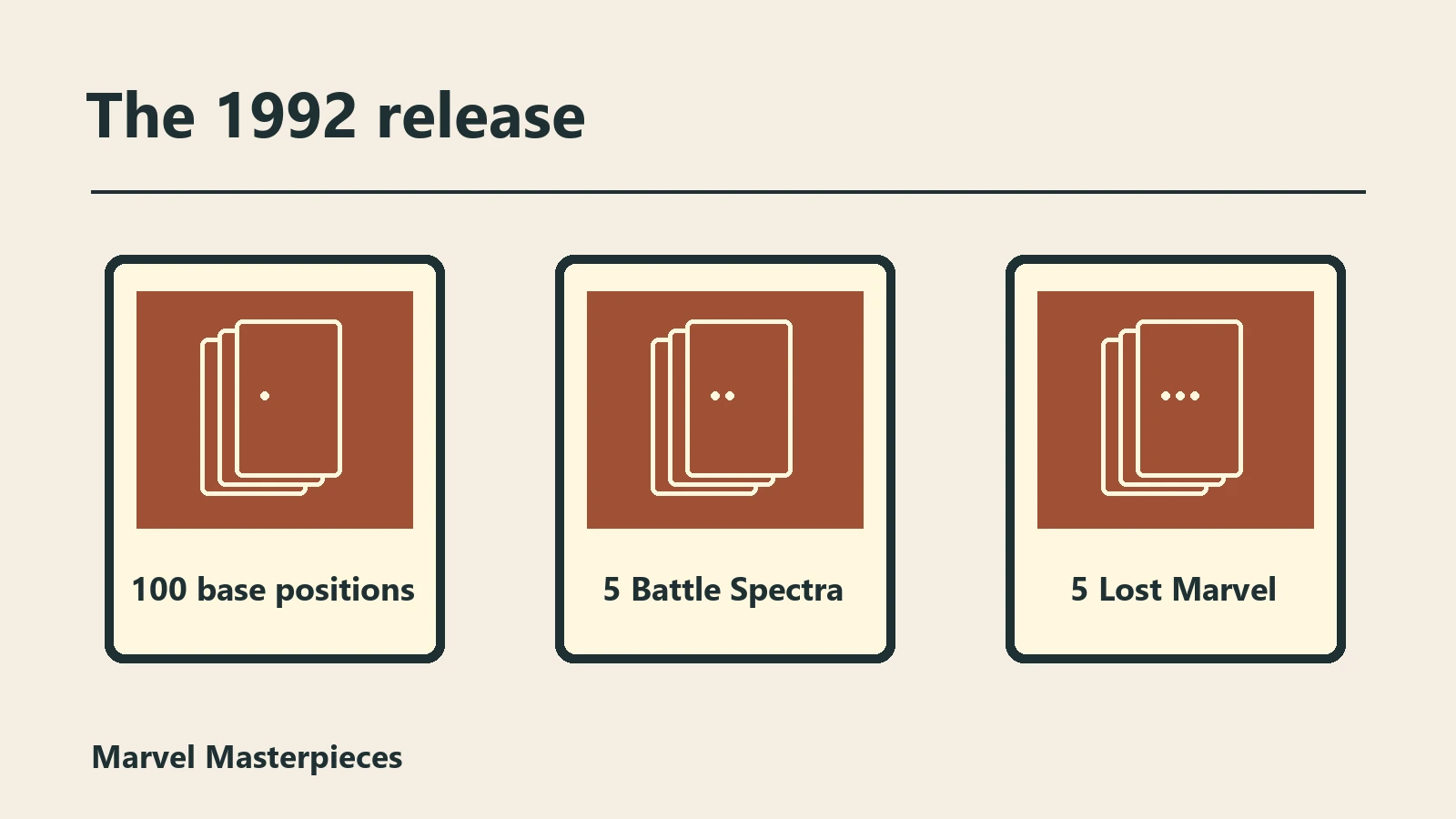
The 1992 SkyBox product illustrates the issue immediately. Surviving checklist references identify a 100-card numbered base sequence, with card 100 serving as the checklist, and separately identify five Battle Spectra cards and five Lost Marvel cards. That inventory already supports several meanings of “the 1992 set.” In the narrowest sense, the phrase can mean the 100 numbered base cards. In a broader sense, it can mean the base sequence plus the two named insert groups. A still broader collecting target can include promotional cards, dealer prototypes, the factory tin associated with Lost Marvel, and other release-related objects. The checklist establishes these categories as identification evidence; it does not, by itself, prove every item’s original distribution intent.
The institutional record helps establish the chronology. The Ronald S. Korda Collection finding aid at the Smithsonian’s National Museum of American History lists SkyBox Marvel Masterpieces products from 1992 and 1993 and a Fleer Hildebrandt Brothers Marvel Masterpieces product from 1994. That record confirms documented products in a preserved collection and supports treating the title as a sequence of releases. It does not, however, resolve every question about artist contracts, print quantities, distribution, or the survival of original paintings.
Later Upper Deck documentation shows how much the descriptive system expanded. Official checklists separate serial-numbered parallels, stated insertion odds, Canvas Gallery cards, printing plates, preliminary art, autographs, buybacks, and redemption categories. The precision is useful for inventory, but it should not be mistaken for an artistic ranking. A one-of-one parallel may be scarcer than a base card without being a more important work of art. A printing plate may be more difficult to locate than a printed card while remaining a tool of manufacture. A unique sketch may be hand-created without having been used to produce the base image.
The chronology also needs more than a simple jump from the 1990s to 2016. The title continued through Fleer’s 1995 release, which surviving checklist transcriptions describe as a 151-card product with several insert and promotional categories, and Upper Deck issued Marvel Masterpieces products in 2007 and 2008. The available records establish those post-1990s releases as part of the lineage, although the surviving evidence for their detailed configurations is primarily collector-maintained checklist material rather than authenticated manufacturer product documentation. They should therefore be acknowledged without assigning them unsupported print runs, artist rosters, odds, or marketing intentions.
That caution is particularly important when describing 2016. It was a later Upper Deck revival after the 2007–2008 cycle, not the first post-1990s return of the name. Its manufacturer material documents a new product architecture involving serial-numbered cards, 1992 buybacks, sketches, parallels, and redemptions. That structure can be compared with 1992 without pretending that the intervening releases did not exist.
2. 1992: The Jusko System, Not Merely a Card Set
The 1992 SkyBox release is often reduced to the phrase “a 100-card set,” but that description misses the way its parts operate together. The surviving checklist reference identifies 100 numbered cards, with card 100 functioning as the checklist, and credits Joe Jusko for the artwork. The important feature is not simply that Jusko’s name appears. It is that the broad Marvel roster is presented as a sustained visual program. Characters with different powers, histories, costumes, and tones are brought into a common painted treatment, giving the base sequence the character of a gallery rather than an unrelated stack of licensed images.
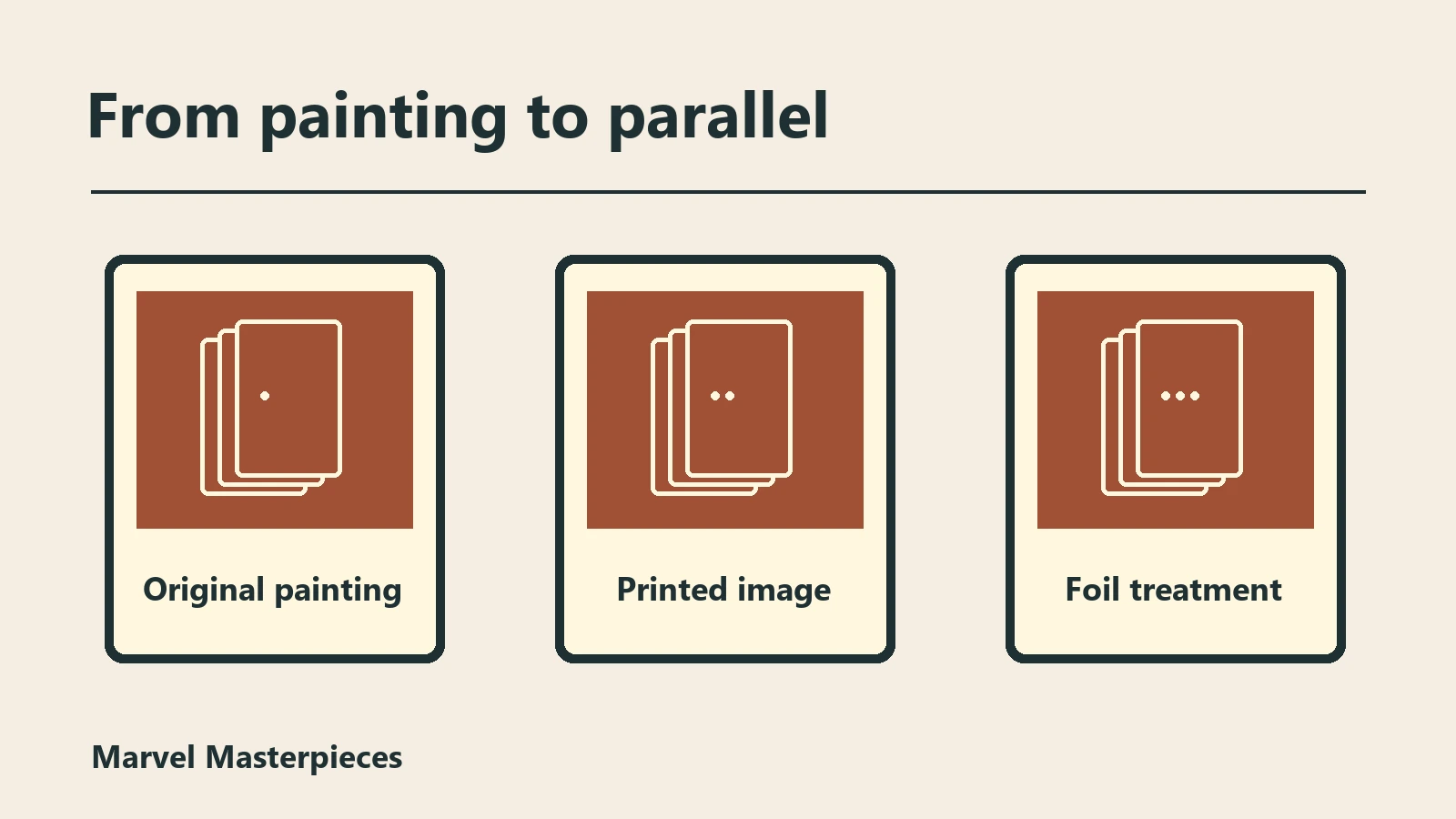
Reproduction is part of that vocabulary. A painting made for a larger surface must be translated into a small rectangular format. The image may be cropped, surrounded by a border, interrupted by typography, or printed with metallic or foil elements. The reverse may supply a checklist, character information, or a design system that links one card to the next. These are important questions because the collector does not encounter the original painting directly. The collector encounters an object in which the painting has been selected, resized, printed, and framed by the card’s physical design. Card-level examination is required before any of those features are generalized across the release.
Card-level analysis of cropping, border treatment, foil, color separation, and reverse-side organization requires identified 1992 cards or high-resolution scans. Without those examples, such features should be treated as objects for examination rather than asserted as uniform properties of the entire set. A general description of the product cannot establish that every card was cropped in the same manner, that foil altered every image’s color relationships, or that every reverse followed one identical organizational scheme.
The insert architecture makes the 1992 release more than its base sequence. Five Battle Spectra-Etch cards are identified as a separate subset, while five Lost Marvel cards are associated with a factory tin rather than ordinary pack distribution. These groups therefore differ from cards 1 through 100 not only by name but by the collecting route recorded in the checklist reference. The tin association should be described as checklist evidence, not as proof of a manufacturer-defined distribution strategy unless period packaging or sales material confirms it.
Promotional and dealer material extends the system again. The surviving checklist reference identifies six-card promotional material and dealer prototype cards. Those objects may resemble the finished cards, but resemblance does not make them part of the base sequence. A promotional card can preview the product or advertise its visual identity. A dealer prototype can document a sales or presentation stage. Unless a manufacturer document defines its purpose more precisely, the safest description is that these were release-related objects occupying a different position from ordinary pack-issued cards.
The 1992 system can therefore be described through four connected layers. First is the artist-led image library associated with Jusko. Second is the 100-card base sequence that gives the library a navigable order. Third is the group of inserts and related objects that create alternative collecting paths. Fourth is the physical card design through which the paintings become reproducible, distributable objects. None of these layers alone explains the release. Together they explain why “the 1992 set” can mean both a numbered checklist and a much wider product environment.
3. Packaging, Tins, Promos, and the Collector Journey
The 1992 product was not encountered only as loose cards emerging from ordinary packs. Its packaging and associated distribution created several routes into the Marvel Masterpieces program. That fact matters because a trading-card release is not only a set of images. It is also a method of delivery. Packs, boxes, tins, dealer material, and promotional cards can determine which objects a collector is likely to see, which objects require a separate purchase, and which objects are preserved mainly by specialists.
Lost Marvel provides the clearest example. The five-card group was associated with a factory tin rather than ordinary pack distribution. That makes the tin part of the documented collecting context for the subset, but the checklist reference does not by itself prove the manufacturer’s original distribution intent, production quantity, or regional availability. The checklist records a separate collecting route; the exact commercial arrangement remains qualified unless period packaging or sales material confirms it.
This creates two related but distinct objects: the packaging format and the card subset delivered through it. A tin can preserve evidence about presentation, construction, and distribution even after its contents have been removed. The cards can survive independently while losing some of the context that explains why they were issued. Conversely, an empty tin can document a product route without proving that all cards originally associated with it remain present. A responsible inventory should record both the cards and the condition in which they were encountered.
Dealer prototypes introduce a different kind of uncertainty. The term identifies an object as connected to dealer presentation or development, but it does not necessarily describe one uniform manufacturing stage. A prototype might be a sales sample, a layout test, a color or foil experiment, or another form of material supplied for review. Without a production record, it is safer to call these dealer prototype cards and describe their association with the release than to assign them a precise purpose. Their value as historical evidence lies partly in showing that the product existed beyond the cards ultimately found in packs.
The six-card promotional material raises a similar issue. The surviving checklist reference identifies the material, but does not by itself establish whether it was distributed through packs, dealers, conventions, mail order, or another channel. Promotional cards may have been intended to advertise the release, preview its art, or communicate its branding to retailers and collectors. They can share images or design language with the finished base set without being part of the base sequence. Their significance is contextual: they show that the program existed beyond the ordinary numbered checklist, not that the manufacturer defined them as a standard insert format.
The Smithsonian’s Korda Collection is useful precisely because it offers an institutional record rather than a modern sales description. Its finding aid documents SkyBox Marvel Masterpieces examples from 1992 and separately catalogs the 1993 SkyBox product. That separation supports a chronological reading and confirms that the releases can be studied as preserved material objects. The archive does not answer every question about packaging or distribution, but it provides a documented foundation for discussing the products as historical artifacts rather than relying solely on marketplace memory.
The physical route also affects how the release is remembered. Ordinary pack cards encourage a sequence-based collecting experience: start with card 1, continue toward card 100, and then pursue the known inserts. A tin-associated subset introduces a second route that is not visible from the base numbering. Promotional cards create a route outside ordinary collation. Dealer prototypes create a route outside ordinary consumer distribution. The product becomes a network of related objects rather than a single ladder of numbers.
This network anticipates later developments in the lineage. Modern products distinguish hobby, retail, and e-Pack configurations; separate numbered tiers; offer buybacks and planned redemptions; and issue sketches or plates through particular formats. The categories are more numerous, but the underlying principle is already present in 1992: related objects can enter the collecting world through different channels and therefore require different kinds of evidence.
Packaging should consequently be treated as part of the product’s historical architecture, not as disposable wrapping that matters only when sealed. The tin explains the route of Lost Marvel. Promotional cards explain a public-facing presentation. Dealer prototypes document a presentation or developmental context. The base cards reveal the central gallery. Together, they show how a painted-card program was not merely printed but staged, distributed, and collected.
4. 1993: The First Test of Whether the Brand Was the Artist
The 1993 release tests what could survive when Marvel Masterpieces moved beyond the unified authorship associated with 1992. The Smithsonian catalog lists SkyBox Marvel Masterpieces from 1992 and 1993 as separate products, supporting a two-year sequence rather than one delayed release. Collector-reference material identifies the 1993 successor as a multi-artist product rather than another Jusko-only set. No manufacturer-primary artist roster has been located in the available packet, so the multi-artist characterization and any visual interpretation based on it should remain explicitly provisional pending identified card examples and artist credits.
In 1992, continuity is easy to locate. Joe Jusko’s credit provides a single organizing authorship across a large and varied roster. The characters differ, but the collector can read them as parts of one sustained project. A multi-artist 1993 product has to create continuity through other means. The title, licensing, numbering, card dimensions, packaging, reverse design, insert program, and overall ambition may still connect the cards. The art, however, is no longer governed by one dominant hand in the same way.
That change should be described as a different production model, not automatically as a decline. Multi-artist structure can make a product less uniform, but it can also create a portfolio of contrasting interpretations. The relevant question is not whether every card resembles a Jusko image. It is how the release organizes difference. Artist credits, character assignments, composition, lighting, anatomy, costume treatment, and background design can be compared directly. Such comparison can establish stylistic variation. It cannot by itself establish collector rejection, commercial failure, or a loss of artistic value.
Visual unity can survive several artists if it is supplied elsewhere. A publisher may coordinate the border system, typography, foil, reverse design, card stock, or overall sequence. Character selection can also create a deliberate rhythm, alternating familiar figures with less frequently represented subjects. Inserts may repeat the same visual logic or may emphasize special effects and scarcity. The checklist can reveal how the product is divided, while card-level comparison can show how the images respond to that structure.
The shift also changes the meaning of a completed base set. In a one-artist product, assembling the sequence can feel like acquiring successive sections of a single visual argument. In a multi-artist product, completion may resemble the construction of a portfolio. The collector may pay more attention to attribution, contrast, or the movement between artists. The title still supplies a shared frame, but the experience of completion is less about preserving one hand from beginning to end and more about preserving a planned range of interpretations.
That does not mean the 1993 release abandoned the idea of a painted gallery. A gallery can contain works by several artists. Its unity may come from subject, format, curatorial selection, or presentation rather than sole authorship. The important distinction is that the source of unity has moved. In 1992, it is strongly associated with Jusko’s authorship. In 1993, it must be sought in the product’s editorial and design structure as well as in any recurring artistic tendencies visible on the cards.
This is also where the word “brand” becomes useful. A brand can preserve a promise while changing its execution. The promise associated with Marvel Masterpieces may include elevated painted presentation, a broad Marvel roster, and a premium collecting experience. A single artist is one way to deliver that promise, but not the only possible way. The 1993 release reveals that the title could be tested as a category of product rather than treated as a permanent synonym for Joe Jusko.
The later chronology makes this test even more important. Fleer’s 1994 Hildebrandt Brothers product and the 1995 multi-artist release continued to modify the relationship among title, artist, and format. The 1996 Fleer/SkyBox program associated the title with Boris Vallejo and Julie Bell and introduced specialized categories and original-art redemption cards. Those products should not be used to prove that 1993 succeeded or failed. They show instead that the brand continued to move between unified authorship, multi-artist organization, artist-specific presentation, and increasingly elaborate premium mechanics.
The 1993 release is therefore best treated as a fork in the lineage. It demonstrates that the name could continue after the Jusko-only structure, but it also makes clear what was being tested. If the brand’s essential object was the coherent gallery of one artist, the change would be substantial. If the essential object was a premium presentation of painted Marvel subjects, the change would be more evolutionary. The available evidence supports describing the altered artistic organization. It does not support choosing between those interpretations through unsupported claims about reception.
5. 1994–1996: Succession, Specialization, and Redemption
After the 1992 Joe Jusko release and the multi-artist organization associated with 1993, Marvel Masterpieces became less a single visual formula than a recurring opportunity to redefine premium Marvel art cards. The title supplied continuity, but the artistic and physical proposition changed from one product to the next. Fleer’s 1994 Hildebrandt Brothers release, the 1995 Fleer program, and the 1996 Fleer/SkyBox set should therefore be treated as distinct experiments rather than as uninterrupted chapters in one design system. The Smithsonian’s Korda Collection independently catalogs a 1994 Fleer Hildebrandt Brothers product, while surviving checklist references identify the structures of the 1995 and 1996 releases.
The 1994 product places the Hildebrandt Brothers at the center of its identity. That credit matters because it describes a collaborative artistic name rather than a continuation of Jusko’s individual authorship. The release can be discussed as artist-led, but not as Jusko continuity. A named partnership creates a different model of authorship: the product is organized around a shared professional identity, and its visual coherence must be assessed from the cards themselves rather than assumed from the title.
1995: a further change in structure
The 1995 Fleer Marvel Masterpieces release changed the line’s structure again. Surviving checklist transcriptions describe a 151-card base set, a 150-card E-Motion Signature parallel, 22 Canvas cards, eight Holoflash cards, two Mirage lenticular cards, and a four-card Wolverine promotional panel. They also identify credited artists including Dave DeVries, Nelson, Peter Scanlan, and Dimitrios Patelis. These details come from collector-maintained checklist references rather than a located Fleer manufacturer checklist or sell sheet.
The 1995 references establish named card groups, counts, and broad artist credits, but they do not establish exact print quantities, the contractual arrangement among the artists, or the manufacturer’s intended hierarchy among the inserts. Nor do they document how collectors responded to the product at the time. The safest interpretation is structural: 1995 expands the number of visual and material routes through which the brand could be collected.
The 151-card base set alone marks a departure from the simpler idea of a compact painted gallery. It creates a larger sequence and distributes the artistic responsibility among several credited contributors. That does not automatically make the release less coherent. It does mean that coherence must be found elsewhere: in the card design, numbering, licensing, recurring formats, or the act of gathering separate artist contributions under one branded program. Without card-level comparison, it would be premature to claim a particular degree of visual unity.
The insert architecture reinforces the change. E-Motion Signature parallels, Canvas cards, Holoflash cards, and Mirage lenticulars do not all represent the same kind of object. A signature parallel is a variation on a printed card category. A canvas card concerns presentation or stock. Holoflash adds a reflective or changing visual treatment. A lenticular uses a different display technology from an ordinary printed card. The product thus distributes its premium identity across several physical effects instead of relying on one dominant painted-card experience.
The Wolverine promotional panel adds another collecting path outside the main numbered sequence. A promotional panel is not automatically part of the base set, and its existence does not establish where or how it was distributed without period packaging or advertising. Its significance is more limited but still useful: it shows that the 1995 program extended beyond the cards required to complete the 151-card sequence. Collectors could define the release by the base set, by the inserts, or by a broader group that included promotional material.
“E-Motion” should likewise be preserved as a product label rather than expanded into an unsupported technical claim. The checklist identifies the parallel category, but the available material here does not establish every manufacturing detail behind it. The same restraint applies to Holoflash and Mirage. Their names identify distinct categories and imply different presentation methods, but a full account of their construction would require packaging, manufacturer documentation, or examination of representative cards.
The 1995 release is therefore important because it interrupts any overly neat progression from one famous painter to the next. It shows a multi-artist, multi-format program in which the title operates as an umbrella. The line could contain a large base sequence, several premium treatments, and a promotional panel without depending on a single artist to supply every image. That is a different production model from 1992 and a different proposition from the artist-specific identity associated with 1994.
1996: specialist formats and the redemption promise
By 1996, surviving checklist references present another defined artistic proposition. The 100-card series is credited to Boris Vallejo and Julie Bell, and the associated categories include Double Impact, Gallery, oversized Masterprints, and nine original-art redemption cards. The product is consequently more than a base sequence with a few incidental inserts. It divides the collecting task among ordinary cards, specialized subsets, larger-format reproductions, and an offer connected to physical artwork. The checklist wording establishes the announced redemption category; it does not establish fulfillment or the survival of the works.
Gallery is best treated as a named product category, not as proof that the cards themselves are paintings. The label may signal a highlighted selection, a distinct finish, a different presentation, or a separate place in the checklist. It establishes that the manufacturer or checklist compiler regarded the cards as a separate pursuit. It does not, by itself, establish the medium, the printing process, or the relationship between the card and any surviving original.
Double Impact similarly identifies a specialized route through the product. The checklist supports discussing it as an insert category without requiring an invented account of its production. A collector can pursue Double Impact as part of the 1996 program, but the category should not be assigned a superior artistic status merely because it is separate from the base set. Its significance is architectural: it adds another destination within the release.
The oversized Masterprints move selected imagery into a different physical scale. That affects storage, display, handling, and comparison with ordinary trading cards. It does not make the objects production originals. “Masterprint” is a product designation; it does not prove that a piece was printed directly from a painting, that it was unique, or that it represents a section of an original canvas. A larger reproduction remains a reproduction unless object-level evidence shows otherwise.
The nine original-art redemption cards make the most consequential promise in the set. A redemption card places no physical painting in the ordinary pack. Instead, it offers a mechanism through which a cardholder may seek artwork described as original art used in the set. The checklist can establish that nine such redemption cards were identified and can preserve the language of the offer. It cannot establish that every card was redeemed, that each claimant received a work, that the supplied art was the exact production original, or that any particular painting survives today.
The redemption changes the collector proposition even when fulfillment remains undocumented. A base card is a published reproduction. A Gallery or Double Impact card is a specialized reproduction within the same program. A Masterprint is a larger presentation of selected imagery. A redemption is a manufactured claim about a possible object outside the normal card format. The cardholder therefore holds both a collectible and an assertion that another object may be obtainable. The historical meaning lies in that relationship, not in assuming that the offer was necessarily completed.
Across 1994, 1995, and 1996, the line moves toward specialization without producing a single inevitable direction. The 1994 Hildebrandt Brothers product centers a collaborative artist identity. The 1995 release distributes the base set among several artists and adds multiple presentation technologies. The 1996 Vallejo and Bell program organizes its premium proposition through named specialist formats and original-art redemption offers. These are changes in product architecture, not a documented ranking of quality or collector approval.
6. What Counts as Painted Artwork?
The history of Marvel Masterpieces becomes imprecise when every attractive or unusual card is called “original art.” The products contain several distinct objects, each with a different relationship to the image. A printed card may reproduce a painting. A sketch card may contain unique hand-drawn marks. A printing plate may have been used in manufacture. A preliminary-art card may reproduce an earlier stage of development. A canvas or foil parallel may alter the surface without changing the underlying composition. These objects can belong to the same product family without being interchangeable.
A production original is the physical artwork used, or intended to be used, as the source for a published image. In a painted-card program, it might be a finished painting created for a base card. The term should be applied only when the object’s production role is documented or supported by reliable provenance. A checklist naming a character proves that the character appears in the product; it does not prove that a particular painting survives, that a seller’s artwork was the final source, or that the work was ever returned to an artist.
Preliminary art belongs to an earlier stage of development. It may establish a pose, costume, expression, composition, lighting plan, or color direction before the final image is completed. Such a study can be historically revealing because it shows decisions that disappear in the finished image. It is not automatically a lesser object, but it is a different object. A printed card labeled “Preliminary Art” reproduces or presents that category; it is not itself the physical study unless the card has been hand-worked and the product specifically says so.
The 2020 checklist’s Preliminary Art entries demonstrate why the distinction matters. Upper Deck lists “Preliminary Art” as a printed subset and separately lists “Preliminary Art Originals by Dave Palumbo” as a redemption category. The printed subset establishes a manufactured representation of an earlier artistic stage. It does not establish that every card corresponds to a surviving physical preliminary or that every preliminary was the direct source for a particular finished base image.
A sketch card is a card bearing original hand-drawn or hand-painted material. The card is usually the support on which the artist works, and the drawing may have been made specifically for the product. Upper Deck’s artist material identifies sketch-card artists as part of the modern Marvel Masterpieces program. A sketch card can therefore be an original art object in the narrow sense that the marks were made by hand on the card. That does not mean the sketch supplied the image for a base card or belongs to the same composition as a published painting.
A printed card is a manufactured reproduction. Its image may originate in a painting, drawing, photograph, digital file, or combination of sources. The checklist identifies categories such as foil, canvas, and metallic treatments, but the exact substrate or finish requires product documentation or object-level examination. Those effects are part of the card’s production identity, not proof that the card has become a hand-painted object.
A printing plate is an editorial term for a manufacturing artifact associated with transferring an image or color component during production. The official 2018, 2020, and 2023 checklists identify printing-plate categories separately from base cards and other art-related categories. In this feature, the term is applied only to the documented checklist category; the exact plate technology and production role require object-level or manufacturer documentation. A listed plate preserves evidence about the route from image to printed card. It does not replace the painting, drawing, or digital artwork that supplied the image, and it should not be called a production original without specific evidence.
A Canvas Gallery card is a manufactured card identified by the product as a canvas category. The checklist establishes the category; the exact substrate or finish requires product documentation or object-level examination. “Canvas” does not, by itself, mean that the card contains a section of the artist’s original canvas or that it is an original painting.
A foil parallel is a version distinguished by foil, color, metallic treatment, or another specified production variation. Gold Foil, Purple, Orange, and the 2018 checklist’s Red Spectrum Foil Parallel illustrate how a related image can circulate in several manufactured forms. The principal Red Spectrum Foil Parallel entries are limited to one example each, but the separate Red Spectrum Foil Parallel–Canvas Gallery entries numbered 91–100 are limited to 25 each. The entire Red Spectrum program therefore should not be described as a one-of-one category. A foil parallel may be numbered or limited, but it remains a printed card with a particular treatment. Scarcity does not turn it into original art, prove that its image was harder to produce, or establish that it is artistically more important than the base card.
A buyback is an older card incorporated into a later product, usually with a stamp, foil mark, signature, or other identifying intervention. The 2016 revival used buybacks of 1992 cards, creating a physical connection between the original release and the later program. A buyback is therefore a layered historical object: the underlying card belongs to the earlier product, while the later marking belongs to the revival. It is not a newly painted version of the image and not a newly printed 1992 card.
An original-art redemption is an offer connected to a physical artwork. The redemption card may require submission or exchange in order to receive the work. The card proves that the product announced the category; it does not prove fulfillment, delivery, survival, or current ownership. Those claims require independent records. Even when fulfillment is documented, the object should be described precisely by subject, medium, dimensions, creator, and chain of custody wherever those details are known.
These categories can overlap in one release without collapsing into one another. A preliminary drawing can be reproduced on a printed card. A finished painting can appear as a canvas reproduction. A base image can return as a foil parallel or buyback. A plate can be inserted alongside all of them. Their shared image creates a family resemblance, but their physical identities remain different.
The phrase “painted set” therefore needs careful handling. It may describe the source imagery or the artistic method behind the base cards, not the material composition of every card in the product. A set built from paintings can contain printed base cards, foil parallels, plates, sketches, preliminary-art cards, and redemption offers. Conversely, a hand-drawn sketch card can be unique without belonging to the painted production sequence that defines the base set.
A disciplined description asks four questions: What is the object made of? Who made the marks or image? What role did it play in production or distribution? What evidence connects it to a particular published card? If the evidence answers only the first two, the description should stop there. Calling an object “original art” without identifying its production role creates a provenance claim that the checklist may not support.
7. 2016: The Later Upper Deck Revival Restores the Chase Ecosystem
Upper Deck’s 2016 revival was not the first post-1990s return of the name: collector-maintained records identify Upper Deck Marvel Masterpieces products in 2007 and 2008, including a 2007 product, 2008 Set 2, and 2008 Set 3. Those records establish chronology but do not provide enough authenticated manufacturer-primary evidence to reconstruct the later products’ configurations, artist rosters, print quantities, or insertion rates responsibly. The 2016 release should therefore be described as a later Upper Deck revival after the 2007–2008 cycle, not as the first modern return.
The manufacturer’s 2016 product document presents a new program rather than a simple reprint. It states a serial-numbered base, Joe Jusko-themed sketch cards, 1992 stamped buybacks, What If material, Holofoil and Gallery parallels, Mirage lenticular cards, and uncut-sheet redemptions. Collector-maintained checklist references may supplement that document for category identification, but they should not be treated as equivalent to the manufacturer’s sell sheet. The connection to 1992 is therefore made through selected objects and product references, while the release establishes its own checklist and chase system.
The 90-card base structure immediately separates the revival from the original 100-card SkyBox sequence. It is not the old checklist printed again under a new date. The new base provides a new set of subjects, and the surrounding categories determine how collectors move beyond it. What If variations create alternate versions of related imagery. Battle Spectra, Holofoil, and Mirage identify additional presentation or finish categories. Their names establish product classifications, but do not by themselves prove different paintings or a hierarchy of artistic importance.
The 1992 buybacks provide the clearest physical bridge to the earlier release. Unlike a new card that merely uses the Masterpieces name, a buyback incorporates an older manufactured card into the 2016 product. The later stamp or marking identifies its new context, while the underlying card remains a product of the earlier SkyBox program. This makes the buyback a layered chronological object. It is not a 2016 remake of the painting, and it should not be described as a newly printed 1992 card.
Buybacks and new sketch material represent two different forms of continuity. The buyback preserves contact with an earlier manufactured object. The sketch program introduces new hand-created material made for the revival. One is archival and connective; the other is contemporary and generative. Both can sit inside the same product, but they answer different collecting motives. The buyback asks the collector to preserve a link to the past. The sketch asks the collector to acquire a new object created within the revived brand.
Sketch cards expand the product beyond reproduction. Upper Deck’s artist material identifies sketch-card artists as part of the Marvel Masterpieces program, including Mitch Ballard’s connection to the 2016 sketch-card component. Each sketch card is a hand-created object, but the existence of a sketch does not establish that it supplied the image for a base card. It may be an independent contribution intended to complement the product. Its originality lies in the marks made on the card, not necessarily in a hidden production role.
Uncut-sheet redemptions add a different kind of physical proposition. An uncut sheet is a sheet of cards before separation into individual cards. A redemption connected to such a sheet therefore offers a manufacturing-stage object rather than a painting. The sheet may preserve card arrangement, borders, registration, and relationships among images that individual cards do not show. It remains a printed production artifact, however, and should not be presented as original painted artwork.
The published odds require equally careful interpretation. Manufacturer-declared insertion odds describe the stated distribution mechanism for a category under the relevant product configuration. They do not guarantee that every box or case contains one item from every category, nor do they predict a representative distribution of artists, characters, variations, or serial tiers. A stated sketch rate is not an observed pull rate for a particular artist. Results from a small opening are not evidence that the manufacturer’s odds were different, and results from one configuration should not automatically be applied to another.
Calling 2016 a reprint would therefore be misleading. The product creates a new base sequence, new variations, new sketch material, and new premium categories while selectively incorporating older cards through buybacks. Its relationship to 1992 is historical and architectural as much as visual. It revives the idea of a premium painted-card ecosystem, but it does so through several object types that must remain distinct.
The broader chronology makes that distinction clearer. The 2007 and 2008 records show that the name had already returned after the 1990s, though the currently available evidence does not support a detailed reconstruction of those products here. The manufacturer’s 2016 material documents a more clearly segmented revival: old cards as buybacks, new hand-created sketches, new variations, and manufacturing artifacts as separate destinations. The significance of 2016 is not that it begins the entire post-1990s history. It is that it makes the modern chase ecosystem especially visible.
8. 2018: Artist-Led Continuity and the Premium Parallel Ladder
Upper Deck presented the 2018 product as a Simone Bianchi program. Its sell sheet identifies Bianchi by name and advertises more than 135 original pieces of artwork by him. The official checklist separately documents the 100-card numbered program, the ten-card Canvas Gallery sequence, parallels, printing plates, autographs, and the Red Spectrum Foil Parallel. The artist-led characterization therefore comes from the manufacturer’s sell sheet, while the checklist establishes the product’s categories and numbering. Neither document, by itself, proves fulfillment of redemptions or surviving physical-art provenance.
The official checklist contains a 100-card numbered base program, but Canvas Gallery is not a 100-card subset. Cards 1–90 form the principal base sequence, while cards 91–100 form the ten-card Canvas Gallery subset. That distinction is essential. The total numbered program and the named Canvas Gallery category are related but not interchangeable.
The product’s artist-led identity and its parallel structure perform different functions. Bianchi supplies the credited visual authorship advertised by Upper Deck. The official checklist then distributes related imagery across the numbered program, Canvas Gallery cards, Gold Foil versions, Purple and Orange serial-numbered parallels, the principal Red Spectrum Foil Parallel entries limited to one example each, the separate Red Spectrum Foil Parallel–Canvas Gallery entries numbered 91–100 and limited to 25 each, autographs, and printing plates. The artist’s identity creates continuity across the program; the parallel ladder creates multiple physical and distributional forms of that continuity.
The first 90 cards provide breadth. They establish the principal sequence and give the collector a defined body of subjects to assemble. Cards 91–100, by contrast, form the separate ten-card Canvas Gallery subset. The category may offer a different stock, texture, finish, or presentation, but the word “canvas” should not be treated as evidence that the cards contain pieces of original canvas. It is a manufactured presentation category unless object-level evidence demonstrates something more specific.
Gold Foil parallels add another manufactured layer. Foil can alter reflectivity, metallic emphasis, contrast, and the way light moves across the printed surface. These effects are central to the card’s identity as a parallel, but they do not make it a hand-painted object. The same visual source may therefore circulate as a standard card, a Canvas Gallery card, a Gold Foil card, a numbered color version, an autograph, or a plate. The family resemblance comes from the image program; the physical objects remain different.
The Purple and Orange versions are serial-numbered parallels. A serial number establishes a declared limit or tier for that particular category. It does not establish that the source image was harder to create, that the artist preferred the treatment, or that the scarcer version is historically more important. Scarcity is a distribution fact. Artistic importance would require evidence about authorship, intent, production role, reception, or historical influence.
The 2018 checklist’s principal Red Spectrum Foil Parallel entries are listed to one example each. The separate Red Spectrum Foil Parallel–Canvas Gallery entries numbered 91–100 are listed to 25 each. Those declared limits establish different manufactured parallels within specified categories; they do not mean that the underlying compositions exist nowhere else. Related imagery may appear in the base sequence, Canvas Gallery, Gold Foil, other numbered parallels, autographs, or plates. The manufacturer’s category names should be retained rather than treating the entire Red Spectrum program as a one-of-one parallel.
Autographs introduce a personal association, but they must also be described precisely. An autograph card is a printed card bearing a signature identified by the product documentation. The signature adds a personal intervention to the manufactured object; it does not make the card the original painting used to create the image. Nor does a signature alone prove that the signer painted the particular composition unless the manufacturer identifies that relationship.
The sell sheet’s reference to more than 135 original pieces of artwork should be read narrowly. It establishes the manufacturer’s product positioning and its advertised scale of the art program. It does not, without further documentation, establish the number of surviving physical paintings, the ownership of those works, or the exact correspondence between every advertised piece and every checklist entry. Marketing language can identify the intended artistic scope while leaving physical-art provenance unresolved.
The 2018 product also includes categories associated with original-art sketches, layouts, and redemptions in the manufacturer’s presentation. Those terms should not be collapsed into the base cards or Canvas Gallery cards. A sketch is a hand-created object if the card or work itself bears the artist’s marks. A layout or preliminary object represents an earlier stage of development. A redemption is an offer connected to another object. The checklist or sell sheet establishes the announced category; it does not prove fulfillment or present ownership.
The 2018 product therefore demonstrates continuity through multiplication. Upper Deck’s product presentation supplies a named artist and an advertised body of artwork, while the official checklist multiplies the ways in which that imagery can be owned: ordinary cards, a ten-card Canvas Gallery subset, foil and numbered versions, principal Red Spectrum Foil entries limited to one each, Red Spectrum Foil Parallel–Canvas Gallery entries numbered 91–100 and limited to 25 each, autographs, and plates. The product remains artist-led while becoming materially complex.
9. 2020: Complexity, Preliminary Art, and Numbered Base Cards
The 2020 Marvel Masterpieces checklist makes product segmentation unusually visible. The official checklist identifies four base versions limited to 1,999, 1,499, 999, and 99 copies, alongside additional named categories and stated odds. These are separate manufactured categories within the release, not merely informal descriptions applied by later collectors.
That structure changes the meaning of “base set.” In 1992, the ordinary numbered sequence could serve as the obvious center of a collection, with Battle Spectra, Lost Marvel, promotional cards, tins, and dealer prototypes treated as additions. In 2020, the collector must first decide which numbered level represents the ordinary set. The checklist supplies the categories, but it does not decide whether completion requires one version of every image, the 1,999-copy tier, all four tiers, or every parallel and insert surrounding them.
The four limits also separate image identity from object scarcity. Related cards may present the same character or composition while existing as different physical editions. A 99-copy card is more limited as a manufactured object than a 1,999-copy card, but its serial number does not prove that its image required more artistic labor, that the underlying painting was harder to create, or that the artist regarded it as more important. A serial limit controls distribution. It does not measure the rarity of a painting or the seriousness of an artistic decision.
This is a significant departure from the original collector’s task. The 1992 base set could be understood as a coherent gallery of printed paintings. The later inserts added different finishes, distribution paths, or special presentations. In 2020, the product places scarcity classes inside the main gallery itself. The collector is no longer deciding only whether to add an insert. The collector is deciding which edition of the central image sequence belongs in the collection.
The same caution applies to the other named categories. The 2020 checklist identifies Canvas Gallery, Gold Foil tiers, Battle Spectra Gems, and Preliminary Art. These names describe product categories and treatments. The technical definitions and provenance limits are set out in Chapter 6; here, the relevant point is that the checklist establishes announced categories, not original physical artworks or undocumented manufacturing methods.
Canvas Gallery is best understood as a named presentation category within the release. The name may encourage a collector to associate the card with the material character of a canvas painting, but the card remains a manufactured reproduction unless object-level evidence demonstrates that physical canvas or another original material is actually embedded in it. Likewise, Gold Foil indicates a treatment identified by the product architecture. It does not, by itself, establish how the treatment was applied or whether the surface was finished by hand.
Battle Spectra Gems extend the vocabulary of an earlier insert concept into a later product system. The checklist establishes their inclusion and category name. It does not, by itself, provide a complete technical explanation of what makes a particular card a “Gem,” nor does the title prove that the material or manufacturing process is identical to the 1992 Battle Spectra-Etch cards. Continuity of terminology is evidence of a recurring product idea, not automatic evidence of identical construction.
The Preliminary Art material is especially important because it complicates the usual division between finished painting and ordinary reproduction. The checklist lists “Preliminary Art” cards numbered 1–90 in the relevant subset. It separately identifies “Preliminary Art Originals by Dave Palumbo” as redemption cards and “Sketch Comic Covers by Dave Palumbo” as “Original Art,” with planned redemptions for hobby and e-Pack. The printed cards and the announced physical-art categories are different product objects: the former present a manufactured representation of an earlier artistic stage, while the latter record planned offers connected to physical original material.
The numbered base levels intensify the same problem from the distribution side. A collector can easily count versions before deciding what those versions represent. Four serial limits may describe four editions of a related image, but they do not necessarily describe four separate artistic acts. The product multiplies the number of cards available to collect without multiplying the number of original paintings in the same proportion.
Compared with 1992, the 2020 product moves more interpretive responsibility onto the collector. The earlier release had a recognizable central gallery and a relatively legible set of additions. The later checklist offers several possible centers: the 1,999-copy base tier, the complete four-level ladder, Canvas Gallery, Gold Foil, Battle Spectra Gems, printed Preliminary Art, or the planned original-art redemptions. The modern checklist does not eliminate the idea of a set. It multiplies the reasonable meanings of one.
10. 2023 Marvel Masterpieces XL: Scale as Tribute
Marvel Masterpieces XL changes the product’s marketed identity, but the official checklist does not provide a card-dimension specification. Accordingly, claims about enlarged dimensions, storage, handling, or display should be treated as matters requiring an identified measured card or an official product specification, not as established facts from the title alone. The supported claim is that Upper Deck marketed the product as XL and issued a distinct checklist with its own roster and categories.
The official 2023 XL checklist begins with characters including Ultimate Spider-Man, Tiger Shark, Fin Fang Foom, Werewolf by Night, Magik, Gorr, Hela, and Gwen Stacy. That sequence establishes the roster of a later product; it does not continue the 1992 numbering. Familiar characters can create a sense of Marvel continuity without proving that XL reuses the 1992 artwork. Character overlap, brand continuity, and image reuse are separate claims.
The checklist also shows that XL belongs to the modern Masterpieces product family through its layered collecting structure. It identifies Gold Foil, Epic Purple, Red Foil Canvas High Series, the Silver Spectrum Parallel, What If, printing plates, Battle Spectrum, and Battle Spectrum Gems. Ordinary base cards, surface variations, alternate versions, manufacturing artifacts, and premium Battle Spectrum material therefore coexist within one release. XL is a tribute through product positioning and checklist vocabulary; the checklist does not by itself prove a relationship to any particular earlier painting.
Gold Foil, Epic Purple, Red Foil Canvas High Series, and the Silver Spectrum Parallel represent distinct checklist categories within the XL structure. What If introduces an alternate branch defined by the checklist. These terms should remain tied to the manufacturer’s categories. A foil version is not automatically a new painting, a Canvas High Series card is not automatically made from original canvas, and a What If card should not be described as a preliminary study unless the documentation makes that connection.
Battle Spectrum and Battle Spectrum Gems continue a named insert tradition while placing it in the XL environment. The recurrence of the name supports a comparison of product vocabulary across eras, but it does not establish that every version uses identical materials, artwork, or manufacturing methods. A collector can study Battle Spectrum as a continuing concept without assuming that the 2023 treatment is technically the same as the 1992 Battle Spectra-Etch cards.
Distribution must be read with equal care. The official checklist distinguishes hobby and blaster odds for specified categories. Those figures belong to their stated configurations and should not be generalized across every territory, box type, retail environment, or later distribution channel. A hobby insertion rate does not describe a blaster product, and a blaster rate does not establish what a collector will encounter in every retail setting.
XL’s tribute function is supported as a product-positioning and checklist claim, not as a measured physical-format conclusion. The official checklist documents a later character sequence and categories including foils, Red Foil Canvas High Series, the Silver Spectrum Parallel, What If versions, plates, and Battle Spectrum material. It does not, on the available evidence, establish that its images are reused from 1992, that original paintings were rescanned, or that the cards have dimensions different from standard releases.
11. 2024 Masterpieces ’92 Platinum: Return, Reproduction, or Reinterpretation?
Upper Deck marketed Masterpieces ’92 Platinum as a return to the 1992 artwork. Its product presentation says collectors can “rediscover the original artwork” associated with the earlier Marvel Masterpieces set, while the official checklist documents a 100-card base set and contemporary parallel and insert architecture. The official checklist documents Rainbow, Precious Metal Gems, Holofoil, Lenticular, Plexi, and variant-cover parallel categories; it does not contain matches for “What If” or “Plate.” The marketing language establishes the advertised relationship to the 1992 visual library. It does not, by itself, establish that the cards were scanned from surviving original paintings or that the original 1992 printing process was recreated.
The 100-card base structure creates an obvious comparison with the original SkyBox release. The official checklist documents the modern 100-card base sequence and its contemporary categories, including Rainbow, Precious Metal Gems, Holofoil, Lenticular, Plexi, and variant-cover parallels. Repeating the number does not make the release the same set again. The numerical correspondence is a structural reference, not proof of identical printing methods or identical physical sources.
Those categories place the marketed 1992 relationship inside a contemporary product architecture. Rainbow and Holofoil are printed parallel treatments; Precious Metal Gems, Lenticular, and Plexi identify additional modern checklist categories; and the variant-cover parallels create another branch of the release. They should be described as manufactured forms unless separate documentation establishes a particular artwork provenance.
The result is not simply a restoration of a 1992 checklist. It is a modern interpretation of 1992 imagery through later collecting mechanisms. The product can refer directly to an earlier visual program while still operating according to contemporary expectations of parallels, serial scarcity, and specialized inserts. The historical reference and the modern product design are present at the same time.
The product consequently occupies a different position from the 2016 revival and the 2023 XL release. The 2016 program connected the present to 1992 through stamped buybacks while building a new art-and-chase ecosystem. XL offered scale as tribute, without a checklist-based basis for calling its images reused 1992 artwork. ’92 Platinum makes the earlier visual library central to its presentation and then subjects that library to modern parallels, inserts, and manufacturing artifacts.
One character across the Platinum checklist
Take Psylocke out of alphabetical order and place her at the center of a page. In the Platinum sequence she is number 65. Nick Fury comes immediately before her and Professor X immediately after her. Lay those three names across the top of a sheet. Down the left side write the treatments you want to compare. Reading across this grid keeps the treatment constant and shows the character sequence. Reading down keeps the character constant and shows how many separate manufactured objects can carry the same number. An empty cell now describes a specific missing object instead of an imprecise missing character.
The official checklist gives the exercise a useful surprise. It lists a Red Prism Psylocke with a limit of 492 and a red Precious Metal Gems Psylocke with a limit of 100. An auction title that says only “red Psylocke 65” has omitted the very words needed to choose between the two rows. Ask for the complete designation and photographs of both faces before entering it into either cell. Comparing prices across the two red rows as if they were interchangeable would turn a difference in product design into an apparent price change.
The problem persists at the opposite end of the color scale. Upper Deck lists Golden Treasures for the ordinary number, a gold Precious Metal Gems version and a Golden Treasures variant cover carrying 65-V. Each of those entries carries a limit of one. Three distinct rows can therefore have the same character and the same denominator. A seller can correctly describe a card as a one of one while leaving the buyer unable to tell which of three objects is on offer. The suffix and the family name do more identification work than the superlative.
Contrast that with the Holofoil and Metallurgy entries. Upper Deck gives a pack ratio for each category in the specified channels. Those figures describe the chance of encountering an entry in a family. A buyer looking for this particular Psylocke still faces the problem of which character will appear. Multiplying the printed ratio by a guessed number of subjects would silently assume equal allocation among them. Neither the collector number nor the order of the names on the sheet establishes equal allocation. Record the published family odds in a separate field and leave individual odds open.
Now consider how the display would look if the collector started with an artwork goal. Place one ordinary number 65 beside one 65-V, leaving space for a caption about the picture on each physical copy. With that choice the viewer can inspect composition before reflectivity. A finish-focused display would look different. The same character can occupy every pocket while treatments change from row to row. Side lighting, held at a constant angle, makes surface differences visible. A second photograph in diffuse light preserves the underlying picture when the brightest reflection hides part of it.
The page can also tell a chronological story without pretending the cards were made together. Leave the first position for a separately identified SkyBox-era example. Put the date and publisher beneath each object and describe only what the two cards show. If the same gesture or silhouette is visible in both, mark those details in the captions. If one image is cropped close enough to lose a background element, identify the missing element. These observations are more useful than a blanket assertion that one card is an exact copy. They can be checked by the next person who sees the page.
A dealer preparing that group for sale can carry the same distinctions into a written inventory. Photograph the number and suffix together, transcribe the stamped sequence exactly when present, and pair those details with the named treatment. Keep the digital filenames tied to the inventory line, particularly when several gold or red examples are in the same group. If one card leaves the collection years later, the photographs still document which treatment occupied that position. The result preserves information that a total count, however accurate, would lose.
12. The Collector’s Definition of “Complete”
Across the Marvel Masterpieces lineage, “complete” has never described only one thing. It can mean that every numbered card in a base sequence is present. It can mean that named inserts have been added. It can mean that packaging, promotional cards, dealer prototypes, or manufacturing artifacts have been preserved. In the modern era, it can mean every serial tier, autograph, sketch, plate, preliminary-art card, or distribution-specific variation. The word becomes useful only after the collector identifies what kind of completeness is intended.
The 1992 program provides the clearest example of a layered definition. A base-set collector might assemble the 100 numbered cards and stop there. A broader pursuit could add the five Battle Spectra-Etch cards and five Lost Marvel cards associated with the factory tin. A still wider project could include six-card promotional material, dealer prototype cards, and relevant packaging. These are not interchangeable levels of achievement. They preserve different parts of the product’s architecture: the central gallery, the insert program, the special distribution route, and evidence of how the release was presented outside ordinary packs.
That structure makes a 1992 “master set” an editorial choice rather than a self-evident object. The checklist can identify subsets, but it cannot determine whether a prototype belongs in every collector’s definition or whether a tin must be preserved with its Lost Marvel cards. One collector may be studying the painted sequence. Another may be reconstructing the full retail experience. A third may be documenting promotional and dealer material as evidence of distribution. Each project is complete according to a different question.
The 1996 program changes the categories that completion must account for. In addition to the 100-card series, a collector may pursue Gallery, Double Impact, oversized Masterprints, and the nine original-art redemption cards. Here completion can extend from printed cards to larger-format objects and offers connected to physical artwork. A collector who includes the redemption cards has preserved evidence that the offer existed. That does not mean the collector has acquired the redeemed originals, and the checklist does not establish that every redemption was fulfilled.
The modern revival expands the possibilities further. A 2016 collector might define completion as the 90-card base set, then add What If variations, Battle Spectra, Holofoil, Mirage, stamped 1992 buybacks, uncut-sheet redemptions, and sketches. Each category preserves something different. The base set records the principal 2016 sequence. What If documents an alternate product branch. Buybacks preserve physical 1992 cards inside the later program. Uncut sheets preserve a manufacturing-stage format. Sketch cards preserve hand-created marks made for the revival.
A collector choosing the 2016 buybacks is not pursuing exactly the same goal as a collector choosing sketches. The buyback is a bridge to an earlier manufactured object. The sketch is a newly created art object associated with the later program. Both can be special material, but their historical functions differ. Both categories are documented in the 2016 product references.
The 2018 and 2020 products make scarcity itself part of the completion problem. The 2018 checklist separates the 100-card numbered program from its ten-card Canvas Gallery subset, while the 2020 checklist identifies base levels limited to 1,999, 1,499, 999, and 99 copies. The collector must therefore decide whether completion means one representative card for each image, every numbered tier, or every parallel and insert surrounding them.
Serial numbering should therefore be treated as a classification tool rather than a command. A 99-copy card is not automatically more central to the set than a 1,999-copy card. It may be more limited, but the collector’s purpose could be to preserve the broad image sequence rather than every scarcity tier. Conversely, a collector studying modern product design may regard the entire ladder as essential because the ladder itself is the historical subject. Both approaches are coherent if their boundaries are stated clearly.
Preliminary Art adds another distinction to modern completeness. A collector may want a card that documents an earlier stage of image development without possessing the physical preliminary. That card preserves evidence of how the product represents its own creative process. It should be labeled as a printed representation, not counted as the same thing as a production original or printing plate.
XL introduces a separate completion boundary because Upper Deck marketed it as a distinct XL product. Its official checklist identifies the base and insert architecture, including Gold Foil, Red Foil Canvas High Series, Silver Spectrum, What If, printing plates, Battle Spectrum, and Battle Spectrum Gems. A collector may pursue that product as a separate project without asserting unverified card dimensions or treating it as part of a standard-size master set.
Masterpieces ’92 Platinum offers another framework: completion as a connection to earlier imagery. The collector may seek the 100-card base set and then choose the documented Rainbow, Precious Metal Gems, Holofoil, Lenticular, Plexi, variant-cover, and other listed categories. The project preserves both the 2024 product and its declared relationship to the 1992 visual library. It does not, without provenance evidence, become a collection of the original paintings.
Distribution distinctions can also define completeness. Hobby and blaster odds belong to their stated configurations, and e-Pack or other distribution routes may create separate collecting paths when identified by product documentation. A collector who wants one example from every distribution context is pursuing a distribution archive, not merely a visual set. That goal may require recording configuration, odds, and category rather than only checking off character names.
The lineage can therefore be organized by what each era asks the collector to preserve. The 1992 program emphasizes a coherent painted gallery and its special distribution material. The 1996 program adds specialized formats and a connection to potential original artwork. The 2016 revival preserves a relationship between new commissions, sketches, old-card buybacks, and manufacturing artifacts. The 2018 and 2020 products foreground the parallel ladder and the representation of preliminary stages. XL preserves scale as tribute. ’92 Platinum preserves a declared connection to earlier imagery through a contemporary product system.
“Complete,” in the end, is a collecting method. It can preserve images, formats, production stages, distribution routes, or connections between generations of cards. The Marvel Masterpieces name survives because each era offers a different answer to what deserves preservation. The collector’s task is not to discover one permanent master checklist hidden behind all the products. It is to decide which historical relationship the collection is meant to make visible—and then to label that relationship accurately.