A historic ballpark seat is one of the most direct forms of sports memorabilia: not a commemorative replica, not a printed image of a famous venue, but a fixture that once held generations of spectators. That appeal also creates an authentication problem. A chair may be old, heavy, painted in a period-appropriate color and still lack a convincing documented connection to the stadium named in its listing.
For collectors of physical sports artifacts, Shibe Park—later known as Connie Mack Stadium—offers an unusually useful case study. The Philadelphia venue operated for more than six decades after opening in 1909, and its seating was not one uniform product. Different makers, configurations, paint schemes and later relocations complicate the question behind every purported stadium seat: what exactly can be proved?
The answer is rarely a single plaque, a seller’s assurance or a layer of worn paint. It is a body of evidence. Old photographs, period advertising, manufacturer details, archival material, documented transfers and the physical construction of the object can work together. Where those pieces do not align, a responsible listing needs to acknowledge the uncertainty rather than turn a plausible story into established fact.
Why vintage stadium seats need closer scrutiny
Stadium fixtures had working lives before they became collectibles. Seats could be removed in renovations, sold to the public, shifted to smaller venues, repainted and used again for decades. That movement is part of their history, but it also means that “from Shibe Park” can describe several different realities.
- A seat may have been installed at Shibe Park and retain its original configuration and paint.
- It may have started at Shibe Park but later been relocated and repainted elsewhere.
- It may resemble a model used at the park without evidence that this particular example was ever there.
- It may be tied to a later sale or local tradition, but lack photographic confirmation from the ballpark itself.
Those distinctions affect both historical meaning and value. In collecting terms, provenance is the documented ownership or location history that helps establish where an item has been. It does not require an unbroken chain in every case, but stronger provenance means the route from the original venue to the present owner is supported by more than assumption.
Authenticity also has layers. A chair can be genuinely old and genuinely made by the correct manufacturer, yet not be demonstrably from the claimed ballpark. Conversely, a seat may be a genuine former Shibe fixture but no longer be wholly original if it was repainted after leaving Philadelphia. Treating these as separate questions avoids the all-or-nothing language that often makes stadium-seat listings misleading.
That caution applies beyond ballparks. Physical collecting frequently involves objects designed to be used, repaired and moved, rather than preserved in sealed packaging. The evidence-first mindset is useful across collectible categories, including artwork and other one-of-a-kind pieces discussed in our coverage of Mark Stafford’s work at Thought Bubble.
Shibe Park’s seat roster is not one chair
Shibe Park’s long lifespan is the key complication. A collector expecting every authentic example to look like the best-known “Double Ribbon” design could wrongly dismiss legitimate later seating. On the other hand, a seller can exploit that complexity by attaching the Shibe name to almost any old grandstand chair.
The earliest documented models date to opening day in 1909 and were made by Royal Metal Manufacturing Company. They include the Slant Arm and the Double Ribbon, also called the Heart Shape, models. These steel-based chairs were promoted as specially made for Shibe Park and are understood not to have been installed at another Major League or minor-league ballpark. That exclusivity makes the pair especially compelling examples of a seat design whose model itself helps support the venue attribution.
Both began in dark green. Later repainting produced Slant Arm examples generally seen with peach paint and yellow numbers, while Double Ribbon examples were commonly red with yellow numerals. Peach Double Ribbons also exist. The Double Ribbon is generally the more sought-after design because of the decorative armrest work, while the Slant Arm remains an unmistakable early ballpark form.
Reported retail ranges illustrate how condition and originality change the conversation. Slant Arm seats have been placed around $500 to $1,000, and Double Ribbons around $600 to $1,500. Those are not universal price guarantees. Damaged wood, incomplete paint, altered frames and restoration can all move an individual example away from the headline range.
Another 1909 style was a free-standing Heywood Wakefield two-slat curved-back seat, used as red box seating and peach reserve seating in upper-level sections. Its two-slat construction matters: Heywood Wakefield also made a three-slat version for other venues, including Tiger Stadium and Boston Garden. The two-slat Shibe version is therefore a better fit for a venue-specific claim than merely saying a chair was made by Heywood Wakefield.
Original paint is evidence, not a magic spell
Paint can be informative, but it needs interpretation. An unrestored red Heywood Wakefield two-slat chair can support the known red Shibe configuration. A peach version may be especially notable because it appears less often. Yet paint alone cannot establish a chair’s entire life.
That is clearest with grey, two-slat Heywood Wakefield seats carrying green stenciled numbers. The chairs are understood to have originated as 1909 Shibe fixtures, then been moved to the Bloomsburg Fairgrounds in Pennsylvania. At the fairgrounds, they were reportedly repainted grey and numbered in green. The number font and size reportedly matched Shibe’s, an overlap that can confuse buyers who use stenciling as their sole test.
For these examples, the careful description is not “fake” and not “fully original Shibe paint.” The more accurate account is that the fixtures are authentic to Shibe Park but have a subsequent paint history. Traces of earlier red or peach under the grey top coat can be useful physical evidence. The distinction is practical: a collector who wants an untouched early-period presentation may value that history differently from someone who prioritizes a confirmed Shibe-origin frame.
Seats in this category have been valued around $400 to $800, with demand described as more modest than for the earliest Royal Metal designs. Again, the condition of boards and frame, the extent of remaining original material and the quality of supporting evidence all matter.
The unresolved grey-seat question
Not every claimed Shibe seat reaches the same evidentiary standard. A light-grey, free-standing three-slat curved-back chair with green numbering has been attributed to the ballpark. The model is associated with American Seating and dates to the late 1930s or early 1940s. Thousands of similarly described “battleship grey” seats were sold from the Bloomsburg Fairgrounds in 1991, accompanied by the claim that they had been removed from Shibe Park in the 1940s.
That history is important, but it does not settle the matter by itself. No in-service photographs of this model at Shibe Park have been identified in the available research, and unrestored examples have not been found in colors known to correspond with Shibe seating sections. The fact that a fairgrounds sale repeated an origin claim is a lead for research, not the same thing as direct visual confirmation.
Analysis: this is exactly where buyers should resist the temptation to replace missing evidence with a good story. The seats may indeed have the stated connection, but the responsible conclusion is that the attribution remains problematic. A seller should state what is documented, what is inferred and what cannot presently be verified. For a buyer, that uncertainty should be reflected in the decision to purchase; it is reasonable to admire the chair as a vintage grandstand object without paying as though its Shibe use has been conclusively demonstrated.
Later Shibe seating broadens the checklist
Shibe Park collecting is not limited to rigid grandstand seats. In the 1950s, the venue used field-box folding chairs with silver frames and padded red leather armrests and bottoms. The same style was also used as locker-room seating. Their rounded, bowl-shaped undersides suggest American Seating manufacture, though that identification is framed as a possibility rather than certainty.
These folding chairs are reported to be scarce, with only a small number encountered over many years. Their practical advantage is obvious: unlike a large, fixed grandstand fixture, they are easier to use as normal home or office seating. Estimated retail values have been placed in the $500 to $1,000 range.
Circa-1940s locker-room or ball-boy stools are another compact Shibe-linked collectible. They are also described as difficult to locate, with an estimated retail range of $300 to $500. Small artifacts are not automatically easier to authenticate, but their limited footprint can make them an appealing complement to larger stadium pieces such as original lockers or seats.
A practical due-diligence routine for buyers
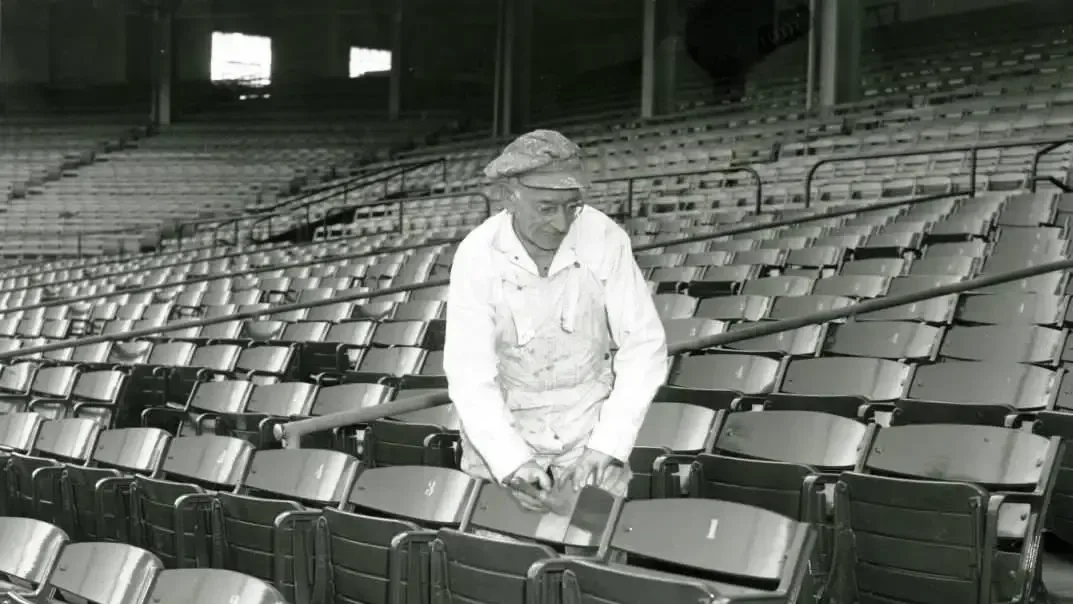
Photo matching is the most useful technique in this field. It means comparing the actual object—not merely its general style—with period photographs. Look at the silhouette of the arms, count back slats, study frame geometry, inspect number placement and compare the visible seating environment. A photo that only shows distant rows may not prove every construction detail, but a combination of images can narrow the possibilities substantially.
Before purchasing a claimed historic stadium seat, ask for clear, current photographs of the front, rear, underside, arms, supports, fasteners, seat number and any maker’s marks. Then work through a short evidence checklist:
- Identify the construction. Is the number of slats, shape of the arms and type of base consistent with the specific claimed model?
- Research the manufacturer. A correct maker can support an attribution, but it does not prove a unique venue unless the model was venue-specific.
- Examine paint layers carefully. Look for signs of repainting and for older color beneath later coats. Do not mistake aged paint for proof of origin.
- Request the ownership trail. Ask where the seller acquired it, whether it came from a documented stadium sale or transfer, and whether paperwork or period photos travel with the item.
- Compare against archival material. Books, magazines, historic newspapers and local archives may show seating in place and record removals, transfers or public sales.
- Separate facts from claims. “Removed from a fairgrounds grandstand” and “sat at Shibe Park” are different claims requiring different levels of proof.
- Factor condition into the offer. Original boards, paint integrity, sound metalwork and unaltered parts can matter as much as the model name.
Major auction houses may conduct research before cataloging stadium artifacts, but buyers should still read the language closely. “Attributed to,” “believed to be” and “from the collection of” are not interchangeable phrases. Private online sales demand even more independent scrutiny because the available evidence may be limited to the seller’s photos and account.
Historic stadium seating rewards collectors who enjoy both the object and the investigation. The most satisfying purchase is not necessarily the chair with the boldest provenance claim. It is the example whose design, materials, documented history and surviving visual record tell the same story—and whose remaining unknowns are stated plainly.