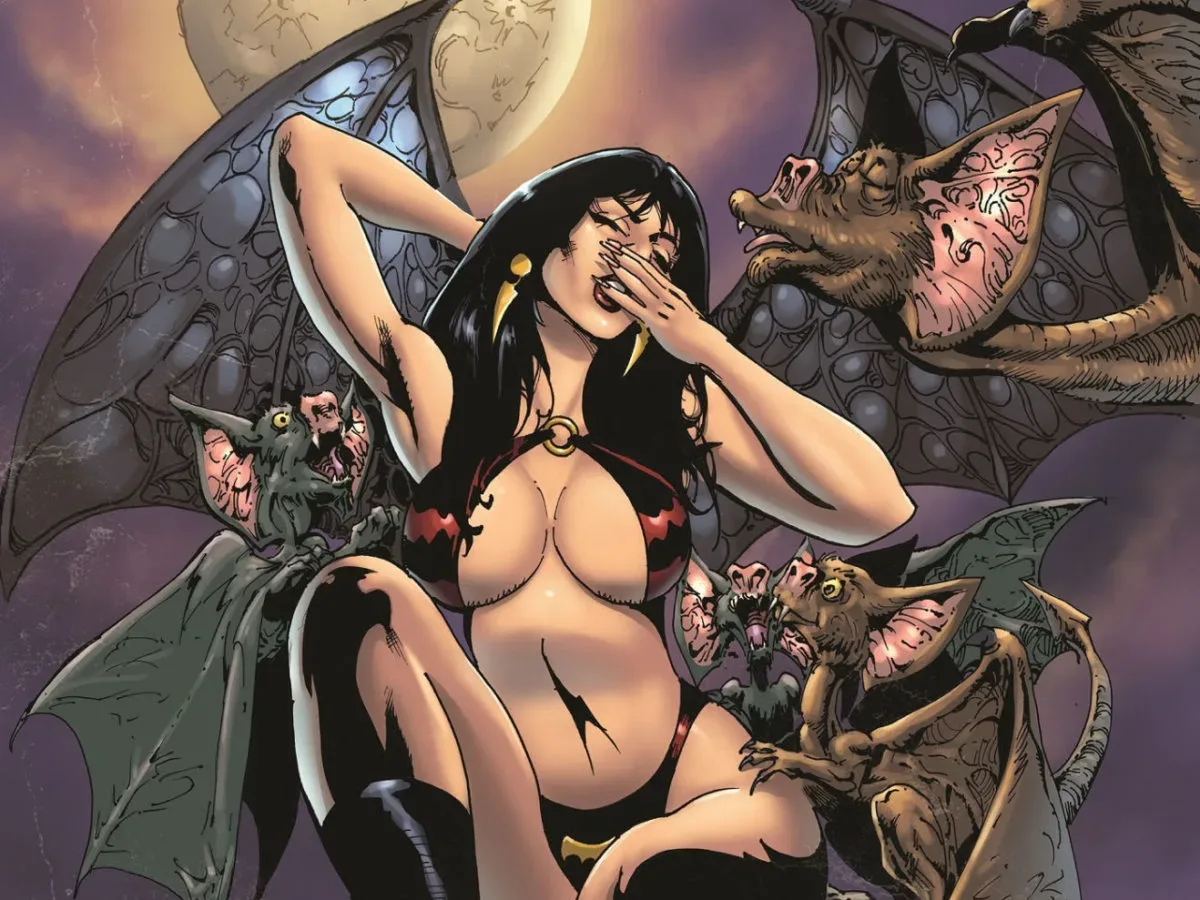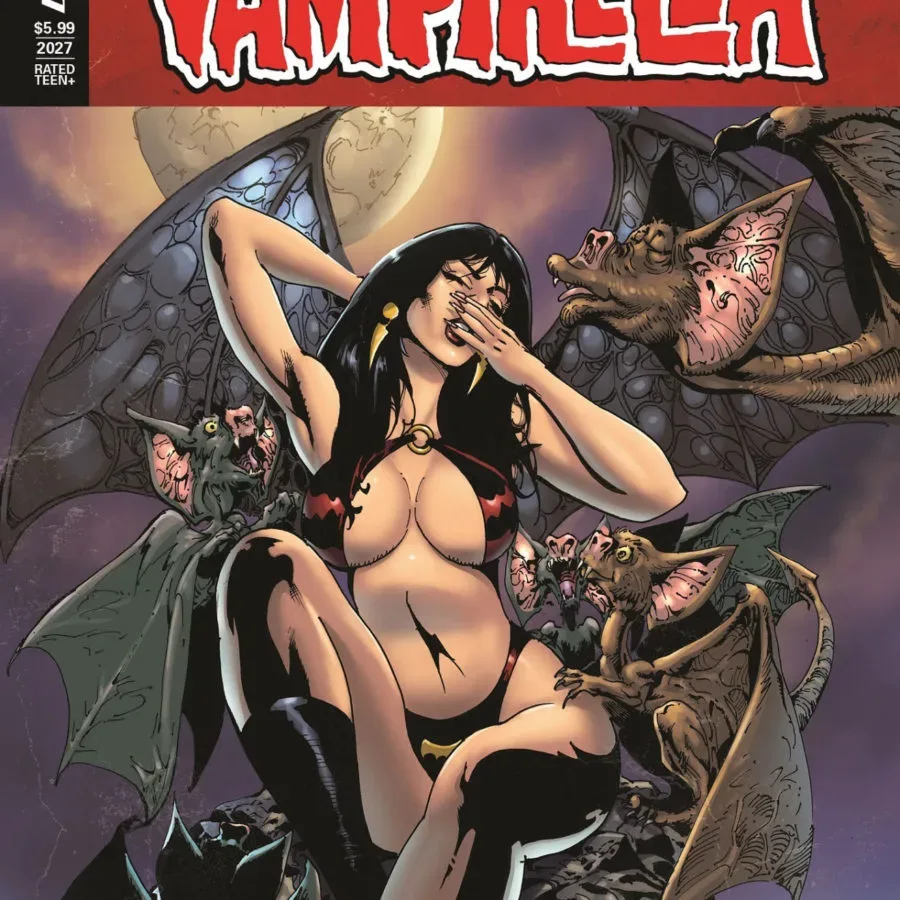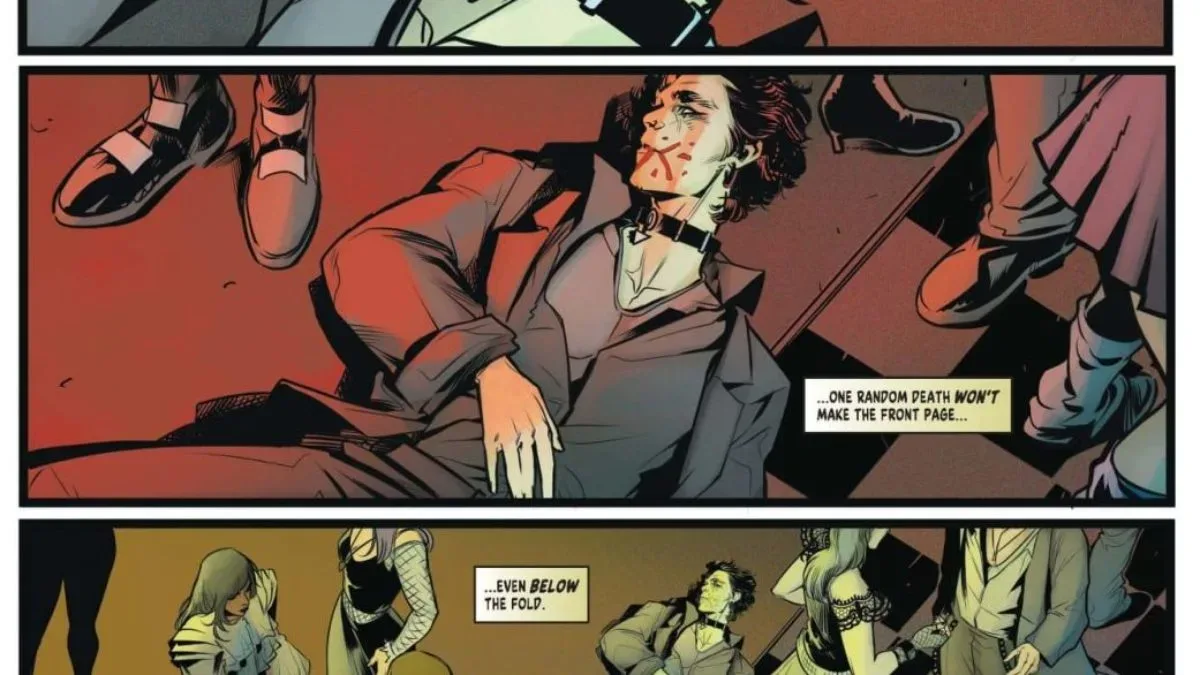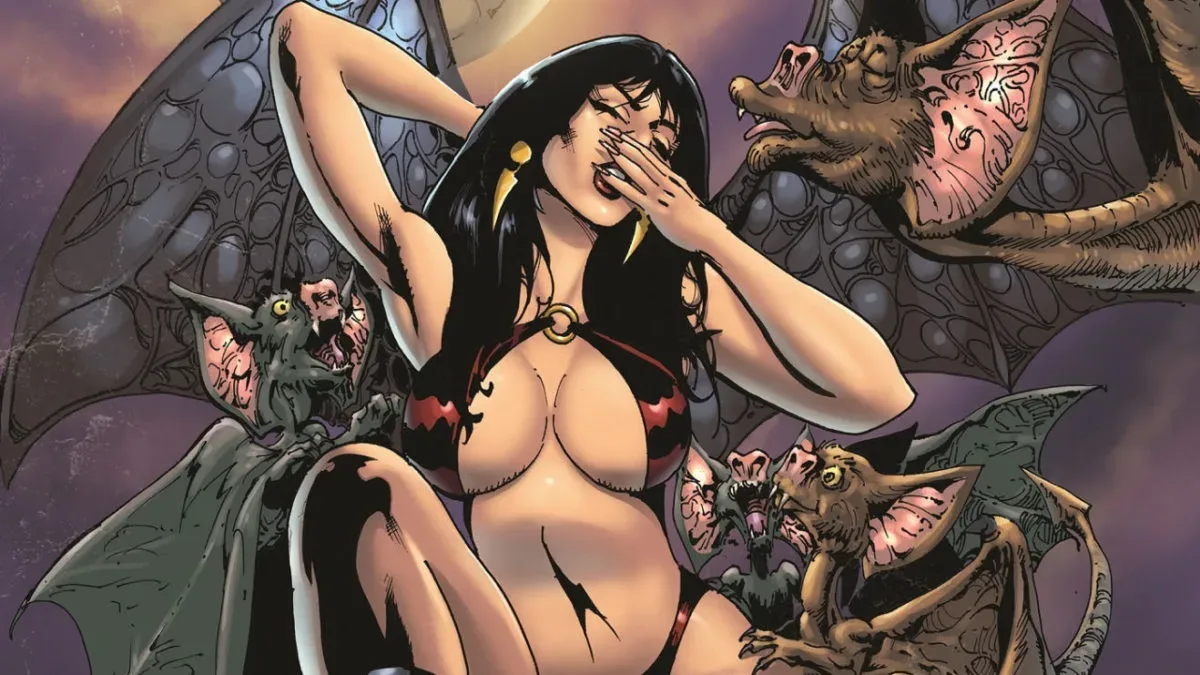
Dynamite Entertainment is preparing a new line of 80-Page Giant comic collections, beginning with Vampirella 80-Page Giant and Red Sonja 80-Page Giant. Each is planned as a $10, oversized anthology-style reprint package rather than a collection of one uninterrupted storyline.
That distinction is the heart of the format. These books are designed to place several eras, creative teams and story lengths between the same covers. For readers curious about either character but unwilling to commit to multiple trade paperbacks or a lengthy run, the Giants are meant to work as compact entry points. For established readers, their appeal is in the particular cross-section of material selected from each character’s publishing history.
The two inaugural volumes are expected in the new year. Both will have new covers by Roberto Castro, alongside retro-style editions that use inset panels from the stories collected inside.
What an 80-Page Giant means here
An anthology is a collection containing separate stories, often by different creative teams, instead of a single narrative broken into chapters. That makes these Giants fundamentally different from a conventional trade paperback, which commonly gathers consecutive issues in reading order to preserve one arc.
Dynamite’s approach is closer to a sampler. A reader can encounter a short standalone story, an annual installment and opening chapters from later runs in one volume. It is a useful structure for characters with long publication histories because it can demonstrate how tone, art and characterization shift from one period to another without claiming to be a complete chronology.
The “Giant” language is also a deliberate nod to oversized, value-oriented reprint comics. The premise is straightforward: place a substantial amount of previously published story material in a single inexpensive package. At $10, the announced books are positioned around accessibility and breadth rather than around a premium archival presentation or a line-wide reading order.
That does create a trade-off worth understanding. A collection built from disconnected selections can offer variety, but it will not necessarily provide the cleanest route through any one creator’s complete run. Readers who discover a favorite story in either Giant may still want to seek out the surrounding issues afterward. The format’s job is introduction and curation, not replacement for every existing collection.
Red Sonja’s Giant spans the Dynamite era
Red Sonja 80-Page Giant draws entirely from Dynamite-published material and includes four stories from 2008 through 2021. The selection brings together work from Christos Gage, Kurt Busiek, Ron Marz and Eric Trautmann, with art by Pablo Marcos, Benjamin Dewey, Lee Moder and Patrick Berkenkotter.
- “Dragons” from Red Sonja Annual #2 (2009), written by Christos Gage with art by Pablo Marcos.
- “Seeing Red” from Red Sonja: Black, White and Red #1 (2021), written by Kurt Busiek with art by Benjamin Dewey.
- A full-length story from Red Sonja #30 (2008), by Ron Marz and Lee Moder.
- A full-length story from Red Sonja #60 (2011), by Eric Trautmann and Patrick Berkenkotter.
The spread of dates matters. The annual, the main-series installments and the later Black, White and Red short are not being framed as consecutive chapters. Instead, they show the flexibility of Red Sonja as a continuing sword-and-sorcery lead across different projects and creative partnerships.
For a prospective reader, the annual and the two main-series selections offer a sample of material tied to the core Dynamite publishing line. The Black, White and Red contribution has a different practical role: it is a short-form piece, so it can give the book a quicker change of pace amid longer stories. That kind of sequencing is one advantage of anthology curation. A volume can include stories that would be difficult to combine in a traditional issue-by-issue collection.
It also means that buyers should approach the book as a set of individual encounters with the character. Someone looking specifically for the full Ron Marz or Eric Trautmann material will need more than this one volume. Someone who wants a varied Red Sonja reading session, however, gets several distinct creative viewpoints without having to start with four separate collections.
Vampirella reaches from 1971 to 2019
Vampirella 80-Page Giant takes the broader historical route. Its contents range from a 1971 story through the launch issues of series from 2014 and 2019. The lineup includes Archie Goodwin and José González, Alan Moore and Gary Frank, Nancy Collins and Patrick Berkenkotter, and Christopher Priest with Ergün Gündüz.
- “Death’s Dark Angel” from Vampirella #12 (1971), by Archie Goodwin and José González.
- “The New European” from the 1997 Vampirella/Dracula: The Centennial one-shot, by Alan Moore and Gary Frank.
- The first issue of the 2014 Vampirella series by Nancy Collins and Patrick Berkenkotter.
- The first issue of Christopher Priest’s 2019 Vampirella run, with art by Ergün Gündüz.
“Death’s Dark Angel” is especially significant within this lineup because it comes from an early point in Vampirella’s history and is identified as a defining story in the character’s move from horror-hostess framing to a protagonist-led role. In plain terms, that makes it more than an old issue included for the sake of age: it represents a formative step in establishing Vampirella as the central engine of her own stories.
The 1997 Moore and Frank story arrives from a one-shot created to mark the 100th anniversary of Bram Stoker’s Dracula. A one-shot is a self-contained comic released as a single issue rather than as part of an ongoing numbered series. Its inclusion gives the Giant a discrete piece between the early material and the modern-series launches.
Those 2014 and 2019 first issues serve a notably practical function. First issues are natural sampler material because they are built to establish a new status quo and invite readers onward. Including both does not promise that either run continues in the book, but it does let readers compare two separate modern starting points for the character.
As with the Red Sonja volume, this is not a comprehensive reading order. It is a curated route across eras. The value lies in seeing how multiple teams approached the same lead character over a long period, from Goodwin and González through Moore and Frank to Collins, Priest and their collaborators.
New covers, retro variants and a collector-friendly distinction
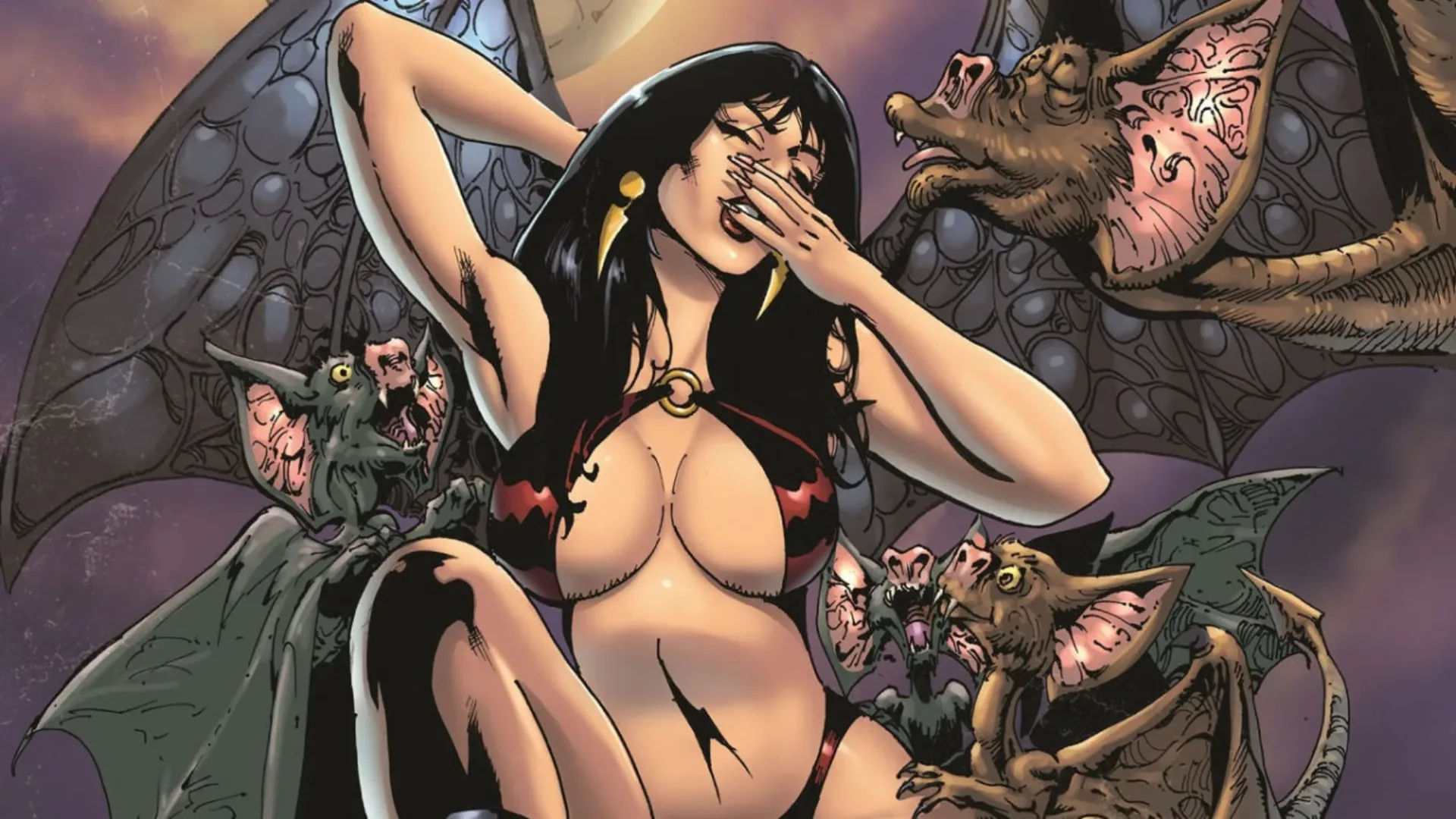
Roberto Castro is providing new covers for both releases. Dynamite will also offer retro treatments featuring inset imagery from the stories collected in each book. That creates two visual approaches for the same editorial concept: one newly commissioned cover image and one that foregrounds the reprinted interiors.
For comic buyers, it is useful to separate the physical-format appeal from the reading content. The retro editions may be visually attractive to fans who enjoy cover design that advertises the material within, while Castro’s new covers provide a distinct contemporary presentation. But the announced reason to pick up either Giant is the reading selection itself: each assembles work from multiple publishing periods in a low-cost package.
That emphasis on curated access is also relevant beyond these two characters. Publishers with deep libraries can use anthology reprints to highlight back-catalog material without waiting to assemble an entire run. Recent comics publishing remains full of ongoing-series developments, such as an upcoming Godzilla series finale and expanded lineup, but a reprint sampler addresses a different need: it gives older stories a new, approachable point of sale.
What the first two books suggest for the line
Dynamite has indicated that more 80-Page Giants are expected after these opening volumes. Vampirella and Red Sonja are positioned as the format’s initial flagship characters, and the publisher’s archive contains stories of varying lengths that can be shaped into future collections of this kind.
There is no confirmed list of later characters or volumes in the material currently available, so any expansion beyond these two books remains unspecified. Whether the line grows will depend on how the initial releases perform after reaching stores.
For now, the pitch is clear. Red Sonja 80-Page Giant offers a Dynamite-era mix built from annual, ongoing and anthology material. Vampirella 80-Page Giant ranges from a 1971 turning point through a Dracula-related 1997 one-shot and first issues from two modern runs. Neither volume is intended as the complete story of its heroine. Each is a deliberately selective, affordable introduction to several versions of her.