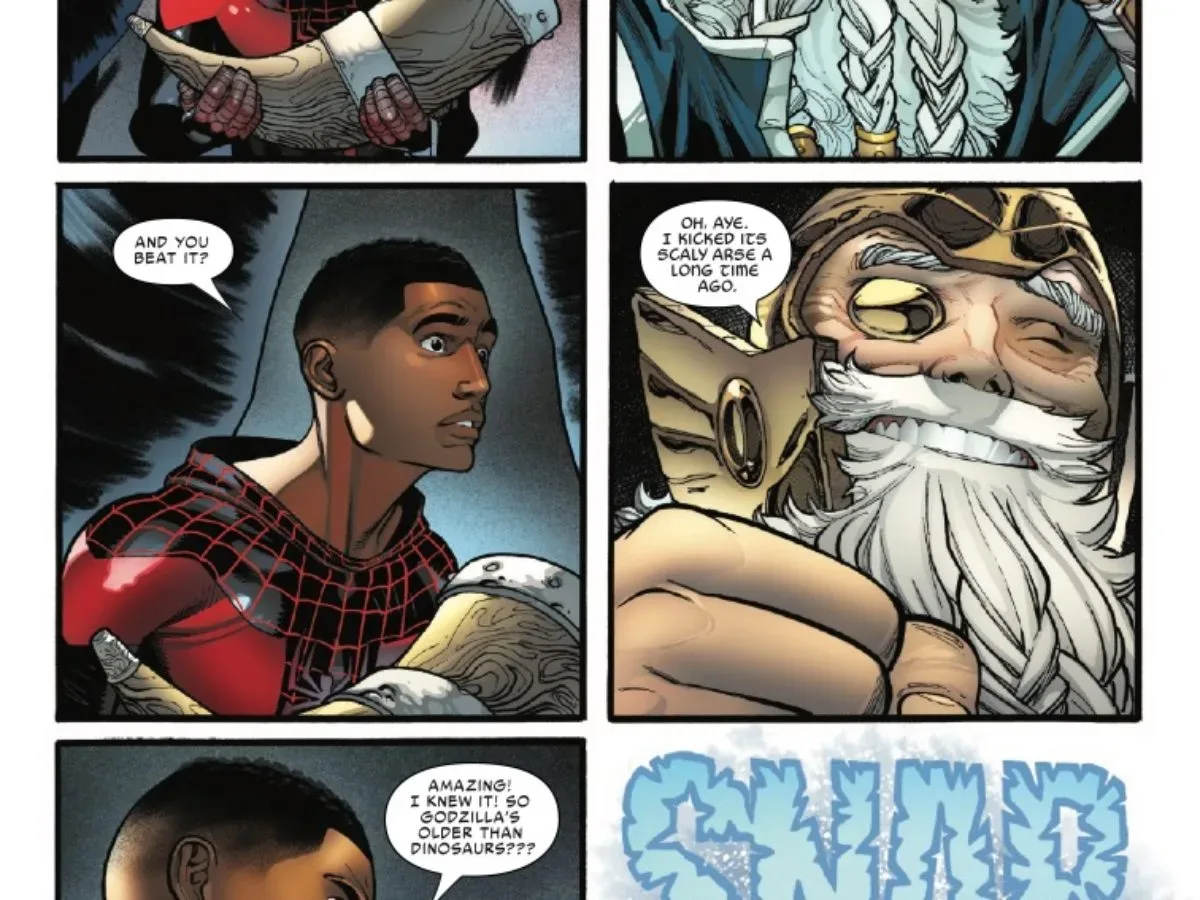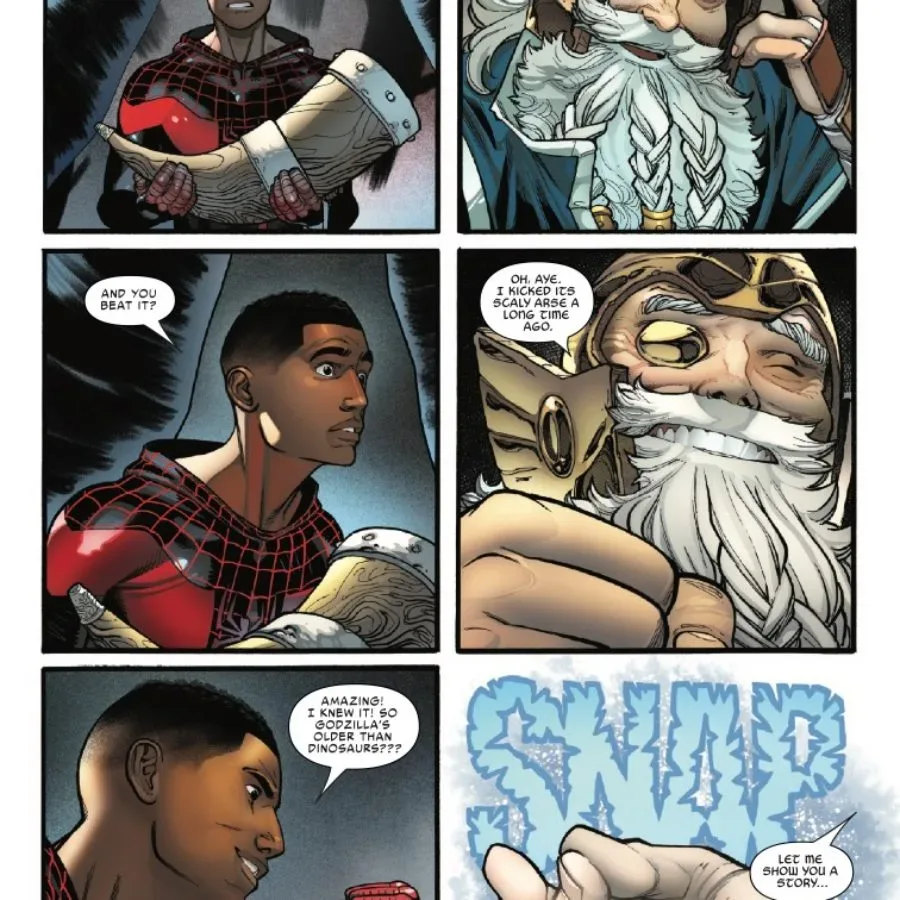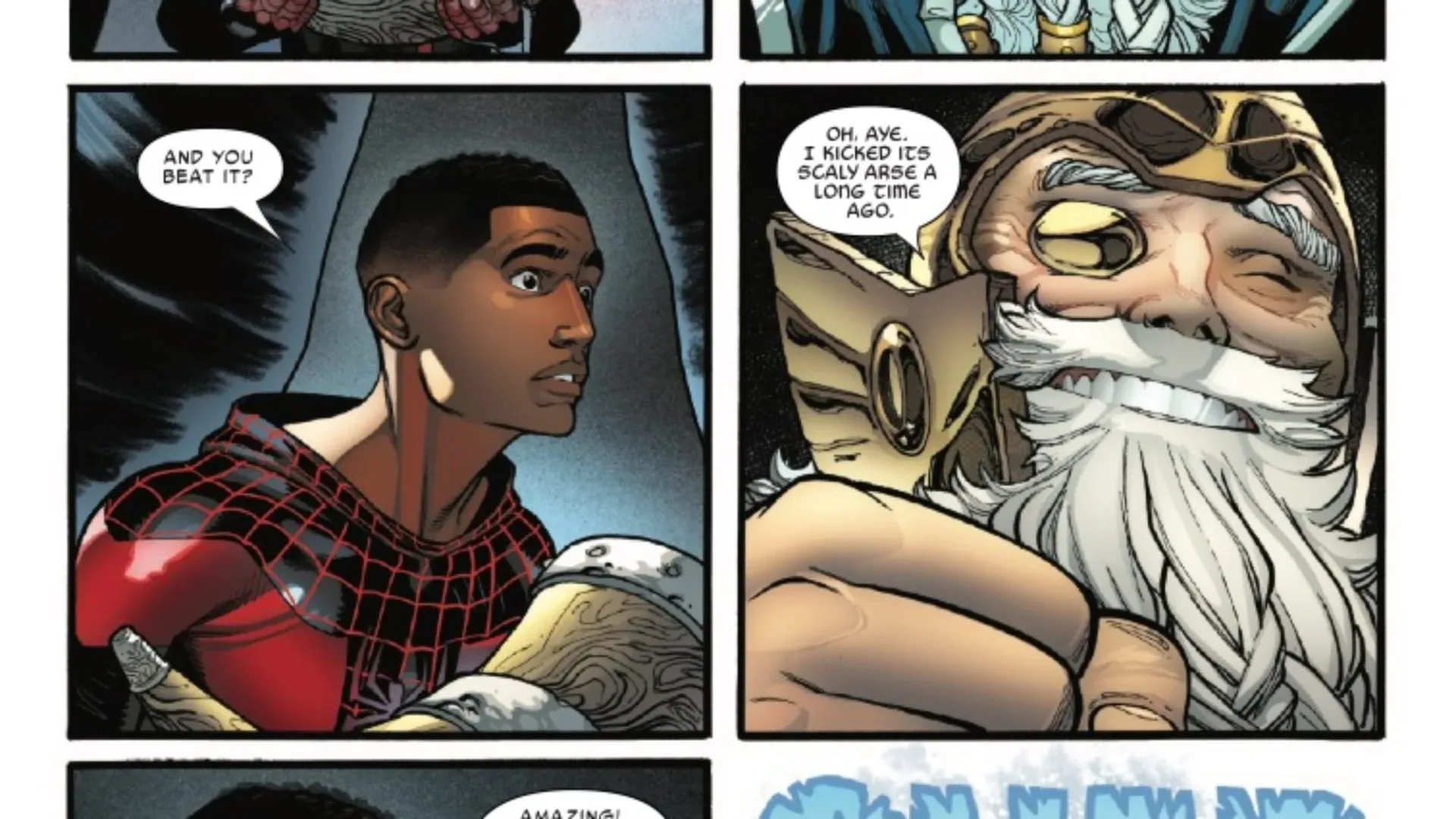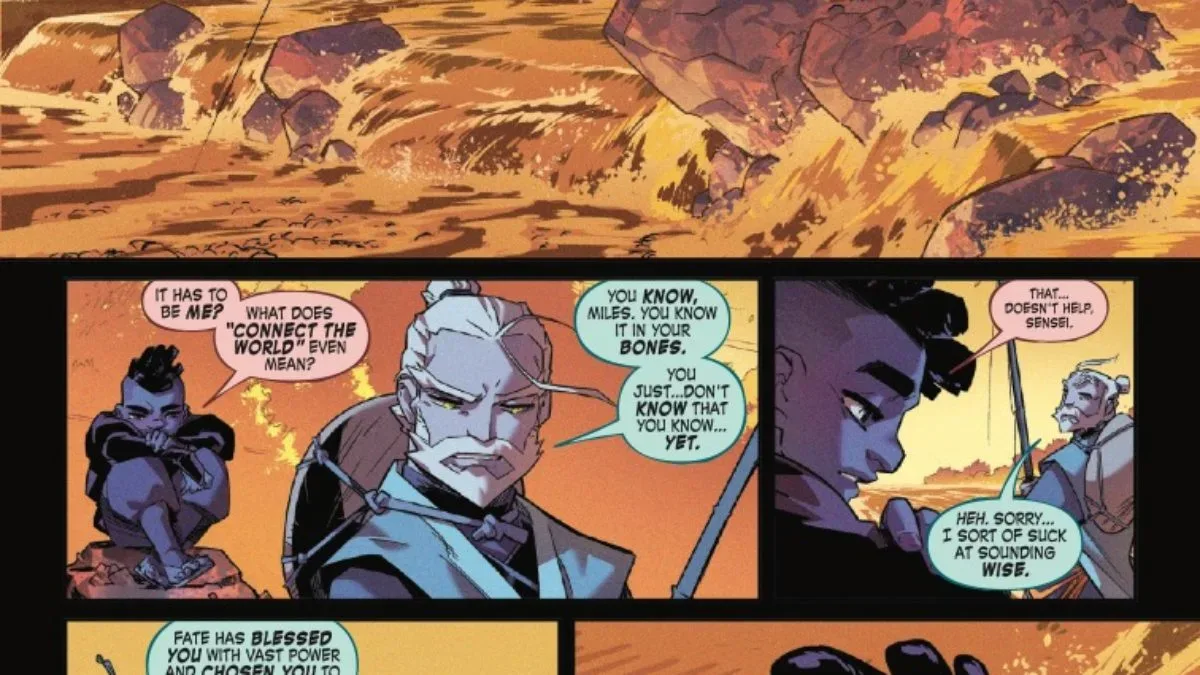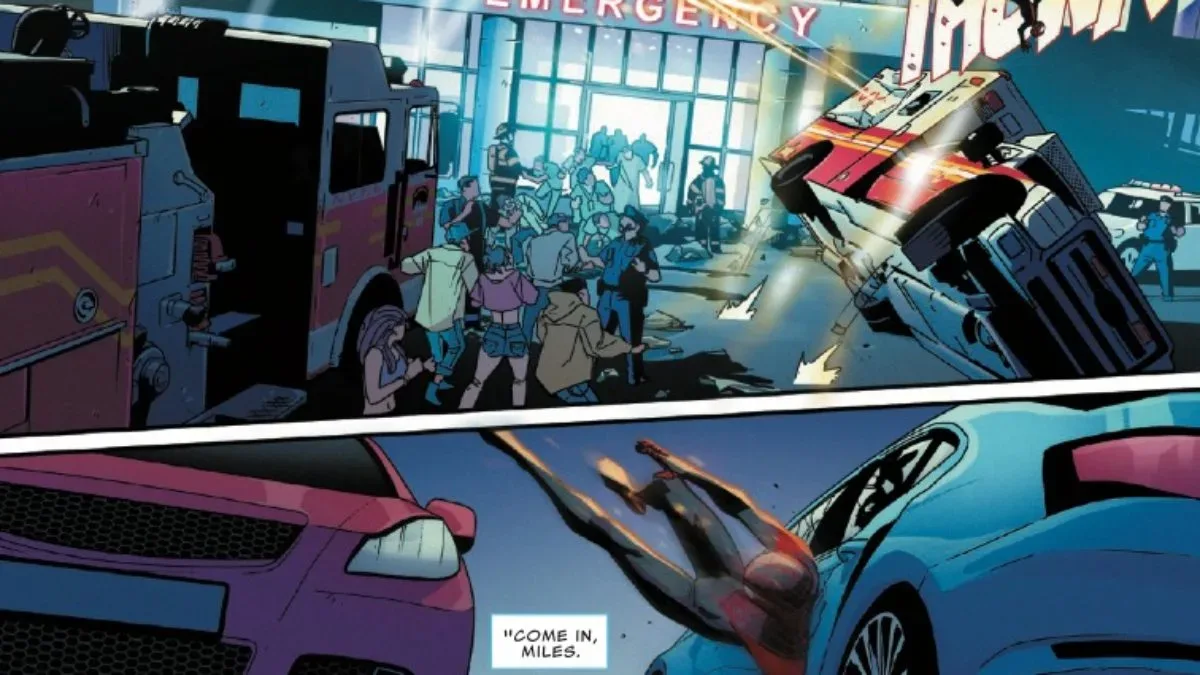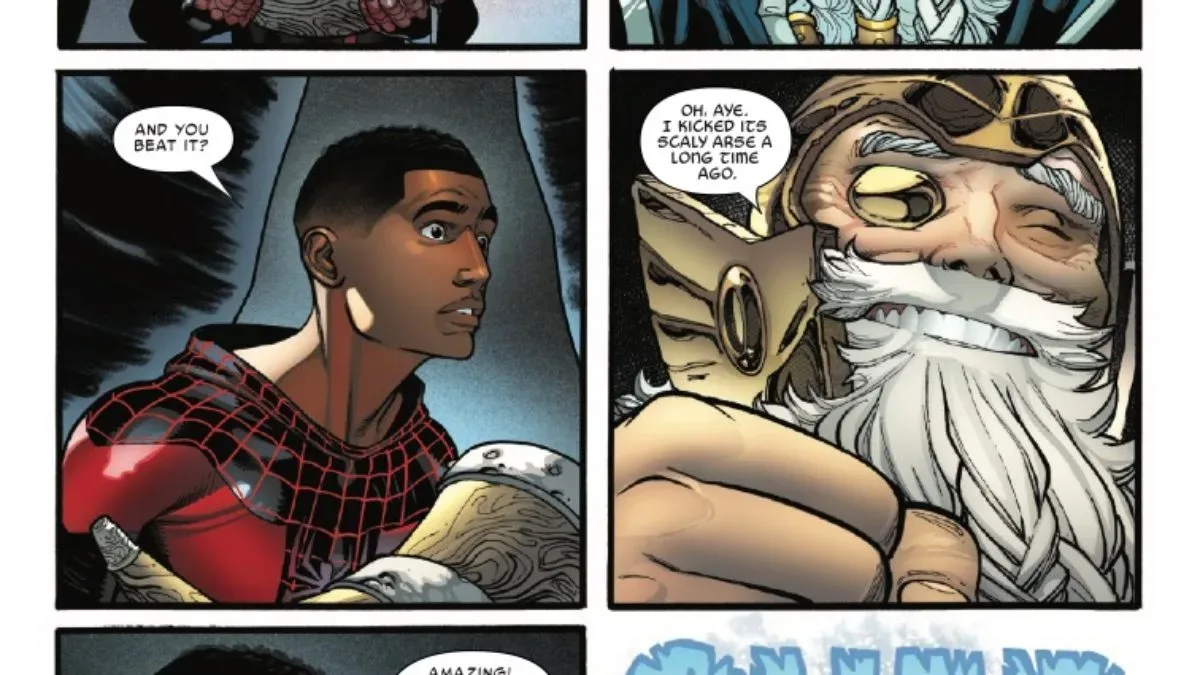
Godzilla Conquers the Multiverse #3 is set to arrive on September 30, 2026, bringing Miles Morales into a desperate search for perspective at a time when Marvel’s reality is already coming apart. Doctor Doom is dead, the Multiverse is broken, and Godzilla is described as unstoppable. Rather than finding another conventional superhero response to a giant-monster crisis, Miles turns to Odin.
That setup makes the third issue sound less like a simple escalation of superhero-versus-kaiju action and more like a story about what happens after the obvious answers have failed. Miles, a hero generally associated with improvisation and responsibility, is seeking out the All-Father’s experience. Odin, meanwhile, has apparently faced Godzilla before—and has a very old war story ready.
An ancient Godzilla encounter becomes the key thread
The preview material places part of Odin’s account one million years in the past on Earth-72630. It frames the sequence with an unusual image: Odin at a campfire, roasting kaiju meat and recounting his encounter with Godzilla. The scene’s rough, storybook quality is important. This is not merely a briefing between allies; it is an elder figure explaining an ancient disaster to someone dealing with a new version of that same impossible problem.
Odin claims that he once defeated Godzilla in a particularly direct fashion, though the larger preview imagery suggests the old battle was anything but small-scale. Godzilla is shown amid a fiery confrontation involving the Midgard Serpent and Surtr. That is a significant blend of Marvel concepts: the Midgard Serpent is a mythic-scale serpent tied to Asgardian stories, while Surtr is a fire-associated adversary. Putting Godzilla into that visual space reinforces the series’ central premise that the kaiju is not confined to one genre, scale, or corner of continuity.
The location label, Earth-72630, is also worth clarifying. In Marvel terminology, an “Earth” designation identifies a particular version of reality within the Multiverse. The label does not automatically explain how every event connects, but it signals that Odin’s tale belongs to a distinct reality framework rather than functioning only as an ordinary historical flashback.
Why Miles and Odin are an intriguing pairing
There is a productive contrast in placing Miles Morales and Odin together. Miles is Spider-Man, a modern street-level hero whose defining challenges often hinge on quick thinking, personal stakes, and doing the right thing with limited resources. Odin is an ancient ruler and god associated with the enormous mythological scale of Asgard. Godzilla provides the bridge between them: a force so overwhelming that it pushes a young hero toward someone whose experience is measured in eras rather than missions.
The official setup poses a blunt question: can Odin’s wisdom alter a war that has already been lost? That wording leaves room for a story in which information alone is not enough. Odin may know how he survived—or defeated—Godzilla in the past, but the broken state of the Multiverse and the death of Doctor Doom could mean the circumstances are radically different now.
That uncertainty is more compelling than treating the flashback as a guaranteed instruction manual. A tale of an old victory can offer strategy, warning, context, or even a reminder that legends tend to simplify the chaos of survival. The issue’s premise seems built around the possibility that experience matters, while also asking whether experience can be repeated when reality itself is unstable.
A very crowded multiversal conflict
Miles and Odin are not the only figures named for the issue. The solicit also lists the Punisher, Mothra, Knull, Kang, Emma Frost, Doctor Strange, and Man-Thing. That lineup spans radically different parts of Marvel storytelling: cosmic threats, time-oriented conflict, telepathy, magic, horror-inflected swamp mythology, and a vigilante defined by lethal pragmatism. Mothra’s inclusion adds another iconic kaiju presence beside Godzilla.
Such a broad roster does not reveal exactly how much page time each character will receive, or whether all of them share the same setting and moment in the plot. But it does establish the intended scale. This is an event-style collision, in which Godzilla is large enough as a narrative problem to draw in characters from numerous corners of Marvel’s fictional universe.
Doctor Strange’s presence is especially logical within the stated premise, since a broken Multiverse implies a problem that may be supernatural or reality-spanning as much as physical. Kang’s name introduces the possibility of time-related complications, although no specific role is detailed. Emma Frost, Knull, Man-Thing, the Punisher, and Mothra each bring very different tones and capabilities. The appeal lies partly in watching a premise deliberately disregard normal boundaries: a giant monster story can coexist with Asgardian legend, superhero drama, cosmic villainy, and horror imagery.
What “kaiju” means in this story
Kaiju is a Japanese term commonly used in popular culture for giant monsters. In practice, a kaiju story often makes scale its central dramatic tool: buildings, armies, ecosystems, famous heroes, and even political or cosmic power structures are forced to respond to something physically and symbolically bigger than them.
Godzilla is particularly effective in a crossover setting because the character changes the terms of any encounter. A fight cannot be approached as a standard duel. Whether the response is military force, magic, time manipulation, divine power, or a team of heroes, the question becomes whether those tools actually matter against an adversary portrayed as unstoppable.
In this case, the monster’s threat is tied directly to the Multiverse. That gives the series permission to use locations and characters that would ordinarily be far apart, while allowing the fight to function as more than a city-level emergency. If reality is already broken, Godzilla is not simply attacking a setting; Godzilla becomes one more overwhelming pressure on a system that has lost its stability.
Creative team, format and covers
Godzilla Conquers the Multiverse #3 is written by Gerry Duggan and drawn by Javier Garron, with a main cover by David Marquez. The issue is listed at 32 pages, rated T, and priced at $4.99 in the United States and $6.25 in Canada.
Three variant editions are also listed: a Cory Smith variant, a Mark Bagley Heisei vs. Marvel variant, and a Scott Hepburn variant. “Variant” here means an alternate cover edition of the same issue, rather than a separate installment of the story. For readers primarily following the narrative, the main distinction is the cover artwork. For those choosing between editions, the credited artists and the Heisei-versus-Marvel theme provide the available guideposts.
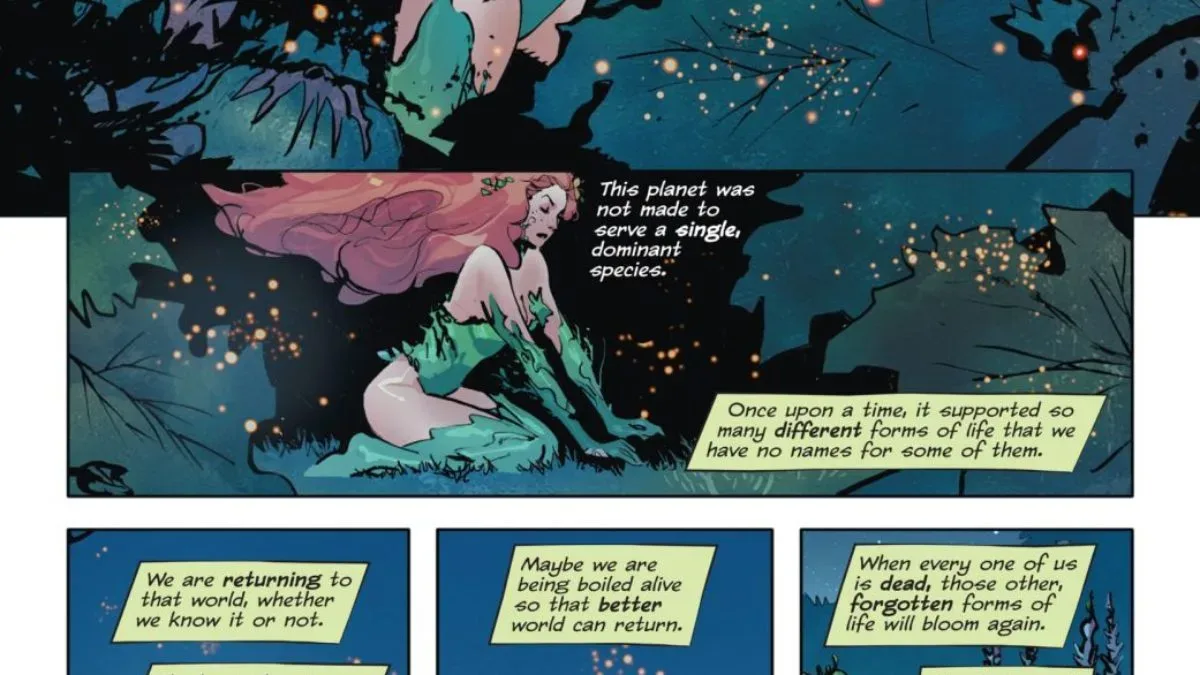
Godzilla’s presence makes cover choice a natural part of the release’s appeal, particularly when the story itself is built around the collision of recognizable worlds. Readers looking for more comic-book preview coverage can also browse this look at Poison Ivy #48.
What to watch for in issue #3
- Odin’s full account: The issue appears positioned to reveal what Odin learned from his earlier conflict with Godzilla—and whether that knowledge has practical value in the present.
- The status of the Multiverse: Doctor Doom’s death and a broken reality are the story’s stated backdrop, not just incidental event language.
- The role of mythic threats: Images involving Surtr and the Midgard Serpent suggest that the flashback will measure Godzilla against the largest dangers in the Asgardian corner of Marvel.
- The function of the ensemble: With characters such as Doctor Strange, Kang, Mothra, Emma Frost, Knull, Man-Thing, and the Punisher listed, the issue may clarify how its many players fit around the central Miles-and-Odin thread.
The central hook remains refreshingly simple despite all the multiversal terminology: Miles needs a way to confront Godzilla, and Odin says he has done it before. Whether that ancient story becomes a path to victory, a warning about the limits of power, or proof that this Godzilla crisis is unlike the one Odin remembers is the question carrying the issue into its September 30 release.