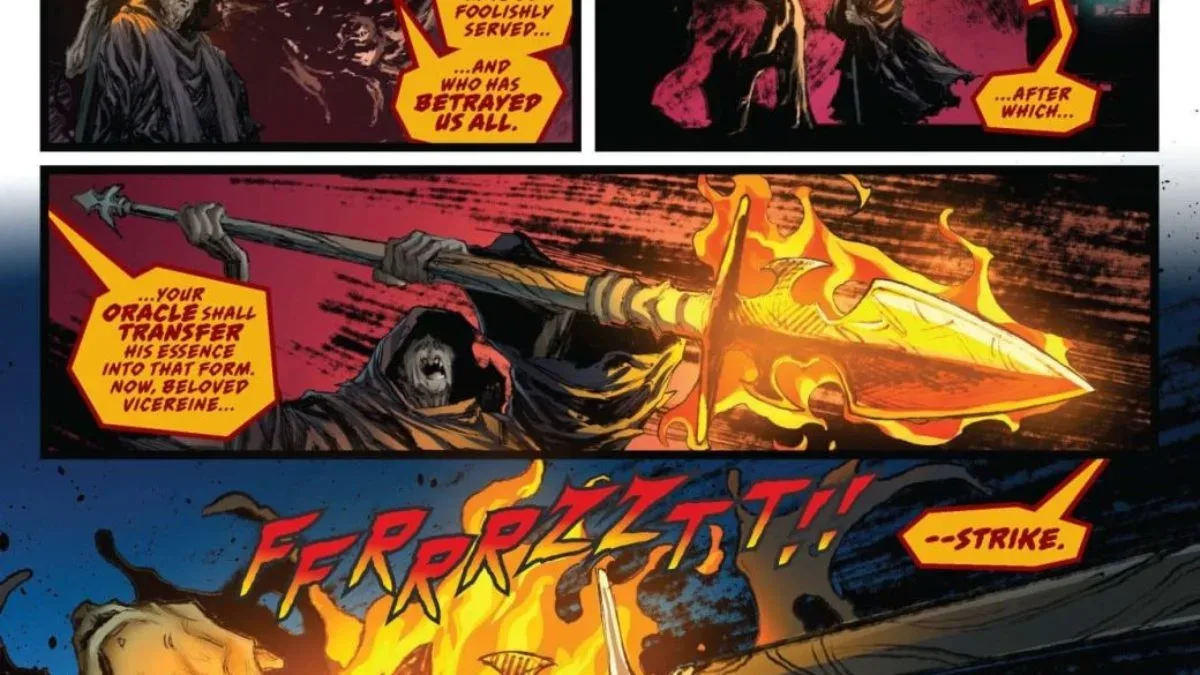
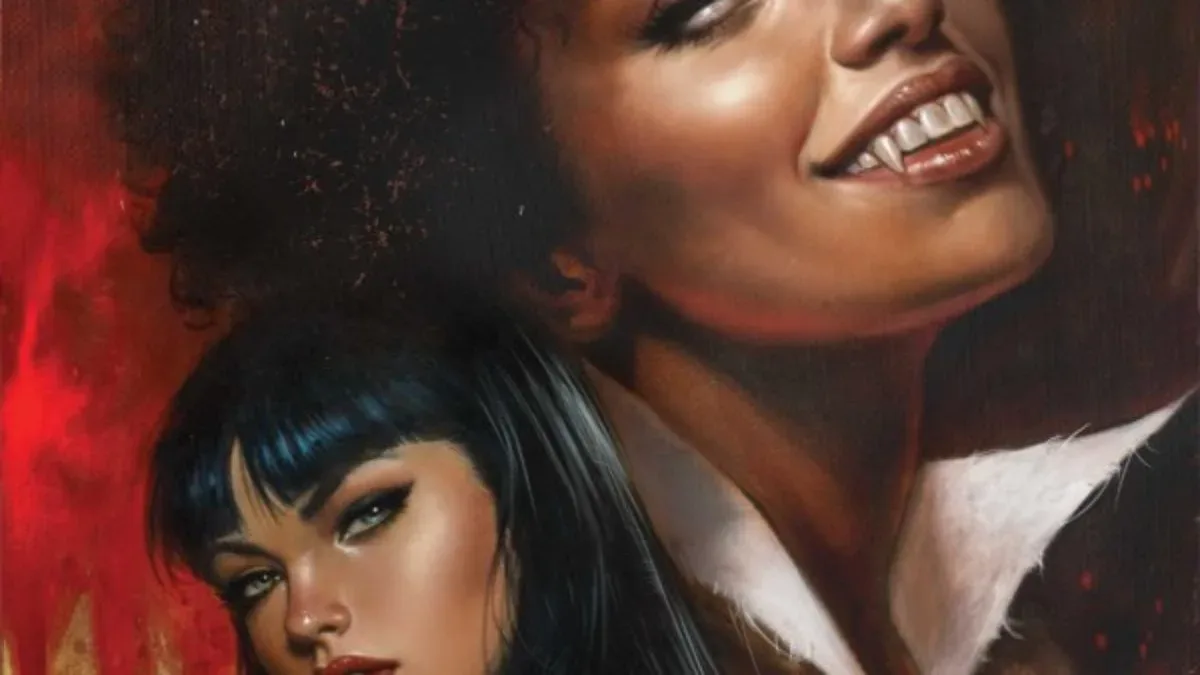
Christopher Priest believes his work on Vampirella deserves a larger audience. The writer, whose bibliography includes Black Panther, Quantum and Woody, Green Lantern, Spider-Man vs. Wolverine, and Deathstroke, has called the Dynamite series some of the best writing of his career. His blunt assessment is also an unusually useful invitation for readers who have never known where a vampire heroine with decades of history fits into their comics reading.
There is an accessible on-ramp in place: a free online Vampirella sampler, known as the “Vampler,” designed to explain the character, the premise, and the key supporting cast. Then comes Vampirella #8, also legacy-numbered #695, a deliberately separate, manga-inspired issue that Priest says requires no prior knowledge of the regular continuity.
That makes the approaching run to issue #700 less daunting than its numbering might imply. Rather than asking newcomers to absorb nearly seven hundred issues of backstory, the current plan provides two distinct entry points: a primer for readers who want the modern setup, and a self-contained experiment for readers who simply want to see what Priest and newcomer artist Ziyan Qiu do with the character outside the usual framework.
Why Priest sees Vampirella as a flagship
Priest has characterized Vampirella as Dynamite’s equivalent of a signature flagship superhero book, even while acknowledging that it may not receive the automatic attention attached to stories featuring the most recognizable Marvel or DC names. His point is not that the character lacks stature within her publisher’s line; it is that reader habits can make a long-running, publisher-specific character feel less familiar to people accustomed to the major shared universes.
That barrier matters because Vampirella brings several expectations with it at once. A prospective reader may see horror, pin-up-oriented cover imagery, supernatural action, continuity, or a legacy character and assume the book is aimed at someone else. Priest has said he understands that hesitation. Before taking on the series, he was familiar with the character and had worked with her in the past, but he did not consider himself deeply invested in Vampirella.
The Vampler is therefore more than a promotional giveaway. It is a practical response to an onboarding problem. In comics, an onboarding point is an issue, recap, or standalone story that lets a reader begin without feeling punished for missing prior chapters. The sampler’s job is to supply context efficiently: who Vampirella is, who is around her, and what kind of story space the book occupies. It is meant to replace the vague fear that a reader will need a spreadsheet, a stack of back issues, and an emergency degree in vampire diplomacy before page one.
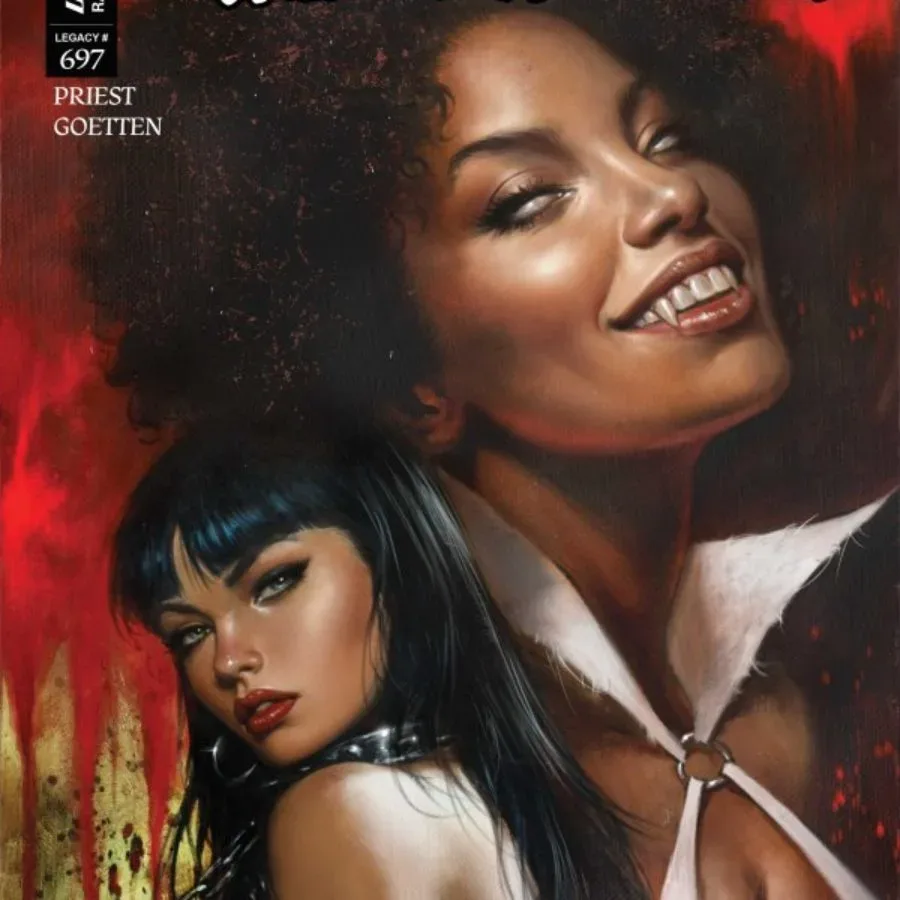
Priest’s confidence also arrives at a moment when the title is balancing an established storyline with a milestone. Issue #7, legacy-numbered #694, was published last month. The issues that follow carry both regular and legacy numbering: #8 is #695, #9 is #696, and #10 is #697. The count continues toward Vampirella #700, a landmark issue the creative team is preparing for on a separate production track.
Vampirella #8 is built to stand apart
Vampirella #8 is scheduled for November 25, 2026, at $4.99. Written by Priest and drawn by Ziyan Qiu, it is a departure from the title’s normal continuity, meaning its events are not presented as a direct next chapter in the ongoing storyline. That distinction is important: this is not merely a detour with a different artist. It is a different interpretation of the character, set in another world where recognizable figures are assigned different roles.
The setup places Vampirella in a world of her own creation after the effects of prescription medication from her therapist. That world combines ancient tradition with political futurism. When the benevolent king of the mystical realm Escala is killed, Vampirella must answer to wüde, described in the solicitation as “Martial Virtue”: ethical boundaries centered on respect, benevolence, and humility. Her obligation is not simply to locate a culprit. She must take responsibility for the murder even if that pursuit leads her to the man she loves.
That premise gives the special issue a clearly defined moral axis. Wüde, as used here, frames violence and duty through conduct rather than brute victory. For a vampire adventure, it is a useful counterweight: the core conflict is not only whether Vampirella can win a fight, but what accountability demands of her and how she chooses to exercise power.
Priest has described the cast as recognizable but reconfigured. Readers familiar with the ongoing book may spot connections, while new readers can treat the parts as belonging to this separate reality. That is a smart use of an alternate setting. It preserves an extra layer for regular followers without turning recognition into a gatekeeping test. Nobody needs to identify Benny the witch before opening the book; the issue is intended to establish its own terms.
A comic designed to be read the other way around
The special will use a manga-style reading direction: back to front, with panels progressing from right to left. Qiu’s interior art will be black and white with color accents. That choice changes the physical act of reading, not just the visual surface. A reader who habitually scans left to right may need a moment to adjust, because panel order is part of comics storytelling. It controls when information lands, where the eye moves, and the rhythm of reveals.
Priest has been candid that he does not describe himself as a manga writer; he cites an affection for Lone Wolf and Cub as part of the creative impulse. The distinction is welcome. Calling an issue manga-inspired should not erase the particular traditions, formats, and creators that make up manga. Here, the supported details are specific: a right-to-left presentation, black-and-white artwork with color accents, and a self-contained fantasy setting filtered through Priest’s version of Vampirella.
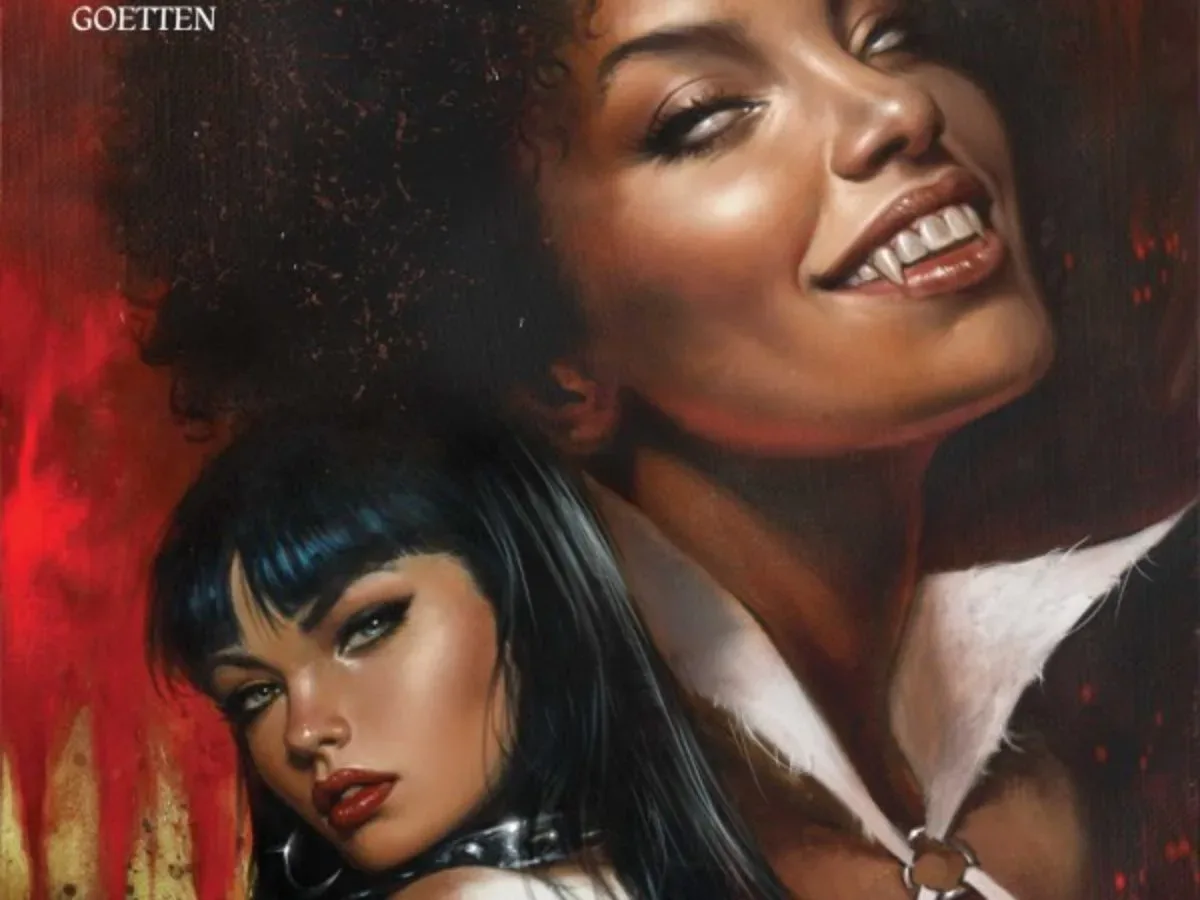
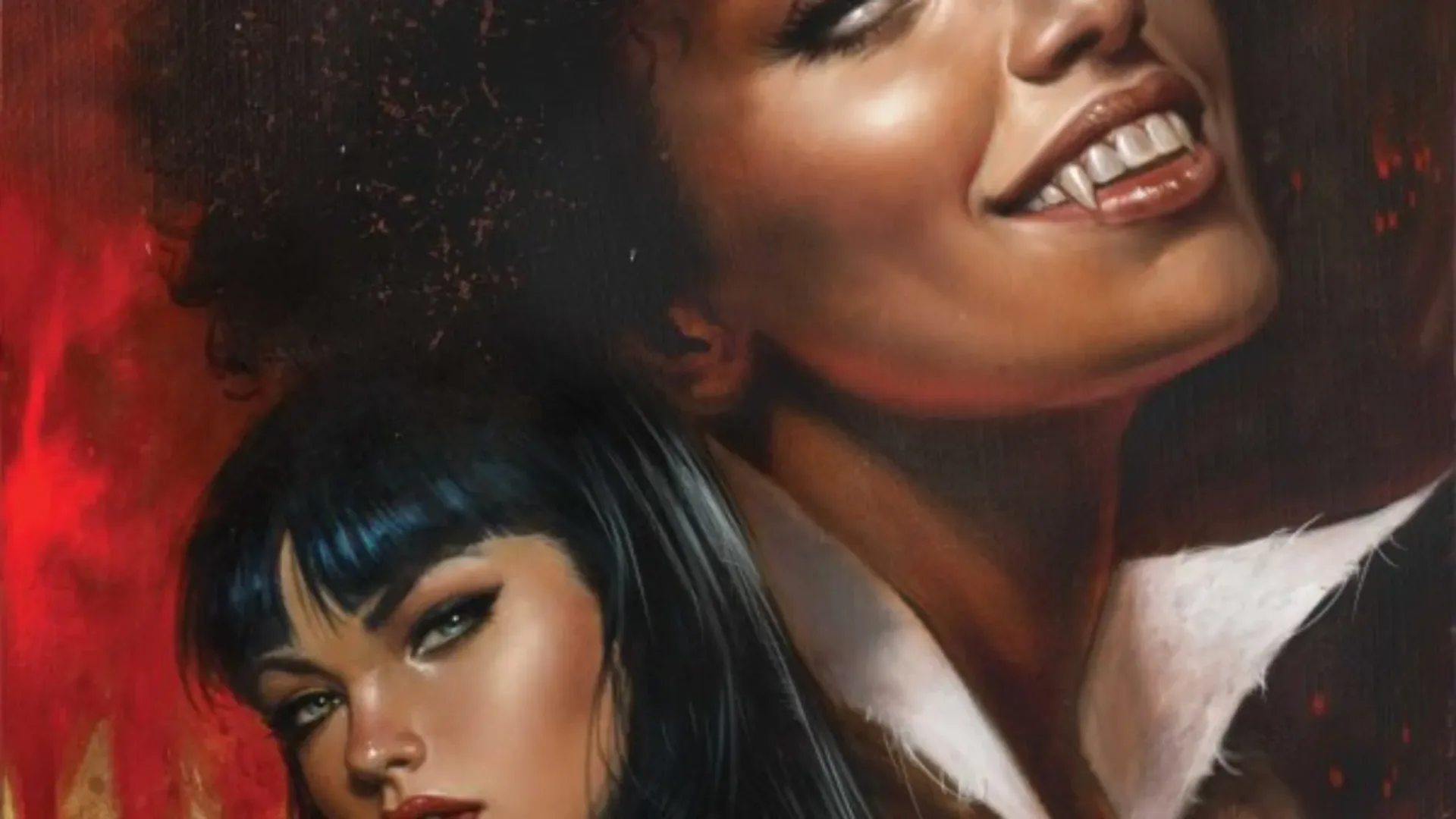
The issue has a Lucio Parrillo cover, alongside additional cover contributions credited to Derrick Chew, Joseph Michael Linsner, Elias Chatzoudis, Rachel Hollon and Dilemmatown for cosplay, and a special back-cover piece by Nishi Lee. Because of the reversed reading format, Priest has suggested retailers display at least one copy flipped so Lee’s back-cover art is oriented correctly. It is a small but sensible retail detail for a comic whose format intentionally challenges the conventional American pamphlet-comic direction.
The unusual production puzzle before issue #700
The road to #700 involves a less visible challenge: making two separately produced stretches of a story connect cleanly. Regular artist Ergün Gündüz has been moved ahead to work on the milestone material, including #700 and #701, and Priest said Gündüz was also working on #703 or #704. Davis Goetten is drawing the issues that lead up to #700.
For a serialized comic, that means the writer is working out of sequence. Priest must write an arc that happens before #700 and another that occurs afterward, while ensuring the earlier material flows into the milestone chapter without contradictions in plot, character locations, knowledge, or emotional state. He likened the task to driving a golden spike between the two storylines: the transition has to be secure enough that the audience experiences one continuous narrative rather than two trains that have politely agreed to stop just short of each other.
It also explains the timing of #8. Rather than using a conventional fill-in issue during a scheduling squeeze, the team chose to make a special that abandons regular continuity altogether. A fill-in issue usually refers to an installment created to maintain a release schedule while a regular team needs more time. Those comics can be enjoyable, but their role is often conspicuous. By contrast, #8 makes its separation central to the concept. Its altered setting, art approach, reading direction, and narrative independence make it an event in its own right, not an apology printed between chapters.
That strategy may prove friendlier to both audiences. Continuing readers receive a stylistically distinct side journey rather than a partial interruption of the Acampis storyline. New readers get an issue that does not make them immediately decode a long-running cast. Meanwhile, Gündüz has space to develop the milestone work and Goetten can carry the main run toward the handoff.
What follows after the special issue
Vampirella #9 (#696), due December 23, 2026 for $4.99, returns Priest and Goetten to the ongoing narrative. The solicitation centers on Acampis, a vampiric monolith pursuing revenge against Dracula over the death of Acampis’ family. Acampis targets Victory, Dracula’s protégé, leaving Vampirella caught in a conflict that could condemn her frenemy to eternal enslavement among the undead.
Issue #10 (#697) follows on January 20, 2027, also priced at $4.99 and drawn by Goetten. The countdown toward #700 continues as Acampis, described as a composite creature who has stolen the power of the interdimensional demon Belial, becomes a growing danger. Vampirella must seek an old friend who has ensorcelled her mother while concealing a serious secret from Katie, the young vampirette. The solicitation emphasizes broken trust and its consequences, which suggests that the personal relationships around Vampirella remain as consequential as the supernatural threat.
Those details make the current reading options straightforward. Readers interested in the main plot should use the free Vampler to get oriented, then follow the numbered run into #9 and #10. Readers curious about Priest’s voice but unwilling to commit to an ongoing supernatural continuity can begin with #8. And readers who want the widest possible sense of how comics writers navigate major characters across publishers may also find related perspective in this look at the cultural reach and professional weight of a Marvel role.
Priest has additionally confirmed that a Sonja Reborn sequel is in development for next year. He is also developing a series for DC and has a project called Babylon at Humanoids, though details on the latter remain under wraps. For now, though, his immediate challenge is unusually concrete: make the road into #700 work while using a continuity-free manga-format issue to welcome people who have never read Vampirella at all.