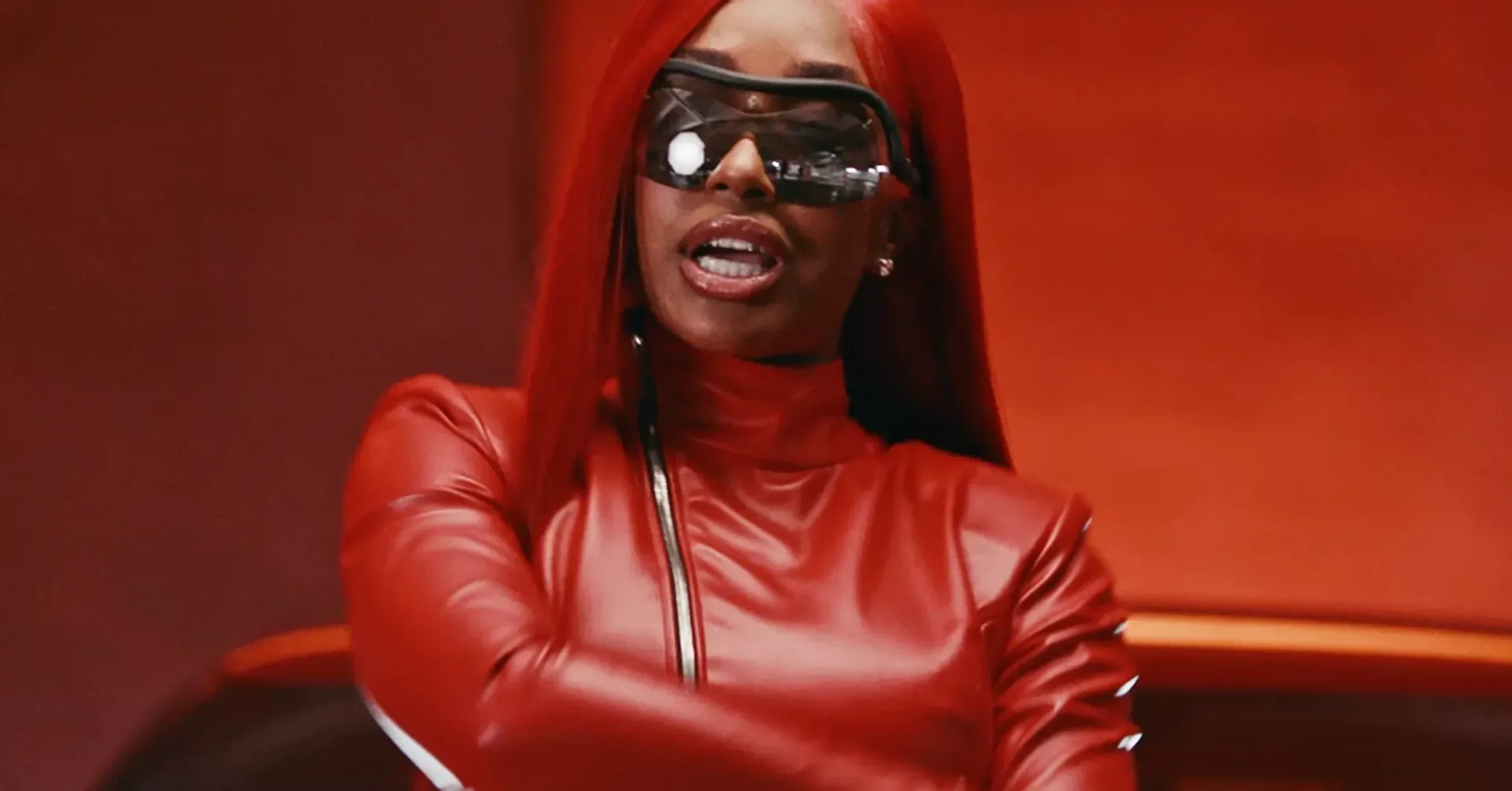

Yung Miami has offered a concise answer to renewed public questions about her personal life: she is focusing on herself.
During the November 4 episode of The Jason Lee Show, the Miami rapper was asked about her relationship status and the ongoing criticism connected to her former relationship with Sean “Diddy” Combs. The exchange arrives after an extended period in which the artist has discussed the personal and professional fallout of standing by her own account of that relationship while public debate around Combs intensified.
Her position does not resolve the criticism surrounding her past support, nor does it attempt to relitigate it. Instead, it draws a boundary between a finished relationship and the life she says she is trying to build now. The relationship ended in 2023, but attention around it continued through Combs’ federal case and through Yung Miami’s request for leniency before his sentencing.
A personal boundary, not a rewrite of events
The core distinction in Yung Miami’s recent comments is important. She has said she can speak to what she knew and experienced personally, rather than claim that her experience establishes what others experienced. That is a narrower statement than a defense of every allegation, every public interpretation, or every part of the legal proceedings.
In a March interview, she described a steep cost for maintaining that perspective: “I lost deals. I lost money. I lost relationships. I lost a lot.” She also said, “I can only judge a person off of what I know and what I experience.”
Those remarks explain why a simple declaration of self-focus carries more weight than a standard celebrity answer about moving on. Yung Miami has tied the scrutiny to tangible consequences: damaged business opportunities, lost income and a smaller circle of trust. She also said that she tries to trust God and her children, framing family and faith as the center of a more guarded outlook.
That does not erase the public disagreement over her choices. Critics have argued that her support matters differently because she has a high-profile platform. At the same time, Yung Miami has not presented her own relationship as a universal answer to questions involving other people. The gap between those two positions is where much of the continuing debate sits: a person’s account of their own life can be genuine while still not settling the broader concerns raised by others.
The legal case remains separate
It is also essential to keep Yung Miami’s personal statements separate from the legal record involving Combs. He was convicted on two counts of transportation to engage in prostitution and acquitted of racketeering and sex-trafficking charges. He received a 50-month prison sentence and is serving it at FCI Fort Dix in New Jersey.
Related coverage includes Yung Miami Turns Her Focus Toward Herself After Renewed Diddy Questions.
Those are specific outcomes of the federal case. They should not be blurred with Yung Miami’s description of the relationship she says she experienced. Her recent comments are about her own boundaries, the public response she has faced and her present priorities; they are not a new legal claim or a revision of the verdict.
That separation is particularly useful in a conversation that often collapses several different subjects into one: a celebrity’s former relationship, audience reaction, a sentencing letter, a criminal case and the artist’s work. They intersect in public discussion, but they are not interchangeable. Treating them as one issue can flatten the facts and turn a personal interview answer into something it is not.
Why the timing matters for her music
The interview also comes during a solo reset. Yung Miami’s debut album, Watch Dis!, arrived in October, bringing the end of City Girls, her fractured relationship with JT and the Combs fallout into the orbit of her music. That gives the new comments an artistic context without requiring the album to function as a complete explanation of her private life.
For an artist, a “solo reset” generally means more than releasing material without a longtime collaborator. It can involve a changed public identity, a different creative voice and the practical work of reconnecting with an audience outside the group framework that made the artist widely known. In this case, the shift is occurring alongside deeply personal headlines, which makes it harder for the music and the controversy to be discussed separately.
Yung Miami’s stated focus on herself suggests an effort to set that separation on her own terms. Rather than spend each appearance defending a relationship that ended years ago, she is pointing toward her children and her next phase of work. It is a limit on the amount of emotional labor she is willing to give an audience that has continued to demand explanations.
There is no guarantee that the questions will stop. Public attention often persists after a relationship ends, particularly when it is connected to a major criminal case. But the answer does clarify the direction she says she wants to take: away from revisiting the same conflict and toward personal stability and career rebuilding.
The practical challenge of a public reset
A public reset is not a switch an artist can flip. Yung Miami has already said that the backlash affected deals, money and relationships, which means the consequences she describes extend beyond social-media arguments. Brand partnerships and professional relationships depend partly on perception; a sustained controversy can affect both even when an artist believes the public has misunderstood their individual position.
Her comments therefore carry a practical dimension. Focusing on herself can mean putting attention back on music, family and the relationships she considers dependable, rather than allowing each new interview to become a referendum on her former partner. It is not a declaration that the past never happened. It is an assertion that the past cannot be the sole framework through which the public views every new project.
That is a difficult line to maintain because her album itself engages with major changes in her life. Yet incorporating hard experiences into art is not the same as remaining permanently available to explain every element of them. The distinction matters for listeners, too: music can document an era, while its creator can still reserve the right to move beyond the most scrutinized parts of it.
Yung Miami’s new answer ultimately leaves the broader debate intact while making her immediate priorities clear. The former relationship is over. The public reaction has had consequences she has openly acknowledged. And as her solo work moves forward, she says her energy is going toward herself, her children and what comes next.
That emphasis on an artist reshaping a public identity after a turbulent period also sits alongside other recent music-world conversations, including Babyface Ray’s reflections on fatherhood and personal choices.