Wonka’s Golden Ticket has a simple, expensive-looking pitch: send contestants into a candy-factory competition inspired by Charlie and the Chocolate Factory, make them endure themed challenges and social eliminations, and put $3 million at the end of the conveyor belt. Yet the show’s defining feature is not its chocolate river, its gumball-machine jeopardy or its sizeable prize. It is the artificial-intelligence recreation of Gene Wilder’s voice as Willy Wonka.
That choice turns a familiar fantasy into something far stranger. Wilder played the chocolatier in 1971’s Willy Wonka & the Chocolate Factory, a performance that remains an especially durable screen image of the character. He died in 2016, so this is not a newly recorded narration or performance. The series uses AI to recreate his voice, with a disclaimer stating that permission was obtained from Wilder’s estate.
Permission resolves one important rights question, but it cannot settle the creative one. The show has built a glossy game show around a voice associated with a performer who is no longer here to participate in the work. That is an unusually heavy burden for a reality competition’s narrator to carry, and it overwhelms nearly everything else the series has to offer.
The voice is the attraction—and the problem
An AI voice recreation, in this context, means a synthetic performance designed to resemble a real person’s recognizable vocal sound. It can reproduce aspects of tone and delivery, but the issue is not merely whether it sounds similar. A performance also depends on intention: why a line is stressed, when a pause lands, how a joke is shaped and how an actor adjusts to the moment. Those qualities matter enormously for Wilder’s Wonka, whose whimsical surface always contained a trace of threat.
Wonka’s Golden Ticket makes that synthetic voice its central host presence. The result is unsettling not because Wonka is supposed to be harmless—he never quite was—but because the show asks viewers to accept a posthumous imitation as an active entertainment personality. A human host might have created distance from the book and film, while an anonymous narrator might have kept the competition moving without claiming any inherited magic. The AI Wilder approach instead places the series directly beside a beloved performance and invites a comparison it cannot comfortably survive.
The discomfort becomes sharper when the voice is asked to be funny. Comedy is not only a matter of words or a familiar vocal texture. Timing, surprise and a sense of play are crucial, particularly for dialogue evoking one of cinema’s most distinct oddballs. The show’s joke-like lines can resemble the outline of a Wonka gag without gaining the peculiar human calibration that made Wilder’s work memorable. It is less a performance than a reminder that a performance once existed.
There is also a thematic irony in making this particular character the face of a synthetic experiment. Wonka has long been an eccentric authority who sends children through elaborate, morally loaded tests. The series leans into that ominous dimension, but its technological centerpiece can make the premise feel more eerie than mischievous. The artificial voice does not deepen the character so much as create a new, unintended tension around him.
A competition built from a cautionary tale
The adaptation has a bigger problem than its narration: its source material is an awkward fit for a straightforward competition format. Dahl’s factory story is not simply a blueprint for challenges, eliminations and a prize. Its children are tested in ways that expose greed, selfishness and lack of restraint. The fantasy’s darker edge is essential to its point.
Related coverage includes ‘Wonka’s Golden Ticket’ Turns a Familiar Fantasy Into an AI-Era Game Show.
Netflix’s series removes the lethal stakes but retains the architecture of competition. Contestants work in pairs through challenges combining physical discomfort with social strategy, including choices over which rivals face “termination.” They are presented as ticket holders, complete with a staged discovery sequence in which golden tickets emerge from chocolate bars. The setup turns the moral machinery of the factory into reality-TV mechanics: alliances, pressure, votes and the prospect of being sent home.
That does not automatically make a competition show impossible. After all, the factory itself is designed as a sequence of themed spaces and tests. But a format adaptation needs a clear reason to convert an allegorical children’s story into a contest. Here, the series appears caught between treating the factory as a playful obstacle course and using its menace as dramatic seasoning. The more insistently the production calls its creator figure simply “Wonka,” the more the design can feel like a corporation operating a legendary character rather than a story finding a fresh form.
The prize is described as $3 million, framed on screen as a six-figure income for 30 years. That is unmistakably life-changing money, but the human stakes do not eclipse the AI host. The contestants may be agreeable, yet the ensemble does not emerge as the show’s main draw. Instead, every game, confession and elimination is filtered through the question of why this production needed a digitally revived Wilder voice in the first place.
The factory looks great, even when the format does not
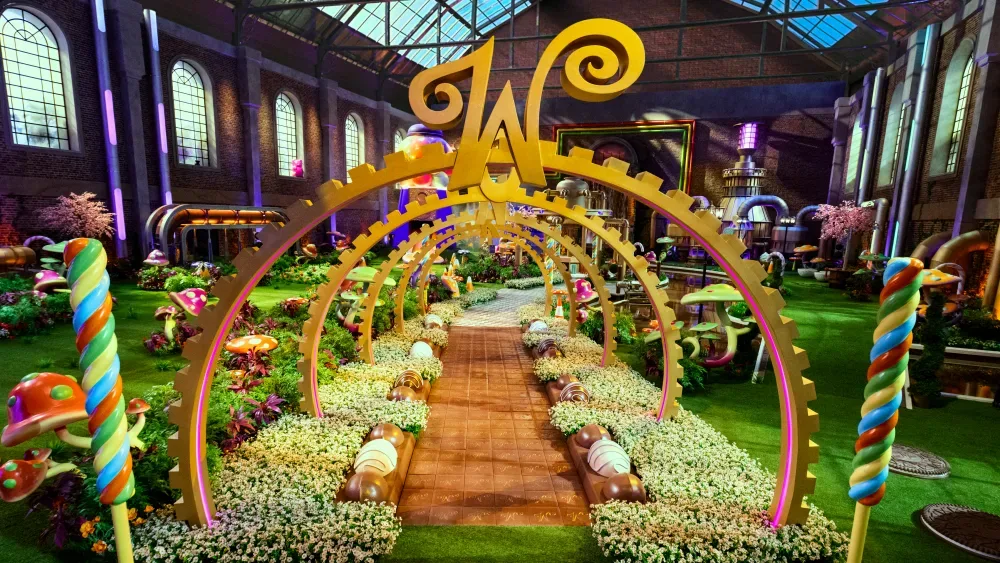
There is real craft in the physical world of Wonka’s Golden Ticket. Its production design recreates major touchstones from the 1971 film, including the chocolate river, the Wonkavision studio and the “half office.” It also expands the factory with rooms of its own, such as a shrinking hallway and a bee-themed space whose floors are made slick with honey.
Those sets demonstrate the strongest case for revisiting Wonka in unscripted television. A candy factory is a useful arena for visual invention, and the show has evidently invested in environments that can operate as both spectacle and challenge spaces. The best parts of the concept are tangible: giant, impractical rooms, playful hazards and a setting built around sensory excess.
But the show repeatedly puts incompatible styles into the same box of chocolates. Challenge videos have a retro, 1950s-adjacent look compared to Fallout, while the competitors’ communal sleeping setup recalls the far more contemporary visual language of dating and social reality television. Neither choice is inherently wrong. Together with the vintage Wonka recreations, however, they create an aesthetic pile-up rather than a coherent new world.
The Oompa Loompas add another layer of oddity. Some are played by actors with dwarfism, while others are average height or considerably taller. The result does not appear to follow one stable visual rule for the characters, which further undercuts the impression that the factory is governed by its own strange but consistent logic.
That inconsistency matters because the original factory works as a total environment. Its rooms may be absurd, but they feel like expressions of one host’s imagination. This version often feels like several different television references competing for shelf space: a classic children’s film, a modern elimination contest, mid-century promotional footage and an AI-era celebrity recreation.
Why the rights context matters
The series arrives after Netflix acquired The Roald Dahl Story Company in 2021. That company manages and monetizes Dahl’s work, and a drama series based on the author’s short stories has also been greenlit. In that sense, Wonka’s Golden Ticket is part of a broader effort to keep Dahl-related material active on screen while other projects make their way through development.
That context explains the business logic without automatically validating every artistic decision. Well-known intellectual property can give a new show instant recognition, while reality television can extend a setting beyond a conventional scripted adaptation. But a recognizable property is not a substitute for a strong reason to reinterpret it. The factory’s imagery is valuable; Wilder’s version of Wonka is valuable; the golden-ticket ritual is valuable. The series has access to all three, yet it struggles to transform them into a satisfying whole.
The posthumous voice is the clearest example of the gap between legal access and creative necessity. Estate authorization is meaningful and should not be dismissed. Still, viewers can reasonably ask different questions: Does the use honor the performer’s legacy? Does it add something that a newly cast host could not? Does the production’s mood justify the unease it produces? Those are artistic and ethical judgments, not ownership disputes, and the series leaves them hanging in the air.
Television is already comfortable revisiting recognizable figures and worlds; the medium’s appetite for reunions and returns is obvious in projects such as the planned Law & Order: SVU milestone reunion. But reviving a character through a living performer’s return is fundamentally different from using AI to recreate a dead actor’s vocal presence. Wonka’s Golden Ticket makes that distinction impossible to ignore.
What viewers should expect
The first seven episodes are streaming now, with a two-part finale scheduled for September 30. Viewers looking for elaborate Wonka-inspired sets will find a production capable of delivering them. The chocolate river, Wonkavision studio and newly devised rooms show considerable ambition, while the paired challenges give the format a recognizable reality-competition structure.
Viewers hoping for the wit, warmth and unsettling precision associated with Wilder’s performance should temper expectations. The show tries to use his familiar sound as a shortcut to Wonka-ness, but the device continually calls attention to itself. Rather than letting the contestants or factory become the story, it asks audiences to reckon with a recreated voice every time it speaks.
That is the lasting aftertaste of Wonka’s Golden Ticket: not chocolate, not triumph, and not even competition-show treachery, but the uncomfortable sense that a technology demonstration has been installed at the center of a fantasy. The factory is impressive. The prize is enormous. The premise has obvious visual potential. Yet the AI Gene Wilder voice is so conspicuous—and so hard to separate from the fact of Wilder’s death—that it turns the entire tour into a question the series cannot answer.