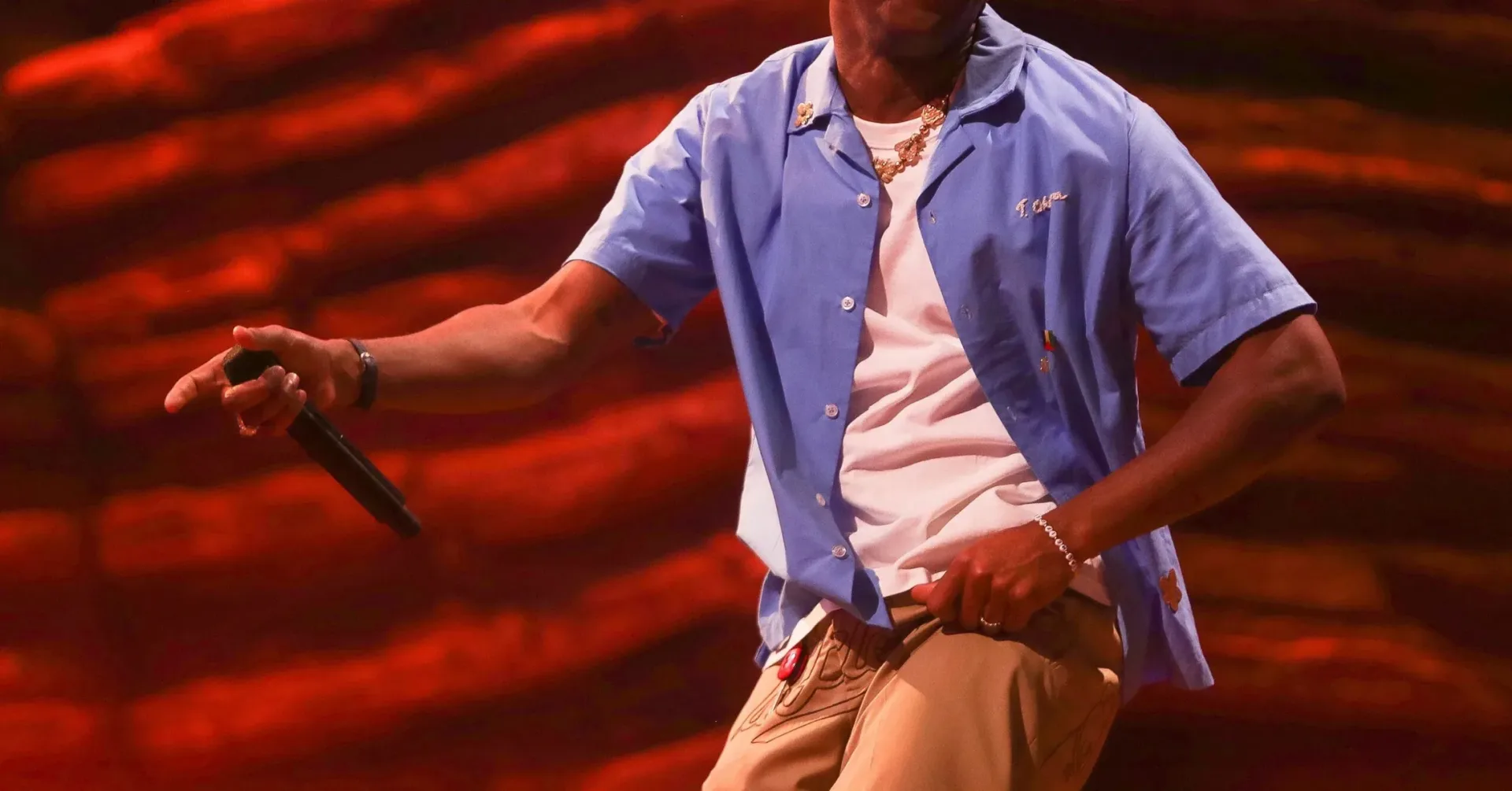
Tyler, the Creator has responded after old NSFW social-media posts about Selena Gomez resurfaced online, answering the renewed criticism with sarcasm rather than an apology or a detailed explanation.
His response framed the moment as familiar territory: material from roughly 15 years ago being circulated again, followed by predictions that it will finally produce a career-ending backlash. Tyler mocked that premise in a post that read, in part, “Oh no im gonna get cancelled,” before sarcastically questioning why the issue had supposedly never been raised during the past 15 years.
“Oh no im gonna get cancelled, this has never happened, why hasnt anyone in the last 15 years EVER brought this up, this is the first time oh no.”
The exchange is straightforward on its surface: old posts have returned to public view, some people object to them, and Tyler’s reply makes clear that he does not see the resurfacing as a new or decisive revelation. But the reaction also illustrates a persistent problem in online celebrity culture: there is a meaningful difference between acknowledging that old conduct was harmful and dismissing a backlash as repetitive.
What Tyler’s response does—and does not—say
Tyler’s message is a rebuttal to the idea that renewed attention to the old posts will “cancel” him. It is not an attempt to defend their wording, offer context for the specific comments, or directly address Gomez. Nor is it an apology.
That distinction matters. In everyday online use, cancelled is often a catch-all term for criticism, lost support, reputational damage, professional consequences, or the simple act of past comments being discussed again. Those are not the same thing. A person can face criticism without losing their platform; old conduct can be regarded as unacceptable without producing a new commercial penalty; and a public figure can have an audience that sees past work and present behavior differently.
Tyler’s sarcasm focuses on the perceived cycle of rediscovery. His point is that the material has existed and circulated for years, and that warnings of an imminent cancellation are therefore unconvincing. Critics, meanwhile, may read the same response as a refusal to confront why the comments continue to provoke discomfort when they reappear.
Both reactions can exist at once. The age of a post can explain why it is not new information, but it does not automatically settle whether it deserves criticism. Equally, a newly viral repost does not necessarily establish new facts or demand that the public treat an old controversy as if it happened that morning.
The weight of old social-media posts
Social platforms make it unusually easy for old material to re-enter public discussion without warning. A screenshot, an archived post, or a clip can travel far beyond its original context. That durability has changed the way audiences evaluate musicians, actors, athletes, creators, and other public figures: their past public statements can remain accessible long after the cultural moment that produced them has passed.
There is a practical difference, however, between archival context and excuse-making. Context means recognizing chronology, age, and whether someone’s public conduct has evolved. It does not require pretending that offensive remarks were harmless. The limited material at hand establishes that Tyler himself characterized many things he said on social media around that period as dumb, while his latest response treats the current outrage as cynical and repetitive.
That creates the tension at the center of this story. People who believe he has changed may see the resurfacing as an attempt to freeze him at an earlier point in his life. People who want clearer accountability may see irony as inadequate, particularly where the revived material concerns another public figure.
Accountability is not one fixed response
Online arguments often turn into a false choice: either a celebrity must be permanently defined by old remarks, or any renewed criticism must be dismissed as a bad-faith effort to ruin them. Real accountability is more complicated than either extreme.
- Acknowledgment means recognizing that the material exists and that people may reasonably object to it.
- Explanation can provide relevant background, but it is not automatically a justification.
- Apology addresses harm or offense directly rather than only disputing the scale of the backlash.
- Change is usually evaluated over time through later conduct, though audiences will differ on what evidence is sufficient.
Tyler’s response lands closest to rejecting the consequence framework: he disputes the idea that this resurfacing will be transformative for his career. It does not engage much with the other elements. That may be strategically efficient in an online environment built around fast-moving outrage, but it is also why the reply is likely to frustrate people looking for a more direct reckoning.
Why “this will end a career” is usually the wrong question
The expectation of a dramatic, immediate cancellation often obscures more useful questions. Does a resurfaced post alter how listeners feel about an artist? Does it prompt fans to revisit earlier work through a different lens? Does it affect the willingness of collaborators, platforms, or audiences to associate with them? And has the artist demonstrated meaningful growth since the material was originally posted?
Those outcomes are rarely uniform. Large artists have broad audiences with different thresholds for criticism, forgiveness, or disengagement. Some followers may be aware of a controversy already. Others may encounter it for the first time through a new viral cycle. Still others may decide it is not relevant to their relationship with the music. None of those reactions has to be universal for the topic to remain worth discussing.
At the same time, declaring that a controversy cannot matter because it will not end a career sets an unnecessarily extreme bar. Career destruction is not the only possible consequence of speech. Public scrutiny, criticism, loss of goodwill, and changed perceptions are all forms of response that can occur without the simplistic label of cancellation.
Tyler’s post appears designed to puncture the most theatrical version of that label. The tradeoff is that the joke can sound like it is aimed not just at exaggerated predictions, but at everyone troubled by the old comments. That is the interpretive gap now driving the discussion.
A familiar cycle for public figures
For celebrities whose early online presence was provocative, informal, or deliberately abrasive, the archive is part of the public record. As platforms and audiences change, past material can be reassessed under different standards. A comment that was once passed around as shock humor can later be seen as demeaning, intrusive, or needlessly cruel.
This is particularly true when the subject of old remarks is another well-known person. Fame does not eliminate the possibility of disrespect, and a celebrity’s name can increase the reach of a post rather than reduce its impact. That is one reason the current conversation is unlikely to be settled solely by pointing out how long ago the posts were made.
The more productive reading of moments like this is not to demand a predetermined punishment or assume that criticism is inherently cynical. It is to keep the facts clear: the posts in question are old; they have resurfaced; Tyler answered with sarcasm; and his answer is not an apology. Readers can decide whether the time that has passed, perceived personal growth, and the nature of the response change how they view the issue.
The entertainment cycle moves quickly, including in adjacent music stories such as recent canceled European dates involving French Montana and D-Block Europe. But resurfaced social-media controversies tend to linger because they ask audiences to judge both a historical record and a public figure’s present-day posture toward it.
In this instance, Tyler has made his position plain: he considers the latest surge of outrage over the old Selena Gomez posts neither surprising nor threatening. Whether that deflection satisfies listeners who want a clearer acknowledgment is a separate question—and one his sarcastic response leaves unanswered.