Major spoilers follow for “Tomorrow’s Enterprise,” the Season 4 finale of Star Trek: Strange New Worlds.
There is a particular kind of pressure involved in telling stories about a character whose future is already iconic. Star Trek: Strange New Worlds has spent its run navigating that pressure with younger versions of familiar Enterprise figures, and “Tomorrow’s Enterprise” makes the challenge literal. The Season 4 closer splits Celia Rose Gooding’s Nyota Uhura across time, asks her to face a version of herself shaped by another year of life, and uses that encounter to look toward the era of Star Trek: The Original Series.
The episode’s big science-fiction premise is deliberately character-focused. Uhura begins as a newly promoted lieutenant returning from a Starfleet conference just as the Enterprise prepares to observe a white hole. Within the story, the white hole is presented as a counterpart to a black hole. Uhura hears music emanating from it, then an energy surge knocks her down. In the aftermath, she hears what sounds like her own voice urgently trying to save Scotty, played by Martin Quinn.
That voice is not an illusion. It belongs to a future Uhura, one year ahead of the present Enterprise timeline. The result is a time-paradox story in the classic Trek mold: information has crossed the boundary between two points in time, but changing events too freely could disrupt the chain of events that produced the future in the first place.
A future Enterprise that moves closer to familiar Trek territory
The future Enterprise offers a concentrated glimpse of the changes waiting ahead. Jim Kirk, played by Paul Wesley, is captain. Ethan Peck’s Spock serves as first officer. Christopher Pike, played by Anson Mount, has become an admiral. La’an Noonien-Singh, played by Christina Chong, is absent under circumstances the episode deliberately leaves unresolved.
Those details matter because they make the episode more than a standalone cosmic anomaly. They position the ship nearer to the configuration audiences associate with The Original Series, often abbreviated by fans as TOS. Yet the future does not merely recreate a familiar status quo. It is also deeply personal for Uhura: she and Scotty are in a romantic relationship.
Future Uhura, Scotty, and Erica Ortegas head out in a shuttle to investigate the black hole. Ortegas, played by Melissa Navia, is now a flight instructor at the Academy. Another energy burst strikes their shuttle. Uhura makes an emergency transport back to the Enterprise, but Scotty is killed. The situation grows more painful and more confusing when Uhura is informed that he had already died a year earlier.
That contradiction is the episode’s core paradox. A paradox, in this setting, is not just a complicated timeline diagram; it is the emotional problem of trying to rescue someone without understanding whether the attempted rescue is what causes, prevents, or repeats the tragedy. The younger Uhura cannot simply be handed answers by her future self, because knowledge of the coming year may itself change the path that led to that future.
Two Uhuras, one performance challenge
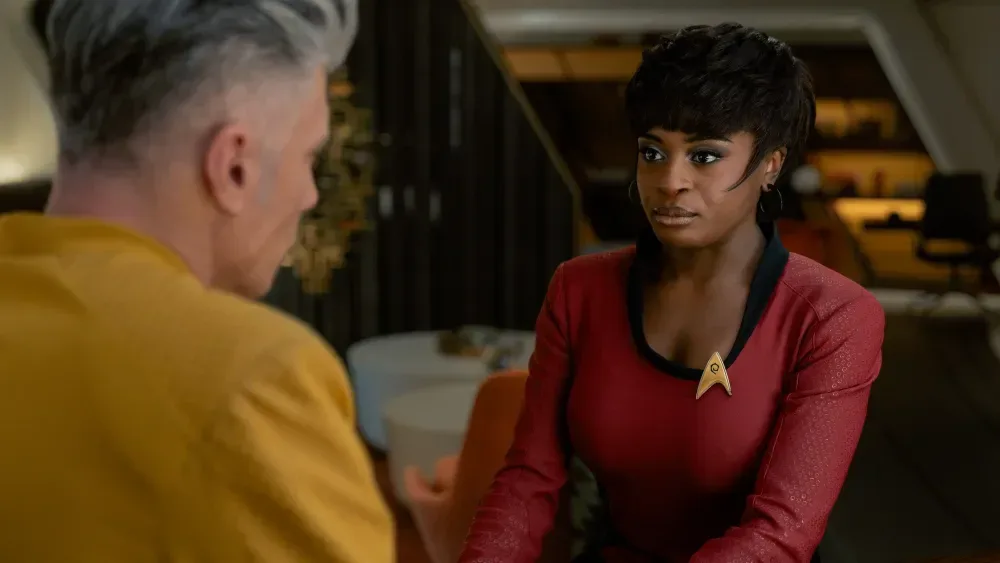
The episode establishes communication between the younger Strange New Worlds Uhura and the Uhura aligned with the original-series era. It also gives Gooding a visual bridge between those periods through a hairstyle that evokes Nichelle Nichols’ classic Uhura look.
Gooding said the change initially took some getting used to. She described feeling insecure because she looked different, before arriving at the idea that unfamiliarity does not automatically mean something is wrong. It is a small but revealing observation about a role that carries both individual ownership and a substantial legacy. The new styling is not simply a nostalgia signal; in the episode, it helps the viewer instantly understand that this Uhura has lived further down the road.
The harder work was in making the two versions of the character feel connected without making them identical. Future Uhura has experiences that younger Uhura has not yet had. She is constrained by the need to protect the timeline, while the younger officer understandably wants direct explanations about danger, loss, and the relationship with Scotty that she has not entered yet.
Gooding characterized that dramatic space as “liminal”: a threshold between what the younger character knows and what the older one cannot safely reveal. She also described the younger Uhura’s resistance as rooted in a desire for certainty. Being told by a future version of yourself that an answer will not help is a uniquely frustrating version of the familiar time-travel rule: trust the process, even when the process is withholding the map.
This is where the episode’s premise earns its emotional value. The future Uhura does not function only as a delivery system for clues. She is evidence of who the younger Uhura can become—more experienced, more guarded, and still connected to the person she used to be. Their conflict is not one between strangers. It is an argument between two stages of the same person, each convinced that she is protecting the other.
The dilithium diamond plan does not go as planned
The two Uhuras identify a possible way to rebalance the timeline with a dilithium diamond. In Trek terminology, dilithium is associated with the franchise’s warp technology, but here the important point is narrative rather than mechanical: the diamond is their proposed tool for correcting the temporal imbalance.
Before they can carry out that plan, another energy pulse switches them into the opposite Enterprises. The future, TOS-aligned Uhura is thrown back into the earlier timeline, while the younger Uhura is sent forward. It is an effective reversal because it denies both characters the comfort of remaining in the environment they understand. The younger officer now has to operate amid the outcome she was trying not to learn about.
That displacement also allows her to decode the music that opened the episode. The white hole and black hole are not merely hostile celestial phenomena. An alien entity within them has been signaling for the Enterprise to keep its distance because a child is about to be born. The violent pulses that endangered the ship and shuttle have been contractions.
It is a very Trek solution to a frightening unknown: the apparent threat turns out to be communication, and the response must shift from defense to understanding. The story’s “space baby” description is undeniably wild, but it gives the time-travel plot a coherent moral turn. Saving Scotty and repairing the timeline become dependent on recognizing that the phenomenon is a birth in progress, not an attack to overpower.
A rescue built around cooperation rather than conquest
The two Uhuras must help deliver the child using specialized drones controlled from outside the ship. Their work eventually brings them face to face in space. Rather than treating the duplicate-Uhura setup as a gimmick, the scene gives the character an unusually direct encounter with her own past and future.
Gooding explained that filming it required several practical arrangements. The call sheet could include Gooding, her stand-in Lisa, and her stunt double Sammy as different Uhuras. At times, she performed opposite a tennis ball on a stick; at others, she faced her stand-in while listening to a recording of her own dialogue so that the exchange’s timing would land correctly. The process speaks to the construction behind a scene that, on screen, needs to feel like a seamless conversation between two versions of one person.
Once the child is successfully delivered, alien midwives thank the Uhuras and the characters are transported back to the Enterprise bridge. The episode has therefore moved from a warning that cannot be understood, through a temporal tragedy involving Scotty, to an act of assistance. The cosmic event is resolved not by treating the unknown as an enemy, but by listening closely enough to understand what it needs.
That emphasis also makes the Uhuras’ final exchange meaningful beyond the mechanics of the plot. Gooding described the moment as a passing of the torch between Strange New Worlds and The Original Series. It is not a replacement of one portrayal with another. Instead, the episode frames them as connected chapters: the younger version is still becoming the person audiences recognize, while the older version carries the accumulated costs and strengths of that journey.
What the finale appears to set up
“Tomorrow’s Enterprise” is described as the Season 4 finale, and the season’s ending points toward a fifth and final season. Gooding’s comments also describe the series’ work as completed in production terms, saying the stories have been written, recorded, edited, and finished with ADR. ADR refers to dialogue work recorded after principal filming, and her remarks indicate that the remaining step is sharing those completed episodes with audiences.
There is an understandable ambiguity in the wording around a “series finale” versus the episode’s position as a Season 4 finale, but the broad direction is clear: the story is laying groundwork for the show’s final stretch while creating opportunities around the Enterprise’s next configuration. Gooding specifically pointed to the possibility of spending more time with Kirk’s captaincy or moving directly into the territory associated with the original series.
That does not confirm a particular continuation or new project. It does explain why the finale invests so heavily in the handoff imagery: Kirk in command, Spock as first officer, Uhura’s visual connection to Nichols’ portrayal, and two eras of the same character briefly meeting in person. The episode’s central metaphor is not subtle. A new life emerges from a frightening transformation, and the Enterprise’s future arrives through a passage that first looks like disaster.
For the legacy characters, that is a way to acknowledge the road ahead without reducing it to checklist continuity. For the characters unique to Strange New Worlds, Gooding said the series has also found a satisfying way to say goodbye. The remaining question is not whether the show knows where its Trek history leads. “Tomorrow’s Enterprise” suggests it does. The more interesting question for its final season is how much room remains to make that destination feel newly earned.
For more television and music coverage from the wider entertainment world, see our report on Dakota Johnson joining Taylor Swift’s “Patient Zero” video.