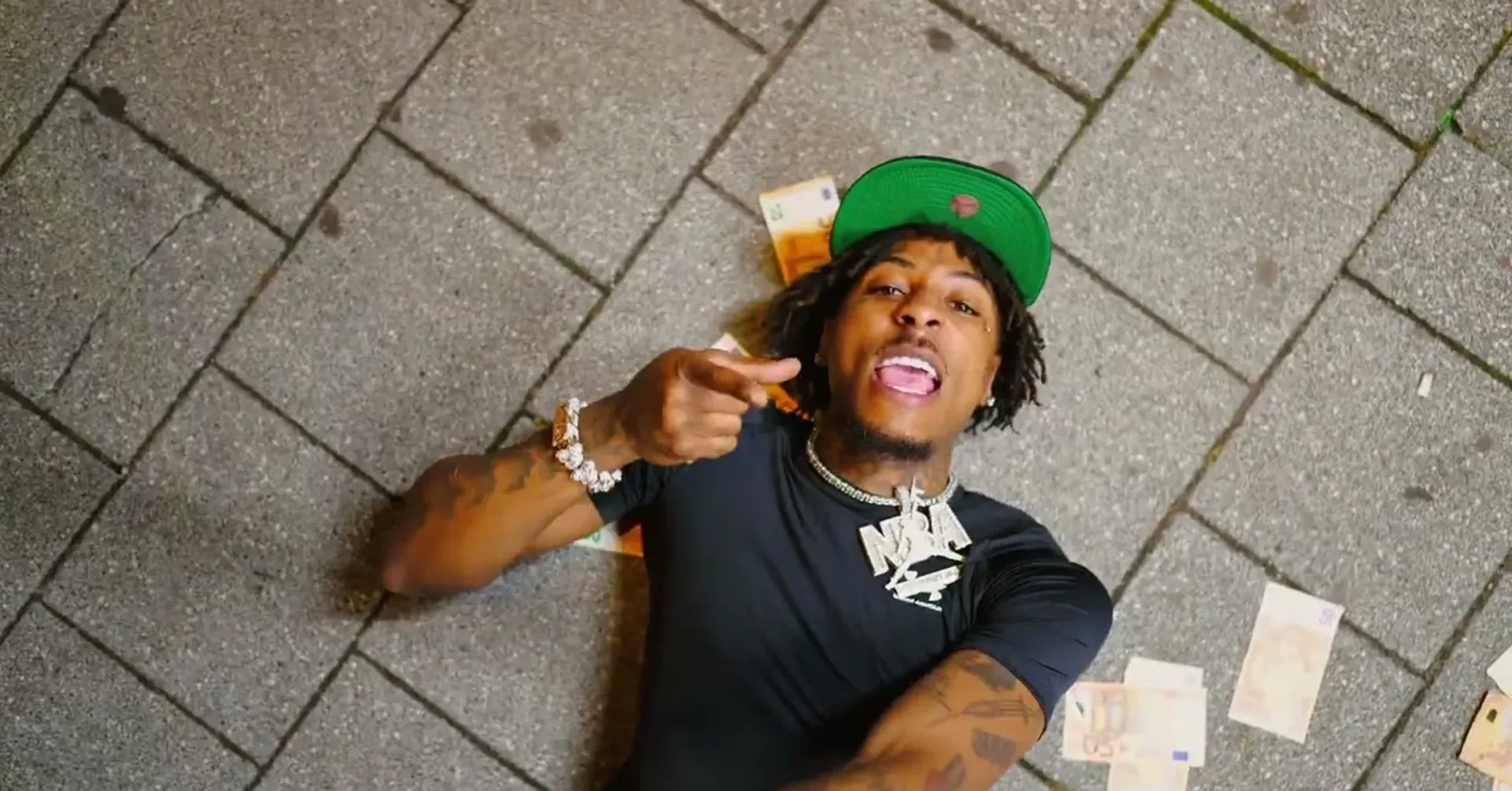
A brief bodycam video said to show NBA YoungBoy during his reported 2020 arrest has resurfaced online, sending fans back into a familiar cycle: scrutinizing an old clip, debating what it shows and attaching it to the larger story of an artist whose public life has repeatedly intersected with legal headlines.
The footage, circulated on Instagram, is described as originating from an encounter during a music-video shoot for “Dirty Stick.” In the clip, officers question YoungBoy, born Kentrell Gaulden, about his identity and whether he understood his rights. He says he had spoken with the officer who handcuffed him and denies possessing guns or drugs at the scene. The officers also ask about the vehicle in which he arrived before he is allowed to leave the room.
That is the central, and limited, record presented by the resurfaced clip. It is a short piece of video rather than a complete account of the encounter, the investigation or any related court proceedings. The reaction online has nevertheless been much larger than the footage itself, demonstrating how quickly archival police video can become a new flashpoint when a major artist’s past is recirculated through social media.
What the clip does — and does not — establish
Bodycam footage can feel unusually definitive because it looks immediate: an officer’s perspective, audible questions and a recognisable person in a stressful situation. But a bodycam excerpt is not automatically the same thing as a full legal record. A short clip may omit what happened before recording began, conversations outside the camera’s view, subsequent decisions by investigators, and eventual case outcomes.
That distinction matters here. Reports tied the 2020 arrest to state and federal drug and gun charges, but the newly circulated footage itself chiefly documents questioning. It shows YoungBoy denying that he had guns or drugs. It does not, on its own, prove possession, explain the basis for any charges, or settle every claim that viewers may make while sharing it.
In practical terms, viewers encountering the video should separate three things that are often compressed into one viral post:
- The recording: what can actually be seen and heard in the excerpt.
- The allegation or report around it: contextual claims about the arrest, the shoot and related charges.
- The outcome: a separate question that requires reliable information beyond a clipped interrogation scene.
This is not an attempt to minimize the seriousness of an arrest or of reported charges. It is a basic standard for interpreting a partial public record. A video can be relevant without being complete, and an emotionally charged online response can be understandable without becoming evidence.
Why old footage gains a second life
The renewed attention arrives as YoungBoy has been teasing retirement from rap, a development that appears to have sharpened public interest in both his next move and his earlier career chapters. When an artist signals a possible turning point, audiences often revisit formative releases, controversies and moments that seemed settled simply because they were no longer new.
That pattern is particularly potent with bodycam material. Unlike a news recap or a court document, video gives viewers the sense that they are witnessing an event for the first time, even if the event occurred years earlier. New circulation can therefore create a strange collapse of time: a 2020 interaction is experienced with the urgency of a current controversy.
For fans, that can mean revisiting questions about fairness, pressure and the weight carried by a young star. For critics, it can reopen concerns about conduct and accountability. For casual viewers, it can turn into a detached spectacle, with a few seconds of footage repeatedly reposted until its original setting is nearly lost.
The clip also led some commenters to bring up other older footage involving YoungBoy. That connective impulse is common on social platforms, but it can blur unrelated events together. One resurfaced video is often treated as an invitation to build a wider dossier, regardless of whether each item has the same factual footing, legal relevance or personal context.
A past incident is being discussed alongside a different past controversy
YoungBoy’s legal team has previously addressed the recirculation of old video. In August, online discussion returned to footage involving a physical altercation with his then-partner, Jania Meshell. His attorney, Jimmy Manasseh, characterized that matter as a misdemeanor that had been resolved nearly a decade earlier and said he believed Meshell had sought to drop the charge. Manasseh also said YoungBoy was on probation in East Baton Rouge and was not revoked over the incident.
Those comments concern that separate matter, not the reported 2020 arrest now being discussed. Keeping the two distinct is important. Viral conversations regularly group together an artist’s past legal issues as if every video, accusation and proceeding were one continuous event. They are not. The circumstances, allegations, legal status and available information can differ significantly from case to case.
There is a broader media-literacy lesson in that separation. Words such as arrest, charge, conviction and resolved are not interchangeable:
- An arrest is a law-enforcement action; it is not itself a finding of guilt.
- A charge is a formal accusation, which may be addressed through multiple legal paths.
- A conviction follows a legal determination of guilt.
- A resolved matter can describe an end point, but the exact meaning depends on the case and should not be assumed from a social-media caption.
That vocabulary is especially useful when the material at issue is a short, reposted recording. The online appetite for a simple verdict can be much stronger than the information available to support one.
The career context makes the response more intense
YoungBoy remains a figure of sustained interest in hip-hop, even while discussion of retirement has put a question mark over what comes next musically. That attention does not stay limited to current releases. It also reaches back to the moments that fans feel explain the artist’s music, public reputation or relationship with the industry.
But looking back can become reductive. A career is not neatly summarized by an interrogation room, and neither is an old clip stripped of its full context. The instinct to treat archival footage as a definitive character assessment is understandable in a media environment built around instant reaction, yet it is still an interpretation rather than a fact contained in the video.
The same dynamic shapes much of music coverage beyond this particular artist: a new song rollout, an apparent retirement tease or a revived clip can all become part of one nonstop narrative. Recent rap news has likewise focused on active release plans, including Stove God Cooks restarting the rollout for “All This For Me?” with a Swizz Beatz single. The contrast is instructive. One musician’s present can be framed through new work, while another’s moment is dominated by a piece of old footage newly placed in front of audiences.
What responsible discussion looks like
There is no requirement that viewers ignore difficult material just because it is old. Time does not erase public interest, and an artist’s prominence naturally invites scrutiny. The more useful question is whether a discussion accurately describes what is known.
For this clip, that means acknowledging that it reportedly relates to a 2020 arrest during a “Dirty Stick” video shoot; noting that YoungBoy denies having guns or drugs in the excerpt; and avoiding claims that the snippet alone cannot establish. It also means not using the footage to make unsupported conclusions about separate cases or personal relationships.
The strongest takeaway is less dramatic than the social-media response: a short video from an earlier period of NBA YoungBoy’s life has returned to public view, and people are reading it through the lens of his long-running visibility, reported legal turbulence and current uncertainty about his musical future. The footage may be old, but the argument over what old footage means is very much current.