
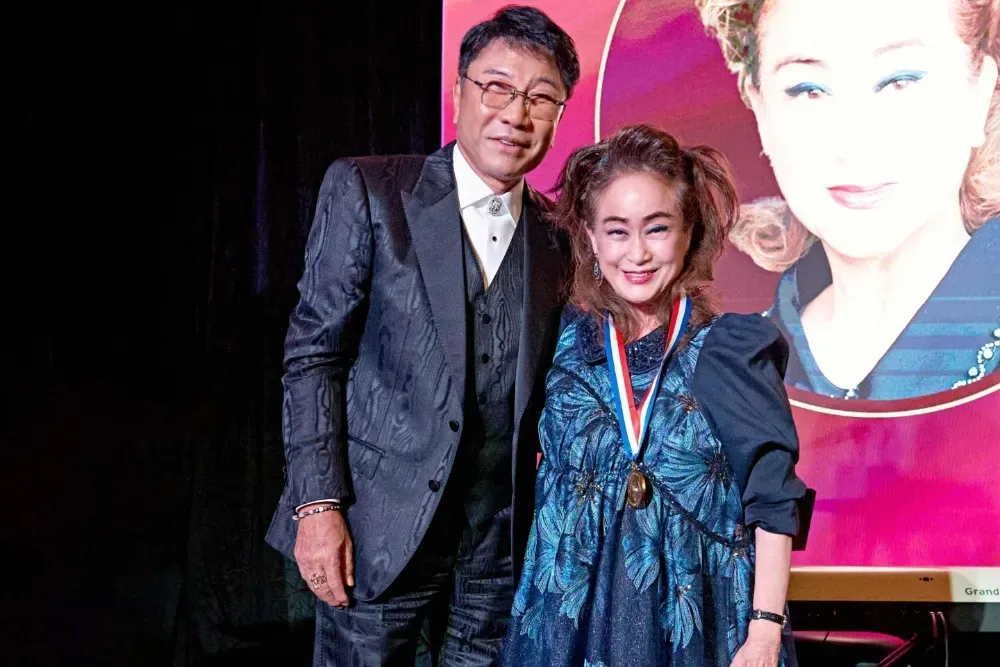
Miky Lee, vice chair of Korea’s CJ Group, has received the Asian Hall of Fame’s Centennial Medal of Lifetime Achievement in Los Angeles. The honor recognizes her more than three decades of work connecting Korean film, television and music with audiences beyond Korea.
Lee Soo-man, founder of SM Entertainment and now a key producer at A2O Entertainment, presented the award. Recalling that Lee had introduced him at the same event a year earlier as the “godfather of K-pop,” he returned the compliment with a title that gets at the scale of her influence: the “godmother of K-culture.”
That phrase is celebratory, rather than an official job title, but it reflects the breadth of the work discussed at the ceremony. Lee’s career has touched investment, movie exhibition, cable television, music programming, awards shows, conventions and production. Together, those areas form much of the machinery that helps creative work move from a local audience to an international one.
An honor for cultural infrastructure as well as hit-making
The Asian Hall of Fame describes its Centennial Medal of Lifetime Achievement as recognition for inductees who demonstrate character, elevate standards in their fields, make a cultural impact and work across racial lines. In Lee’s case, the award speaks not only to individual projects but to institutions and platforms that have given artists, filmmakers and fans places to meet.
That distinction matters. A producer can help a particular film get made; an executive can help create the conditions in which many films, performers and audiences can find one another. Lee’s remarks and the tribute from Lee Soo-man emphasized the second role. The story was one of building channels for cultural exchange, from cinemas and television to fan gatherings that encompass music, food, beauty and lifestyle.
Lee was born in Knoxville, Tennessee, and raised in Seoul. In her speech, she traced her outlook to her grandfather, who founded both CJ and Samsung and used the phrase, “No culture, no country!” At a business then centered on food, she and her brother Jay asked a straightforward expansion question: if the company was already entertaining people’s mouths, why not also engage their eyes and ears?
Her answer was not framed as culture for culture’s sake. It was an argument that culture is essential social infrastructure. “Culture is like oxygen,” Lee said in accepting the award. “We may take it for granted, but we cannot live without it.”
From a food business to entertainment platforms
Lee Soo-man pointed back to 1995, when CJ was still known as a food company and Korea was not yet a leading force in global entertainment. He credited Miky Lee with helping guide CJ’s DreamWorks investment that year. Lee herself described that investment as an opportunity to learn from an established studio rather than an attempt to borrow Hollywood glamour.
Related coverage includes Miky Lee Receives Asian Hall of Fame Lifetime Achievement Medal.
That explanation provides useful context for what followed. Investment can mean more than financial participation: it can be a way to study the production, distribution and business structures behind large-scale entertainment. The subsequent steps cited at the event suggest a strategy of building a connected ecosystem rather than relying on a single export.
- CGV: Launched in 1998 as Korea’s first multiplex. A multiplex is a cinema venue with multiple screens, allowing a wider range of films and showtimes to be offered in one place.
- Cable television and Studio Dragon: CJ expanded into cable TV and later launched Studio Dragon as a production house, increasing its role in creating television programming as well as distributing it.
- Mnet: The music channel was created to give a newer generation a place to discover Korean music.
- MAMA Awards and KCON: These events helped turn music fandom into a cross-border communal experience rather than treating it solely as a broadcast or a record sale.
Each component serves a different part of the entertainment chain. Exhibition gives viewers access to films. Production houses develop and make programming. Music channels create a route for discovery. Awards shows and conventions create high-visibility moments and real-world gatherings. None alone explains the international reach of Korean entertainment, but the combined structure helps explain why the label “K-culture” has become larger than any one artist, genre or company.
Music’s changing balance and the fan community
Lee said Mnet was created at a time when nearly 85% of songs aired on Korean television were American pop. By the 2000s, she said, that balance had reversed. Her point was not simply that the playlists changed. It was that a domestic platform helped create room for homegrown artists to be discovered, discussed and supported.
The MAMA Awards began in 1999 as the Mnet Video Music Awards. KCON launched in the United States in 2012 and has since developed from a K-pop festival into a convention also focused on Korean food, beauty and lifestyle. Lee said the MAMA Awards and KCON took their communities to cities including Bangkok, Hong Kong, Los Angeles and Tokyo.
This is where the “K” in K-pop often becomes too narrow a shorthand. The music may be the initial draw, but the audience experience can include language, fashion, food, screen entertainment and personal connections among fans. KCON’s wider convention format is a clear example of that overlap. It makes fandom a doorway into several parts of Korean culture, while fans themselves help determine what travels.
Lee summarized that aspiration with the MAMA slogan, “Music Makes One,” and credited fans with making it real. The wording also avoids suggesting that cultural exchange only moves one way. Global audiences are not passive recipients; they organize, attend, amplify and build communities around the work they care about.
Film, television and the people behind the stories
Lee named filmmakers Park Chan-wook, Bong Joon Ho and Lee Chang-dong, along with Squid Game creator Hwang Dong-hyuk, among the Korean creative figures she has worked with. She also cited Lee Isaac Chung, KPop Demon Hunters director Maggie Kang and Celine Song as evidence that stories shaped by Asian cultures can resonate well beyond their original settings.
One of the clearest markers of that reach is Parasite. Lee served as an executive producer on Bong Joon Ho’s film, which became the first non-English-language winner of the Academy Award for Best Picture in 2020. It won four Academy Awards in total. The milestone did not make Korean cinema international overnight, but it became a highly visible confirmation that a film need not be in English to command the industry’s largest stage.
“Executive producer” can cover different responsibilities across productions and companies, so it should not be treated as a single creative credit with one universal meaning. In this context, the credit establishes Lee’s direct connection to a landmark film while the broader ceremony focused on her long-running institutional role across the entertainment business.
CJ ENM’s newer First Light StoryHouse label extends that role toward earlier stages of storytelling. The label is intended to support projects from Asian creators through direct investment and co-production beginning in early development. Early development is the period when an idea is being shaped into a viable project, often before a production is ready to shoot. Support at that point can matter because it gives creators an opportunity to refine material and assemble a project before later financing and distribution decisions arrive.
Why the legacy argument looks forward
Lee’s acceptance speech did not present cultural expansion as a finished accomplishment. “Our greatest legacy is not simply what we have accomplished, but the opportunities we create for those who come after us,” she said.
That is the most practical way to read the recognition. A lasting cultural legacy is not just a list of trophies, global tours or breakout titles. It also includes the networks that let future creators work, the venues that let audiences encounter their work, and the investment structures that allow stories to develop before their commercial outcome is known.
The Asian Hall of Fame is an educational and research institution recognizing Asian and Indigenous legacy. Its 22nd induction ceremony also honored Blackpink member Rosé and Japanese baseball great Nomo Hideo. The event’s guests included Tiger JK, Yoon Mi-rae, Yoshiki, Maggie Kang, Amy Homma, Lisa Joy, Maja Hoffmann and Ram Shriram.
For readers following the continued global movement of Korean entertainment, this ceremony offers a useful counterpart to headlines about an individual song, series or idol. Those moments have their own importance, as does the evolving solo work around artists such as Blackpink’s Jisoo. But Lee’s medal recognized the less immediately visible work of creating the platforms on which many individual moments can happen.
Lee Soo-man’s “godmother of K-culture” description was delivered as a warm tribute from a friend of more than 50 years. Still, the career it describes is concrete: a 1995 DreamWorks investment, CGV’s 1998 opening as Korea’s first multiplex, a music network built to elevate domestic discovery, global fan events, a Best Picture-winning film and a new label aimed at Asian creators. The common thread is the belief that culture does not merely accompany a country’s identity. It helps make and carry that identity across borders.