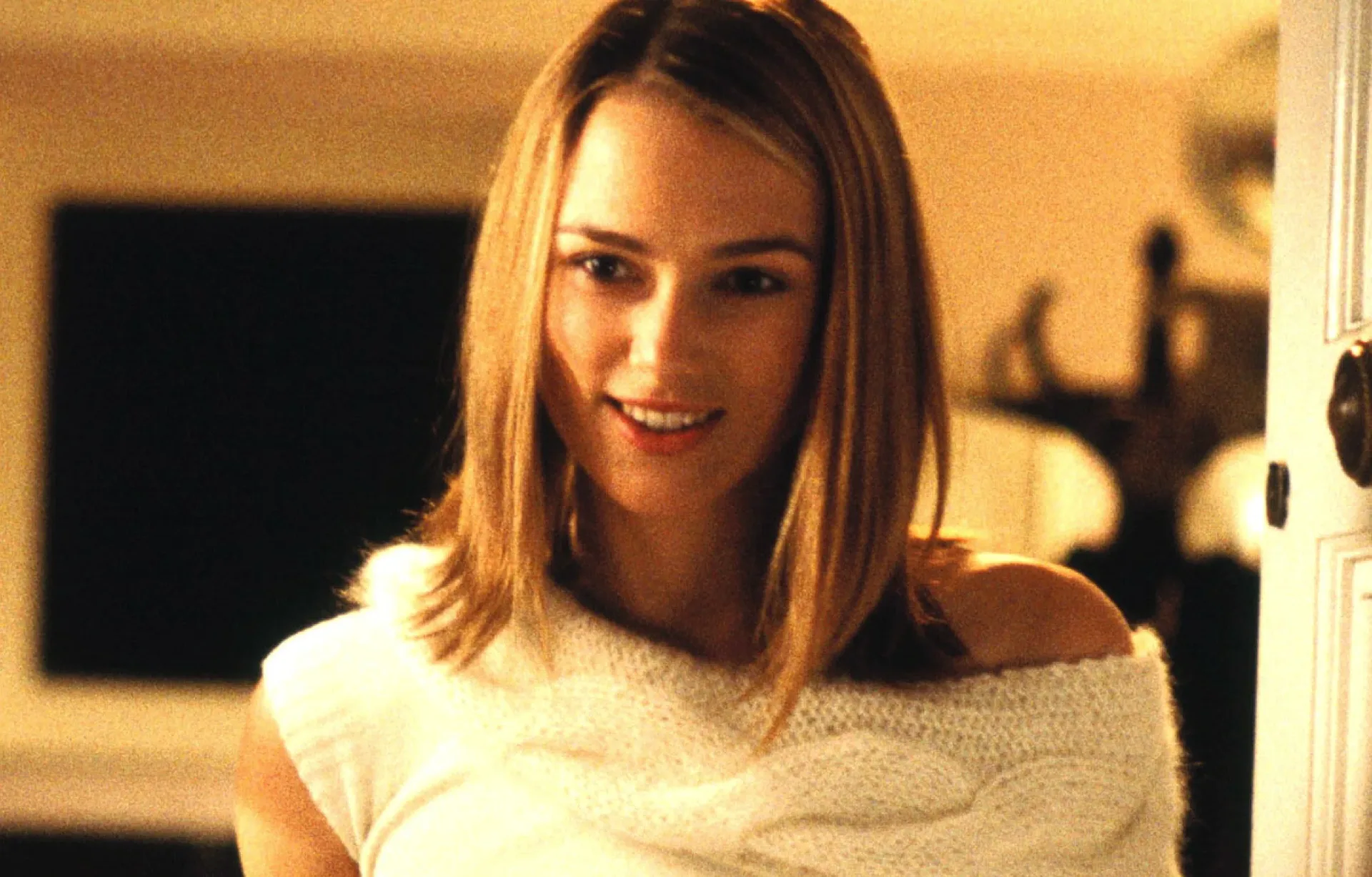
For plenty of viewers, Love Actually is a seasonal ritual: a 2003 ensemble romance revisited often enough that individual scenes, gestures and lines have become cultural shorthand. Keira Knightley, who played Juliet, occupies a notably different position. She says she has not watched the film since its premiere and does not recognize the quotations fans bring to her.
Speaking recently, Knightley explained that she can tell when someone is reciting dialogue from the movie from the look on their face and the way they approach her. But she does not know what the words are meant to recall. In her own blunt phrasing, the references “mean nothing” to her—not as a dismissal of viewers’ attachment, but because the movie is not something she has revisited or committed to memory.
That gap between an audience’s long-term relationship with a film and a performer’s brief time making it is especially striking in this case. The scene most associated with Knightley’s character has grown far beyond its original place in the plot, while Knightley says her actual production experience was short: she was 17 and on set for roughly a week.
A classic scene, and a very different memory of making it
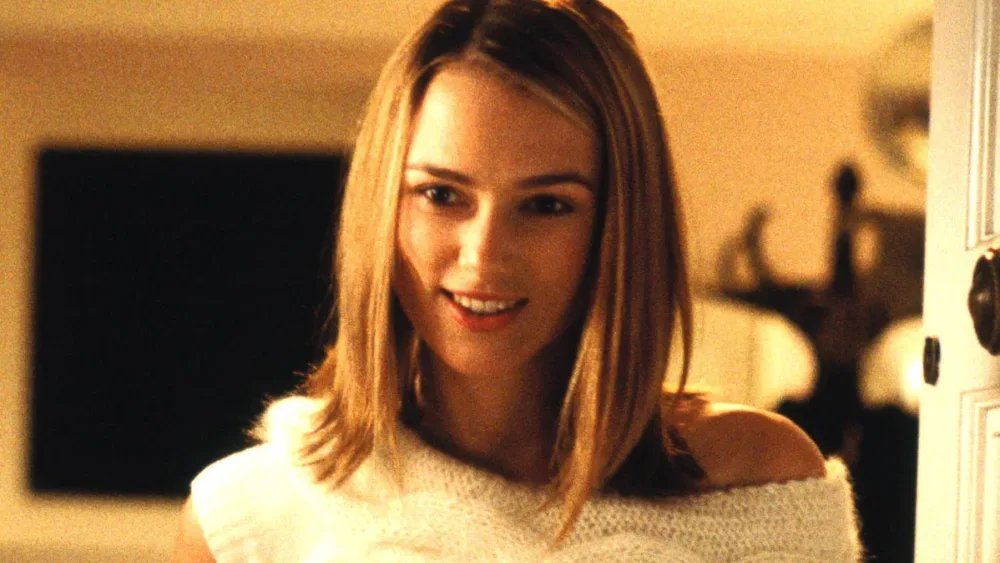
In Love Actually, Juliet marries Peter, then discovers that Peter’s best friend Mark is secretly in love with her. Mark’s declaration arrives at her door through cue cards, a sequence that has become one of the film’s most recognizable moments. The message is framed as a Christmas confession without expectation, culminating in Mark’s claim that Juliet is perfect.
For audiences, the cue-card scene has taken on a life as a concentrated symbol of the movie’s romance. It is visually simple, immediately legible and easy to quote, which helps explain why fans still bring it up with Knightley decades later. It has also become one of the film’s most debated scenes.
Knightley has previously made clear that her own read of the moment was not uncomplicatedly swooning. In a 2024 interview, she called its “stalker-ish” dimension something she remembered from filming. She recalled looking at Andrew Lincoln’s Mark as though he were creepy and being directed to adjust her expression so that he would not seem that way onscreen.
That recollection matters because it separates two things that are frequently flattened together in conversations about old films: the intended emotional effect of a scene and the actor’s response to performing it. A sequence can be edited, scored and remembered as a romantic grand gesture, while a performer can see troubling implications in the same setup. Neither observation erases the other; they describe different parts of how fiction is made and later received.
Why the age context changes the conversation
Knightley also emphasized that she was 17 at the time. She said the scene had a “creep factor” then and suggested that broader recognition of her age arrived much later. The detail gives modern discussion of the moment a more concrete basis than a vague sense that its dynamics have aged awkwardly.
Related coverage includes Keira Knightley Still Doesn’t Know the ‘Love Actually’ Quotes Fans Bring Up.
Juliet is a fictional character in a heightened romantic comedy, but Knightley was a teenage actor portraying her. That distinction is important when the scene is revisited. It does not require viewers to deny the sequence’s famous status or its role in the film’s Christmas identity. It does mean that the real-world conditions around the performance deserve to be part of the discussion, particularly when the scene’s drama centers on an adult man pursuing the wife of his close friend.
“Creepy” is not a technical film-studies term, but it usefully captures the tension at the scene’s center: behavior presented as intimate and vulnerable can also feel intrusive when viewed from Juliet’s perspective. Mark arrives uninvited, conceals the purpose of his visit from Peter, and makes a powerful emotional disclosure that Juliet has not asked to receive. The scene’s appeal for some viewers has traditionally been its restraint—Mark leaves after saying his piece—but the circumstances are also why it attracts criticism.
Knightley’s comments do not announce a new evaluation of the whole film. They are narrower and more personal: she barely remembers the production, has not rewatched it, enjoys that it has endured with viewers, and remembers feeling that this particular scene carried an unsettling edge. That is a more useful framing than treating her remarks as either a total rejection or a blanket endorsement of the movie.
Fandom quotation is not the same as actor ownership
There is an odd assumption built into celebrity quotation culture: if a line becomes famous, the actor who said it must retain a deep personal connection to it. Knightley’s account is a reminder that this is not necessarily true. An actor may work on a scene for a short time at a young age, move through decades of other roles, and find that the audience has made that scene into a recurring communal reference point.
That does not make fans wrong to enjoy the movie or to recognize its dialogue. It simply places the interaction in perspective. Fans may be recalling a tradition—watching the film at Christmas, sharing its lines, debating its romances—while the performer may be responding to an isolated job from early in her career. The same material can carry enormous personal nostalgia for one person and almost no active memory for another.
Knightley’s response also avoids a more cynical reading of the film’s longevity. She said she likes that it has such a large life outside the original production. That is a generous acknowledgement of what audiences have built around Love Actually, even if she cannot join in the line-by-line recollection.
Pop culture is full of works whose afterlife becomes larger than the circumstances of their making. Quotable scenes, especially, are repeatedly lifted out of their surrounding story and turned into seasonal references or conversational shorthand. In that process, details such as a performer’s age at filming, the character’s point of view or a scene’s uncomfortable subtext can disappear. Revisiting them does not have to ruin a beloved tradition; it can make the tradition more attentive.
What Knightley’s remarks do—and do not—say
- They do say: Knightley has not watched Love Actually since its premiere and does not recognize its fan-quoted lines.
- They do say: She filmed her part when she was 17 and spent about a week on set.
- They do say: She remembers considering the cue-card scene creepy and was asked to make that reaction less apparent.
- They do not say: That viewers are forbidden from loving the film or considering the scene romantic.
- They do not say: That Knightley is attacking the movie’s audience; she explicitly said she appreciates its continuing life.
- They do not say: That a current project, rerelease or new Love Actually production is in the works.
The conversation is therefore less about a celebrity “forgetting” a famous movie than it is about memory, performance and changing cultural context. Fans remember the polished, endlessly replayable result. Knightley remembers a small slice of a shoot from when she was 17, including a direction that complicated her natural reaction to the scene.
That distinction may be worth keeping in mind the next time the cue cards appear during a holiday rewatch. The sequence can remain a famous piece of movie iconography, but its legacy now includes the perspective of the actor at its center. For more on another performer addressing the shifting status of a high-profile screen project, see Julia Garner’s comments on the Madonna biopic.