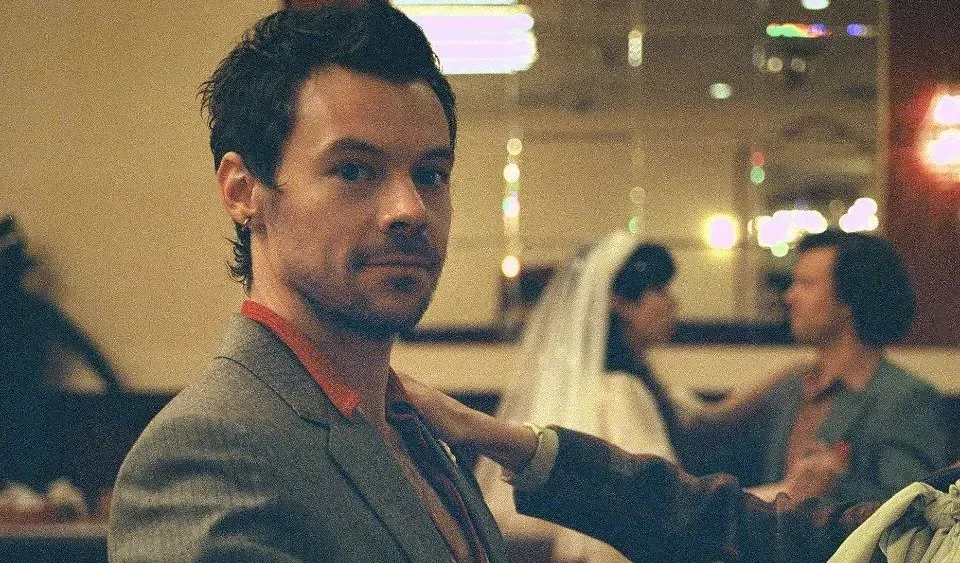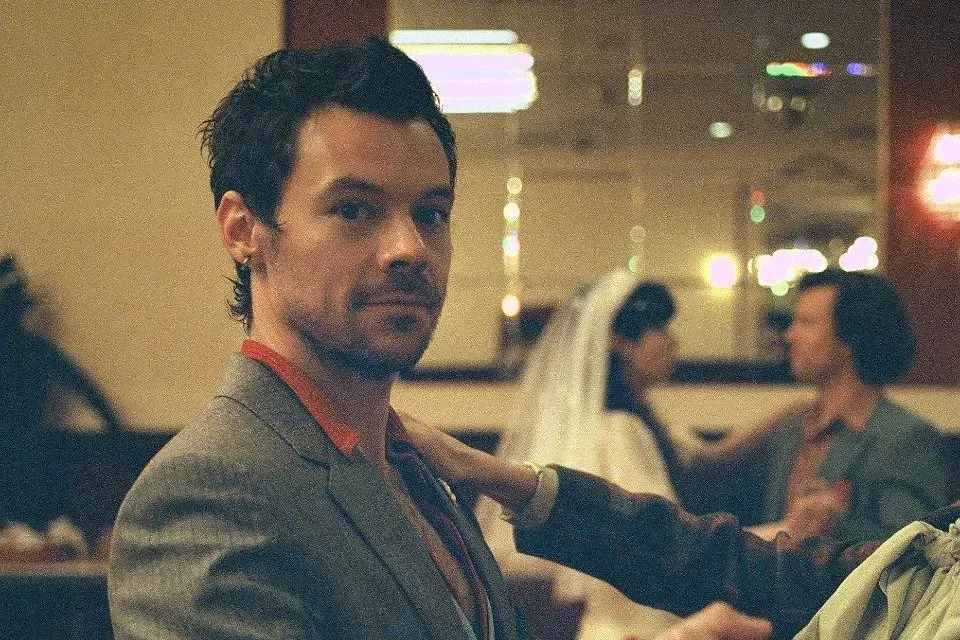
Harry Styles has given “Coming Up Roses” a movement-first visual treatment, waltzing with a series of partners in the new music video for the track from Kiss All the Time. Disco, Occasionally. The clip reunites Styles with directing duo Bradley & Pablo, whose earlier collaborations with the singer include the videos for “Watermelon Sugar” and “Late Night Talking.”
The premise is notably direct: Styles dances, the partners change, and the choreography provides the video’s central visual language. A woman later performs an interpretive dance to the song before the cast comes together for a smiling, photo-like final image. Rather than presenting an elaborate narrative with characters and plot turns, the video appears to use performance and changing physical pairings as its structure.
A waltz as the video’s organizing idea
A waltz is traditionally a dance in triple meter, commonly counted in groups of three. In a music-video setting, that matters because it can give camera movement, partner changes and editing a shared sense of flow even when the action remains simple. The available description does not establish the song’s precise musical arrangement or choreography credits, but it does make clear that waltzing is not a passing detail: it is the visual engine of “Coming Up Roses.”
That choice creates a contrast with the broad, quick-cut spectacle frequently associated with arena-scale pop campaigns. Here, the attention is on repeated human movement—Styles moving from partner to partner—before the spotlight shifts to a solo interpretive-dance section. Interpretive dance generally means movement designed to express a song’s mood or ideas rather than follow a fixed social-dance pattern. Placing it after the partner waltzes gives the clip a clear change in visual vocabulary without requiring a literal storyline.
The ending brings those separate strands back into one frame. Everyone assembling for a photograph is a small but useful punctuation mark: the video begins with movement and exchange, then pauses for a communal image. It turns the performers into a group rather than leaving the dancers as anonymous stations in a star-centered sequence.
The Bradley & Pablo connection
Bradley & Pablo’s return is significant because it extends an established creative relationship. They previously directed “Watermelon Sugar” and “Late Night Talking,” two major videos from earlier stages of Styles’ solo career. Repeat collaborations can provide continuity without demanding that every video look identical. The source material does not claim that “Coming Up Roses” follows either previous clip stylistically, so the safer read is simply that Styles is again working with filmmakers familiar with translating his music into concise visual concepts.
For viewers, the names behind a music video can matter almost as much as the setting or wardrobe when an artist has a recognizable visual era. Directors shape how a song is framed: whether the focus falls on plot, gesture, comic timing, spectacle, intimacy or, in this case, dance. The described approach suggests a deliberately stripped-back concept, one that lets the act of waltzing carry the clip rather than surrounding it with unnecessary lore.
That economy may also fit the track’s role in the album campaign. “Coming Up Roses” is the latest song from Styles’ fourth album to receive a video, following the project’s March release. A new video gives a song a distinct identity outside its place in a tracklist, while also creating a new focal point for listeners already following the record.
Released during a major live run
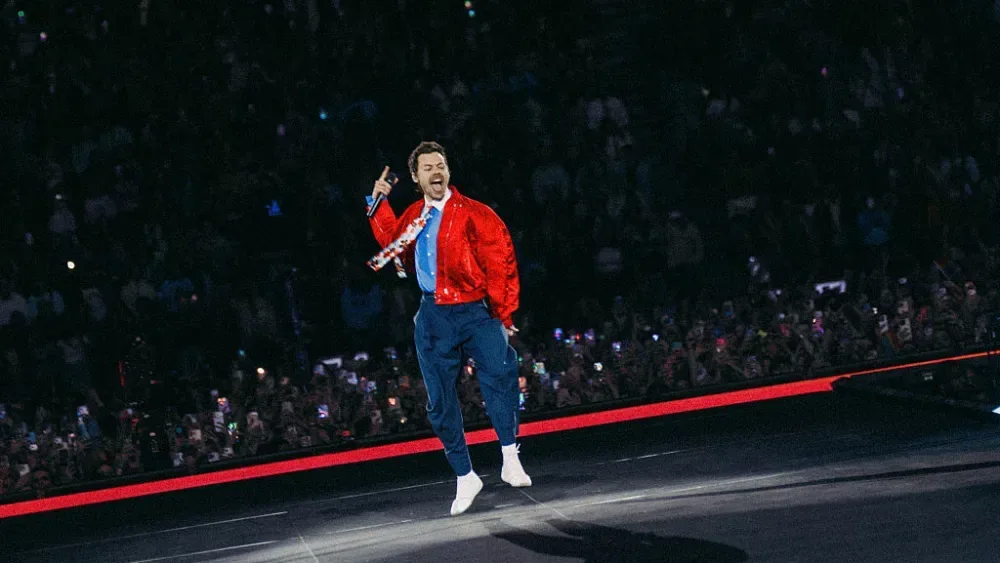
Styles hinted that the video was coming during the 27th of 30 scheduled performances at New York City’s Madison Square Garden. He is currently in the middle of his “Together, Together” tour, with the Madison Square Garden residency set to end October 31.
The timing places the release inside an especially public stretch of the campaign. After New York, this leg of the tour is scheduled to finish with dates in Melbourne and Sydney in November and December. The itinerary then resumes in Glendale, Arizona, in April, before continuing through Arlington, Pasadena, Toronto, Chicago, Berlin, Nanterre, Madrid, Rome and Dublin. The tour is due to end with three Wembley Stadium shows in London on August 24, 27 and 28.
A music video arriving amid that scale of touring has a practical role as well as a creative one. It gives fans who are not in an arena a new piece of the era to engage with, and it provides a compact visual companion to a song while live performances remain the campaign’s largest shared events. There is no indication that the video reproduces staging from the tour, so it should not be treated as a preview of the concert production. Its connection is one of timing: both are part of the same album cycle.
A documentary is also filming the tour world
The Madison Square Garden run has another camera presence around it. Documentary filmmaker John Wilson has reportedly been filming Styles at the venue since August for a project expected to combine concert material with an inside look at the wider touring operation.
The description of that documentary is broader than a conventional performance film. It is expected to include the people around the tour—Styles, fans and the many workers involved behind the scenes—alongside live footage. That distinction is worth noting. A concert film centers the onstage event; a documentary with an observational element can potentially examine the systems and relationships that make the event happen. Specific content, release timing and final format have not been detailed, so expectations should remain measured.
Against that backdrop, “Coming Up Roses” offers something different: a controlled, self-contained music-video performance. The documentary may eventually show the sprawling reality of an arena tour; the video narrows its frame to partners, choreography and a final posed smile. Both formats concern performance, but they can serve very different purposes.
The album context
Kiss All the Time. Disco, Occasionally. is Styles’ fourth album. Led by “Aperture,” it debuted at No. 1 on the Billboard 200 with 430,000 equivalent album units. Equivalent album units are an industry measurement that combines traditional album sales with streaming and track-equivalent consumption, allowing different kinds of listening and purchasing activity to be counted in a single chart figure.
The number establishes a strong commercial opening for the album, but the “Coming Up Roses” video’s appeal is more specific: it gives the current era a dance-centered image distinct from a chart statistic or a tour routing update. Styles’ visual campaigns have long been part of how individual tracks linger in public memory, and this entry appears designed around a simple, legible motif rather than maximal production.
For a separate look at how musicians’ visual choices become part of the larger pop-culture conversation, see Drake’s recent New York style statement.
“Coming Up Roses” now sits at the intersection of several active Styles projects: the ongoing album campaign, an international arena itinerary, and a documentary production filming around the tour. Yet the video itself keeps its idea clean. Its dance partners, interpretive interlude and closing group image make for a compact visual built around connection, rhythm and the pleasure of watching a pop star commit to the steps.