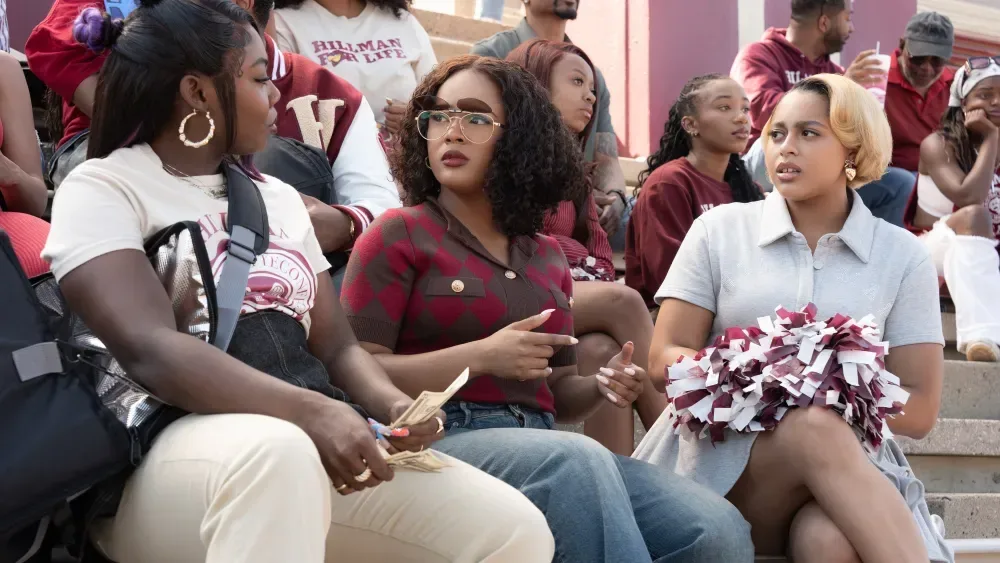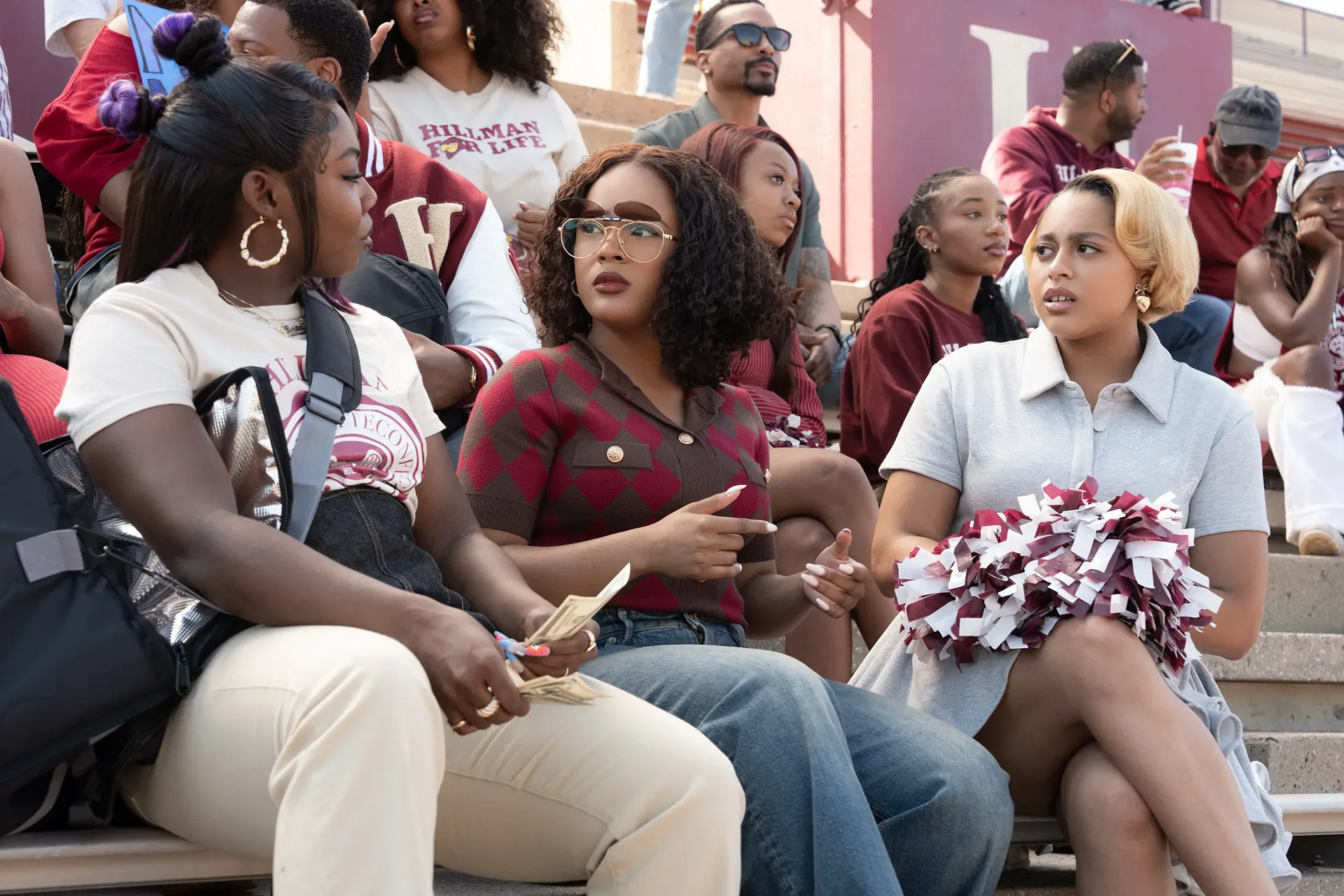
Hillman College is open again, but the new A Different World is not treating its return as a museum visit. Created by Felicia Pride and executive produced by Debbie Allen, the Netflix continuation shifts its center of gravity to Deborah Wayne, the youngest daughter of Whitley Gilbert-Wayne and Dwayne Wayne. That choice gives the series an immediate connection to the original while making room for a college story designed around a new generation of students.
Deborah, played by Maleah Joi Moon, arrives at the fictional historically Black college after her acceptance to NYU Tisch School of the Arts is rescinded following an unspecified unfortunate incident. Artistic, distracted and prone to privileged missteps, she is not introduced as a perfectly composed legacy character ready to carry a famous family name. She is a student trying to regain her bearings in an unfamiliar version of a place her parents once called home.
That is an effective launch point for a reboot. Deborah’s surname carries considerable history, but Hillman is not presented as a backdrop built exclusively for nostalgia. The first season follows an entire academic year across 10 half-hour episodes, using move-in-day disorder as the starting gun for new friendships, romantic complications, money worries, cultural arguments and campus ambitions.
A new Hillman class, rather than a rerun of the old one
The show’s core group is deliberately varied. Deborah shares a room with Rashida Duvall, played by Alijah Kai Haggins, a scholarship student from Compton whose practical outlook quickly clashes with Deborah’s scattered, nepo-baby behavior. Their roommate Hazel Henry, played by Kennedi Reece, is presented as kind and sheltered, raised in a conservative environment but determined to pursue her own ambitions.
On the other side of campus, Deborah’s former flame Shaquille Johnson, played by Cornell Young IV, has chosen Hillman over a Division 1 school and wants to elevate the college’s football program. His father is Ron Johnson, returning character Ron Johnson’s only child. Shaquille’s roommates widen the show’s perspective: Kojo Achebe, played by Chibuikem Uche, is a Nigerian-Ghanaian student who has come from the United Kingdom, while Jordan Aaron Hall’s Amir Rodale is a queer student from Harlem rebuilding his life after earlier mistakes.
Those descriptions matter because they signal the reboot’s biggest creative priority: Hillman is a shared space, not one singular version of Black student life. The new ensemble has differing economic circumstances, regional identities, family expectations and ideas about what college should accomplish. The series uses that friction for comedy and drama rather than pretending every disagreement must resolve into neat agreement.
In this context, the HBCU setting is more than a piece of familiar branding. An HBCU is a historically Black college or university, a term that refers to institutions established before 1964 with the principal mission of educating Black Americans. The original series helped put a fictional HBCU at the center of mainstream television, and the new version approaches the setting through contemporary student pressures: financial aid, online life, athletics, friendships and questions of identity that follow students into dorm rooms and classrooms.
Legacy is part of the story, not the whole assignment
Jasmine Guy and Kadeem Hardison return as Whitley and Dwayne, while Darryl M. Bell returns as Ron Johnson and Cree Summer appears as Freddie Brooks. Their presence gives the series a genuine generational bridge. The familiar characters can enter Deborah’s story as parents, alumni and adults with decades of life beyond their student days, rather than being frozen at the stage viewers remember.
Related coverage includes ‘A Different World’ Returns to Hillman With a New Gen Z Class.
The practical benefit is that newcomers are not required to do homework before pressing play. The series is structured to stand on its own through Deborah and her classmates, even as people who know the prior relationships will catch additional layers in the Wayne family dynamic. That is usually the difficult balance in a continuation: too much reverence can turn new leads into supporting players in their own show, while too little can make the use of an established title feel cosmetic.
Here, the generational connection appears to serve a more useful dramatic purpose. Deborah is navigating Hillman with a parental legacy that is public enough to shape other people’s assumptions of her, but she still has to establish a life separate from the stories that preceded her. It is a setup with natural comic possibilities and real emotional weight, especially when paired against Rashida’s scholarship-driven approach to campus life.
The reboot arrives amid a broader wave of television revisiting known properties. The important question for any return is not simply whether old characters reappear, but whether the new work has a point of view of its own. It is an issue also hanging over other revival talk, including the reported progress on a possible Glee reboot. A Different World makes its case by placing an original student group at the heart of the action rather than asking its predecessors to do all the heavy lifting.
Modern concerns meet a compressed streaming format
The new A Different World is a single-camera dramedy, meaning it is filmed with a more cinematic, scene-by-scene production approach than the multi-camera studio format often associated with classic network sitcoms. That format supports a mix of humor and more serious social material, and the show reportedly takes on federal funding pressures affecting Hillman, sexual health and wellness, social media, and financial-aid concerns alongside dating and talent-show chaos.
One especially packed installment, Episode 7, is titled “Sometimes You Get the Culture… Sometimes The Culture Gets You.” It combines a sexual-health and wellness thread, a conflict involving Kojo and diaspora tensions, and end-of-year talent-show material. “Diaspora” in this context refers broadly to people dispersed from an original homeland and the varied identities and relationships shaped by that movement. The fact that the show puts this subject beside an on-campus performance illustrates its willingness to let big conversations coexist with ordinary college life.
That ambition is also where the season’s central limitation emerges. Ten episodes of roughly 30 minutes must cover a full school year and introduce a substantial new cast while finding space for returning figures. Earlier network seasons had room for more than 20 episodes, allowing romantic arcs, conflicts and friendships to evolve at a less hurried pace. The Netflix season instead packs material that might once have unfolded over multiple episodes into a much tighter run.
The result is not a lack of ideas. Quite the opposite: the show has enough happening that individual threads may not get the quiet time they deserve. Rapid storytelling can create momentum and make a school year feel turbulent, particularly for students who are still discovering who they are. But it can also make major shifts in relationships or outlook feel as if they have arrived before viewers have had time to sit with the previous beat.
That is a structural observation rather than an argument against the show’s themes. The series is engaging precisely because it has a clear appetite for messy, overlapping concerns. Friendship breakups and personal breakdowns receive attention alongside romance, and the adult lives of Whitley and Dwayne are not ignored. The challenge is that every compelling subject is competing for limited screen time.
Music, artists and campus culture
The soundtrack includes music by Summer Walker, Mariah the Scientist and Alex Isley, and known artists also appear in the series. Music and guest appearances were part of the earlier show’s identity, so their inclusion is one more way this version recognizes its lineage without duplicating the original’s exact shape.
More importantly, the music fits the reboot’s stated interest in a present-day campus. Social media is woven into the storytelling, as are the pressures that come with visibility, relationships and belonging in a hyperconnected environment. A college ensemble is naturally suited to these subjects: students are making adult decisions while their social circles are intensely immediate, and a disagreement can be simultaneously private, public and permanent-feeling.
The original A Different World was a major cultural touchstone in its focus on Black Gen X characters. Its popularity was linked with a reported 26% rise in HBCU enrollment, though any cultural effect that large should be understood as part of a wider social picture rather than the product of one television program alone. What the statistic reinforces is the visibility the franchise achieved—and the size of the legacy this continuation inherits.
The new series cannot recreate the original era, nor should it try. Its most persuasive idea is that Hillman remains useful as a setting because each generation arrives with its own mix of inherited problems, fresh language, changing technology and competing hopes. Deborah, Rashida, Hazel, Shaquille, Kojo and Amir give that premise enough range to feel active rather than ceremonial.
What the reboot gets right
The strongest case for this return is not nostalgia alone; it is the sense that the show knows nostalgia is insufficient. Pride and Allen’s version preserves the idea of Hillman as a place where comedy, aspiration, political consciousness and romantic mistakes can all collide. It also recognizes that those collisions look different for Gen Z students than they did for their parents.
Its brisk rhythm will likely be divisive. Viewers who want every storyline to unfold patiently may wish the season had more room. Yet the same density gives the show its lively, sometimes unruly character. This is a college dramedy where the students’ worlds are crowded, their concerns overlap, and the campus is never merely a nostalgic landmark.
A Different World is streaming on Netflix. For longtime viewers, it offers the pleasure of seeing Hillman’s past carried forward. For new viewers, it provides a distinct entry point through a new class whose stories are allowed to be complicated, funny and fully their own.